| Study | Design & population | Finding & comparison |
|---|---|---|
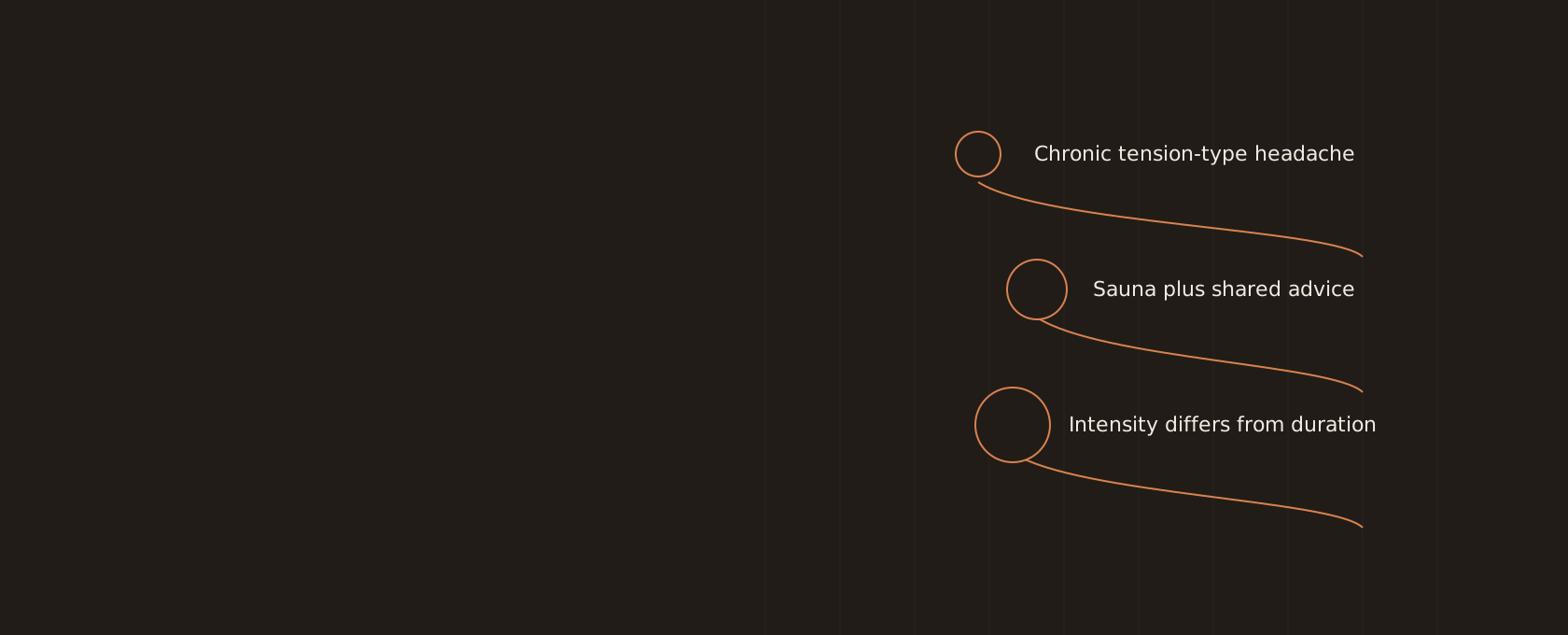
| 2015 · Kanji G ↗ | randomized controlled trial Chronic tension-type headache Participants: 37. regular sauna; exact modality unreported · 8 weeks | The reported between-group difference in change of headache intensity was 1.27 scale units (95% CI 0.48–2.07), favoring the sauna-plus-advice group. Headache duration, sleep, depression and disability did not significantly differ. The result concerns chronic tension-type headache, not migraine. Comparison: Advice and education alone Small study |
| 2019 · Cho EH ↗ | Uncontrolled before-after intervention Low back pain Participants: 37. Dry sauna · Twice daily for 5 consecutive days | Pain and disability ratings improved after the short program, but no comparison group was described to isolate a sauna effect. Comparison: Before versus after program No comparator described |
| 2015 · Soejima Y ↗ | Uncontrolled inpatient pilot Inpatients with chronic fatigue syndrome Participants: 10. Clinical far-infrared Waon therapy · 4weeks | Fatigue was lower after the program but not significantly lower at the midpoint. Pain and vigor did not significantly change. No adverse effects were reported in this small inpatient group. Comparison: Before versus during and after the program Uncontrolled small inpatient sample. |
Did the tension-type headache study find a benefit?
It found a greater reduction in reported headache intensity with sauna plus advice than with advice and education alone. That is a specific favorable result from a small randomized trial. It did not find clear between-group differences in headache duration, sleep, depression or disability.
The distinction matters because the broad phrase headache benefit can imply more than the source measured. Intensity, duration and interference with daily life are different outcomes. A favorable result in one should not be rewritten as improvement in every aspect of the condition. This guide keeps the direct trial result separate from other pain research and from claims about migraine, which was not the population studied.
Which headache population was actually enrolled?
The trial enrolled people meeting the study’s criteria for chronic tension-type headache. That diagnosis defines its applicability. It was not a trial in every person who sometimes experiences a headache, and it did not establish a finding for migraine or another headache category by analogy.
This is a boundary on the evidence, not an invitation to self-diagnose from a brief article. The source’s enrollment classification cannot determine which condition an individual reader has. When a product claim says sauna helps headaches generally, the first check is whether it retains the actual population. Removing the tension-type label broadens the statement beyond the trial and makes a narrow research finding sound like a general clinical answer.
Was sauna compared with no advice or attention?
No. Both groups received advice and education, while the intervention group also attended sauna. The study therefore assessed an addition to that shared advice, not sauna against a group receiving no information or care. Preserving the comparator helps identify what the favorable intensity difference actually describes.
The source does not establish superiority over every alternative intervention or usual-care arrangement. It also does not isolate every nonspecific aspect of attending a sauna, because a participant can perceive the exposure. A full appraisal would need the methods for attention, adherence and subjective assessment. The useful conclusion is a difference under the reported comparison, rather than an unlimited claim about sauna’s independent clinical effect.
How large and long was the direct study?
Thirty-seven people were randomized in the trial, which followed the assigned program for eight weeks. The control group received advice and education, and the added-sauna group received the same advice. This was a small clinical experiment, not a large long-term study establishing how the outcome persists across years.
A small randomized study is more informative for an intervention question than an uncontrolled symptom series, but the allocation label does not remove every uncertainty. Precision, missing information, assessment methods and follow-up still require review. The result belongs to the studied condition and period. It cannot establish the same intensity change for every patient, the durability after stopping or an optimized program for a different clinical setting.
How should the numerical intensity result be read?
The reported between-group difference in the change of headache intensity was 1.27 scale units, with a 95% confidence interval of 0.48–2.07, favoring the sauna-plus-advice group. These are units on the study’s subjective pain measure, not a percentage of patients whose headaches disappeared.
The estimate should keep its outcome and comparison attached. It is a difference in change across groups under the tested program, not a personal guarantee or an absolute prediction for a new user. This guide does not add a response threshold or a clinically important cutoff that the abstract-level review has not verified. A statistical difference can support further research while leaving the practical size of benefit for a particular person uncertain.
Did headaches become shorter or less disabling?
The trial did not find statistically clear between-group changes in headache duration, sleep, depression or its headache-disability measure. Those null outcomes belong beside the favorable intensity estimate. A summary presenting only the positive result would give an incomplete impression of the program’s measured effects.
A null comparison does not demonstrate that every possible program has no effect on those outcomes. It constrains the claim for this trial. The correct synthesis neither ignores the nulls nor uses them to erase the reported intensity difference. Each endpoint needs its own line. That approach lets the reader see which question had a favorable result and which questions remained unresolved under the actual comparison.
| Outcome or claim | What the source reports | Boundary |
|---|---|---|
| Headache intensity | Difference in change favored sauna plus advice | Subjective scale units, not a responder percentage |
| Duration, sleep, depression, disability | No statistically clear between-group difference | Retain each null outcome |
| Migraine | Not the enrolled condition | Do not transfer the result by label |
| Home exposure schedule | Incomplete in indexed abstract | Do not assemble a new protocol from other pain studies |
Does a subjective pain result still matter?
Yes. Reported pain is a meaningful patient-centered observation, and it should not be dismissed merely because it is subjective. At the same time, a measured pain rating does not directly establish a biological mechanism, tissue change or improvement in every functional outcome.
The fact that sauna is perceptible makes expectation and comparison design relevant review questions. This abstract-level appraisal does not assume those issues were eliminated or quantify their influence. It retains the observed result and asks what the full methods would need to show. This is more useful than either treating a pain score as proof of a universal mechanism or discounting the participant’s experience entirely. The trial supports a specific symptom comparison, with those evidentiary limits visible.
The indexed abstract uses an unusual label for one secondary assessment associated with depression. This guide retains the reported outcome without correcting the instrument name from memory. A full-text check is needed before reproducing a detailed instrument table; the wording discrepancy does not justify inventing a different measurement or a favorable secondary result.
What sauna temperature or schedule can be inferred?
The indexed abstract does not provide complete exposure details for a transferable sauna protocol. The eight-week study period does not by itself identify the session temperature, length, cooling method or frequency a reader should use. Missing method information should remain missing until the full source is reviewed.
It would be misleading to borrow a hot-room temperature from the back-pain study and attach it to this headache result. The studies involved different populations, designs and outcomes. A precise-looking routine assembled from separate papers has not thereby been tested. The session planner can make assumptions visible, but it cannot supply clinical validation or establish that an assumed exposure reproduces the tension-type trial’s intensity finding.
Does the low-back-pain report replicate the headache finding?
It does not. The low-back-pain report described symptom and disability improvements after a short sauna program without a comparison group described in its abstract. It concerned a different pain condition and used a different design. Its favorable before-and-after result cannot be counted as an independent randomized confirmation of the headache outcome.
The report is useful context for understanding the breadth and limitations of sauna pain research. It shows why outcome labels and control conditions matter. A change in a back-pain rating does not establish a change in headache intensity, and an uncontrolled series cannot isolate a sauna effect in the same way as an appropriately compared trial. Context is informative when it is not mistaken for replication.
Why include a pilot with a null pain finding?
The small inpatient chronic-fatigue pilot reported a later reduction in fatigue, while pain and vigor did not significantly change. That result concerns a different condition and an uncontrolled program. It neither refutes the tension-type headache result nor supplies broad confirmation that heat improves pain generally.
Its role here is to keep the pain narrative outcome-specific. A study can show a favorable change in one symptom without improving every measured symptom. The rheumatic-disease review similarly offers broad possible mechanisms and symptom context while calling for better protocols and long-term safety work. A mechanistic review is not another headache efficacy trial. Together these sources support careful questions, rather than an all-purpose statement that sauna reliably reduces every pain condition.
How should broader reviews affect the evidence grade?
The dry-sauna systematic review found that small studies and heterogeneous outcomes limited conclusions about benefits and harms. That context supports restraint when interpreting one favorable headache trial. The presence of a review does not create additional direct headache participants or confirm the result in another independent trial.
Grade C reflects the small direct study, subjective endpoint and incomplete practical exposure information. It does not imply that the result is meaningless, nor that evidence about migraine can be filled in from other conditions. The most useful classification states exactly what is emerging: an intensity difference under a particular tension-type comparison. A stronger general claim would need more directly relevant evidence, clearer methods and appropriate replication rather than a larger collection of unrelated pain titles.
What should a reader record before repeating the finding?
Record the condition, comparison, assessment period and endpoint before the favorable estimate. For this source, that means chronic tension-type headache, added sauna alongside shared advice, a limited clinical program and a subjective intensity result. Give duration and disability their own entries so that their null comparisons remain visible.
Then inspect what a claim adds beyond those observations. Saying the trial found lower intensity describes the result. Saying every headache improves, symptoms become shorter or an optimal home routine is known adds conclusions the source did not establish. A clear evidence ledger makes those additions easier to detect. It also prevents a back-pain series or a broad mechanism review from being mistaken for a direct repeat of the same headache experiment.
What can be concluded without a clinical-care promise?
The trial supplies a limited favorable intensity finding that warrants further source-specific research. It does not diagnose a reader, establish individual safety or justify changing prescribed care. Discuss intended exposure with a qualified clinician if a medical condition or medication is relevant, rather than using this result as a self-clearance checklist.
This appraisal uses indexed abstracts and verified source abstractions. Full trial methods, formal risk of bias, funding and conflicts of interest have not been comprehensively reviewed, and unreported information remains unknown. The historical safety review names important cardiac contraindications and alcohol-related concerns, but it does not provide an exhaustive headache assessment. The justified conclusion remains emerging evidence for one tension-type intensity endpoint, with the wider symptom, protocol and generalization questions kept open.
Inspect the assumptions
Explore the session planner.
This planning tool describes a routine. It does not estimate a health benefit or provide medical clearance; the study exposures discussed above remain separate research methods.
Interactive workspace
In-memory checkpoint · no medical clearance
Pause for the personal context.
Check every item that applies or that you are unsure about. Current serious symptoms need appropriate care, not a tool result.
Context, with limits
- Checkpoint
- Complete the acknowledgment
A checklist cannot assess every relevant condition. No answer is medical clearance. Responses are in memory only, and are reset on reload.
Calculated on your device. Theme and unit preferences can be stored locally; health answers, weights and logs remain in memory. A shared settings URL contains its visible planning inputs.
Open the complete tool and methodologyExplore the evidence with a tool.
Questions, considered
Questions about this evidence
Was the reported intensity difference a percentage of headaches eliminated?
No. It was a between-group difference in the change of a subjective intensity score. Scale units, responder proportions and elimination of headaches are different quantities. The estimate should keep its comparison and confidence interval attached, without being converted into a guaranteed individual response or an unverified percentage of people whose symptoms resolved.
Follow the sourceWhy does shared advice matter in the headache comparison?
The sauna group received the same advice and education as the control group, with sauna added. The result therefore concerns an addition to shared advice, not a comparison against no attention or care. It should not be expanded into superiority over every other clinical option or interpreted as isolating every component of the sauna experience.
Follow the sourceDid the study establish a favorable change in disability as well as intensity?
The abstract did not report a statistically clear between-group improvement in the headache-disability measure. It also reported no clear differences in duration, sleep or depression. Those findings should remain separate from the favorable intensity result, so a specific symptom change does not become a claim that every aspect of the condition improved.
Follow the sourceCan the back-pain program supply the missing headache exposure details?
It involved a different condition and an uncontrolled before-and-after design. Its numerical exposure cannot be attached to the tension-type outcome as though the resulting routine was tested. Missing headache methods should remain unreported until the full source is reviewed, rather than filled with a schedule from another pain study.
Follow the sourceDoes the chronic-fatigue pilot establish that sauna improves pain generally?
The pilot concerned a different inpatient population and did not find significant pain or vigor changes, despite a later fatigue improvement. It is useful context for avoiding an all-purpose pain claim. It neither directly reproduces nor disproves the tension-type result, because the diagnosis, comparison and measured outcomes differ.
Follow the sourceCan a person infer their headache diagnosis from this sauna evidence?
The trial used an enrolled chronic tension-type population; an educational summary cannot determine whether a reader has that condition. Its result should not be transferred automatically to migraine or every unexplained headache. Diagnosis, clinical care and suitability for heat exposure are separate questions that the group intensity comparison does not resolve for an individual.
Follow the sourceFollow the evidence
Sources & references
Research summaries in this edition are based on indexed abstracts unless otherwise noted. A source link is not a claim of medical review.
- Efficacy of regular sauna bathing for chronic tension-type headache: a randomized controlled study.
Kanji G, Weatherall M, Peter R, Purdie G, Page R
Volume 21, issue 2, pages 103-109 · PMID 25636135
Open-access flag: not recorded.Abstract-level editorial review - Dry sauna therapy is beneficial for patients with low back pain.
Cho EH, Kim NH, Kim HC, Yang YH, Kim J, Hwang B
Volume 14, issue 4, pages 474-479 · PMID 33329780
Open-access flag: yes.Abstract-level editorial review - Effects of Waon therapy on chronic fatigue syndrome: a pilot study.
Soejima Y, Munemoto T, Masuda A, Uwatoko Y, Miyata M, Tei C
Volume 54, issue 3, pages 333-338 · PMID 25748743
Open-access flag: not recorded.Abstract-level editorial review - Sauna therapy in rheumatic diseases: mechanisms, potential benefits, and cautions.
Fedorchenko Y, Fedorchenko M, Yessirkepov M, Bekaryssova D
Volume 45, issue 5, pages 94 · PMID 40202605
Open-access flag: not recorded.Abstract-level editorial review - Clinical Effects of Regular Dry Sauna Bathing: A Systematic Review.
Hussain J, Cohen M
Volume 2018, pages 1857413 · PMID 29849692
Open-access flag: yes.Abstract-level editorial review - Benefits and risks of sauna bathing.
Hannuksela ML, Ellahham S
Volume 110, issue 2, pages 118-126 · PMID 11165553
Open-access flag: not recorded.Abstract-level editorial review