| Study | Design & population | Finding & comparison |
|---|---|---|
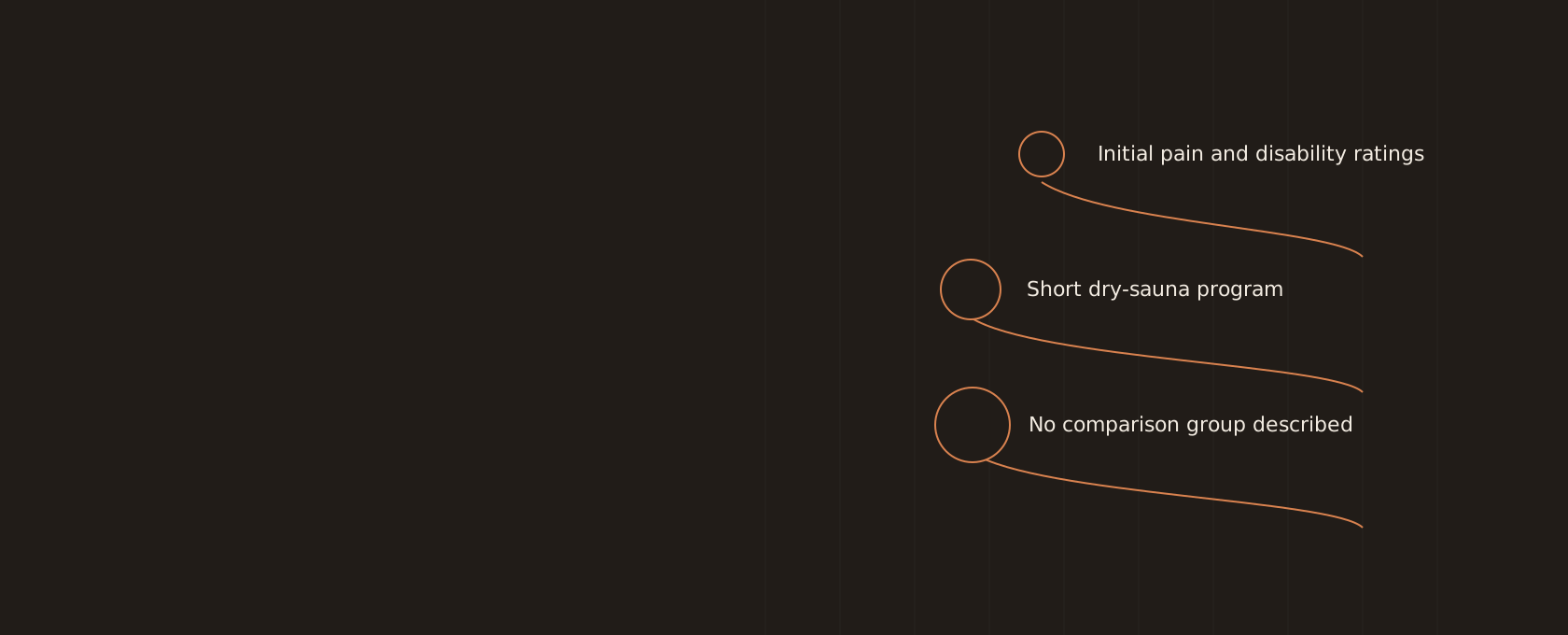
| 2019 · Cho EH ↗ | Uncontrolled before-after intervention Low back pain Participants: 37. Dry sauna · Twice daily for 5 consecutive days | Pain and disability ratings improved after the short program, but no comparison group was described to isolate a sauna effect. Comparison: Before versus after program No comparator described |
| 2015 · Kanji G ↗ | randomized controlled trial Chronic tension-type headache Participants: 37. regular sauna; exact modality unreported · 8 weeks | The reported between-group difference in change of headache intensity was 1.27 scale units (95% CI 0.48–2.07), favoring the sauna-plus-advice group. Headache duration, sleep, depression and disability did not significantly differ. The result concerns chronic tension-type headache, not migraine. Comparison: Advice and education alone Small study |
| 2015 · Soejima Y ↗ | Uncontrolled inpatient pilot Inpatients with chronic fatigue syndrome Participants: 10. Clinical far-infrared Waon therapy · 4weeks | Fatigue was lower after the program but not significantly lower at the midpoint. Pain and vigor did not significantly change. No adverse effects were reported in this small inpatient group. Comparison: Before versus during and after the program Uncontrolled small inpatient sample. |
Original publication: Dry sauna therapy is beneficial for patients with low back pain.
What did the low-back-pain report observe?
The report examined whether pain and disability ratings changed after a short dry-sauna program in adults with low back pain. The registered finding is improvement after the program. The abstract did not describe a comparison group that would separate the sauna contribution from other possible explanations for change over time.
That distinction is central to interpreting the favorable title. A before-and-after observation can motivate further research without establishing a causal or comparative clinical effect. This summary therefore describes what was observed and avoids adopting a stronger intervention claim simply because the authors’ conclusion was optimistic. The design, measurement and observation period need to stay attached to the result.
Who entered this short program?
The source included thirty-seven consecutive patients over twenty years of age with low back pain. Consecutive recruitment describes how the sample was assembled; it is not the same as random allocation to sauna and a control condition. The abstract does not establish a broadly representative sample of every back-pain presentation.
This matters for applicability. A group-level symptom change cannot determine what diagnosis an individual has or whether their medical circumstances resemble the enrolled patients. Unreported participant characteristics should remain unknown rather than inferred from the setting or authors’ affiliations. The study adds a specific clinical observation, with its selected sample preserved rather than expanded into an answer for all people with back pain.
What exposure was reported?
The program used dry sauna at 90°C, equivalent to 194°F, with fifteen-minute sessions twice daily for five consecutive days. Those are source-verified methods, not an optimized routine established by a controlled comparison. The short intensive schedule belongs to the particular study context.
A reader should not treat the precision of those numbers as proof that the exposure is suitable or effective for everyone. An alternative temperature, duration or schedule would be a different intervention, while copying the published schedule would not reproduce clinical assessment or other unreported circumstances. The source describes what the investigators did; it does not identify a minimum effective dose, compare doses or validate a general home-sauna prescription.
Which outcomes improved?
Pain and disability ratings improved after the program. These are separate symptom-related measurements and should remain identified as such. A lower pain rating is not automatically proof of a structural change, and a disability-score change is not the same as demonstrating every functional outcome a reader might value.
This page uses the qualitative result already registered in the facts dataset rather than adding unregistered numerical score changes or responder percentages from the abstract. That preserves the scope of the review. The findings can be discussed as reported improvements, while clinical importance, individual response and the amount caused specifically by sauna require stronger analysis than a favorable post-program measurement alone.
Why does the missing comparator limit the conclusion?
Without a comparison group described in the abstract, the study cannot determine how ratings would have changed over the same period without sauna or under another approach. That unobserved comparison is necessary for isolating the additional intervention effect. Time, expectations, other circumstances or measurement variability could contribute to a before-and-after pattern.
These are possible explanations to examine, not claims that a particular one caused the observed change. A formal appraisal would inspect the full methods and any concurrent care. The useful conclusion is therefore a signal for further controlled investigation. It is neither a demonstrated sauna-specific effect nor a reason to dismiss the participants’ reported experience as meaningless.
| Reported feature | What it supports | What remains unestablished |
|---|---|---|
| Pain and disability ratings improved | A short before-and-after observation | The amount caused by sauna |
| No comparator described | Design limitation is visible | Superiority over another approach |
| Specific exposure schedule | Reconstruction of study methods | An optimized universal routine |
| No attributed adverse effects reported | A limited source safety observation | General personal clearance or long-term safety |
Does the study establish benefit months later?
The short program and abstract-level follow-up do not establish that improvements persist for months, how maintenance would work or whether repeat exposure changes the outcome. Those are distinct durability questions. A favorable result immediately around a brief program cannot answer them by extension.
The source also did not compare a range of schedules to identify an optimal approach. A longer home routine assembled from its methods would be a new program with unestablished effects. This summary keeps the observation window visible so that a short-term symptom report does not become a promise of sustained clinical improvement or a reason to replace ongoing care.
What does the absence of reported adverse effects mean?
The report did not observe adverse effects attributed to the program in this small series. That is information about the source, not proof that sauna is universally safe for low back pain or every accompanying condition. Sample size, selection, monitoring and observation time all constrain what an absence of reported harm can establish.
The historical sauna safety review provides separate context about named cardiac contraindications and alcohol-related concerns. It is not an exhaustive back-pain screening tool or a substitute for individual assessment. A pain improvement and a lack of reported adverse effects answer different questions, and neither should be converted into personal medical clearance.
How does this fit the headache trial and other pain research?
The tension-type headache trial used a randomized comparison with shared advice and found an intensity difference, while several other outcomes did not clearly differ. The chronic-fatigue pilot involved another condition and did not find significant pain or vigor changes. Those papers are context, not replications of this low-back-pain series.
The rheumatic-disease review discusses potential mechanisms and symptom questions while calling for better protocols and long-term safety research. Its broad scope cannot fill the missing control in this report. Reading across these sources is useful when each diagnosis, endpoint and design remains visible. They should not be combined into a generalized claim that every pain condition responds similarly to sauna.
What remains open after this source summary?
The indexed abstract and verified corpus abstraction were read. Complete methods, concurrent care, outcome handling, formal risk of bias and longer follow-up have not been comprehensively assessed. Funding and conflict-of-interest disclosures remain unreported in the abstract-level record rather than assumed absent.
The justified conclusion is limited: participants reported better pain and disability ratings after a short program, but the source does not isolate a sauna effect or establish a durable comparative benefit. Its methods cannot become a universal recommendation simply because numerical exposure details are available. Further source appraisal and appropriately controlled research would be needed before making stronger claims about efficacy, routine selection or suitability for a particular person.
Explore the evidence with a tool.
Questions, considered
Questions about this study
What improved in the 2019 low-back-pain sauna study?
Participants reported lower pain ratings and disability scores after the short sauna program. Those are relevant symptom measures, but the abstract does not describe a comparison group. The findings are therefore preliminary before-and-after observations, rather than proof that sauna caused the improvement or corrected the source of back pain.
Follow the sourceDoes the back-pain study show that benefits persist for months?
No. The abstract reports outcomes around a brief intervention and does not establish long-term durability. Pain can vary over time for many reasons. A longer controlled follow-up would be needed to determine whether any improvement persists, how large it is compared with usual care and which patients might benefit.
Follow the sourceHow should the absence of reported adverse events in the back-pain study be interpreted?
It means the investigators did not report adverse effects in that small, short program. It does not establish that the same exposure is appropriate for every person with back pain. Rare harms, different underlying diagnoses, medication effects and longer-term use require evidence beyond a single uncontrolled study.
Follow the sourceFollow the evidence
Sources & references
Research summaries in this edition are based on indexed abstracts unless otherwise noted. A source link is not a claim of medical review.
- Dry sauna therapy is beneficial for patients with low back pain.
Cho EH, Kim NH, Kim HC, Yang YH, Kim J, Hwang B
Volume 14, issue 4, pages 474-479 · PMID 33329780
Open-access flag: yes.Abstract-level editorial review - Efficacy of regular sauna bathing for chronic tension-type headache: a randomized controlled study.
Kanji G, Weatherall M, Peter R, Purdie G, Page R
Volume 21, issue 2, pages 103-109 · PMID 25636135
Open-access flag: not recorded.Abstract-level editorial review - Effects of Waon therapy on chronic fatigue syndrome: a pilot study.
Soejima Y, Munemoto T, Masuda A, Uwatoko Y, Miyata M, Tei C
Volume 54, issue 3, pages 333-338 · PMID 25748743
Open-access flag: not recorded.Abstract-level editorial review - Sauna therapy in rheumatic diseases: mechanisms, potential benefits, and cautions.
Fedorchenko Y, Fedorchenko M, Yessirkepov M, Bekaryssova D
Volume 45, issue 5, pages 94 · PMID 40202605
Open-access flag: not recorded.Abstract-level editorial review - Benefits and risks of sauna bathing.
Hannuksela ML, Ellahham S
Volume 110, issue 2, pages 118-126 · PMID 11165553
Open-access flag: not recorded.Abstract-level editorial review