| Study | Design & population | Finding & comparison |
|---|---|---|
| 2024 · Kunutsor SK ↗ | cross-sectional and longitudinal cohort analysis Population cohort Participants: 2012. habitual sauna · Fitness measured at baseline and 11 years | Frequency was associated with fitness at baseline; the longitudinal association was statistically clear only for the middle-frequency category. Session duration was not significantly related to fitness. Comparison: Once-weekly sauna Observational association rather than assigned training |
| 2022 · Lee E ↗ | randomized controlled trial Low activity with at least one cardiovascular risk factor Participants: 47. postexercise sauna · 8 weeks | Relative to exercise alone, exercise plus sauna produced an additional fitness change of +2.7 mL/kg/min (95% CI +0.2 to +5.3) and a systolic-pressure difference of −8.0 mmHg (−14.6 to −1.4). This small combined-program trial did not test sauna alone or clinical-event prevention. Comparison: Exercise alone; control Small eight-week multi-arm trial |
| 2021 · Kirby NV ↗ | controlled endurance-training intervention trained middle-distance runners Participants: 20. post-exercise sauna · 3 weeks; subset continued to 7 weeks | Added sauna improved several tested exercise-capacity markers; extended exposure produced limited additional change. Comparison: normal training without added sauna Small trained sample; no randomization stated in abstract; surrogate performance markers. |
Fitness is a capacity, not every response to heat
Cardiorespiratory fitness describes a tested physiological capacity during exercise. It should not be confused with feeling less breathless, having a higher heart rate in heat or recording a later respiratory diagnosis. Those observations may be relevant to different questions, but they do not establish the same outcome.
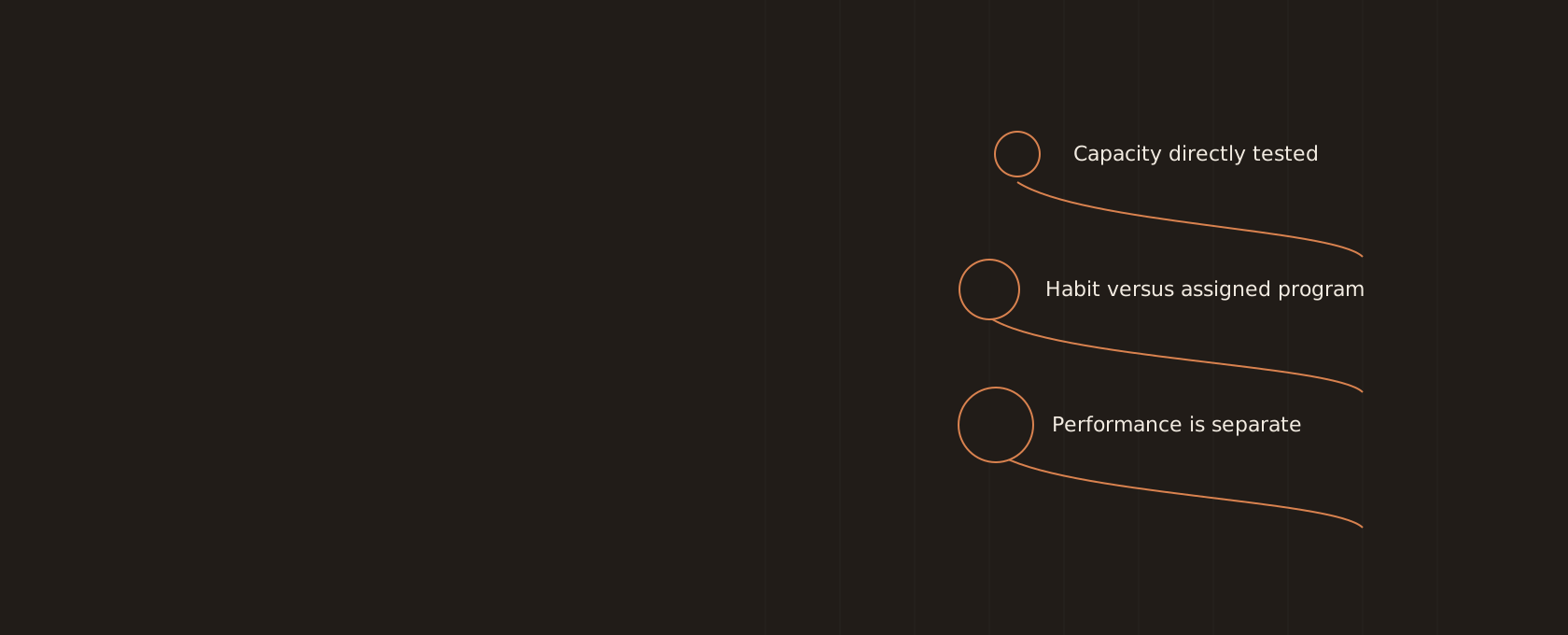
This page asks whether sauna is associated with fitness and whether assigned programs have changed it. The answer depends on design. A cohort can describe differences between people with existing habits; an intervention can compare changes after programs are assigned. Athletic performance requires another endpoint, such as the result of a specific task. Keeping these categories separate prevents a plausible story about heat and circulation from becoming an unsupported claim that passive exposure produces the full effect of exercise training. The evidence here is promising in selected comparisons and uncertain in its wider application.
The KIHD analysis directly tested fitness
The KIHD sauna-and-fitness study assessed cardiorespiratory fitness using respiratory gas analysis during exercise testing. Its outcome was therefore measured directly rather than inferred solely from a report of physical activity. That is a useful strength when evaluating what the cohort actually observed.
The exposure remained a reported habit, however. Objective outcome testing does not randomize sauna use or remove every difference between people who bathe at different frequencies. The sample consisted of middle-aged men in a Finnish population setting, rather than every group considering a sauna purchase. A reader should retain both the measurement strength and the exposure limitation. A direct capacity measure gives a clearer endpoint, while the causal question still concerns whether deliberately changing sauna use would change that capacity under a suitable comparison.
Baseline association is not an assigned fitness gain
The cohort found frequency-related fitness differences at baseline. These observations do not establish that sauna use caused the difference or preceded it in the way required for an intervention claim. People who were already fitter could have had different habits, health or resources from those in another frequency category.
The later association was less consistent across categories. Only the middle-frequency contrast was statistically clear in the reported longitudinal analysis, while the highest category did not provide the same clear result. A summary that uses the baseline pattern to promise progressively greater later fitness would therefore overstate consistency. The source is most informative when baseline and follow-up analyses remain separate. Neither an attractive cross-sectional comparison nor the passage of time turns the observed frequency categories into experimentally assigned training doses.
Frequency and duration did not tell one dose story
Session duration was not significantly associated with fitness in either the baseline or longitudinal analysis. Frequency and duration therefore should not be combined into a general claim that more total heating automatically builds more fitness. The study did not test an optimal session length or establish an unlimited exposure-response relationship.
Adjustment for physical activity also needs careful wording. An association that remains after accounting for a measured activity variable is not proof that sauna reproduces activity’s effects independently of every relevant difference. Measurement error and other characteristics can remain important. The correct statement is an adjusted observational relationship, not a demonstration that exercise is dispensable. A reader choosing a routine needs evidence about an actual exposure change, rather than a statistical category detached from the source’s design.
A randomized add-on trial provides direct program evidence
The exercise-plus-sauna trial compared a combined program with exercise alone and control in less active adults with cardiovascular risk factors. Relative to exercise alone, the combined program produced an additional fitness change of +2.7 mL/kg/min, with a 95% confidence interval of +0.2 to +5.3. That is the registered incremental comparison, not the total effect of the whole program attributed to sauna.
This result is encouraging because the comparison was assigned. Its limits still matter: the sample was small, the program was short and sauna was tested after exercise. The trial did not establish the effect of sauna alone or determine which schedule would work best for every reader. The confidence interval describes uncertainty around the average between-group estimate. It is not a range of improvement that an individual is guaranteed to receive from a different home routine.
The runner study adds selected capacity markers
The controlled runner study compared normal training with training plus intermittent postexercise sauna and reported favorable changes in selected exercise-capacity markers. Its participants were already trained, and the abstract does not state randomization. The result therefore adds a sport-specific intervention question rather than universal confirmation of the less-active-adult trial.
The distinction is useful when deciding which source supports which claim. A capacity marker in trained runners does not establish the same effect in an untrained person, and it does not automatically imply a faster race. The study also reported limited extra change with extended exposure, which argues against assuming that continuing longer necessarily multiplies benefit. Read the actual endpoint and comparison before borrowing a training result to justify a new routine or a stronger claim about long-term health.
An acute exercise-like response is not exercise equivalence
The infrared crossover study in healthy women found that heating produced a response pattern different from exercise, with effects appearing mainly thermoregulatory. It did not establish the same training adaptations simply because temperature or heart rate changed. This is important context for a claim that a sauna session counts as exercise.
The experiment concerns acute physiology, not the later development of tested fitness. A similar response in one variable cannot establish equivalence of complete activities. Nor can findings from one heat technology be transferred to another by sharing the sauna label. The useful question is which capacity or outcome was actually measured under the tested conditions. A device that warms the body has not thereby demonstrated the incremental fitness gain reported in a separate combined-program trial.
Heat adaptation and performance need their own outcomes
The military-context comparison of sauna and hot-water immersion found modest heat adaptations without a statistically significant performance improvement. That illustrates why a physiological response should not be substituted for the result of a meaningful task. Adaptation, tested capacity and task performance are related research areas rather than interchangeable findings.
The performance-focused systematic review also found uncertainty and low to very low certainty in pooled postexercise-heating effects, despite some physiological changes. That synthesis does not directly refute every fitness result, because it evaluates a different endpoint and varied methods. It does constrain a leap from promising heat-related measurements to guaranteed faster performance. This page therefore keeps fitness gains and performance evidence in separate columns rather than allowing either to supply a missing result for the other.
The comparator determines the practical claim
A sauna-alone claim needs a comparison that isolates sauna alone. An exercise add-on claim needs the same exercise with and without the added heating. A claim that sauna replaces training needs a direct substitution comparison and outcomes appropriate to training. The current sources do not answer all of those questions simply because each involves heat and cardiovascular measurements.
This comparison discipline is useful for a reader evaluating an advertisement or personal plan. Ask whether the quoted improvement belongs to the entire combined program, the added component or an observed group difference. Then check population and endpoint. The randomized incremental fitness result is more relevant to an add-on claim than the cohort, while the cohort is informative about established habits in its own setting. Neither should be stretched into a universal exercise-replacement promise.
No single fitness-building sauna schedule is established
The evidence does not establish one optimum combination of temperature, duration and frequency for improving fitness across populations. Habit categories, postexercise interventions and acute heating comparisons are different exposure definitions. Assembling a frequency from one source with a duration from another would create a new program that the fitness studies did not test.
The study explorer can help inspect source methods and comparisons. Session and heat-dose tools organize assumptions; they do not validate a clinical or training effect from the entered settings. Grade C reflects limited source-specific evidence, with a favorable small assigned comparison beside observational inconsistency and uncertain transfer. A personal routine should not escalate simply to match the highest habit category or recreate a demanding athletic exposure. The scientific question is what an appropriate comparison establishes, rather than how much heating can be accumulated.
What would change confidence and personal decisions
Larger independent trials could test sauna alone and exercise additions in relevant populations, with directly measured fitness and follow-up long enough to assess persistence. Clear reporting of adherence, uncertainty and adverse events would improve interpretation. The value would come from answering a defined comparison, not simply adding another cardiovascular marker to a paper.
This page is an abstract-level synthesis of refreshed sources and registered findings. Full-text bias assessment, funding and conflicts of interest were not independently established here. The historical safety review names unstable angina, recent myocardial infarction and severe aortic stenosis as contraindications and warns about alcohol, but is not a complete clearance checklist. Discuss relevant conditions and medications with a qualified clinician. A favorable average fitness result is separate from personal heat suitability, and it does not supply medical clearance or a replacement for an appropriate exercise plan.
Inspect the assumptions
Explore the session planner.
This planning tool describes a routine. It does not estimate a health benefit or provide medical clearance; the study exposures discussed above remain separate research methods.
Interactive workspace
In-memory checkpoint · no medical clearance
Pause for the personal context.
Check every item that applies or that you are unsure about. Current serious symptoms need appropriate care, not a tool result.
Context, with limits
- Checkpoint
- Complete the acknowledgment
A checklist cannot assess every relevant condition. No answer is medical clearance. Responses are in memory only, and are reset on reload.
Calculated on your device. Theme and unit preferences can be stored locally; health answers, weights and logs remain in memory. A shared settings URL contains its visible planning inputs.
Open the complete tool and methodologyExplore the evidence with a tool.
Questions, considered
Questions about this evidence
Why is tested fitness different from a higher heart rate in sauna?
A heat-related heart-rate response describes an acute physiological state. Cardiorespiratory fitness was assessed during exercise testing in the cohort, and a training effect requires an appropriate comparison over time. A response that resembles one part of exercise does not establish the same capacity gain or make the activities equivalent.
Follow the sourceDid the later KIHD frequency results form a uniform fitness dose response?
No. The longitudinal association was statistically clear only for the middle-frequency category, and session duration was not significantly related to fitness. The pattern therefore does not justify a precise claim that progressively more sauna produces progressively greater later fitness. Reported habit categories also remain observational rather than assigned doses.
Follow the sourceWhose improvement is represented by the exercise add-on fitness estimate?
It is an average between-program difference in less active adults with cardiovascular risk factors, comparing exercise plus sauna with exercise alone. It does not represent sauna by itself or guarantee an individual response. The study’s small size and defined program should remain attached to the favorable incremental result.
Follow the sourceCan an athletic capacity result establish a faster race for everyone?
A tested capacity marker and race performance are different endpoints. The runner experiment adds useful sport-specific evidence, while the broader performance review found uncertain pooled effects and low certainty. Those findings do not support a universal race-time promise or automatic transfer from trained runners to every reader considering sauna.
Follow the sourceDoes physical-activity adjustment show that sauna replaces exercise?
An association remaining after adjustment for a measured activity variable is still an observational relationship. It does not randomly substitute sauna for training or remove every difference between groups. A replacement claim needs a direct comparison and suitable outcomes, rather than interpreting statistical adjustment as proof that passive heat reproduces exercise adaptations.
Follow the sourceWhat is missing before recommending one sauna schedule for fitness?
The evidence does not identify a universal optimum across baseline health, training status and heat methods. Larger direct comparisons should specify the whole program, measure fitness and assess persistence and safety. A schedule assembled from separate cohort categories and athletic protocols would remain untested, even when every borrowed detail appears in a published source.
Follow the sourceFollow the evidence
Sources & references
Research summaries in this edition are based on indexed abstracts unless otherwise noted. A source link is not a claim of medical review.
- Enhancing Cardiorespiratory Fitness Through Sauna Bathing: Insights From the Kuopio Ischemic Heart Disease Prospective Study.
Kunutsor SK, Isiozor NM, Kurl S, Laukkanen JA
Volume 44, issue 4, pages 295-300 · PMID 38836690
Open-access flag: not recorded.Abstract-level editorial review - Effects of regular sauna bathing in conjunction with exercise on cardiovascular function: a multi-arm, randomized controlled trial.
Lee E, Kolunsarka I, Kostensalo J, Ahtiainen JP, Haapala EA, Willeit P, Kunutsor SK, Laukkanen JA
Volume 323, issue 3, pages R289-R299 · PMID 35785965
Open-access flag: yes.Abstract-level editorial review - Intermittent post-exercise sauna bathing improves markers of exercise capacity in hot and temperate conditions in trained middle-distance runners.
Kirby NV, Lucas SJE, Armstrong OJ, Weaver SR, Lucas RAI
Volume 121, issue 2, pages 621-635 · PMID 33211153
Open-access flag: yes.Abstract-level editorial review - The effect of post-exercise heat exposure (passive heat acclimation) on endurance exercise performance: a systematic review and meta-analysis.
Solomon TPJ, Laye MJ
Volume 17, issue 1, pages 4 · PMID 39762944
Open-access flag: yes.Abstract-level editorial review - Infrared sauna as exercise-mimetic? Physiological responses to infrared sauna vs exercise in healthy women: A randomized controlled crossover trial.
Hussain JN, Cohen MM, Mantri N, O'Malley CJ, Greaves RF
Volume 64, pages 102798 · PMID 34954348
Open-access flag: not recorded.Abstract-level editorial review - Post-exercise, passive heat acclimation with sauna or hot-water immersion provide comparable adaptations to performance in the heat in a military context.
Ashworth E, Cotter J, Kilding A
Volume 66, issue 1, pages 49-60 · PMID 35332846
Open-access flag: not recorded.Abstract-level editorial review - Cardiovascular and Other Health Benefits of Sauna Bathing: A Review of the Evidence.
Laukkanen JA, Laukkanen T, Kunutsor SK
Volume 93, issue 8, pages 1111-1121 · PMID 30077204
Open-access flag: not recorded.Abstract-level editorial review - Benefits and risks of sauna bathing.
Hannuksela ML, Ellahham S
Volume 110, issue 2, pages 118-126 · PMID 11165553
Open-access flag: not recorded.Abstract-level editorial review