| Study | Design & population | Finding & comparison |
|---|---|---|
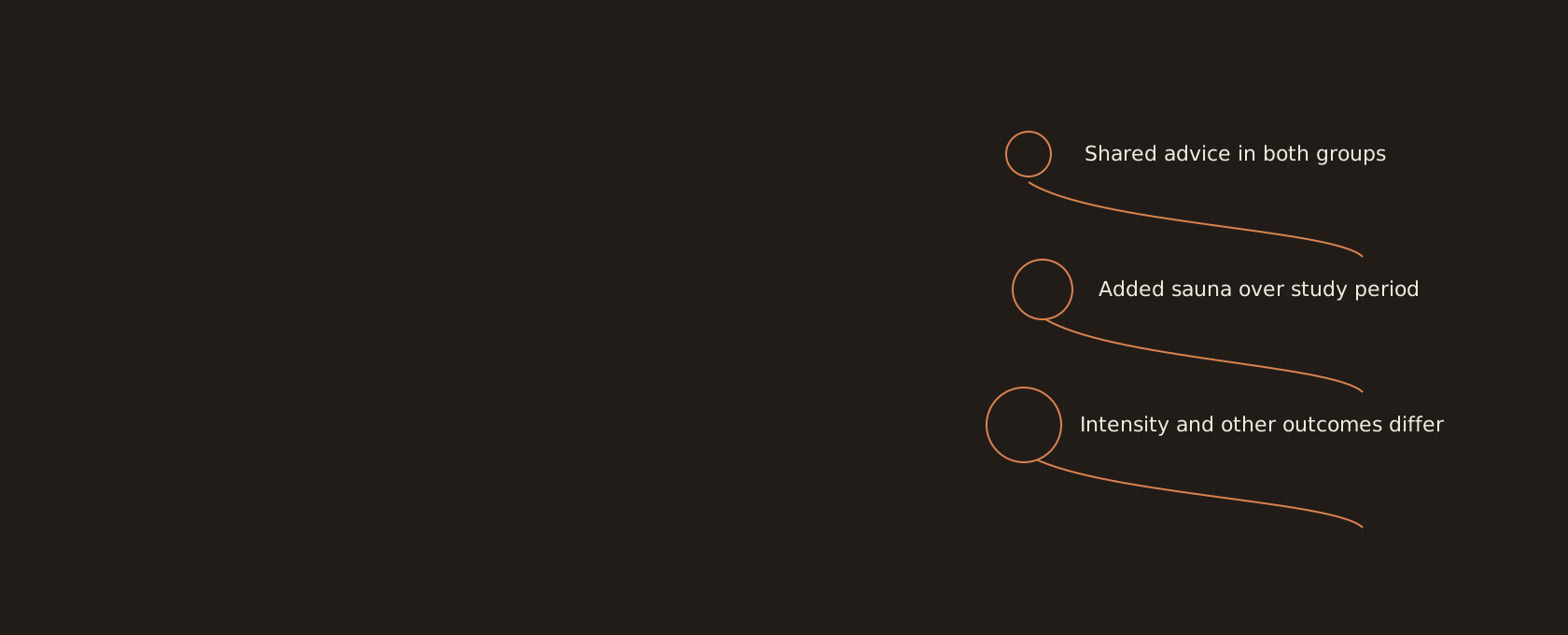
| 2015 · Kanji G ↗ | randomized controlled trial Chronic tension-type headache Participants: 37. regular sauna; exact modality unreported · 8 weeks | The reported between-group difference in change of headache intensity was 1.27 scale units (95% CI 0.48–2.07), favoring the sauna-plus-advice group. Headache duration, sleep, depression and disability did not significantly differ. The result concerns chronic tension-type headache, not migraine. Comparison: Advice and education alone Small study |
| 2019 · Cho EH ↗ | Uncontrolled before-after intervention Low back pain Participants: 37. Dry sauna · Twice daily for 5 consecutive days | Pain and disability ratings improved after the short program, but no comparison group was described to isolate a sauna effect. Comparison: Before versus after program No comparator described |
| 2015 · Soejima Y ↗ | Uncontrolled inpatient pilot Inpatients with chronic fatigue syndrome Participants: 10. Clinical far-infrared Waon therapy · 4weeks | Fatigue was lower after the program but not significantly lower at the midpoint. Pain and vigor did not significantly change. No adverse effects were reported in this small inpatient group. Comparison: Before versus during and after the program Uncontrolled small inpatient sample. |
Original publication: Efficacy of regular sauna bathing for chronic tension-type headache: a randomized controlled study.
What intervention question did the trial ask?
The trial assessed whether adding regular sauna to advice and education changed outcomes in chronic tension-type headache. It is a direct intervention comparison for that enrolled condition. It should not be grouped with every pain report as though all measured the same effect.
The source is small, but random allocation makes its question different from an uncontrolled symptom series. The important reading task is to preserve the condition, shared advice and measured endpoint together. A favorable intensity result can then be evaluated without becoming a universal claim about headaches, every sauna exposure or all aspects of chronic pain.
Was the study evidence about migraine?
No. Participants met the study’s criteria for chronic tension-type headache. That population does not establish the same result for migraine, every occasional headache or another diagnosis. The source’s condition label is an essential part of the finding rather than a detail that can be shortened to headache generally.
An educational summary also cannot determine whether an individual reader belongs to the enrolled diagnostic category. It can describe who was studied and what was measured, while leaving clinical assessment separate. The trial should therefore be used to inspect a research claim, not as a self-diagnosis method or a way to infer suitability for heat from a symptom label alone.
What scale of experiment was conducted?
Thirty-seven people were randomized, with a program assessed over eight weeks. That is a limited clinical experiment rather than a large study of long-term persistence or a program optimized across many exposure schedules. The enrolled sample and horizon constrain what can be concluded about durability and generalization.
Randomization is valuable but does not answer every methodological question by itself. A full appraisal should inspect allocation, follow-up, adherence and analysis populations. This abstract-level review does not assume those details were flawless or infer missing procedures. The source provides one small comparative finding that can motivate further work while leaving the long-term and individualized outcome questions open.
What does the intensity estimate actually represent?
The between-group difference in the change of headache intensity was 1.27 scale units, with a 95% confidence interval of 0.48–2.07, favoring the sauna-plus-advice group. The quantity belongs to the subjective intensity measure and this comparison. It is not the percentage of headaches eliminated or a proportion of patients who no longer had symptoms.
The abstract-level review has not established a responder threshold or a clinically important cutoff for translating that average difference to an individual. The estimate is useful as reported, with its units and uncertainty preserved. Adding an unverified interpretation about symptom disappearance would make the result more definite than the measured outcome supports.
Which other outcomes did not clearly differ?
Headache duration, sleep, depression and the headache-disability measure did not show statistically clear between-group improvement in the abstract. Those findings should appear beside the favorable intensity estimate. They prevent the study from becoming a claim that the program improved every measured consequence of the condition.
A null result is also limited to its own comparison. It does not prove that no possible program can influence those outcomes. The correct account preserves each endpoint rather than using the positive result to overwrite the nulls or using the nulls to deny the reported intensity difference. The paper is most informative when read as a set of separate outcome questions.
| Endpoint | Reported direction | Interpretation boundary |
|---|---|---|
| Subjective intensity | Change favored sauna plus advice | Scale units rather than a responder proportion |
| Duration | No clear between-group difference | Not an established shortening of episodes |
| Sleep, depression and disability | No clear between-group improvement | Do not expand the intensity result |
| Migraine | Not the enrolled population | Requires separate direct evidence |
Can the abstract supply a transferable sauna protocol?
The indexed abstract does not provide complete exposure details for an ordinary home schedule. The study period alone does not identify an effective temperature, session length, frequency or cooling sequence. Those missing details should be checked in the full source rather than filled with customary sauna advice.
The abstract also uses an unusual label for a secondary assessment associated with depression. This page does not silently correct that instrument name or create a more detailed measurement result from memory. The reported outcome is retained at the level verified, while precise instrument terminology remains a full-text question. Neither gap justifies borrowing methods or measures from another pain paper.
How do other pain reports fit this finding?
The low-back-pain report described improvement after a short program without a comparison group described in its abstract. The chronic-fatigue pilot did not find significant pain or vigor changes despite a later fatigue improvement. They concern different conditions and designs, not additional randomized confirmations of the tension-type result.
The dry-sauna systematic review similarly highlights small studies and heterogeneous outcomes across the literature. Its presence does not create a new headache trial. Context helps readers understand the breadth and limitations of the evidence when it remains labeled as context. It should not be used to turn one direct intensity finding into a general analgesic claim or an apparent body of repeated headache efficacy experiments.
What is the justified source-level conclusion?
The source reports a favorable subjective intensity comparison in a small chronic tension-type headache trial, alongside several null secondary outcomes. It does not establish a migraine result, a complete home-sauna protocol or individual medical clearance. The safety review provides separate historical context without replacing a person’s clinical assessment.
This appraisal uses the indexed abstract and verified source abstraction. Complete methods, formal risk of bias, funding and conflict-of-interest disclosures remain unassessed or unreported here. The exposure and instrument wording questions are logged rather than silently resolved. The defensible interpretation keeps the direct finding and its limits together, with further source review and directly relevant replication needed for stronger claims.
Explore the evidence with a tool.
Questions, considered
Questions about this study
Did the tension-headache trial find less intense headaches or shorter headaches?
The clearer between-group result concerned reported pain intensity. Headache duration did not significantly differ, and several other measures were also unchanged. These distinctions matter because a favorable pain score should not be described as improvement in every aspect of headache burden or as evidence concerning a different headache diagnosis.
Follow the sourceWas the tension-headache comparison sauna against no advice or care?
No. Both groups received advice and education, with regular sauna added in the intervention group. That design addresses the added program within this context. It does not establish sauna as a replacement for clinical assessment, and the abstract does not provide enough exposure detail to create a universal headache routine.
Follow the sourceCan the tension-headache sauna result be applied directly to migraine?
No. Participants met criteria for chronic tension-type headache, a different diagnostic category from migraine. The small trial measured specific outcomes over a limited period, and some remained unchanged. Migraine-specific triggers, medication needs and clinical guidance require their own evidence rather than borrowing this pain-intensity result across diagnoses.
Follow the sourceFollow the evidence
Sources & references
Research summaries in this edition are based on indexed abstracts unless otherwise noted. A source link is not a claim of medical review.
- Efficacy of regular sauna bathing for chronic tension-type headache: a randomized controlled study.
Kanji G, Weatherall M, Peter R, Purdie G, Page R
Volume 21, issue 2, pages 103-109 · PMID 25636135
Open-access flag: not recorded.Abstract-level editorial review - Dry sauna therapy is beneficial for patients with low back pain.
Cho EH, Kim NH, Kim HC, Yang YH, Kim J, Hwang B
Volume 14, issue 4, pages 474-479 · PMID 33329780
Open-access flag: yes.Abstract-level editorial review - Effects of Waon therapy on chronic fatigue syndrome: a pilot study.
Soejima Y, Munemoto T, Masuda A, Uwatoko Y, Miyata M, Tei C
Volume 54, issue 3, pages 333-338 · PMID 25748743
Open-access flag: not recorded.Abstract-level editorial review - Clinical Effects of Regular Dry Sauna Bathing: A Systematic Review.
Hussain J, Cohen M
Volume 2018, pages 1857413 · PMID 29849692
Open-access flag: yes.Abstract-level editorial review - Benefits and risks of sauna bathing.
Hannuksela ML, Ellahham S
Volume 110, issue 2, pages 118-126 · PMID 11165553
Open-access flag: not recorded.Abstract-level editorial review