| Study | Design & population | Finding & comparison |
|---|---|---|
| 2024 · Kunutsor SK ↗ | cross-sectional and longitudinal cohort analysis Population cohort Participants: 2012. habitual sauna · Fitness measured at baseline and 11 years | Frequency was associated with fitness at baseline; the longitudinal association was statistically clear only for the middle-frequency category. Session duration was not significantly related to fitness. Comparison: Once-weekly sauna Observational association rather than assigned training |
| 2022 · Lee E ↗ | randomized controlled trial Low activity with at least one cardiovascular risk factor Participants: 47. postexercise sauna · 8 weeks | Relative to exercise alone, exercise plus sauna produced an additional fitness change of +2.7 mL/kg/min (95% CI +0.2 to +5.3) and a systolic-pressure difference of −8.0 mmHg (−14.6 to −1.4). This small combined-program trial did not test sauna alone or clinical-event prevention. Comparison: Exercise alone; control Small eight-week multi-arm trial |
| 2021 · Kirby NV ↗ | controlled endurance-training intervention trained middle-distance runners Participants: 20. post-exercise sauna · 3 weeks; subset continued to 7 weeks | Added sauna improved several tested exercise-capacity markers; extended exposure produced limited additional change. Comparison: normal training without added sauna Small trained sample; no randomization stated in abstract; surrogate performance markers. |
Original publication: Enhancing Cardiorespiratory Fitness Through Sauna Bathing: Insights From the Kuopio Ischemic Heart Disease Prospective Study.
The question joins two different kinds of measurement
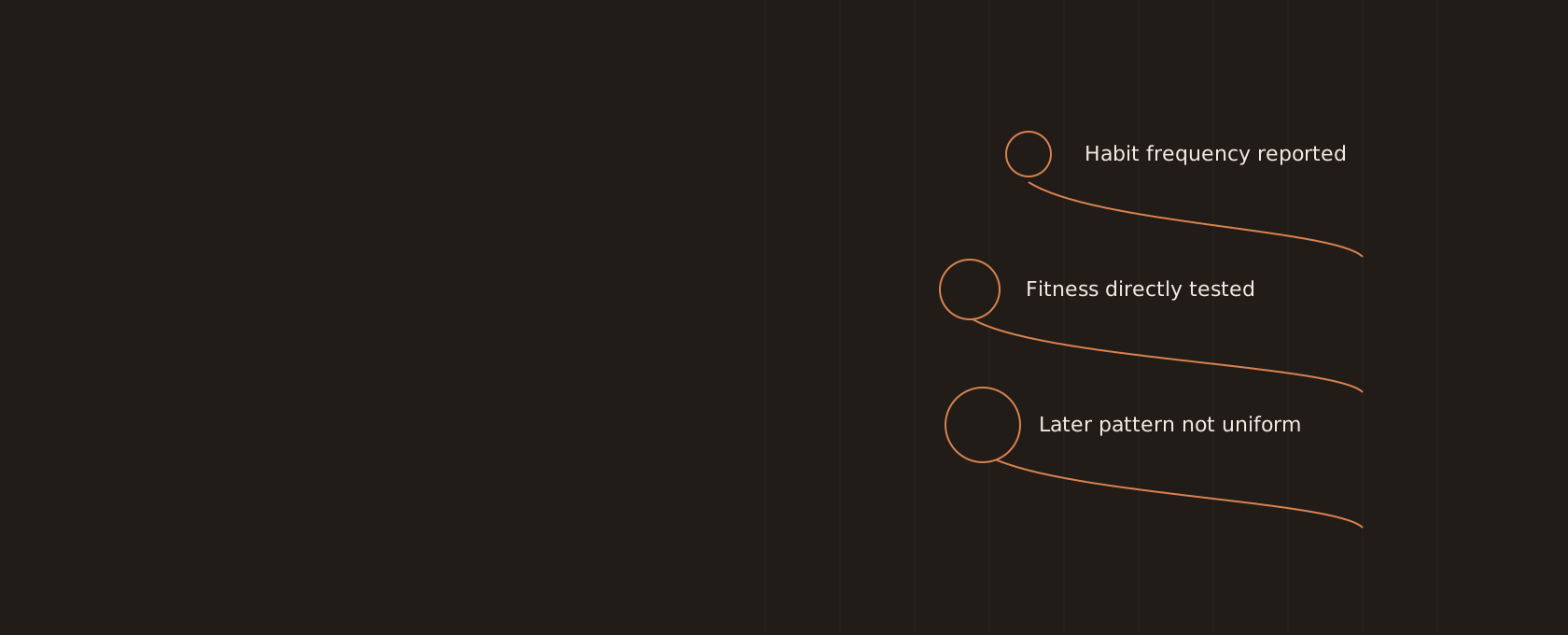
The study examined whether reported sauna frequency and duration were related to cardiorespiratory fitness measured during exercise testing. Its design included both baseline and later associations. The title, Enhancing Cardiorespiratory Fitness Through Sauna Bathing, should therefore be read with the observational methods visible rather than as a claim that an assigned sauna program enhanced fitness.
The distinction is important because exposure and outcome were measured differently. Direct testing improves the description of fitness, while sauna habits remained reported behaviors. An objectively measured outcome does not by itself establish that the exposure caused it. The paper contributes a useful population-level association, but it is not a randomized comparison of beginning sauna with remaining a nonuser or substituting heat for training.
Fitness was tested rather than guessed from activity reports
Cardiorespiratory fitness was assessed with respiratory gas analysis during cardiopulmonary exercise testing. This is more specific than assuming people were fit because they said they exercised. The outcome therefore deserves a clear label: a tested physiological capacity, not an ordinary impression of breathlessness or a survey of respiratory symptoms.
That strength does not answer every applicability question. The sample consisted of men in the KIHD setting, and the source does not establish identical associations in every population or sauna technology. A reader should preserve both aspects at once: the fitness measurement was direct, while the relationship with sauna remained observational. Losing either detail would make the study easier to summarize but less useful for judging a practical claim.
Baseline frequency and fitness were associated
The baseline analyses found an association between frequency of sauna use and fitness. These comparisons describe people at the same stage of observation. They cannot establish that sauna use preceded the fitness difference in the way an intervention would require, or that a participant could reproduce the difference by changing frequency.
Several explanations can remain compatible with a cross-sectional association. Sauna habits may accompany other activities, health characteristics or resources, some measured imperfectly. Adjustment for reported physical activity addresses a measured variable without making all remaining differences disappear. The appropriate reading is therefore a relationship worth testing, rather than a training prescription hidden in a frequency category. This summary does not introduce additional numerical coefficients beyond the site’s registered qualitative result.
The later frequency pattern was less uniform
The longitudinal analysis did not show an equally clear association across all frequency categories. The statistically clear finding was confined to the middle-frequency category compared with weekly sauna. That qualification should not vanish when the study is used to support a general statement that more sauna always produces greater fitness.
A nonsignificant higher-category result does not establish no possible association, but it does limit a precise escalating-dose story. The later analysis concerns follow-up fitness levels under the reported model; it should not be converted into a guaranteed gain from an assigned routine. A careful account keeps baseline and longitudinal findings separate, because a more consistent cross-sectional pattern cannot supply precision missing from the later comparison.
Duration did not supply an alternative dose claim
Session duration was not significantly associated with fitness in the described baseline or longitudinal analyses. Frequency and duration are therefore not interchangeable findings. The source does not support a claim that staying longer inside sauna builds fitness in proportion to time spent heating.
This is a practical limit, not an instruction to choose a particular shorter session. The study observed habits rather than testing an optimal exposure. A schedule assembled from frequency associations and an unrelated experimental temperature would be a new, untested program. The null duration result is useful because it prevents a broad interpretation of dose from outrunning the actual exposure variables. A direct trial would need to specify and compare programs rather than rely on the existence of established habits.
The exercise add-on trial offers a different causal question
The randomized exercise-plus-sauna trial reported an additional fitness change compared with exercise alone. That is intervention evidence about a defined combined program in less active adults with cardiovascular risk factors. It is not a replication of the cohort’s habit comparison and does not test sauna in isolation.
The distinction helps organize evidence without forcing the studies to agree on one universal effect. The cohort asks how existing habits relate to tested fitness; the trial asks what adding sauna to exercise changed under its program. Each can inform the field while leaving a sauna-alone substitution claim unresolved. A favorable randomized add-on result does not turn observational frequency categories into experimentally tested doses.
Runner capacity markers are not the same population question
The controlled runner study compared normal training with training plus intermittent postexercise sauna and reported favorable changes in selected exercise-capacity markers. Its small trained sample and marker outcomes differ from a middle-aged population cohort. It should not be used to imply that every person can gain fitness without training.
Together the sources suggest specific follow-up questions about population, program and endpoint. They do not establish that a long-term habit association, an exercise add-on effect and an athletic capacity response are one interchangeable estimate. The emerging grade here reflects that limited source-level contribution. It recognizes direct fitness testing while retaining uncertainty about causation, category consistency and transfer beyond the men whose habits were observed.
Access, disclosures and safety remain separate
The live indexed abstract was checked against the included corpus and registered fact statement. The PubMed record and DOI identify the original publication. This is not a full-text assessment of selection, missing data, every regression decision, funding or conflicts of interest. Financial details not established in the reviewed material remain unreported.
The safety review cited separately names unstable angina, recent myocardial infarction and severe aortic stenosis as contraindications and warns about alcohol. It does not validate copying a cohort frequency as a personal routine. Fitness research and medical suitability are different questions. The defensible conclusion is an observational relationship between sauna habits and directly measured fitness, with important uncertainty about how changing those habits would affect an individual.
Explore the evidence with a tool.
Questions, considered
Questions about this study
Was fitness measured directly in the KIHD sauna-and-fitness analysis?
Yes. Cardiorespiratory fitness was assessed using respiratory gas analysis during exercise testing, rather than inferred solely from a questionnaire. Sauna habits were still observational. A direct fitness measurement strengthens the outcome description but does not turn the relationship between reported sauna frequency and later fitness into a randomized training effect.
Follow the sourceWere sauna frequency and session duration equally related to fitness?
No. Frequency showed associations in several analyses, while duration was not significantly associated with fitness in the described cross-sectional or longitudinal comparisons. The longitudinal frequency finding was also not equally clear across categories. This mixed pattern is more informative than a broad assertion that longer sauna automatically builds fitness.
Follow the sourceDoes the KIHD fitness paper show sauna can replace aerobic training?
No. It evaluates associations with existing habits and measured fitness, not a randomized substitution of sauna for exercise. The authors call for definitive trials. Readers should distinguish an association remaining after adjustment for physical activity from proof that passive heat produces the full adaptations or health benefits of aerobic exercise.
Follow the sourceFollow the evidence
Sources & references
Research summaries in this edition are based on indexed abstracts unless otherwise noted. A source link is not a claim of medical review.
- Enhancing Cardiorespiratory Fitness Through Sauna Bathing: Insights From the Kuopio Ischemic Heart Disease Prospective Study.
Kunutsor SK, Isiozor NM, Kurl S, Laukkanen JA
Volume 44, issue 4, pages 295-300 · PMID 38836690
Open-access flag: not recorded.Abstract-level editorial review - Effects of regular sauna bathing in conjunction with exercise on cardiovascular function: a multi-arm, randomized controlled trial.
Lee E, Kolunsarka I, Kostensalo J, Ahtiainen JP, Haapala EA, Willeit P, Kunutsor SK, Laukkanen JA
Volume 323, issue 3, pages R289-R299 · PMID 35785965
Open-access flag: yes.Abstract-level editorial review - Intermittent post-exercise sauna bathing improves markers of exercise capacity in hot and temperate conditions in trained middle-distance runners.
Kirby NV, Lucas SJE, Armstrong OJ, Weaver SR, Lucas RAI
Volume 121, issue 2, pages 621-635 · PMID 33211153
Open-access flag: yes.Abstract-level editorial review - Benefits and risks of sauna bathing.
Hannuksela ML, Ellahham S
Volume 110, issue 2, pages 118-126 · PMID 11165553
Open-access flag: not recorded.Abstract-level editorial review