| Study | Design & population | Finding & comparison |
|---|---|---|
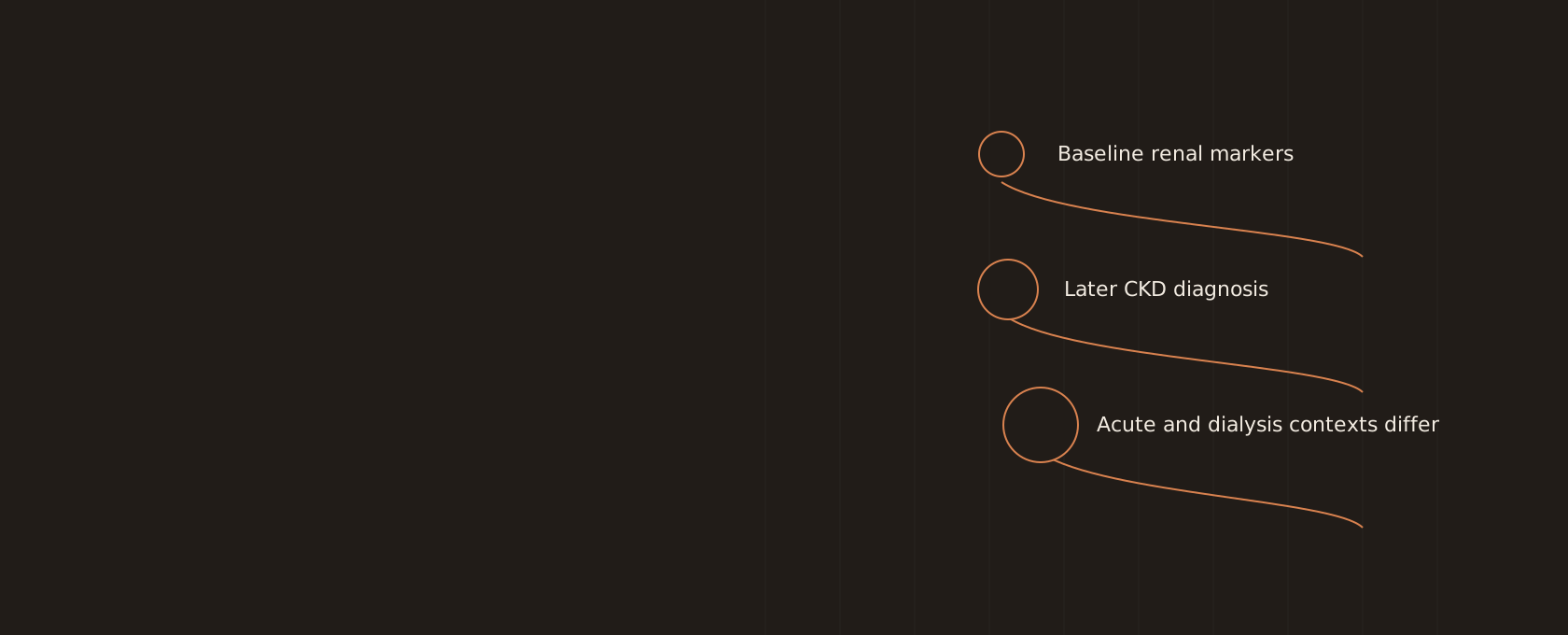
| 2023 · Kunutsor SK ↗ | cross-sectional and prospective cohort analysis normal kidney function at baseline Participants: 2071. habitual sauna bathing | Frequent bathing was not significantly associated with incident chronic kidney disease in this cohort. Comparison: highest versus reference frequency Normal baseline renal function; observational male cohort; not dialysis safety evidence. |
| 2018 · Laukkanen T ↗ | Single-session experimental before-after study At least one cardiovascular risk factor Participants: 102. Sauna | Blood pressure and pulse-wave velocity fell after exposure, but the study did not establish durable changes or fewer cardiovascular events. Comparison: Before, immediately after and recovery No unheated comparator described |
| 2025 · McIver WJ ↗ | clinical case report classical heat stroke after prolonged sauna use Participants: 1. sauna, subtype not specified | A patient developed severe heat stroke with multiple organ complications after collapse in a sauna. Comparison: Not reported in the reviewed abstract Single case; exposure duration and population risk not quantified. |
The cohort does not establish improved kidneys
The reviewed KIHD analysis did not find a significant association between higher sauna frequency and later chronic kidney disease in men who began with normal kidney function. That is a limited observational result. It should not be relabeled as proof that sauna improves renal function or that every exposure is safe.
The study also examined several laboratory measures with different sampling arrangements. Most comparisons were null, while a slight baseline potassium difference was reported. These details matter because kidney function is not one interchangeable number. Grade C applies to the bounded evidence discussed here, with clinical benefit and individual suitability unresolved. This guide does not claim to cover every newly published CKD trial or every heat intervention. It interprets selected verified sources and keeps their populations, outcomes and limitations separate.
Normal baseline function defines the starting population
The cohort enrolled middle-aged men with normal kidney function at entry. That makes the study different from a trial in people already living with advanced kidney disease, receiving dialysis or undergoing evaluation for an acute problem. An absence of a clear later association in the starting population does not answer all those clinical questions.
The distinction is especially important because the paper’s title includes CKD. It followed initially normal participants for a diagnosis rather than assigning an intervention after disease was established. A reader should preserve the starting condition before deciding how the result applies. The male study setting also does not directly establish the same response in every sex, age or heat environment. These are boundaries on transfer, not proof of benefit or harm outside the cohort.
Baseline filtration and laboratory measures were distinct outcomes
Higher-frequency versus reference sauna use was not significantly related to baseline estimated filtration, creatinine or sodium. The authors described a slight baseline potassium increase. That is a mixed set of measurements rather than a finding that every renal marker improved or remained identical.
A small group difference in one measure does not establish a clinical diagnosis in an individual. Conversely, a nonsignificant difference is not an equivalence demonstration. The cross-sectional comparisons also observe people with different existing habits, leaving other characteristics relevant despite adjustment. The appropriate interpretation retains each measurement and its comparison. It does not turn a potassium difference into a desirable target or use a null creatinine comparison to certify that a particular person’s intended exposure is suitable.
These baseline contrasts are between participants with different habits, not measurements showing that each person’s kidney markers improved after a session. That distinction remains necessary even when a marker is precisely measured. The source should not be turned from a cross-sectional comparison into a within-person intervention result.
Later electrolyte sampling was not comprehensive surveillance
The abstract describes follow-up potassium and sodium measurements in a random subset, limited by logistics. It does not describe repeated collection of every baseline renal measure in every participant. The later electrolyte comparisons were not significant.
That data structure should remain visible in an evidence summary. Long follow-up does not necessarily mean continuous or complete laboratory monitoring. A later registry diagnosis and a subset laboratory sample provide different information. Full-text appraisal would be needed to assess missing data, selection and measurement procedures more completely. This guide does not assume that all aspects of renal function were observed throughout the cohort simply because the study included both cross-sectional and longitudinal analyses. The distinction limits how broadly its reassuring-sounding conclusion can be applied.
The CKD endpoint has its own uncertainty
The incident CKD comparison did not establish a significant association with sauna frequency. That is neither a demonstrated preventive benefit nor proof that the true association must be exactly absent. The estimate belongs to the reported model and selected population.
A personal safety threshold would require a different question and design. The cohort did not allocate a specific new exposure to every participant, and baseline habits could change over time. Outcome ascertainment also deserves full-text review rather than being reconstructed from other KIHD papers. The defensible result is that this analysis did not show a clear relationship with later CKD. It cannot establish how a different routine affects someone with existing disease, or predict whether a short-term acute event will occur during an individual session.
An acute creatinine response is not a chronic diagnosis
The acute cardiovascular experiment reported a slight creatinine increase around its sauna visit. It observed a short physiological window in adults with cardiovascular risk factors. That laboratory response should not be equated automatically with chronic kidney disease or a diagnosed acute injury.
The difference in time scale also prevents the opposite mistake. A null cohort association with later CKD does not establish that acute laboratory responses never occur. A source-led account can retain both findings without forcing them into a universal yes-or-no statement about kidney safety. Before comparing the papers, identify the participant group, sampling time and endpoint. The current evidence does not supply a personalized interpretation of a laboratory value or a rule for deciding whether an individual heat exposure caused kidney damage.
A severe heat-stroke case has another evidentiary role
The heat-stroke case report described collapse after prolonged sauna use with multiple organ complications, including kidney injury. It demonstrates that serious acute illness has been reported in a sauna context. It does not estimate how often that outcome occurs among ordinary users or define a universally safe duration.
A case report and a population cohort answer different questions. The case should not be used to claim that every session causes kidney injury, while the cohort’s long-term null association should not erase the existence of an acute severe event. Their roles are complementary: one documents a particular presentation, the other examines an association over follow-up in a selected group. This guide does not convert either into a personal exposure threshold or a self-diagnosis tool.
The dialysis-fluid pilot needs its own clinical context
The portable-sauna pilot involved people on peritoneal dialysis with fluid overload. It reported changes in fluid-related measures but also transient dizziness and a skin burn. Its abstract gives tolerated-session counts, which must not be mistaken for the number of participants.
This is not evidence that a public user should deliberately pursue fluid loss or change a dialysis plan. The clinical setting, monitoring and purpose differ from the baseline-normal KIHD cohort. A favorable feasibility description also does not remove the reported adverse events. The pilot is relevant because it shows why existing kidney disease requires direct, carefully bounded research rather than automatic extrapolation. Its result does not establish a general renal-health program, and this page does not provide the procedure as a routine to copy.
The reviewed evidence is not an exhaustive CKD-trial verdict
The main cohort result should remain attributed to its specific participants and outcomes. This page does not claim that no CKD intervention research exists or that every potential vascular or exercise effect in CKD has been evaluated. Newly identified sources require their own appraisal before being integrated into a verified clinical claim.
That scope protects both accuracy and usefulness. A normal-function cohort cannot settle all established-disease questions, and a small fluid-overload pilot cannot supply a universal benefit. A broader evidence review would need appropriate discovery, eligibility and source-level assessment rather than a larger list of titles. Here the conclusion stays with the reviewed registry sources. Unassessed work is neither counted as confirming a benefit nor treated as evidence that no further question can be studied.
There is no personal renal exposure or fluid recipe here
No temperature, frequency or fluid-management routine is established by this collection for improving kidney outcomes in every reader. Baseline habit categories are not a prescribed program, and a supervised clinical pilot is not a general leisure-use protocol. Combining their details would create a new intervention.
For a practical conversation, identify whether the question concerns a current kidney condition, an isolated laboratory result, a fluid-management plan or recreational sauna. Those are not the same decision. Discuss intended exposure and relevant medications with the clinical team that knows the situation. A session tool can organize assumptions; it cannot validate renal safety or tell a person to change a restriction. The reviewed studies do not justify escalating heat to chase a larger scale response or interpreting an unchanged marker as personal clearance.
Review limits and the proportionate conclusion
This synthesis uses refreshed indexed abstracts, verified source findings and the supplemental renal-marker interpretation. Full-text laboratory and registry procedures, formal bias assessment, funding and conflicts of interest have not been independently completed. Unreported details remain unknown rather than being inferred from a favorable conclusion.
The historical safety review names unstable angina, recent myocardial infarction and severe aortic stenosis as contraindications and warns about alcohol, but is not comprehensive renal screening. The justified conclusion is conditional: the reviewed cohort did not establish a clear CKD association in men with normal baseline function, while marker sampling, a small potassium difference and distinct acute or dialysis contexts limit wider claims. That is useful evidence without being a kidney-benefit promise, a fluid-loss strategy or a universal safety certificate.
Inspect the assumptions
Explore the session planner.
This planning tool describes a routine. It does not estimate a health benefit or provide medical clearance; the study exposures discussed above remain separate research methods.
Interactive workspace
In-memory checkpoint · no medical clearance
Pause for the personal context.
Check every item that applies or that you are unsure about. Current serious symptoms need appropriate care, not a tool result.
Context, with limits
- Checkpoint
- Complete the acknowledgment
A checklist cannot assess every relevant condition. No answer is medical clearance. Responses are in memory only, and are reset on reload.
Calculated on your device. Theme and unit preferences can be stored locally; health answers, weights and logs remain in memory. A shared settings URL contains its visible planning inputs.
Open the complete tool and methodologyExplore the evidence with a tool.
Questions, considered
Questions about this evidence
Does the null CKD association prove that sauna improves kidney function?
It did not establish an improvement. The result was a nonsignificant observational association with later CKD in men who began with normal kidney function. That does not demonstrate prevention, equivalence or safety for every exposure. Keep the population and diagnosis endpoint attached rather than converting absence of a clear association into a benefit claim.
Follow the sourceWere all renal laboratory comparisons null in the KIHD analysis?
Most baseline comparisons were nonsignificant, but the authors reported a slight potassium increase. Follow-up potassium and sodium comparisons were nonsignificant and available only in a subset. That mixed pattern should not become a blanket claim that every measure was identical, improved or monitored repeatedly in every participant.
Follow the sourceCan a temporary creatinine response be treated as the cohort’s CKD outcome?
They are different observations. The acute experiment sampled a short window around exposure, while the cohort examined a later diagnosis. A laboratory change does not by itself establish chronic disease, and a null long-term association does not rule out every acute response. Personal test interpretation requires an appropriate clinical assessment.
Follow the sourceWhy is the dialysis pilot not a public fluid-loss program?
It involved a selected clinical population with fluid overload and a specific research purpose. Fluid-related changes occurred alongside reported dizziness and a burn. Those observations do not validate copying the procedure or changing a fluid or dialysis plan. The abstract’s session count also is not a count of enrolled participants.
Follow the sourceWhat does the heat-stroke case establish about ordinary-user kidney risk?
It documents a severe event with kidney injury after prolonged sauna use, but it does not estimate its frequency among ordinary users or define an individual safe limit. The case should not be generalized to every session, just as a population cohort’s null association should not erase acute severe presentations.
Follow the sourceDoes repeatable dehydration show that a sauna helps the kidneys remove fluid?
The reliability experiment assessed a laboratory challenge in healthy young adults, not improved renal outcomes or an individualized fluid strategy. A predictable scale change does not establish better filtration or CKD benefit. People with clinical fluid-management questions need their care team’s assessment rather than a target derived from that method.
Follow the sourceFollow the evidence
Sources & references
Research summaries in this edition are based on indexed abstracts unless otherwise noted. A source link is not a claim of medical review.
- Sauna bathing, renal function and chronic kidney disease: Cross-sectional and longitudinal findings from the KIHD study.
Kunutsor SK, Kauhanen J, Laukkanen JA
Volume 53, issue 8, pages e14001 · PMID 37029766
Open-access flag: not recorded.Abstract-level editorial review - Acute effects of sauna bathing on cardiovascular function.
Laukkanen T, Kunutsor SK, Zaccardi F, Lee E, Willeit P, Khan H, Laukkanen JA
Volume 32, issue 2, pages 129-138 · PMID 29269746
Open-access flag: not recorded.Abstract-level editorial review - Severe heat stroke with multiorgan failure following collapse in a sauna.
McIver WJ, Zia M
Volume 18, issue 1, pages e262069 · PMID 39773956
Open-access flag: not recorded.Abstract-level editorial review - Portable sauna stimulated-diaphoresis for the treatment of fluid-overload in peritoneal dialysis patients: A pilot study.
Maggiani-Aguilera P, Chávez-Iñiguez JS, Navarro-Blackaller G, Hernández-Morales K, Geraldo-Ozuna AL, Alcantar-Villín L, Montoya-Montoya O, Luquín-Arellano VH, García-García G
Volume 9, pages 887609 · PMID 36203760
Open-access flag: yes.Abstract-level editorial review - Reliability of achieving target dehydration levels using a portable infrared sauna protocol in healthy young adults.
Lebron MA, Fukuda DH, Cregan JT, Shell JM, Wells AJ, Stout JR
Volume 22, issue 1, pages 2586598 · PMID 41320841
Open-access flag: yes.Abstract-level editorial review - Benefits and risks of sauna bathing.
Hannuksela ML, Ellahham S
Volume 110, issue 2, pages 118-126 · PMID 11165553
Open-access flag: not recorded.Abstract-level editorial review