| Study | Design & population | Finding & comparison |
|---|---|---|
| 2015 · Sutkowy P ↗ | Acute comparative biomarker experiment Healthy male volunteers Participants: 25. Single dry sauna or whole-body cryostimulation | Heat and cold exposures produced differing acute antioxidant-enzyme patterns. Biomarker changes do not establish reduced disease risk or favor one exposure for long-term health. Comparison: Distinct heat and cold exposure groups Small separate groups. |
| 2020 · Gryka D ↗ | Before-after study comparing activity groups Healthy; trained and untrained groups Participants: 20. Finnish sauna · 10 baths over 3 weeks | Selected oxidative-balance and nitric-oxide markers changed, with some differences between trained and untrained men; clinical outcomes were not measured. Comparison: Trained versus untrained; within-person measurements Small groups |
| 2018 · Kunutsor SK ↗ | cross-sectional and longitudinal cohort analysis Population cohort Participants: 2269. habitual sauna · Baseline and 11-year measurements | Greater frequency was associated with lower inflammatory-marker levels in several analyses, but sauna frequency was not associated with GGT. Comparison: Once-weekly sauna Observational markers |
Does the evidence show that sauna reduces oxidative stress?
The answer depends on the actual measurement, and a general health benefit is not established. Small experiments report selected changes in oxidative-related markers and antioxidant-enzyme activity, while a cohort analysis found no association with one marker used in its oxidative-stress question. These are not one interchangeable outcome.
The most useful summary identifies the assay, timing, participants and comparison before interpreting direction. An enzyme response after a challenge does not automatically show that tissue damage decreased. A laboratory observation also does not establish fewer later diseases or a universally better recovery method.
This page assigns C to emerging source-specific physiology. It does not give that grade to a confirmed disease-prevention program. The evidence can guide a precise research question without becoming a promise that every sauna visit lowers all oxidative stress. Different endpoints and designs should remain distinct rather than be condensed into a single favorable health label.
What does the broad oxidative-stress label conceal?
The cited papers include antioxidant-enzyme activities, selected oxidative-balance measurements, nitric-oxide-related markers and an observational GGT analysis. The common topic does not mean each test measures the same process or can supply the result of another.
An evidence claim therefore needs more than the word antioxidant. A reader should ask whether the report describes enzyme activity, a particular circulating concentration, a regional or whole-body functional test, or a clinical outcome. It should also be clear whether the comparison is before and after exposure, between different groups or among existing habits.
Those distinctions prevent a useful measurement from acquiring a meaning it did not establish. A change can be statistically detectable and relevant to physiology while leaving clinical importance unresolved. Conversely, one unchanged marker does not prove that every oxidative-related process was unaffected. Endpoint-specific wording is necessary in both directions.
Which enzyme patterns followed the single heat and cold exposures?
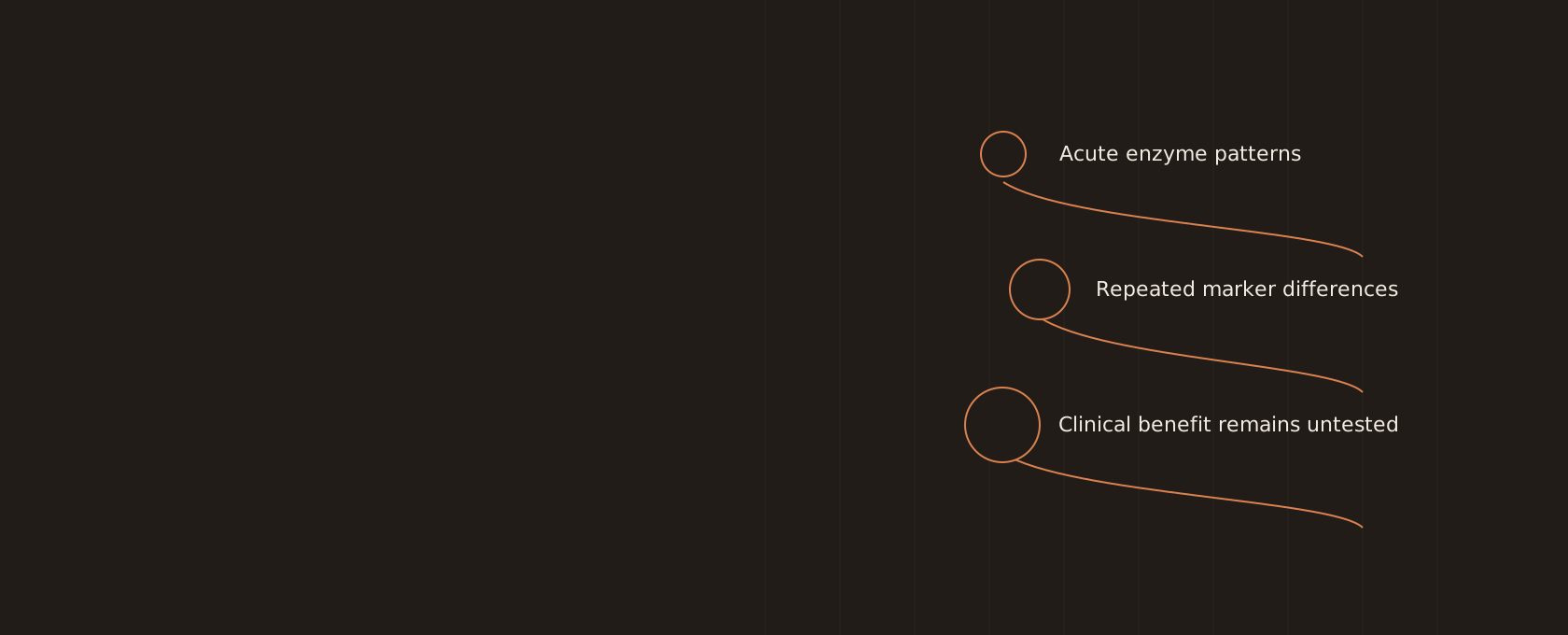
The acute comparison reported increased superoxide dismutase activity after both dry sauna and whole-body cryostimulation. Glutathione peroxidase activity increased after cryostimulation, while catalase activity increased after sauna. The paper also described a between-group superoxide dismutase difference. That is a selective pattern, not one uniform antioxidant result.
This page does not add unregistered numerical effects to those directions. The names and conditions are important enough to retain without presenting a spurious precision. The source did not establish that a larger activity change in one enzyme produces a better clinical outcome.
The appropriate conclusion is that the exposures elicited differing blood responses. It would be inaccurate either to call every tested result null or to describe both activities as equivalent ways to improve health. The study provides a more specific and more limited comparison than either simplification.
Why does the heat-cold design limit a health ranking?
The experiment used small separate groups of healthy men. It was not a large within-person outcomes trial demonstrating that everyone responded better to one exposure. The indexed description does not establish random allocation, so this summary does not add it.
Between-group differences can reflect participant characteristics as well as exposure. A complete appraisal would inspect baseline comparability, measurement variation and analysis. Those design questions remain relevant even before considering the gap between an enzyme result and health.
Whole-body cryostimulation also should not be treated as every form of cold exposure. A cold-water routine is another intervention. Neither a shared thermal label nor an increase in the same enzyme establishes equivalence. Combining sauna and cold into a new sequence would create an untested program rather than reproduce the separate-group comparison. The source therefore cannot identify the healthiest option for a reader’s personal circumstances.
The heat-cold experiment involved twenty-five healthy men distributed across the two exposure groups. That sample describes a preliminary comparison, not a large clinical test of which activity produces better long-term outcomes.
Does more antioxidant-enzyme activity prove less damage?
It does not provide that demonstration by itself. The acute experiment assessed several blood measures, but the enzyme findings should not be treated as a complete clinical account of oxidative damage. A response to a challenge and a beneficial consequence are different claims.
The abstract also describes measurements related to lipid peroxidation, without providing a basis here for a general statement that oxidative damage was reduced. Missing result detail should be checked in the full paper rather than filled from the direction of another assay.
This reading discipline prevents two opposite errors. A larger enzyme response should not automatically be called protective, while a challenge-related response should not automatically be described as harmful to everyone. The source’s actual measurements, uncertainty and relevant outcomes need to support the interpretation. A clinical label cannot be supplied from the assay name alone.
What did repeated-sauna research in activity groups find?
A study of trained and untrained young men reported selected oxidative-balance and nitric-oxide marker changes across a sauna series. Some patterns depended on the marker, group and measurement occasion. Those details do not establish a uniform beneficial response to every bath.
Training status was an existing characteristic, not a randomized intervention. The abstract also does not describe an independent non-heated comparison. A difference between groups or across visits therefore cannot isolate every reason for change. The paper can inform a mechanistic question while leaving causal attribution less certain.
Its nitric-oxide-related findings also do not directly demonstrate a clinical vascular improvement. A proposed pathway is distinct from an observed patient outcome. The useful contribution is the named marker pattern and its conditions, rather than a prescription for increasing heat until a desirable antioxidant state has been achieved.
What does the KIHD GGT result add?
The cohort analysis associated sauna frequency with lower levels of several inflammatory markers in some comparisons, but frequency was not associated with GGT. The outcome-specific null finding deserves its own place in a discussion that might otherwise quote only favorable directions.
GGT is not a comprehensive assessment of every oxidative process. Its unchanged association cannot settle every possible effect, just as a favorable inflammatory marker cannot substitute for a demonstrated oxidative-damage result. The measurements should remain identified rather than merged.
The design also concerned established habits in men, not assigned changes in sauna exposure. Statistical adjustment does not remove all uncertainty about confounding or changing habits. The source contributes a cross-sectional and longitudinal association question, which differs from the acute enzyme experiment and the repeated small-group series. The publications can inform the same topic without becoming interchangeable replications or an informal pooled estimate.
Can cytokine or CRP results fill an oxidative-evidence gap?
They answer related but distinct questions. An acute crossover study in older adults found marker-specific cytokine responses with unchanged CRP. A randomized pilot of sauna added to cycling did not detect an added change in high-sensitivity CRP and selected gut-related measurements.
Neither source can supply an unmeasured oxidative-damage benefit. Their relevance here is to show why broad biological labels should not erase differences between assays and programs. A null CRP result does not establish that every oxidative-related process was unchanged; a cytokine response does not establish reduced oxidative disease.
The broader narrative review organizes possible mechanisms but does not create another experiment linking them to clinical outcomes. These are contextual references, rather than six independent trials showing one antioxidant benefit. The bibliography’s breadth should help readers follow the distinctions, not inflate the apparent replication of a claim none of the sources directly established.
| Source setting | Actual measurement question | Interpretation to avoid |
|---|---|---|
| Single heat-cold comparison | Which enzyme activities changed acutely? | A universal health ranking |
| Repeated activity-group series | Which selected markers differed by time or group? | An isolated causal effect of training |
| KIHD habit analysis | How did frequency relate to selected markers? | An assigned intervention or whole-system oxidative result |
| Cytokine and CRP studies | What happened to those distinct endpoints? | A substitute result for oxidative damage |
What would connect a biomarker pattern to a meaningful benefit?
The outcome would need to match the claim. A proposal about less tissue damage, better function or fewer diseases requires relevant measurement and an appropriate comparison. Evidence about a single enzyme is not automatically evidence for every later step.
Timing and persistence matter as well. A sample collected shortly after one exposure cannot establish a resting effect maintained over a longer program. A repeated-series observation would still need suitable controls and a clear clinical interpretation. The current sources do not complete that chain.
This approach allows the physiology to remain interesting without exaggeration. A laboratory finding can motivate focused research, including whether it is reproducible and whether its magnitude predicts a useful outcome. Until those links are established, the paper should be described as a response study rather than proof that a reader will recover better or avoid a future health problem through a selected routine.
Is an antioxidant-focused exposure routine validated?
The cited evidence does not identify a universally effective combination of modality, temperature, duration and frequency for a clinical antioxidant goal. Different samples and measurement windows produced different findings. Assembling attractive details from the papers would create a new intervention rather than reproduce a validated program.
Nor does a larger perceived thermal challenge necessarily indicate a larger useful biological response. The studies did not establish a personal target for maximizing enzyme activity, and they did not validate a planner as a test of oxidative status.
A study explorer can help identify the actual comparison, while a heat log can record assumptions. Those tools cannot determine tissue damage or clinical benefit from entered settings. The practical value is better interpretation of evidence, not a numerical routine that makes an unconfirmed mechanism appear more certain than the data allow.
What should remain separate about safety and review scope?
The historical safety review names unstable angina, recent myocardial infarction and severe aortic stenosis among contraindications and identifies alcohol-related concerns. It is an older narrative source, not a complete personal screening checklist. Relevant conditions and medications should be discussed with a qualified clinician.
This page synthesizes refreshed indexed abstracts and registered findings. It does not claim a medical review, completed full-text risk-of-bias assessment or comprehensive examination of funding and competing interests. Those financial details remain unreported where the material read did not establish them.
The proportionate conclusion is emerging evidence about selective measurements, with uncertainty about attribution, persistence and clinical importance. It does not rank heat and cold for universal health or establish disease prevention. Keeping those limits explicit preserves the useful scientific observations while avoiding an exposure prescription or an assurance of personal benefit that the studies did not test.
Inspect the assumptions
Explore the session planner.
This planning tool describes a routine. It does not estimate a health benefit or provide medical clearance; the study exposures discussed above remain separate research methods.
Interactive workspace
In-memory checkpoint · no medical clearance
Pause for the personal context.
Check every item that applies or that you are unsure about. Current serious symptoms need appropriate care, not a tool result.
Context, with limits
- Checkpoint
- Complete the acknowledgment
A checklist cannot assess every relevant condition. No answer is medical clearance. Responses are in memory only, and are reset on reload.
Calculated on your device. Theme and unit preferences can be stored locally; health answers, weights and logs remain in memory. A shared settings URL contains its visible planning inputs.
Open the complete tool and methodologyExplore the evidence with a tool.
Questions, considered
Questions about this evidence
What is missing between an enzyme increase and less oxidative damage?
The enzyme measurement alone does not establish the proposed consequence. The relevant damage or clinical outcome needs its own assessment under an appropriate comparison. The acute heat-cold study reported selective enzyme patterns, not a demonstrated reduction in disease or a complete account of tissue damage throughout the body.
Follow the sourceDoes a shared superoxide dismutase response make heat and cold equivalent?
The experiment found differences as well as shared responses, and it used small separate groups. An overlap in one marker cannot establish equivalent physiology or clinical effects. Whole-body cryostimulation also is not interchangeable with every cold-water routine, so the paper cannot validate a universal contrast-therapy sequence or health ranking.
Follow the sourceCan a blood-marker finding establish the same effect in every tissue?
The sampled compartment and assay limit the finding. These studies assessed selected blood-related measurements rather than directly demonstrating a uniform response across organs or a clinical benefit. A broader tissue-specific claim needs relevant evidence, not a whole-body interpretation added to a circulating marker because the mechanism seems plausible.
Follow the sourceDoes the absent GGT association show that all oxidative processes were unchanged?
It does not settle every oxidative question. GGT was one marker in an observational analysis, not a comprehensive direct test of all relevant processes. The result should remain visible without being universalized, just as the cohort’s favorable inflammatory associations should not be substituted for an unmeasured oxidative-damage benefit.
Follow the sourceDo activity-group differences establish a personal antioxidant heat dose?
The trained-versus-untrained experiment did not assign training history or compare complete schedules to identify an optimum. Its marker-specific differences can guide research without becoming a decision rule for an individual. A larger physiological response is not automatically better, and the study did not validate a target enzyme level for public use.
Follow the sourceHow should someone compare an antioxidant claim across sauna products?
Ask for the actual exposure, measurement, population, comparator and time window, then check what clinical outcome was established. A general heat label or a favorable enzyme result does not supply product-specific evidence. The cited studies do not identify one universally healthier thermal activity or validate a personal disease-prevention routine.
Follow the sourceFollow the evidence
Sources & references
Research summaries in this edition are based on indexed abstracts unless otherwise noted. A source link is not a claim of medical review.
- Single whole-body cryostimulation procedure versus single dry sauna bath: comparison of oxidative impact on healthy male volunteers.
Sutkowy P, Woźniak A, Rajewski P
Volume 2015, pages 406353 · PMID 25866782
Open-access flag: yes.Abstract-level editorial review - The influence of Finnish sauna treatments on the concentrations of nitric oxide, 3-nitrotyrosine and selected markers of oxidative status in training and non-training men.
Gryka D, Pilch WB, Czerwińska-Ledwig OM, Piotrowska AM, Klocek E, Bukova A
Volume 33, issue 2, pages 173-185 · PMID 31950931
Open-access flag: not recorded.Abstract-level editorial review - Longitudinal associations of sauna bathing with inflammation and oxidative stress: the KIHD prospective cohort study.
Kunutsor SK, Laukkanen T, Laukkanen JA
Volume 50, issue 5, pages 437-442 · PMID 29897261
Open-access flag: not recorded.Abstract-level editorial review - Impact of Finnish sauna bathing on circulating markers of inflammation in healthy middle-aged and older adults: A crossover study.
Behzadi P, Gravel H, Neagoe PE, Barry H, Sirois MG, Gagnon D
Volume 52, pages 102486 · PMID 32951736
Open-access flag: not recorded.Abstract-level editorial review - No effects of a 4-week post-exercise sauna bathing on targeted gut microbiota and intestinal barrier function, and hsCRP in healthy men: a pilot randomized controlled trial.
Karolkiewicz J, Nieman DC, Cisoń T, Szurkowska J, Gałęcka M, Sitkowski D, Szygula Z
Volume 14, issue 1, pages 107 · PMID 35710395
Open-access flag: yes.Abstract-level editorial review - Cardiovascular and Other Health Benefits of Sauna Bathing: A Review of the Evidence.
Laukkanen JA, Laukkanen T, Kunutsor SK
Volume 93, issue 8, pages 1111-1121 · PMID 30077204
Open-access flag: not recorded.Abstract-level editorial review - Benefits and risks of sauna bathing.
Hannuksela ML, Ellahham S
Volume 110, issue 2, pages 118-126 · PMID 11165553
Open-access flag: not recorded.Abstract-level editorial review