| Study | Design & population | Finding & comparison |
|---|---|---|
| 2026 · Heinonen IHA ↗ | acute before-after experimental study Adult sample; health status not fully specified Participants: 51. Finnish sauna · Immediate and 30-minute recovery samples | Immune-cell counts changed more broadly than cytokines after heat exposure; these acute laboratory shifts do not show fewer infections. Comparison: Own pre-exposure blood sample No randomized comparator described |
| 2023 · Pilch W ↗ | trained-versus-untrained repeated-exposure experiment healthy men Participants: 20. Finnish sauna · ten baths | Some immune and hormonal responses differed by training status and exposure timing. Comparison: trained versus untrained; first versus last bath Biomarkers only; no infection endpoint; small male groups. |
| 2020 · Behzadi P ↗ | Randomized-order crossover physiology study Healthy middle-aged and older adults Participants: 20. Finnish sauna | Selected cytokines increased after sauna, whereas CRP did not change; the response depended on exposure pattern and marker. Comparison: Seated time control Acute response |
Does an immune response mean stronger protection from illness?
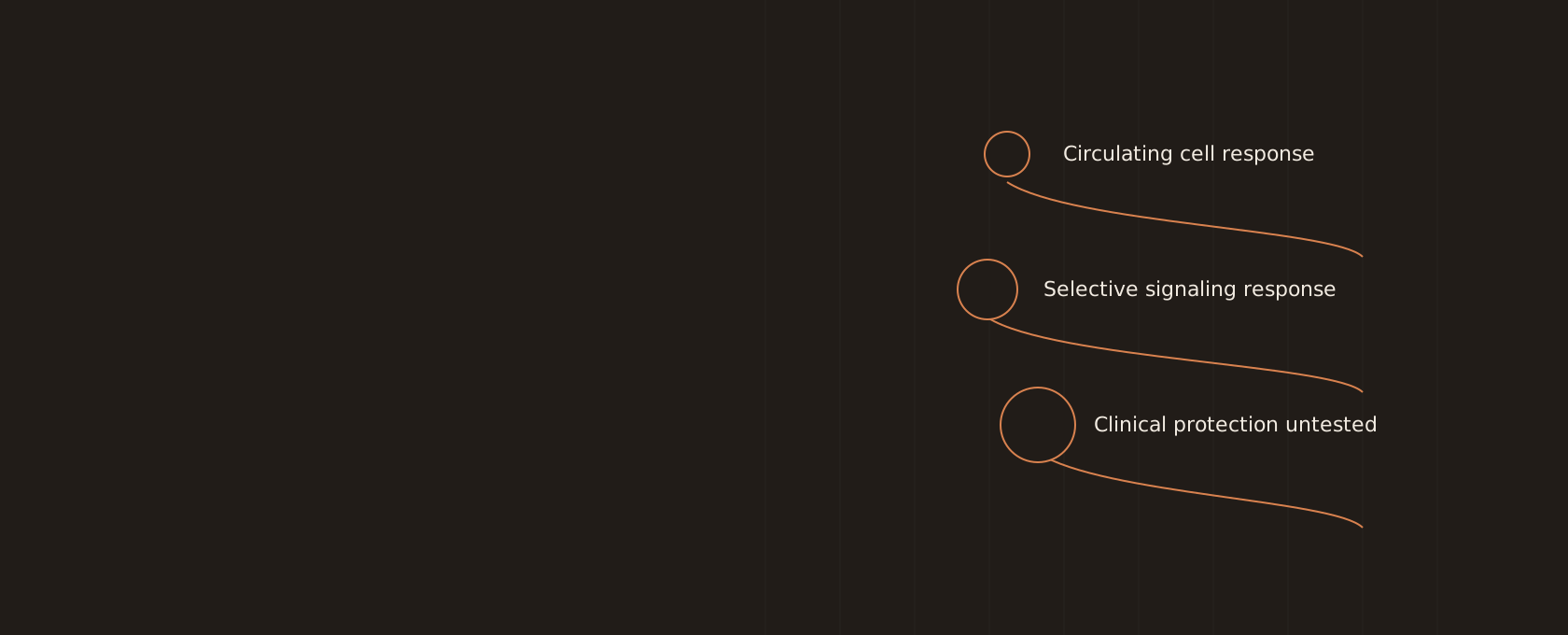
Not automatically. The source studies can show that a measured blood response occurred without establishing that participants later experienced fewer infections. Immune response is a broad description covering different cells, signals and functions. An acute laboratory shift is not a complete clinical measure of protection.
The distinction matters because a higher count or a statistically detectable change can be presented as a straightforward benefit. The studies discussed here ask narrower questions: what changes around a visit, how timing affects the result and whether participant background changes the pattern. Those are useful scientific questions in their own right.
This page assigns C to the emerging physiological evidence. It does not assign that grade to a confirmed infection-prevention program. The appropriate answer retains the laboratory signal while identifying the missing clinical endpoint, rather than declaring that every immune measurement improved or that every response was absent.
What can a circulating immune-cell count establish?
It describes the population present in the sampled blood under the measurement conditions. The acute Finnish-sauna experiment reported broader changes in circulating cells than cytokines. That is a finding about a measured compartment, not proof that the entire immune system became more effective.
The source uses cell mobilization to describe the response. This should not be rewritten as permanent immune enhancement, new protective-cell production or improved pathogen control. Those statements would add biological and clinical conclusions not directly measured. A reader should keep the sample and timing attached to the count.
This precision also prevents a universal good-versus-bad interpretation of direction. An increased circulating count is not automatically a health improvement, while a return toward baseline is not automatically a loss of benefit. The question is what the response represents and predicts, which requires evidence beyond its appearance in one blood sample.
Did cytokines change as broadly as the cell counts?
No. The acute experiment found more selective cytokine responses than the broader cell changes. A cytokine is a signaling measurement rather than a cell count, and the paper did not show one uniform response across all signals. This page does not attach unregistered numerical effects to individual markers.
A selective pattern should remain selective when the paper is summarized. Describing global immune activation would conceal the different outcomes. It would also leave unanswered whether the measured signal has an established functional or clinical meaning in this setting.
Correlations between temperature and some signals can help form hypotheses, but they do not by themselves demonstrate that a pathway caused better health. The source can motivate mechanistic investigation without completing the sequence from heating through a laboratory response to infection prevention. The difference between those stages is part of the finding’s practical meaning, not an optional disclaimer.
Why does recovery sampling change the apparent result?
Some immediate cell changes moved back toward baseline during the brief recovery period, while other populations remained elevated. A sample taken only at the end of heating would therefore not describe everything the experiment observed. Timing changes the response a reader sees.
This is a concrete reason not to call an acute shift a permanent change in immune capacity. A measured difference persisting into short recovery is still different from an adaptation demonstrated between visits over a longer program. Neither observation would automatically establish fewer illnesses.
When papers are compared, their sampling windows need to be aligned before their directions are treated as agreement or disagreement. A measurement after the final bath of a series asks another question from a measurement during recovery from one visit. A shared post-sauna label is insufficient to make them equivalent.
What do trained-versus-untrained men add to the question?
A small study compared immune-related measurements around an initial and later bath in trained and untrained men. Some responses differed by participant background or timing. Those details argue against a universal immune response identical for all users.
The groups were existing training categories, not an experiment assigning a long-term training history. A difference between them therefore cannot show that training alone caused the response or that either pattern is clinically preferable. The source also did not count infections as an outcome.
The study’s title includes HSP70, but a method listing an assay does not supply an unreported protein result. Its abstract does not give a clear directional HSP70 finding to support a general increase claim. This is another reminder that measured variables and demonstrated results must be separated, even when a broad concluding interpretation sounds more confident than the individual endpoints.
Do controlled cytokine measurements give a simple immune-benefit answer?
A randomized-order crossover study in healthy middle-aged and older adults compared different sauna patterns with a seated time control. CRP did not change, while selected cytokine responses depended on the marker and exposure pattern. This controlled experiment adds a more direct acute comparison without establishing a clinical immune benefit.
The result is not simply lower inflammation or a uniform improvement in defenses. Different signals behaved differently. A summary should identify the measured marker and the sampling interval before assigning a broad meaning.
The participant group and tested conditions also differ from the acute cell-mobilization study. The papers can contribute to a common physiological discussion without being interchangeable replications. Together, they show why the term immune response needs more detail: a cell count, a cytokine concentration and CRP are different measurements, and an observed response is not the same endpoint as protection from illness.
What does the exercise-plus-sauna pilot contribute?
A randomized pilot in young men compared cycling alone with the same exercise program followed by sauna. It did not detect an added effect on selected gut measurements or high-sensitivity CRP. That is an important null comparison for the particular added-program claim.
It does not prove that every immune-related response is exactly zero. A small study of selected outcomes leaves uncertainty, and its endpoints do not cover the whole immune system. Equally, the possibility of another unmeasured response is not evidence that a useful benefit occurred.
The direct lesson is about attribution. An outcome changing during a combined exercise-and-sauna program cannot automatically be credited to the sauna component. An appropriate exercise-only comparison helps identify what was added. This distinction limits claims based on an appealing overall wellness program rather than on the actual endpoint and between-group result.
Can a pneumonia association validate the cell mechanism?
The pneumonia cohort associated existing sauna frequency with later hospital diagnoses. That is a clinical outcome, but exposure was not assigned and the study did not experimentally connect an acute cell change to the observed diagnosis association. Placing the two findings beside each other does not complete a causal pathway.
The cohort also represents a particular male Finnish population and frequency comparison. It cannot supply a universal infection effect for every modality or person. Statistical adjustment does not turn the observed habits into a prescribed prevention program.
The sources therefore contribute different questions. Acute physiology can suggest a mechanism worth testing; a cohort can identify an association with an outcome. Evidence connecting them requires an appropriate design and analysis, not an assumption that a plausible explanation has already been demonstrated. This page retains the clinical context without borrowing it to validate a laboratory marker as a personal protection score.
| Evidence level | What was assessed | Missing clinical inference |
|---|---|---|
| Acute blood experiment | Cell populations and cytokines around a visit | Fewer subsequent infections |
| Repeated trained-group study | Selected markers at different stages | A universal immune benefit |
| Exercise-adjunct pilot | Selected changes beyond cycling alone | Improved whole-system immunity |
| Habitual pneumonia cohort | Existing habits and later diagnoses | Experimental mediation by cell mobilization |
What does the common-cold experiment say about illness claims?
The randomized common-cold trial compared inhaling hot dry air with room-temperature dry air within a sauna setting. Its main overall symptom-severity result was not significantly different. Isolated secondary findings did not establish an overall symptom benefit.
That comparison addresses a different question from established habits before a later pneumonia diagnosis. It also does not directly measure the acute immune-cell pattern. The useful synthesis keeps these distinctions instead of combining every respiratory topic into one claim of stronger resistance.
There is no recommendation here to use heat during illness. An observed marker response is not evidence that sauna improves an ongoing episode, and the overall symptom trial does not supply such a positive result. A person with symptoms or a condition needs the appropriate clinical discussion rather than an exposure routine inferred from a laboratory mechanism.
Is there an established immune-enhancing exposure schedule?
The sources do not establish one. An acute before-and-after study, a trained-group series, a controlled marker experiment and an exercise-adjunct pilot have different participants, comparisons and endpoints. Their details cannot be assembled into a validated public immune-health protocol.
A complete intervention claim would need the defined population, whole exposure program, comparator and relevant outcome. More heat, a larger cell count or an accumulated session total is not automatically a better result. None of these studies provides a personal target for maximizing immune activity.
The study explorer can help identify methods and evidence scope, while a planner or heat log organizes assumptions. Those tools do not determine a person’s immunity, validate infection protection or establish the suitability of increasing exposure. The appropriate use of the evidence is to refine the question rather than make an unconfirmed benefit appear precise through a calculation.
What remains separate about safety and source review?
The historical safety review identifies unstable angina, recent myocardial infarction and severe aortic stenosis among contraindications and describes alcohol-related concerns. It is an older narrative source, not a complete eligibility checklist. Discuss relevant conditions and medications with a qualified clinician before interpreting a group result as personal clearance.
This synthesis is based on refreshed indexed abstracts and registered findings. It does not claim a clinical review, completed full-text risk-of-bias assessment or comprehensive appraisal of funding and competing interests. Those financial details remain unreported when the reviewed abstracts did not establish them.
The strongest conclusion remains bounded: sauna can elicit measured cell and signal responses in selected experiments, but the clinical meaning and persistence require their own evidence. Better controlled work with relevant populations and illness outcomes could test protection directly. Until then, an acute immune result should not become a universal health promise, an illness-management plan or a reason to pursue increasingly demanding heat exposure.
Inspect the assumptions
Explore the session planner.
This planning tool describes a routine. It does not estimate a health benefit or provide medical clearance; the study exposures discussed above remain separate research methods.
Interactive workspace
In-memory checkpoint · no medical clearance
Pause for the personal context.
Check every item that applies or that you are unsure about. Current serious symptoms need appropriate care, not a tool result.
Context, with limits
- Checkpoint
- Complete the acknowledgment
A checklist cannot assess every relevant condition. No answer is medical clearance. Responses are in memory only, and are reset on reload.
Calculated on your device. Theme and unit preferences can be stored locally; health answers, weights and logs remain in memory. A shared settings URL contains its visible planning inputs.
Open the complete tool and methodologyExplore the evidence with a tool.
Questions, considered
Questions about this evidence
What endpoint would a claim about stronger infection protection need?
It would need a relevant illness outcome under a suitable comparison, rather than only a blood-cell or signal change. The acute immune experiment measured laboratory responses around exposure. Those observations can guide further research, but they do not show that users developed fewer infections or validate a personal preventive routine.
Follow the sourceCould one immediate blood sample summarize the entire post-sauna immune response?
It would miss the timing distinctions reported in the acute study. Some cell populations moved toward baseline during recovery while others remained elevated. That is why a measurement should retain its sampling occasion. An immediate response cannot be relabeled as permanent immune capacity or used to infer a lasting clinical benefit.
Follow the sourceDoes a training-group difference reveal who gains better immune protection?
The trained-versus-untrained study did not measure that outcome. It observed different laboratory patterns in small groups with existing activity backgrounds. Training was not randomly assigned, and a response magnitude is not a clinical ranking. The comparison therefore cannot identify whose sauna use provides superior protection from illness.
Follow the sourceWhy can unchanged CRP coexist with other immune-related changes?
CRP, cytokines and circulating cell counts are different measurements. The controlled marker study found selective cytokine responses without a CRP change, while another experiment examined broader cell mobilization. The results should remain specific to their endpoints and timing rather than being treated as one interchangeable immune score.
Follow the sourceDoes the pneumonia cohort prove that acute cell mobilization is protective?
It does not experimentally connect those findings. The cohort related existing habits to later diagnoses, while the acute study assessed blood changes around a visit. A plausible link is a research hypothesis, not demonstrated mediation. Both sources can be informative without turning the marker into a validated personal protection test.
Follow the sourceCan a heat log confirm that an immune goal has been reached?
A log records exposure assumptions or visits; these studies did not validate it as an immune-function or infection-protection measure. Accumulated time is not a demonstrated biological target. The clinical meaning of a laboratory response and the suitability of an intended routine remain separate from what a planning tool can record.
Follow the sourceFollow the evidence
Sources & references
Research summaries in this edition are based on indexed abstracts unless otherwise noted. A source link is not a claim of medical review.
- Acute Finnish sauna heat exposure induces stronger immune cell than cytokine responses.
Heinonen IHA, Koivula T, Hollmén M, Immonen J, Kunutsor SK, Jalkanen S, Laukkanen JA
Volume 13, issue 2, pages 186-199 · PMID 42282896
Open-access flag: yes.Abstract-level editorial review - The effects of a single and a series of Finnish sauna sessions on the immune response and HSP-70 levels in trained and untrained men.
Pilch W, Szarek M, Olga CL, Anna P, Żychowska M, Ewa SK, Andraščíková Š, Pałka T
Volume 40, issue 1, pages 2179672 · PMID 36813265
Open-access flag: not recorded.Abstract-level editorial review - Impact of Finnish sauna bathing on circulating markers of inflammation in healthy middle-aged and older adults: A crossover study.
Behzadi P, Gravel H, Neagoe PE, Barry H, Sirois MG, Gagnon D
Volume 52, pages 102486 · PMID 32951736
Open-access flag: not recorded.Abstract-level editorial review - No effects of a 4-week post-exercise sauna bathing on targeted gut microbiota and intestinal barrier function, and hsCRP in healthy men: a pilot randomized controlled trial.
Karolkiewicz J, Nieman DC, Cisoń T, Szurkowska J, Gałęcka M, Sitkowski D, Szygula Z
Volume 14, issue 1, pages 107 · PMID 35710395
Open-access flag: yes.Abstract-level editorial review - Frequent sauna bathing may reduce the risk of pneumonia in middle-aged Caucasian men: The KIHD prospective cohort study.
Kunutsor SK, Laukkanen T, Laukkanen JA
Volume 132, pages 161-163 · PMID 29229091
Open-access flag: not recorded.Abstract-level editorial review - Visiting a sauna: does inhaling hot dry air reduce common cold symptoms? A randomised controlled trial.
Pach D, Knöchel B, Lüdtke R, Wruck K, Willich SN, Witt CM
Volume 193, issue 11-12, pages 730-734 · PMID 21143077
Open-access flag: not recorded.Abstract-level editorial review - Benefits and risks of sauna bathing.
Hannuksela ML, Ellahham S
Volume 110, issue 2, pages 118-126 · PMID 11165553
Open-access flag: not recorded.Abstract-level editorial review