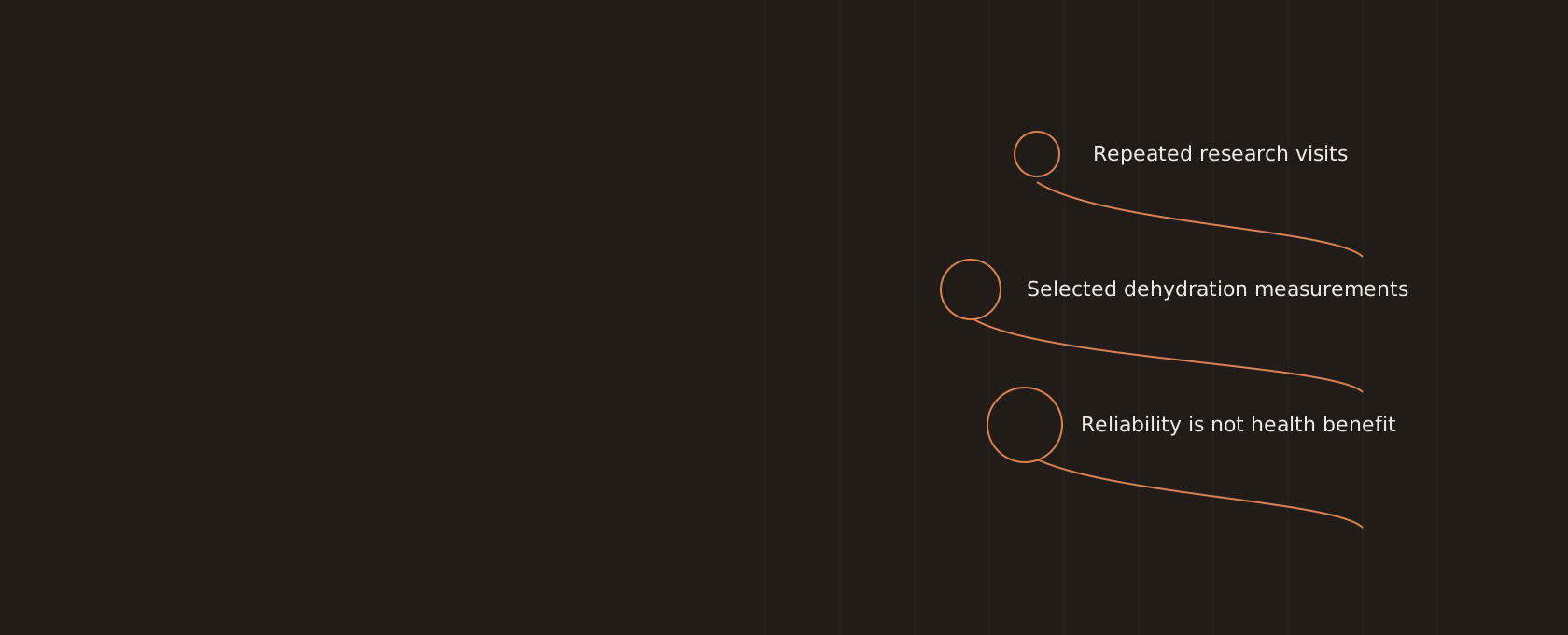
| Study | Design & population | Finding & comparison |
|---|---|---|
| 2025 · Lebron MA ↗ | test-retest experimental reliability study healthy Participants: 15. portable infrared sauna · two trials at least 72 hours apart | The protocol produced repeatable dehydration measurements for laboratory research. Comparison: repeat of the same dehydration protocol Deliberately induced dehydration; not a weight-loss or personal-use protocol. |
| 2021 · Roca Rubio MF ↗ | Randomized-order crossover challenge study Healthy adults Participants: 20. Sauna-induced dehydration · Acute challenge | A deliberately dehydrating sauna challenge increased upper-intestinal permeability and selected inflammatory markers without changes in the reported enterocyte-injury markers. Comparison: NSAID condition and negative control Deliberate substantial dehydration |
| 2019 · Podstawski R ↗ | Acute repeated-exposure physiology study Overweight, sedentary, infrequent sauna users Participants: 45. Dry sauna | Physiological strain increased across repeated exposures and correlated with body size; the observed immediate body-mass decrease does not establish fat loss. Comparison: Repeated exposures and correlations with body size No separate control described |
Original publication: Reliability of achieving target dehydration levels using a portable infrared sauna protocol in healthy young adults.
Was the portable-sauna protocol evaluated as a health program?
No. The experiment evaluated a method for producing and measuring dehydration in a research setting. Its central question was whether selected outcomes were sufficiently reproducible when the procedure was repeated. That is a laboratory-method question, rather than a trial of fat loss, improved recovery or better long-term health.
The source title includes target dehydration levels, which identifies the experimental purpose. Those targets should remain descriptions of the research, not become a public goal. This summary deliberately does not provide a sequence, target loss or timing recipe for recreating the challenge. Its value is to help readers recognize that a measurable and repeatable body-mass change can be the outcome of a stress model without being a beneficial result to pursue. The appropriate distinction is between studying a controlled challenge and recommending a routine.
What did repeating the same procedure contribute?
Participants completed separate visits using the same general laboratory procedure. A test-retest structure allows researchers to assess how consistently selected measurements behave across occasions. The same person’s repeated data can help characterize variability in a research method.
Repeatability does not mean that every recorded outcome must be numerically identical. It also does not answer whether another laboratory, device, population or set of operating conditions would produce the same pattern. Those would require additional comparisons. The abstract provides evidence about the studied procedure rather than a universal certification of every portable infrared sauna. A reader should therefore retain the device and setting as part of the result. Reproducibility within the experiment is useful methodological information, but it is narrower than a general claim that portable heat produces predictable personal physiological responses wherever it is used.
Is a reliable measurement necessarily beneficial?
No. Reliability concerns consistency, not whether the measured state is desirable. A research procedure can create repeatable fluid loss without demonstrating improved health, fitness or recovery. That distinction is especially important when the measured outcome is intentionally induced dehydration.
A related concept is validity: whether a measurement answers the question for which it is being used. Even a consistent body-mass measurement cannot become a valid measure of fat reduction merely because it changes repeatably. The source did not test that interpretation. It evaluated a dehydration method. Moving from that purpose to a weight-management promise changes the scientific question and requires new evidence. This source is useful precisely because it makes the purpose explicit, allowing a careful reader to identify the inappropriate leap before a reproducible laboratory outcome is advertised as a practical wellness benefit.
Who does the reliability evidence represent?
The sample consisted of healthy young adults and included women and men. It provides data from those participants under research conditions, rather than an individualized prediction for every user. Representation of both sexes does not itself establish a precise estimate for every subgroup or life stage.
The study also does not provide clinical clearance for a person with an illness or medication concern. Healthy volunteers and a defined research procedure are not interchangeable with unsupervised home use. Differences in familiarity, health and operating conditions can affect how closely a real situation resembles the experiment. This summary does not invent a general safe limit from the sample or convert its selection criteria into a complete screening checklist. The population description supports applicability assessment; it does not replace a separate clinical discussion about whether a particular person should use heat.
Does the scale change identify tissue loss?
The experiment deliberately used dehydration to produce body-mass loss. That makes the outcome distinct from a demonstration that body fat decreased. A scale records overall mass; the paper’s experimental purpose does not convert a short-term change in that measure into sustained tissue reduction.
The distinction also limits athletic interpretation. Reliability of a fluid-loss method is not evidence that making weight this way improves performance or recovery. The source did not validate a personal weight-cutting strategy, and this page does not supply one. A reader looking for lasting body-composition change should seek an appropriate study with relevant follow-up and endpoints. The present method may support a laboratory’s ability to study a challenge, while leaving the effectiveness and safety of a proposed public use unestablished.
How do other sauna challenge studies clarify the boundary?
A separate randomized-order challenge study examined intestinal-barrier responses during deliberate sauna dehydration. It reported increased upper-intestinal permeability and selected inflammatory signals without changes in the reported enterocyte-injury markers. That illustrates a different research purpose again: creating a physiological stress model to test measurements.
An acute study in sedentary overweight men likewise observed an immediate mass decrease with rising strain, rather than a lasting fat-loss outcome. Neither source should be folded into a general claim that inducing more fluid loss is useful. The studies contribute to understanding methods and responses under their own conditions. Their shared use of sauna does not make their endpoints interchangeable or their exposures suitable for a reader to combine into a personal plan. Purpose, comparator, measurement and population define the actual contribution of each report.
What conclusion is proportionate to the abstract?
The grade is C for source-specific experimental evidence about a laboratory method in a small healthy sample. The registered result supports repeatable dehydration measurements in the tested setting. It does not establish a general health benefit, uniform individual response or a personal exposure threshold.
This appraisal reviewed the indexed abstract and refreshed bibliographic record. Detailed measurement procedures, complete statistical assumptions, full-text risk of bias and all funding or competing-interest disclosures were not assessed. The abstract’s reliability terminology should therefore not be expanded into a stronger certification than the observed outcomes support. Financial details remain unreported here rather than presumed absent. The appropriate practical takeaway is to recognize a research-method study as such. Readers should not use its existence as permission to chase dehydration, substitute a scale target for clinical advice or infer a weight-management benefit that the experiment did not test.
Explore the evidence with a tool.
Questions, considered
Questions about this study
Was the portable-infrared reliability study a weight-loss program?
No. It deliberately produced body-mass loss through dehydration to evaluate a research method. That differs from reducing body fat or improving health. Repeatability does not convert the protocol into a recommended sauna routine, athletic weight-cutting strategy or approach to long-term weight management.
Follow the sourceWhat did test-retest reliability mean in the portable-sauna experiment?
Participants repeated the same dehydration procedure on separate visits, and researchers examined how consistently selected measurements behaved. Reliability concerns reproducibility, rather than whether the exposure is beneficial. A method can create repeatable fluid loss without demonstrating improved recovery, fitness, hydration practices or safety during ordinary sauna use.
Follow the sourceWhy should the portable-sauna dehydration thresholds remain research descriptions?
The thresholds were part of an experiment in healthy young adults designed to produce fluid loss. They were not individualized limits for public sauna users or patients. Copying those targets would change a measurement study into personal prescribing, which the reported reliability results do not justify.
Follow the sourceFollow the evidence
Sources & references
Research summaries in this edition are based on indexed abstracts unless otherwise noted. A source link is not a claim of medical review.
- Reliability of achieving target dehydration levels using a portable infrared sauna protocol in healthy young adults.
Lebron MA, Fukuda DH, Cregan JT, Shell JM, Wells AJ, Stout JR
Volume 22, issue 1, pages 2586598 · PMID 41320841
Open-access flag: yes.Abstract-level editorial review - Sauna dehydration as a new physiological challenge model for intestinal barrier function.
Roca Rubio MF, Eriksson U, Brummer RJ, König J
Volume 11, issue 1, pages 15514 · PMID 34330970
Open-access flag: yes.Abstract-level editorial review - Correlations between Repeated Use of Dry Sauna for 4 x 10 Minutes, Physiological Parameters, Anthropometric Features, and Body Composition in Young Sedentary and Overweight Men: Health Implications.
Podstawski R, Borysławski K, Clark CCT, Choszcz D, Finn KJ, Gronek P
Volume 2019, pages 7535140 · PMID 30800676
Open-access flag: yes.Abstract-level editorial review - Benefits and risks of sauna bathing.
Hannuksela ML, Ellahham S
Volume 110, issue 2, pages 118-126 · PMID 11165553
Open-access flag: not recorded.Abstract-level editorial review