| Study | Design & population | Finding & comparison |
|---|---|---|
| 2023 · Kunutsor SK ↗ | cross-sectional and prospective cohort analysis normal kidney function at baseline Participants: 2071. habitual sauna bathing | Frequent bathing was not significantly associated with incident chronic kidney disease in this cohort. Comparison: highest versus reference frequency Normal baseline renal function; observational male cohort; not dialysis safety evidence. |
| 2018 · Laukkanen T ↗ | Single-session experimental before-after study At least one cardiovascular risk factor Participants: 102. Sauna | Blood pressure and pulse-wave velocity fell after exposure, but the study did not establish durable changes or fewer cardiovascular events. Comparison: Before, immediately after and recovery No unheated comparator described |
| 2022 · Maggiani-Aguilera P ↗ | open-label clinical pilot peritoneal dialysis with fluid overload portable sauna · 10 days | Fluid measures changed during the pilot; dizziness and a burn were reported. Comparison: control versus intervention period Small uncontrolled clinical pilot; abstract gives session count, not participant number. |
Original publication: Sauna bathing, renal function and chronic kidney disease: Cross-sectional and longitudinal findings from the KIHD study.
The question joined markers and a later diagnosis
The KIHD analysis examined sauna frequency in relation to renal-function measures and subsequent chronic kidney disease, or CKD. These are related questions but different outcomes. A laboratory comparison at baseline is not the same observation as a later registry diagnosis.
The original title explicitly identifies cross-sectional and longitudinal findings. That design should remain visible beside the result. Participants reported established habits rather than being assigned a kidney intervention. The paper can describe whether those habits were associated with the recorded measures in its selected population. It cannot establish what happens when someone with existing kidney disease begins a new routine or deliberately changes fluid handling. The study’s contribution is a bounded observational renal question, not a universal safety or benefit verdict.
Normal baseline kidney function is an important boundary
Participants were middle-aged men with normal kidney function at entry. That makes the cohort relevant to an association in that starting population, but not direct evidence for dialysis, advanced CKD or a person experiencing an acute kidney problem. Those clinical settings require their own sources and assessment.
The distinction should not be lost because follow-up included CKD. Beginning without a condition and observing later diagnoses is different from intervening in people who already have it. Similarly, a male Finnish setting does not establish identical responses across all populations and heat methods. The accurate claim retains baseline health, observed habits and the outcome source. A reader can find the cohort informative without assuming that its result supplies personal clearance for a different clinical circumstance.
The baseline marker results were not one blanket null
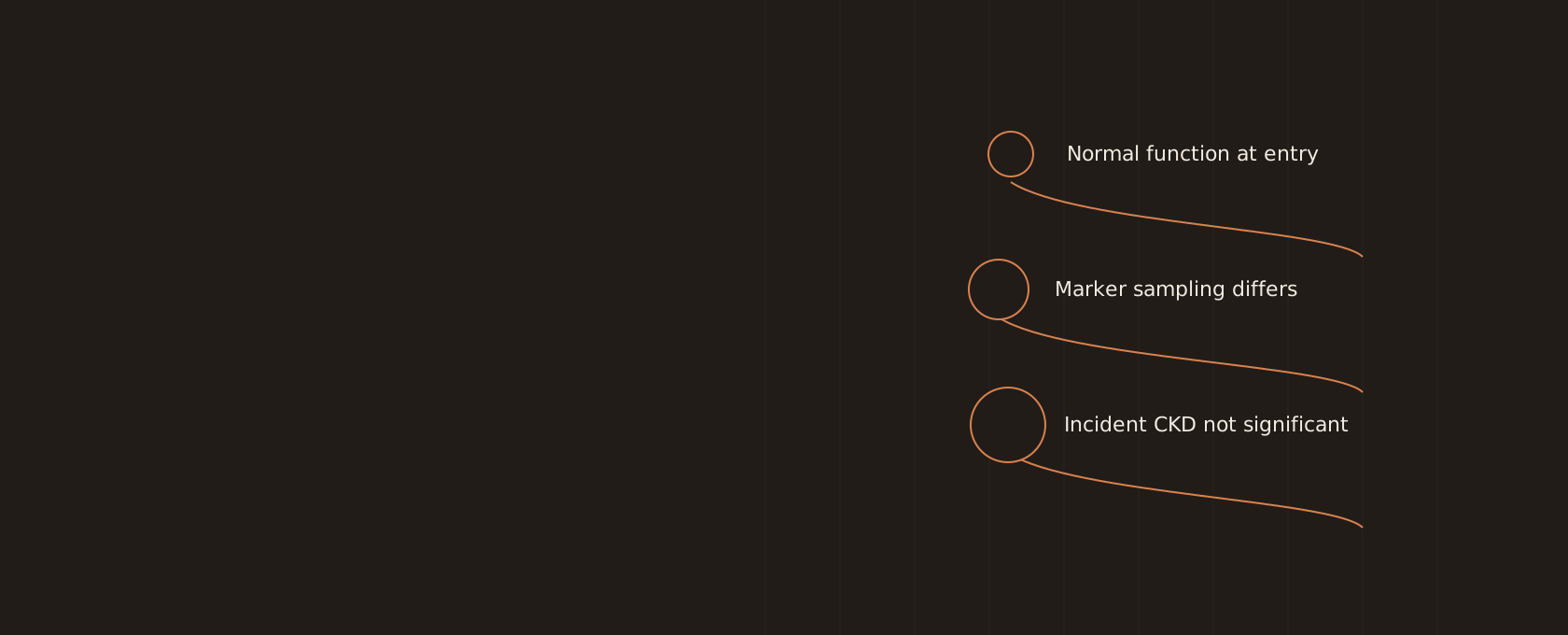
Higher-frequency versus reference sauna use was not significantly related to baseline estimated glomerular filtration rate, creatinine or sodium. The authors reported a slight increase in baseline potassium. This mixed marker pattern should not be summarized as every renal measurement being unchanged or improved.
Estimated filtration, creatinine and electrolytes are distinct measurements. A small group difference in one does not establish a clinical benefit or injury in an individual, and a null comparison in another does not prove exact equivalence. The source did not assign exposure, so baseline associations also remain subject to differences between people with different habits. Keeping the endpoint-specific directions visible is more accurate than using a broad label such as better kidney function.
Repeated laboratory coverage was limited
The abstract describes follow-up potassium and sodium measurements in a random subset because of logistical constraints. It does not describe comprehensive repeated collection of every baseline renal marker in every participant. The later electrolyte comparisons were not statistically significant.
This matters when assessing how much monitoring the cohort provides. A reader should not picture continuous laboratory surveillance simply because the study followed people for a long time. The subset measurements and registry-based CKD outcome answer different questions. Full-text details would be needed to assess selection and missing information more completely. The present appraisal retains the reported data structure rather than filling it in from other KIHD papers or assuming that every renal process was repeatedly measured.
The incident CKD association was not significant
The comparison of frequent sauna use with the reference group did not show a statistically significant association with incident CKD. That result does not demonstrate an assigned preventive benefit, but it also should not be rewritten as proof of a harmful long-term association.
A nonsignificant cohort estimate is not an equivalence test or a personal safety threshold. Precision, diagnostic ascertainment and unmeasured differences remain relevant. The useful conclusion is that this analysis did not establish a clear association in the men studied. It cannot settle every question about a different heat exposure, an acute event or existing kidney disease. A broader clinical claim would require more than the absence of a significant relationship in this particular observational comparison.
An acute laboratory response is not a CKD endpoint
The separate acute cardiovascular experiment reported a slight creatinine increase around sauna exposure, alongside other immediate physiological measurements. Its observation window differs from the cohort’s later CKD diagnosis. A short-term laboratory response should not be equated with a chronic diagnosis or used to erase the cohort result.
The distinction also works in the opposite direction. A null long-term association does not show that no acute stress response can occur. The studies can inform related questions while preserving their timing and design. This summary does not diagnose acute kidney injury from the experimental average. It identifies why a marker measured around heat and a later registry-defined disease require separate interpretation and appropriately matched evidence.
A dialysis pilot does not generalize the cohort result
The portable-sauna fluid-overload pilot involved peritoneal dialysis patients, a different clinical setting from men with normal baseline function. It reported changes in fluid-related measures but also dizziness and a skin burn. The abstract’s session count is not a participant count and should not be presented as one.
That pilot does not establish a general renal-benefit program or authorize copying a fluid-loss procedure. It illustrates why an existing-disease intervention must be evaluated separately from a baseline-normal cohort. This page does not claim that all CKD research has been reviewed or that no other trial exists. Its conclusions concern the selected verified sources and their own endpoints, with clinical applicability limited accordingly.
What this abstract-level appraisal leaves open
The live indexed abstract was checked against the corpus and supplemental qualitative fact. The PubMed entry and DOI identify the original publication. Full-text laboratory methods, diagnosis procedures, missing data, funding and conflicts of interest have not been fully assessed here. Unreported details remain unknown.
The historical safety review provides named cardiac contraindications and alcohol cautions, not comprehensive renal clearance. A person with kidney disease, a fluid-management plan or medication concerns should discuss intended heat exposure with their clinical team. This source summary does not provide hydration, restriction or exposure instructions. Its emerging grade reflects the bounded observational result: several marker comparisons and the CKD association were null, with a small potassium difference and incomplete repeated laboratory coverage retained.
Explore the evidence with a tool.
Questions, considered
Questions about this study
Did the KIHD kidney analysis find a clear chronic-kidney-disease association?
No. The comparison of frequent bathing with the reference frequency did not show a statistically clear association with subsequent chronic kidney disease. This is not proof of benefit or zero risk. The estimate came from an observational male cohort with normal kidney function at baseline.
Follow the sourceDoes the KIHD kidney analysis establish sauna safety for dialysis patients?
No. Participants had normal kidney function at baseline, which differs substantially from dialysis or advanced kidney disease. Their long-term observational outcomes do not resolve fluid restrictions, medication issues or individual heat tolerance in those clinical settings. Applying the findings directly to dialysis would exceed the population studied.
Follow the sourceWere all renal measurements repeatedly collected throughout the cohort?
No. The abstract describes logistical limits on follow-up laboratory measurements, with selected electrolyte measurements available in a subset. The study also used registry-defined chronic kidney disease outcomes. Recognizing those different data sources prevents an inaccurate impression of continuous, comprehensive laboratory monitoring for every participant over follow-up.
Follow the sourceFollow the evidence
Sources & references
Research summaries in this edition are based on indexed abstracts unless otherwise noted. A source link is not a claim of medical review.
- Sauna bathing, renal function and chronic kidney disease: Cross-sectional and longitudinal findings from the KIHD study.
Kunutsor SK, Kauhanen J, Laukkanen JA
Volume 53, issue 8, pages e14001 · PMID 37029766
Open-access flag: not recorded.Abstract-level editorial review - Acute effects of sauna bathing on cardiovascular function.
Laukkanen T, Kunutsor SK, Zaccardi F, Lee E, Willeit P, Khan H, Laukkanen JA
Volume 32, issue 2, pages 129-138 · PMID 29269746
Open-access flag: not recorded.Abstract-level editorial review - Portable sauna stimulated-diaphoresis for the treatment of fluid-overload in peritoneal dialysis patients: A pilot study.
Maggiani-Aguilera P, Chávez-Iñiguez JS, Navarro-Blackaller G, Hernández-Morales K, Geraldo-Ozuna AL, Alcantar-Villín L, Montoya-Montoya O, Luquín-Arellano VH, García-García G
Volume 9, pages 887609 · PMID 36203760
Open-access flag: yes.Abstract-level editorial review - Benefits and risks of sauna bathing.
Hannuksela ML, Ellahham S
Volume 110, issue 2, pages 118-126 · PMID 11165553
Open-access flag: not recorded.Abstract-level editorial review