| Study | Design & population | Finding & comparison |
|---|---|---|
| 2018 · Laukkanen T ↗ | Single-session experimental before-after study At least one cardiovascular risk factor Participants: 102. Sauna | Blood pressure and pulse-wave velocity fell after exposure, but the study did not establish durable changes or fewer cardiovascular events. Comparison: Before, immediately after and recovery No unheated comparator described |
| 2018 · Lee E ↗ | nonrandomized acute experimental study Asymptomatic adults with cardiovascular risk factors Participants: 102. Finnish sauna · Acute plus 30-minute recovery | Pressure-wave speed and blood pressure fell immediately after exposure; some changes persisted during the short recovery observation. Comparison: Within-person pre-exposure measurement No randomized comparison |
| 2019 · Gravel H ↗ | Randomized crossover physiology trial Healthy middle-aged and older adults Participants: 21. Finnish sauna | Neither sauna pattern significantly improved the measured flow-mediated dilation or reactive-hyperemia endpoints acutely. Comparison: Seated time control Small healthy sample |
Original publication: Acute effects of sauna bathing on cardiovascular function.
The original question was about measured responses
The investigators asked whether cardiovascular measurements and blood-based markers changed around a single sauna session. This is a physiological experiment, not a long-term prevention cohort. Its title, Acute effects of sauna bathing on cardiovascular function, signals the time scale that should remain attached to every result discussed here.
An acute response can help generate a mechanism worth testing. It cannot by itself show that an artery has undergone lasting structural improvement or that a future event has become less likely. The practical reading task is to identify which measurements changed, when they were taken and what comparison supports attribution to heat. Those details determine what the experiment contributes to the larger sauna literature, rather than a general expectation that every favorable number reflects a durable health benefit.
Participants and the exposure setting
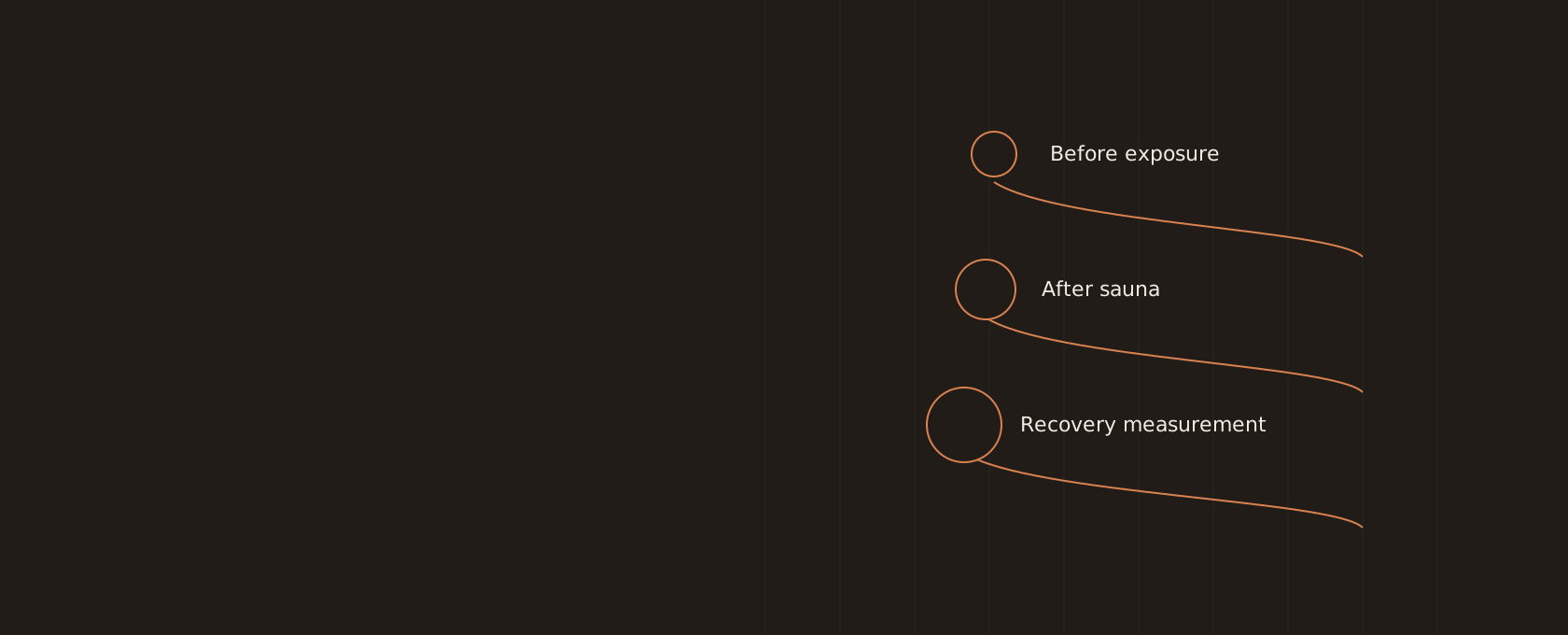
Participants had at least one cardiovascular risk factor, so the sample was neither a survey of the entire population nor a group selected for an unstable cardiac presentation. The corpus records a single sauna exposure with measurements before exposure, immediately afterward and during recovery. This sequence makes the within-person time course central to the paper.
The exposure is a description of what researchers tested. It is not a recommendation that a reader reproduce the session, particularly when their heat tolerance, medications or clinical status differ. An experimental protocol can be useful for interpreting a result without being suitable for unsupervised adoption. In this summary the retained conclusion is qualitative, avoiding extra numerical biomarker claims that have not been separately entered in the site’s verified fact registry.
What changed after sauna
The recorded pattern was lower blood pressure and pulse-wave velocity after exposure. Pulse-wave velocity measures how quickly a pressure wave travels along an arterial path; it is used as a marker related to arterial stiffness. A lower measurement under these immediate conditions is therefore a relevant physiological observation.
However, the term stiffness can suggest a fixed property when the measured response may depend on current pressure and vascular conditions. The study does not demonstrate permanent remodeling. Nor does observing lower pressure after a session establish better pressure control throughout ordinary days and nights. Those distinctions keep the result useful: the paper describes changes around heat exposure and recovery, while questions about persistence and clinical significance remain open for studies designed to address them.
Why the missing unheated comparison matters
The abstract describes no unheated comparator. A before-and-after sequence shows that measurements differ across time, but time around a sauna session includes more than heat alone. Rest, repeat testing and the circumstances of recovery can also affect an observed measurement. Without a comparison that follows similar timing without heating, the entire change cannot automatically be assigned to sauna.
This limitation does not erase the measured pattern. It changes the strength of the causal statement that follows from it. A well-matched control condition would help estimate what would have happened over the same period without exposure. Randomization would address a further question about allocation. Treating those design elements separately is more informative than labeling the study simply positive or negative and losing the reasons for uncertainty.
The arterial-compliance paper may overlap
A related publication examined arterial compliance and hemodynamics in a similarly described acute sauna experiment. Its population and exposure characteristics are sufficiently close that participant overlap requires full-text confirmation. This appraisal therefore does not count the two papers as independent replications of an acute vascular response.
Separate articles can legitimately answer different questions from the same experiment. One may focus on blood-based markers alongside vascular measurements while another examines the dynamics of pressure and flow. Their combined contribution is broader measurement coverage, not necessarily a second group confirming the first. An evidence table should flag the unresolved overlap and identify the publication-level difference. Counting every paper as an independent experiment would make a small research base look more replicated than the available record justifies.
A controlled vascular experiment provides a useful contrast
A separate randomized crossover experiment in healthy middle-aged and older adults compared sauna patterns with seated rest and found no significant acute improvement in the measured flow-mediated dilation or reactive-hyperemia endpoints. Those are different tests from pulse-wave velocity, so the findings should not be framed as a direct contradiction over one identical outcome.
The comparison instead demonstrates why endpoint and control design matter. A favorable pressure-wave response does not require every endothelial test to improve. Likewise, a null endothelial result does not prove that no physiological response occurred. Organizing the literature by actual measurement, population and timing prevents a broad phrase such as vascular health from smoothing away important differences between experiments.
How to use this paper in a larger argument
The study belongs in a discussion of plausible short-term cardiovascular responses to sauna. It is less suited as the central citation for claims about long-term disease prevention. To connect an immediate marker change with a durable health outcome, research would need to establish persistence, relevance of the marker and an effect on outcomes important to patients.
A useful reading exercise is to write the conclusion with its time stamp intact: a measurement was lower after the tested session in this sample. If removing the time phrase makes the claim sound stronger, that phrase is doing necessary scientific work. The emerging evidence grade reflects this narrow contribution. It does not mean the experiment is uninformative; it means the uncertainty concerns design and translation beyond the observed window.
Source access and the personal safety boundary
This summary is based on the live indexed abstract and the stored verified interpretation. The publication is linked through PubMed and its DOI. The full methods, detailed biochemical analyses, funding and competing-interest declarations have not been audited from full text here. Where those details are not in the reviewed material, no assertion about them is made.
Personal safety should not be inferred from the direction of a post-session measurement. The cited narrative safety review names unstable angina, recent myocardial infarction and severe aortic stenosis as contraindications and warns about alcohol. It is a source of specific cautions rather than an exhaustive screening instrument. A person with medical conditions or medications should discuss intended exposure with a qualified clinician rather than using this experimental result as clearance.
Explore the evidence with a tool.
Questions, considered
Questions about this study
Did PMID 29269746 find immediate changes in arterial stiffness and blood pressure?
Yes. The measured pulse-wave velocity and blood pressure were lower after the single sauna exposure than before it. These are acute within-person findings. They should not be presented as proof of permanently less stiff arteries, sustained hypertension control or fewer future cardiovascular events.
Follow the sourceWhy is a control condition important for interpreting the acute cardiovascular study?
A before-and-after comparison cannot fully separate heat effects from resting time, repeat measurement or other features of the session. The abstract describes no unheated comparison group. That does not make the observations uninformative, but it limits how confidently the entire measured change can be attributed specifically to sauna.
Follow the sourceShould the acute cardiovascular paper count as an independent replication of every related biomarker report?
Not automatically. Related publications can analyze different measurements from overlapping participant groups. The abstract alone does not settle overlap, so the corpus flags that question for full-text checking. Counting papers and counting independent cohorts are different tasks, and evidence summaries should make the distinction explicit.
Follow the sourceFollow the evidence
Sources & references
Research summaries in this edition are based on indexed abstracts unless otherwise noted. A source link is not a claim of medical review.
- Acute effects of sauna bathing on cardiovascular function.
Laukkanen T, Kunutsor SK, Zaccardi F, Lee E, Willeit P, Khan H, Laukkanen JA
Volume 32, issue 2, pages 129-138 · PMID 29269746
Open-access flag: not recorded.Abstract-level editorial review - Sauna exposure leads to improved arterial compliance: Findings from a non-randomised experimental study.
Lee E, Laukkanen T, Kunutsor SK, Khan H, Willeit P, Zaccardi F, Laukkanen JA
Volume 25, issue 2, pages 130-138 · PMID 29048215
Open-access flag: not recorded.Abstract-level editorial review - Acute effect of Finnish sauna bathing on brachial artery flow-mediated dilation and reactive hyperemia in healthy middle-aged and older adults.
Gravel H, Coombs GB, Behzadi P, Marcoux-Clément V, Barry H, Juneau M, Nigam A, Gagnon D
Volume 7, issue 13, pages e14166 · PMID 31293098
Open-access flag: yes.Abstract-level editorial review - Benefits and risks of sauna bathing.
Hannuksela ML, Ellahham S
Volume 110, issue 2, pages 118-126 · PMID 11165553
Open-access flag: not recorded.Abstract-level editorial review