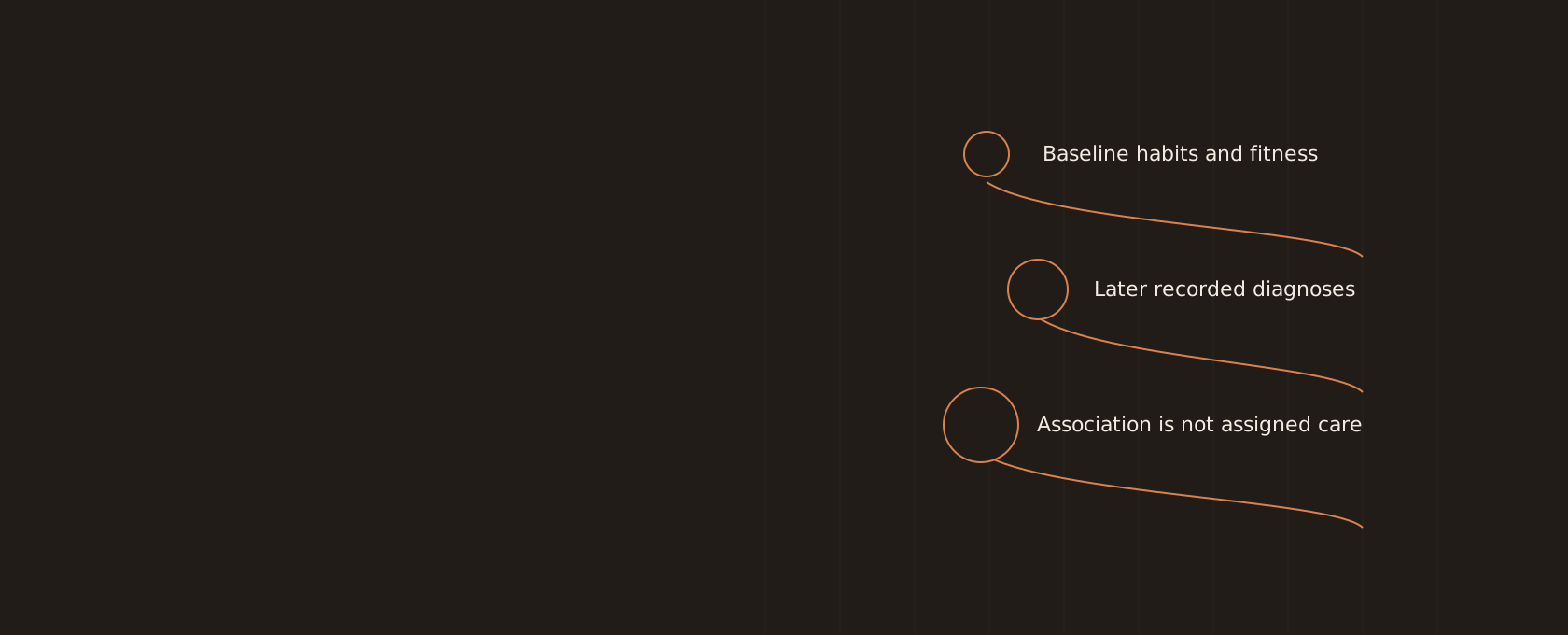
| Study | Design & population | Finding & comparison |
|---|---|---|
| 2018 · Laukkanen T ↗ | prospective cohort No history of psychotic disorders Participants: 2138. habitual sauna | The highest-frequency category had lower recorded psychotic-disorder hazard after adjustment; a preventive mental-health intervention was not tested. Comparison: Once-weekly sauna Observational |
| 2024 · Kunutsor SK ↗ | prospective cohort analysis no psychosis history at baseline Participants: 2221. habitual sauna bathing | Higher sauna frequency was associated with lower psychosis incidence after adjustment including fitness. Comparison: low versus high sauna frequency and fitness categories Observational exposure; residual confounding; male cohort; not prevention evidence. |
| 2017 · Laukkanen T ↗ | prospective cohort Apparently healthy at enrollment Participants: 2315. habitual sauna | For 4–7 versus 1 session weekly, adjusted HRs were 0.34 (95% CI 0.16–0.71) for dementia and 0.35 (0.14–0.90) for Alzheimer disease. Results describe observed habits in Finnish men, not randomized prevention. Comparison: Once-weekly sauna Shared KIHD cohort with other reports |
Did the studies establish psychiatric prevention with sauna?
No assigned psychiatric prevention program was tested. The direct sources observed sauna habits in men without a history of psychosis and related those baseline characteristics to later recorded disorders. They reported lower estimated incidence in some higher-frequency comparisons, which is an association rather than an intervention result.
The distinction is especially important for a mental-health topic. A population finding cannot determine whether sauna is suitable for an individual, establish a clinical diagnosis or justify changing prescribed care. This guide preserves the reported signal without presenting it as a personal strategy. The research can motivate more precise questions while leaving prevention, care for existing illness and the consequences of starting a routine unresolved.
What outcome did the papers actually record?
The source category was recorded psychotic disorders during follow-up. It should not be replaced with a general promise about mental wellbeing, every psychiatric diagnosis or everyday mood. A named clinical endpoint and a pleasant reported sauna experience are different kinds of evidence.
A full appraisal would inspect the detailed ascertainment and diagnostic definitions before describing every condition within that category. This abstract-level guide does not invent subtype estimates or assume an identical association for all diagnostic groups. It also does not translate an incident-outcome finding into evidence about managing symptoms after a diagnosis. The endpoint, observation period and baseline history need to remain attached before a practical interpretation is attempted.
Who entered the earlier cohort analysis?
The earlier analysis included 2,138 men aged 42–61 years with no history of psychotic disorders at baseline. Their sauna habits were assessed within the Kuopio Ischemic Heart Disease framework. The exclusion of prior illness defines an incident-outcome question rather than a trial addressing an established clinical condition.
The male population and baseline selection also limit transfer. The analysis does not establish the same finding in women, every age group or people with different medical circumstances. A cohort result should retain those features even when an adjusted association is strong. Long follow-up cannot retrospectively broaden enrollment or make the participants equivalent to every reader considering a sauna routine.
Why do the two frequency definitions need separate labels?
The earlier study used once-weekly sauna as its main reference. The later fitness-related analysis instead grouped lower and higher frequency using different cutoffs. Those are different analytical comparisons, not interchangeable descriptions of one universal dose.
They also are not randomized comparisons with never using sauna. Existing habitual users can differ in health, resources, activity or other circumstances that influence both use and later outcomes. A summary that changes the reference to nonuse or presents a category as an assigned schedule changes the question. This guide therefore does not select a personal target by combining the most favorable labels across the papers. The study-specific definitions belong beside each reported association.
Did adjustment turn the earlier signal into a causal effect?
The highest-frequency group had a lower recorded psychotic-disorder hazard after adjustment in the earlier analysis. The registered result does not mean that every relevant difference was measured, accurately recorded or fully addressed by the model. Adjustment can investigate confounding without eliminating it.
The possibility of reverse causality also deserves attention: health-related circumstances before a recorded diagnosis could influence habitual participation. This is an appraisal concern, not a claim that it explains the entire association. The appropriate conclusion keeps the lower estimate and the causal uncertainty together. It does not manufacture an absolute personal benefit or infer what would happen if an individual changed frequency next week.
What did measured fitness add in the later analysis?
The later paper included 2,221 men without psychosis history and assessed cardiorespiratory fitness using respiratory gas analysis. Higher sauna frequency remained associated with lower recorded psychosis incidence after accounting for fitness. That is useful evidence about a measured characteristic considered alongside the habit.
It does not make sauna or fitness an assigned intervention. The study cannot show that a reader can substitute heat for exercise, or that changing either reproduces the whole association. Measurement quality and causal allocation are different questions. Fitness was more informative than an assumed lifestyle label, while residual confounding, selection and the consequences of changing habits remained unresolved.
Can joint fitness categories identify an optimal prevention strategy?
A joint analysis compares combinations of existing characteristics. The later source examined sauna frequency alongside fitness categories, but that is not a clinical program assigning people to exercise, sauna or both. A favorable combination does not isolate the extra contribution of each component under an intervention.
The reference category and uncertainty should therefore remain visible, rather than selecting a single joint estimate as a personal target. A direct comparison among otherwise comparable assigned programs would answer a different question. These observational categories are useful for understanding patterns and planning research, not for prescribing a psychiatric prevention routine or ranking which individual should pursue more heat.
| Research feature | What it contributes | Unsupported extension |
|---|---|---|
| Incident psychotic-disorder cohort | Association with existing habits | Management of an established diagnosis |
| Fitness-adjusted analysis | A measured characteristic considered | Randomized exercise or sauna effect |
| Joint categories | Observed profile comparisons | An optimal personal prevention program |
| Other brain-outcome cohorts | Different diagnostic context | Direct psychosis replication |
Do two publication titles establish two independent confirmations?
The reports concern related cohort research and different analyses of baseline habits and later diagnoses. Independence of participants and observations needs checking in the complete methods before the papers are counted as separate populations reproducing one result. Different sample sizes or follow-up choices do not by themselves establish independence.
The earlier source names KIHD, a framework also used in several sauna papers. A new analytical question can add information without recruiting an entirely new population. This guide therefore describes related observational analyses rather than presenting the bibliography as multiple independent prevention trials. The difference between an additional paper and additional independent people is part of an honest evidence count.
Do dementia findings confirm a psychosis result?
They do not directly replicate it. The dementia cohorts examined different diagnoses, exposure definitions and populations. Their associations can provide broader brain-outcome context without supplying another psychotic-disorder comparison or a clinical mechanism for the observed signal.
One dementia paper uses the male KIHD setting, while the other follows a broader Finnish population cohort. These differences matter before counting overlap or agreement. A favorable finding about one diagnosis should not be transferred to another simply because both involve brain health. The sources need their actual outcome and design attached, with psychiatric prevention, cognitive disease and everyday performance remaining separate research questions.
Can a general sauna review explain the psychiatric association?
A narrative review can organize proposed mechanisms and uncertainties across different topics. It does not add a new psychosis trial or demonstrate that one biological pathway caused the cohort association. Plausibility remains distinct from a measured causal sequence.
The review’s mixed designs and older search context also prevent it from serving as current comprehensive confirmation of every mental-health claim. It is cited here as context, not as a substitute for direct outcome evidence. A stronger explanation would require appropriate exposure, intermediate and clinical measurements under a defensible comparison. The sources reviewed do not complete that chain or validate a psychiatric use of a home sauna device.
What can a person with an existing diagnosis infer?
These analyses did not test symptom management in people already diagnosed at baseline. They cannot establish how a particular clinical condition would respond, determine individual suitability or justify reducing medication or other prescribed care. The incident-outcome selection must not disappear when a broad headline is applied to an existing illness.
A qualified clinician familiar with the person is the appropriate source for clinical assessment and discussion of intended heat exposure. The historical safety review provides limited general cautions but is not a psychiatric clearance process. The scientific finding can be discussed as an association, with care decisions kept separate from the habit categories used in a population model.
Does a lower relative hazard give an individual prevention forecast?
A hazard ratio describes a modeled comparison of event rates during follow-up. It is not the number of diagnoses prevented by beginning sauna, an individual probability of remaining well or an estimate of what would happen after changing prescribed care. A personal absolute-benefit claim needs an appropriate starting risk and evidence about the consequences of an assigned change, neither supplied for a reader by these habit categories.
This distinction remains important even when the association is large and persists after adjustment. The value still belongs to its outcome, reference, population and model. Removing those labels can make an observational estimate appear to be a clinical prediction. This guide retains the registered qualitative finding rather than importing an unverified headline percentage or constructing a personal risk calculator. The research can identify a pattern worth investigating without establishing how much benefit, if any, an individual would gain by starting or intensifying a routine.
Is there a validated psychiatric sauna schedule?
No such schedule was established by these sources. Baseline frequency groups do not supply a tested temperature, duration, cooling sequence or program for preventing psychotic disorders. Borrowing methods from unrelated experiments would create an untested routine, even if the individual details appear in scientific papers.
A planner or heat log cannot convert those assumptions into a psychiatric risk score or verify that an individual’s goal has been reached. The evidence also does not show that stronger heat or a larger accumulated total produces more protection. Its useful role is to define the population question and the missing intervention evidence, not to make an unsupported personal prescription appear precise.
What conclusion is justified after this review?
Grade C reflects emerging observational associations, related populations and uncertainty about causal interpretation. The reports are informative enough to warrant careful investigation, while they do not establish prevention, a clinical-care replacement or a forecast for an individual reader. Contextual brain-outcome papers should not inflate the direct evidence count.
This appraisal uses indexed abstracts and verified source abstractions. Full diagnostic ascertainment, participant overlap, formal risk of bias, funding and conflict-of-interest disclosures have not been comprehensively assessed; unreported details remain unknown. The appropriate conclusion preserves the recorded outcome, reference and sample alongside the lower association, with suitability and clinical decisions left to an individual qualified assessment rather than a cohort-derived exposure target.
Inspect the assumptions
Explore the session planner.
This planning tool describes a routine. It does not estimate a health benefit or provide medical clearance; the study exposures discussed above remain separate research methods.
Interactive workspace
In-memory checkpoint · no medical clearance
Pause for the personal context.
Check every item that applies or that you are unsure about. Current serious symptoms need appropriate care, not a tool result.
Context, with limits
- Checkpoint
- Complete the acknowledgment
A checklist cannot assess every relevant condition. No answer is medical clearance. Responses are in memory only, and are reset on reload.
Calculated on your device. Theme and unit preferences can be stored locally; health answers, weights and logs remain in memory. A shared settings URL contains its visible planning inputs.
Open the complete tool and methodologyExplore the evidence with a tool.
Questions, considered
Questions about this evidence
Can an incident-psychosis association guide care after an existing diagnosis?
The cohorts enrolled men without the relevant history at baseline. They did not test management of an established condition, medication changes or symptom response. The finding therefore cannot provide those instructions. Preserve the first-outcome population before applying the result, and discuss clinical decisions with a qualified clinician familiar with the individual.
Follow the sourceDoes measuring fitness make the sauna comparison randomized?
Fitness was assessed as an existing characteristic, while sauna habits were reported at baseline. Including that information improves the observational question but does not allocate exercise or heat. The adjusted association cannot establish what happens when an individual changes either behavior, and it does not support substituting sauna for another aspect of care.
Follow the sourceCan the frequency labels from both papers define one personal target?
The studies used different frequency groupings and comparisons. They were analytical categories of existing habits, not tested schedules selected for a reader. Combining favorable labels would create a new interpretation that neither study validated. A clinical prevention target requires evidence beyond an observational group contrast and should not be inferred from the numbers alone.
Follow the sourceDo different sample sizes prove the psychosis papers are independent cohorts?
A changed analysis sample can arise within related cohort research. Complete methods are needed to establish participant independence and overlap. Separate titles or totals do not automatically add new people confirming the same association, so a synthesis should distinguish an additional analysis from an independent population before judging replication.
Follow the sourceCan a dementia association be counted as another psychosis finding?
The diagnostic outcomes differ, along with aspects of population and exposure. Dementia papers can supply context about the wider sauna literature without independently reproducing a psychotic-disorder result. Keep each outcome named rather than grouping all brain-related diagnoses into one effect or using a favorable estimate for one to stand in for another.
Follow the sourceWould a heat log show that psychiatric protection has been achieved?
The cited studies did not validate such a use. A log records assumptions or visits, not a clinical risk response or an effective prevention dose. More accumulated exposure is not established as greater protection, and the cohort categories do not provide individual clearance or a basis for changing prescribed psychiatric care.
Follow the sourceFollow the evidence
Sources & references
Research summaries in this edition are based on indexed abstracts unless otherwise noted. A source link is not a claim of medical review.
- Sauna Bathing and Risk of Psychotic Disorders: A Prospective Cohort Study.
Laukkanen T, Laukkanen JA, Kunutsor SK
Volume 27, issue 6, pages 562-569 · PMID 30173212
Open-access flag: not recorded.Abstract-level editorial review - Frequent sauna bathing and psychosis: Interrelationship with cardiorespiratory fitness.
Kunutsor SK, Kauhanen J, Laukkanen JA
Volume 175, pages 75-80 · PMID 38718442
Open-access flag: not recorded.Abstract-level editorial review - Sauna bathing is inversely associated with dementia and Alzheimer's disease in middle-aged Finnish men.
Laukkanen T, Kunutsor S, Kauhanen J, Laukkanen JA
Volume 46, issue 2, pages 245-249 · PMID 27932366
Open-access flag: not recorded.Abstract-level editorial review - Does sauna bathing protect against dementia?
Knekt P, Järvinen R, Rissanen H, Heliövaara M, Aromaa A
Volume 20, pages 101221 · PMID 33088678
Open-access flag: yes.Abstract-level editorial review - Cardiovascular and Other Health Benefits of Sauna Bathing: A Review of the Evidence.
Laukkanen JA, Laukkanen T, Kunutsor SK
Volume 93, issue 8, pages 1111-1121 · PMID 30077204
Open-access flag: not recorded.Abstract-level editorial review - Benefits and risks of sauna bathing.
Hannuksela ML, Ellahham S
Volume 110, issue 2, pages 118-126 · PMID 11165553
Open-access flag: not recorded.Abstract-level editorial review