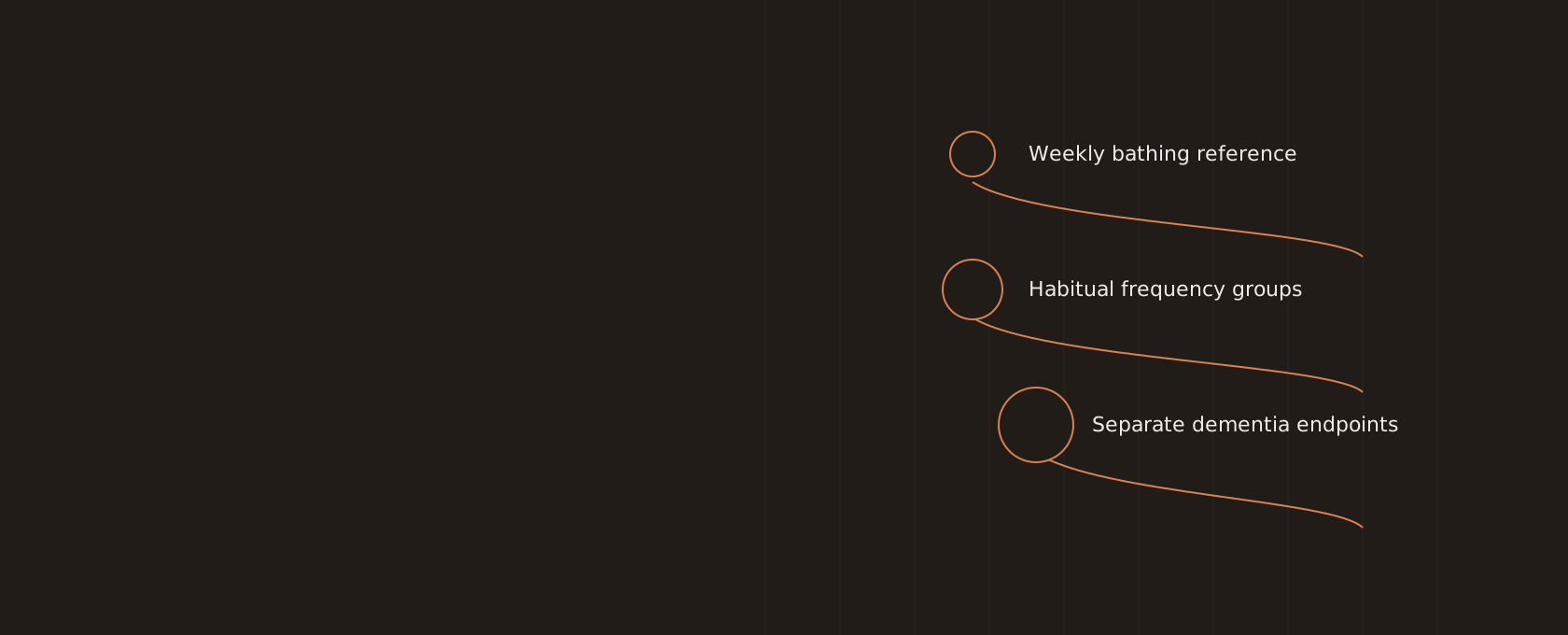
| Study | Design & population | Finding & comparison |
|---|---|---|
| 2017 · Laukkanen T ↗ | prospective cohort Apparently healthy at enrollment Participants: 2315. habitual sauna | For 4–7 versus 1 session weekly, adjusted HRs were 0.34 (95% CI 0.16–0.71) for dementia and 0.35 (0.14–0.90) for Alzheimer disease. Results describe observed habits in Finnish men, not randomized prevention. Comparison: Once-weekly sauna Shared KIHD cohort with other reports |
| 2020 · Knekt P ↗ | Prospective population cohort No dementia diagnosis at baseline Participants: 13994. Sauna habits assessed by questionnaire | More frequent sauna use was associated with lower dementia incidence, with a weaker association across the entire follow-up than during the initial period. Comparison: 9–12 monthly visits versus none or fewer than 4 monthly Observational exposure |
| 2018 · Laukkanen JA ↗ | narrative review Epidemiological and experimental populations primarily Finnish sauna | This review surveys associations, interventions and mechanisms, while identifying remaining uncertainty; it does not constitute a new outcome trial. Comparison: Varied across studies Narrative synthesis |
Original publication: Sauna bathing is inversely associated with dementia and Alzheimer's disease in middle-aged Finnish men.
What did the dementia analysis investigate?
It investigated whether reported sauna frequency was associated with later dementia and Alzheimer disease diagnoses among men in the Finnish KIHD cohort. The researchers did not assign a new routine, recruit nonusers into a prevention program or assess a prescribed sauna course. The starting point was an existing habit in a defined population.
The publication describes sauna bathing as inversely associated with dementia and Alzheimer disease in middle-aged Finnish men. That wording identifies the direction and the population. An inverse association means that the more frequent exposure category had a lower estimated hazard in the reported analysis. It does not identify why the difference occurred or show that changing the habit changes future diagnoses. Its contribution is a prospective observational signal with a clearly stated exposure and outcome. Readers lose that contribution’s boundaries when the paper becomes a universal claim about protecting the brain, regardless of sex, diagnosis, setting or heat technology.
Who did the cohort represent?
The participants were apparently healthy men enrolled in middle age in eastern Finland. This setting provides a coherent population for examining established sauna habits, but it is an applicability boundary. A finding in these men does not directly establish the same association in women, people with existing dementia or readers using another form of heat exposure.
Apparently healthy at enrollment should not be read as proof that every relevant risk was absent. Long-term observational research follows people whose health and behavior can change. The useful question is how differences were measured and addressed, rather than whether an initial health label eliminates confounding. The abstract describes adjustment for measured factors, but an assessment of measurement quality needs the full methods. The cohort also does not directly answer whether an existing neurological condition changes heat tolerance. Interpreting a diagnosis association and deciding if a person can safely use sauna are separate tasks.
Why must the weekly-bather reference remain visible?
The frequent-use comparison used weekly bathers as its reference, rather than people who never used sauna. The retained estimates concern men reporting 4–7 sessions weekly compared with those reporting one weekly session. Changing the reference to no sauna would misstate the evidence and alter the research question.
That has practical implications. A current nonuser cannot take the ratio as a forecast of the benefit from beginning sauna. A weekly bather cannot assume that increasing frequency will produce the same change in personal risk. Those decisions concern interventions in particular people; this paper compares groups with established habits. The exposure categories also do not supply a temperature, duration and cooling schedule for a prevention program. Turning frequency into a prescription would add information the comparison did not establish. A careful summary therefore keeps the comparator beside the result every time the result is reused, including in short answers and visual summaries.
What were the reported estimates for the separate diagnoses?
For frequent versus weekly bathing, the adjusted dementia hazard ratio was 0.34, with a 95% confidence interval of 0.16–0.71. The corresponding Alzheimer disease hazard ratio was 0.35, with a 95% confidence interval of 0.14–0.90. These values retain the comparator and outcome from the verified abstract-level fact record.
A hazard ratio describes a relative event-rate relationship during follow-up under the analysis model. It is not the proportion of participants who avoided disease, nor an individual’s absolute lifetime risk. The confidence interval conveys uncertainty around the estimate but cannot remove systematic problems such as an unmeasured influence shared by sauna habits and later diagnosis. Dementia and Alzheimer disease also remain distinct endpoints. An estimate for one should not be silently used for the other, and neither is a measured improvement in a cognitive task performed just after a session. That precision is necessary even when both numerical associations appear substantial.
Does a larger bibliography mean many independent populations?
Not automatically. KIHD publications can examine different outcomes or combinations of exposures while sharing participants. A mortality report, a fitness analysis and this dementia report are not necessarily separate replications in newly enrolled populations. Counting publications without identifying their underlying cohort can make the research base appear broader than it is.
A separate dementia analysis from the Finnish Mobile Clinic Follow-up Survey is therefore useful context. It included women and men from another Finnish population, extending the question beyond the original male KIHD sample. It still observed habits rather than allocating exposure. A narrative review can organize possible vascular or other mechanisms, but discussion of a plausible pathway does not demonstrate that the pathway explains this association. Independent populations, mechanistic proposals and successful preventive interventions represent different kinds of support. The paper contributes to the first observational stage of that investigation without completing the entire causal account.
What conclusion is proportionate to the source?
The B grade applies to the prospective association in this stated population, with material limits on causal interpretation. It does not grade sauna as an established dementia-prevention intervention. The finding gives researchers a concrete exposure, reference group and diagnosis outcome to investigate, while giving readers a reason to resist treating a relative ratio as a personal guarantee.
Measured adjustment can address some differences between groups, but cannot establish that all relevant differences were captured accurately. Health, social circumstances or the ability to sustain a bathing habit could matter; these are interpretive possibilities, not explanations proved by the study. This appraisal reviewed the indexed abstract and refreshed the bibliographic record. Complete diagnosis methods, missing-data handling, model specification and formal risk of bias remain outside its scope. Funding and competing-interest information were not established by the reviewed abstract. Those details should be sought in the original full paper before making a more comprehensive assessment of reliability or clinical relevance.
Explore the evidence with a tool.
Questions, considered
Questions about this study
Did the sauna dementia study test whether a new routine prevents dementia?
No. It followed existing sauna habits in a cohort of apparently healthy Finnish men and recorded later diagnoses. Lower estimated hazards among frequent users are associations, not a trial of starting sauna. Health differences that influence both sauna use and future diagnosis remain relevant to interpretation despite statistical adjustment.
Follow the sourceCan the male KIHD dementia results be assumed to apply to women?
This particular analysis cannot directly establish an association in women because its participants were men. It also began in a specific Finnish setting and age range. Any extension to women, other countries or different sauna technologies needs separate evidence, rather than assuming a large observational association is automatically universal.
Follow the sourceWere dementia and Alzheimer disease identical endpoints in the sauna paper?
No. The investigators reported all-cause dementia and Alzheimer diagnoses separately, with different case counts and estimates. Alzheimer disease is not interchangeable with every dementia diagnosis. Summaries should identify which endpoint they discuss and retain uncertainty around both, instead of combining them into a single claim of proven cognitive protection.
Follow the sourceFollow the evidence
Sources & references
Research summaries in this edition are based on indexed abstracts unless otherwise noted. A source link is not a claim of medical review.
- Sauna bathing is inversely associated with dementia and Alzheimer's disease in middle-aged Finnish men.
Laukkanen T, Kunutsor S, Kauhanen J, Laukkanen JA
Volume 46, issue 2, pages 245-249 · PMID 27932366
Open-access flag: not recorded.Abstract-level editorial review - Does sauna bathing protect against dementia?
Knekt P, Järvinen R, Rissanen H, Heliövaara M, Aromaa A
Volume 20, pages 101221 · PMID 33088678
Open-access flag: yes.Abstract-level editorial review - Cardiovascular and Other Health Benefits of Sauna Bathing: A Review of the Evidence.
Laukkanen JA, Laukkanen T, Kunutsor SK
Volume 93, issue 8, pages 1111-1121 · PMID 30077204
Open-access flag: not recorded.Abstract-level editorial review - Benefits and risks of sauna bathing.
Hannuksela ML, Ellahham S
Volume 110, issue 2, pages 118-126 · PMID 11165553
Open-access flag: not recorded.Abstract-level editorial review