| Study | Design & population | Finding & comparison |
|---|---|---|
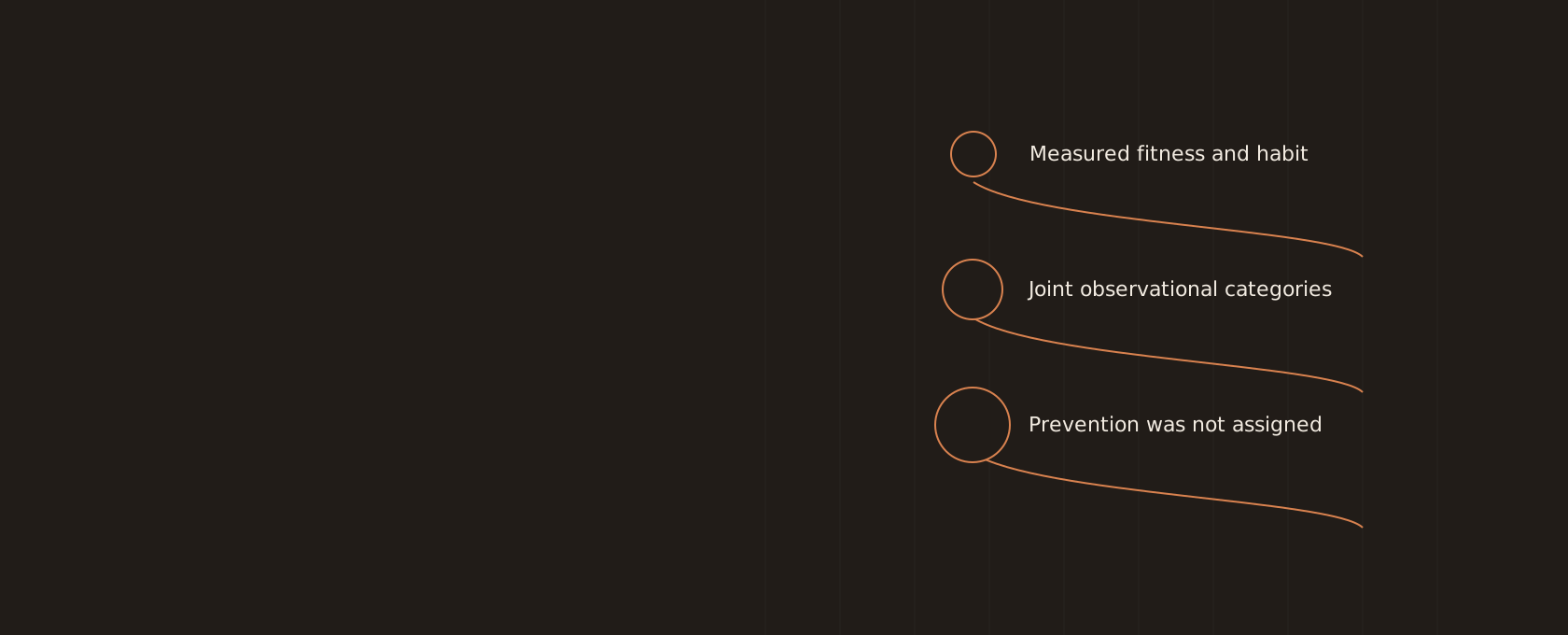
| 2024 · Kunutsor SK ↗ | prospective cohort analysis no psychosis history at baseline Participants: 2221. habitual sauna bathing | Higher sauna frequency was associated with lower psychosis incidence after adjustment including fitness. Comparison: low versus high sauna frequency and fitness categories Observational exposure; residual confounding; male cohort; not prevention evidence. |
| 2018 · Laukkanen T ↗ | prospective cohort No history of psychotic disorders Participants: 2138. habitual sauna | The highest-frequency category had lower recorded psychotic-disorder hazard after adjustment; a preventive mental-health intervention was not tested. Comparison: Once-weekly sauna Observational |
| 2018 · Kunutsor SK ↗ | prospective cohort Population-based male cohort Participants: 2277. habitual sauna | High fitness combined with frequent sauna use was associated with lower cardiovascular and overall mortality than the low-fitness/low-frequency category. Comparison: Joint fitness/frequency categories Observational joint analysis |
Original publication: Frequent sauna bathing and psychosis: Interrelationship with cardiorespiratory fitness.
What did adding fitness information investigate?
The paper examined whether the sauna-frequency association with recorded psychosis could be understood alongside measured cardiorespiratory fitness. It assessed both separate characteristics and joint profiles in a prospective male cohort. This is a more specific question than assuming frequent sauna users all share the same fitness.
It remains an observational analysis. Participants were not allocated to a new training or heat program, and the study did not test a psychiatric prevention intervention. The fitness information improves description of an existing profile without establishing what happens when a person changes that profile. This distinction should remain visible before the result is interpreted as a practical combined strategy.
Who entered the analysis?
The source included 2,221 men aged 42–61 years without psychosis history at baseline. That selection defines an incident-outcome population rather than a study of managing symptoms in people already diagnosed. It also does not establish identical applicability to women, every age group or other clinical circumstances.
The total differs from the earlier psychotic-disorder analysis, but a changed sample count does not prove a wholly independent cohort. Participant selection, outcome availability and analytical definitions need checking in the full methods. This summary preserves the reported enrollment while avoiding an inference that a larger total automatically adds an independent psychiatric-prevention experiment.
Was fitness merely another reported habit?
Fitness was assessed using respiratory gas analysis, whereas sauna frequency was self-reported. These are different measurement methods. A tested physiological characteristic can help investigate a potential confounder, but it is not equivalent to assigning an exercise prescription or observing an allocated training response.
The distinction matters for a reader considering the practical implications. Existing fitness can reflect a history and circumstances the study did not manipulate. Accounting for it does not make the remaining sauna association a randomized heat effect. The source should therefore be described as fitness-informed observational research, with measurement quality and causal allocation treated as separate features.
How did the frequency and fitness categories work?
Sauna frequency was divided into lower and higher groups, using a threshold different from the earlier once-weekly reference. Fitness was categorized separately, and combined profiles were compared. Those labels describe analytical groups, not validated targets for an individual to reach.
A joint reference can change more than one characteristic at once. The resulting comparison cannot automatically isolate the effect of adding sauna among otherwise identical people or identify the best exercise-plus-heat combination. A summary should retain the actual group definition and uncertainty rather than transferring an attractive label from another paper. The study did not compare complete assigned programs for clinical benefit.
What was the main frequency finding?
Higher sauna frequency was associated with lower psychosis incidence after adjustment that included fitness. That is the registered qualitative result. This page does not add numerical hazard estimates or turn the association into an absolute probability for a reader.
The finding suggests the recorded frequency relationship was not explained entirely by the included fitness measure under that model. It does not establish that every relevant confounder was removed. Baseline measurement, other differences and possible reverse causality remain important appraisal questions. The result can motivate further research without becoming proof that changing sauna use prevents a diagnosis or provides a personal clinical decision rule.
Were all fitness comparisons equally clear?
No. The abstract’s separate fitness comparisons were not uniformly precise, and the highest-fitness estimate had an interval compatible with no association. That uncertainty should not be overwritten by the clearer sauna-frequency result or by a general statement that every higher fitness category had an established lower hazard.
The differing estimates also cannot be ranked as a personal choice between exercise and sauna. Category definitions and uncertainty matter, and neither characteristic was assigned. This is a source-specific reason to keep the frequency, fitness and joint-profile questions separate. The paper does not validate sauna as a replacement for fitness or show that one habitual profile is an optimal psychiatric strategy.
| Analytical question | Reported feature | Unsupported inference |
|---|---|---|
| Sauna frequency after fitness adjustment | Lower recorded incidence association | A randomized heat-prevention effect |
| Separate fitness comparisons | Precision differed by category | Every higher category had a clear benefit |
| Joint profiles | Combinations of existing characteristics | An optimal assigned combined program |
| Individual prediction | Not validated here | A personal psychiatric score from a heat log |
Does an association establish a clinical prediction tool?
It does not automatically validate a tool for individual risk assessment. A population hazard relationship and a calibrated clinical prediction system are different research products. The abstract does not establish that a reader can enter sauna frequency and obtain a reliable psychiatric forecast.
The same limit applies to a heat log or planner. Recording exposure assumptions cannot determine whether protection has been achieved, and a category with a lower model estimate does not supply personal clearance. A clinical application would need its own validation and relevant population. This page therefore retains the association without turning the comparison into an individual diagnostic or prevention instrument.
What is the defensible conclusion after this review?
The source reports a lower psychosis-incidence association with higher reported sauna frequency after considering measured fitness in selected men. It does not establish an assigned prevention effect, a universal optimal combination or a validated individual risk tool. Fitness uncertainty and related-cohort context remain part of the interpretation.
The indexed abstract and verified source abstraction were read. Full outcome ascertainment, overlap, model choices, formal risk of bias, funding and conflict-of-interest disclosures have not been comprehensively assessed; unreported details remain unknown. The historical safety review supplies limited general context, not psychiatric clearance. Existing clinical care and personal suitability remain separate from the source’s baseline profile comparisons.
Explore the evidence with a tool.
Questions, considered
Questions about this study
What did the sauna-and-fitness psychosis analysis find?
Higher reported sauna frequency was associated with fewer subsequent psychotic disorders in this male cohort, including after adjustment for measured fitness. The study observed habits rather than assigning an intervention. It therefore does not demonstrate that increasing sauna frequency prevents psychosis or replaces psychiatric assessment and care.
Follow the sourceWas fitness measured or simply self-reported in the psychosis analysis?
Fitness was assessed through respiratory-gas testing, whereas sauna frequency was self-reported at baseline. That distinction helps describe the exposures accurately. Adjustment for measured fitness can address one competing explanation, but it cannot remove every unmeasured difference between frequent and less frequent sauna users in a cohort.
Follow the sourceDid the psychosis analysis compare frequent sauna with never using sauna?
Its frequency categories were low, defined as up to two sessions weekly, and high, defined as three to seven. The reference was not restricted to people who never used sauna. Describing the result as a frequent-versus-never comparison would misstate the groups actually analyzed in this paper.
Follow the sourceFollow the evidence
Sources & references
Research summaries in this edition are based on indexed abstracts unless otherwise noted. A source link is not a claim of medical review.
- Frequent sauna bathing and psychosis: Interrelationship with cardiorespiratory fitness.
Kunutsor SK, Kauhanen J, Laukkanen JA
Volume 175, pages 75-80 · PMID 38718442
Open-access flag: not recorded.Abstract-level editorial review - Sauna Bathing and Risk of Psychotic Disorders: A Prospective Cohort Study.
Laukkanen T, Laukkanen JA, Kunutsor SK
Volume 27, issue 6, pages 562-569 · PMID 30173212
Open-access flag: not recorded.Abstract-level editorial review - Joint associations of sauna bathing and cardiorespiratory fitness on cardiovascular and all-cause mortality risk: a long-term prospective cohort study.
Kunutsor SK, Khan H, Laukkanen T, Laukkanen JA
Volume 50, issue 2, pages 139-146 · PMID 28972808
Open-access flag: not recorded.Abstract-level editorial review - Does the Combination of Finnish Sauna Bathing and Other Lifestyle Factors Confer Additional Health Benefits? A Review of the Evidence.
Kunutsor SK, Laukkanen JA
Volume 98, issue 6, pages 915-926 · PMID 37270272
Open-access flag: not recorded.Abstract-level editorial review - Benefits and risks of sauna bathing.
Hannuksela ML, Ellahham S
Volume 110, issue 2, pages 118-126 · PMID 11165553
Open-access flag: not recorded.Abstract-level editorial review