| Study | Design & population | Finding & comparison |
|---|---|---|
| 2018 · Laukkanen T ↗ | prospective cohort No history of psychotic disorders Participants: 2138. habitual sauna | The highest-frequency category had lower recorded psychotic-disorder hazard after adjustment; a preventive mental-health intervention was not tested. Comparison: Once-weekly sauna Observational |
| 2024 · Kunutsor SK ↗ | prospective cohort analysis no psychosis history at baseline Participants: 2221. habitual sauna bathing | Higher sauna frequency was associated with lower psychosis incidence after adjustment including fitness. Comparison: low versus high sauna frequency and fitness categories Observational exposure; residual confounding; male cohort; not prevention evidence. |
| 2017 · Laukkanen T ↗ | prospective cohort Apparently healthy at enrollment Participants: 2315. habitual sauna | For 4–7 versus 1 session weekly, adjusted HRs were 0.34 (95% CI 0.16–0.71) for dementia and 0.35 (0.14–0.90) for Alzheimer disease. Results describe observed habits in Finnish men, not randomized prevention. Comparison: Once-weekly sauna Shared KIHD cohort with other reports |
Original publication: Sauna Bathing and Risk of Psychotic Disorders: A Prospective Cohort Study.
What did this study actually investigate?
The investigators examined whether baseline sauna frequency was associated with later recorded psychotic disorders in the Kuopio Ischemic Heart Disease cohort. The prospective design relates an existing habit to subsequent outcomes. It does not allocate sauna as a psychiatric prevention program.
That distinction defines the paper’s useful contribution. A lower adjusted hazard can motivate further investigation without identifying the consequence of starting, stopping or increasing sauna. This summary therefore keeps the finding at the level of the recorded population association. The title should not become a personal clinical instruction, a guarantee about mental health or evidence that an ordinary home routine substitutes for established assessment and care.
Who was followed, and why does prior history matter?
The analysis included 2,138 men aged 42–61 years without a history of psychotic disorders at baseline. That enrollment establishes an incident-outcome question. It is different from assessing symptom changes in people already diagnosed or comparing alternative clinical management strategies.
The male age-selected sample also does not establish the same response in every sex, life stage or medical circumstance. A long follow-up adds outcome information without broadening who entered the study. The source can describe what happened in the observed cohort, while the applicability and clinical suitability of another person remain separate questions. Those limits should accompany the favorable association rather than disappear from a shortened headline.
Which sauna comparison produced the association?
The main frequency reference was once-weekly sauna, with higher-frequency groups compared against it. These were reported habitual categories, not randomly assigned schedules. The comparison should not be changed to never using sauna or to a controlled trial of new users.
The reference is especially important when a relative estimate is repeated without context. It describes how one observed category differed from another under the model. It does not reveal how much benefit an individual gains by changing their routine, nor establish a universal frequency target. Keeping the actual baseline comparison attached makes the result more informative and prevents a familiar group label from becoming a prescription.
| Source feature | What it means | Unsupported replacement |
|---|---|---|
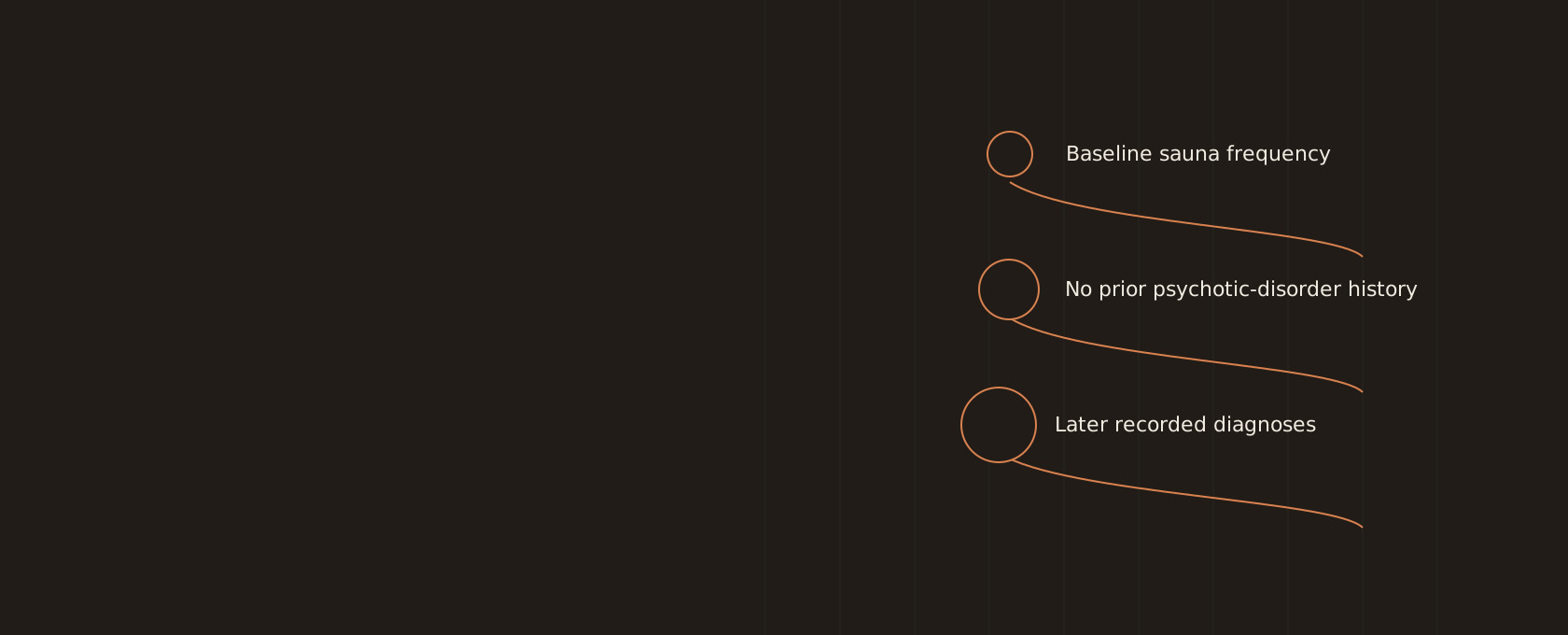
| Prospective existing-habit cohort | Later recorded diagnoses related to baseline reports | Assigned prevention program |
| No prior psychotic-disorder history | Incident-outcome enrollment | Existing-illness management |
| Once-weekly reference | A specific habitual comparison | Never-user or new-user trial |
| Adjusted lower hazard | A modeled population association | Personal absolute prevention benefit |
What can be said about the registered result?
The highest-frequency category had a lower recorded psychotic-disorder hazard after adjustment. This page retains that qualitative result without introducing numerical hazard ratios absent from the registered result facts. Its direction belongs to the source’s outcome, sample and reference.
A lower adjusted hazard is not an individual’s absolute probability of avoiding diagnosis. It also is not proof that sauna prevented a recorded event. The analysis observed habits and outcomes without assigning the change of interest. The appropriate interpretation is therefore a research signal with uncertainty, rather than a personalized forecast or a numerical argument for replacing psychiatric care with a heat-exposure schedule.
Did adjustment resolve every alternative explanation?
No statistical adjustment can guarantee that every relevant difference was measured accurately or modeled completely. Health, behavior or circumstances can influence both habitual participation and later outcomes. The study investigated measured confounding, while residual differences and potential reverse causality remain appraisal concerns.
Those possibilities should not be described as proven explanations for the entire finding. They define the uncertainty in causal interpretation. A full source review would inspect the adjustment sets, measurements and sensitivity analyses before making a stronger judgment. The result can remain interesting without treating persistence after adjustment as random allocation or the definitive effect of changing a person’s sauna frequency.
What does the recorded diagnostic endpoint not establish?
The abstract reports psychotic disorders as the outcome category. It does not supply every diagnostic subtype, ascertainment procedure or clinical trajectory needed for a complete appraisal. This summary does not invent condition-specific estimates or infer that every psychiatric diagnosis shares the association.
An incident diagnostic endpoint is also different from current mood, perceived relaxation or response to care. Removing that distinction broadens the claim beyond the paper. The relevant next review step is to inspect the source’s actual outcome definitions and methods, not fill gaps from another study or general mental-health knowledge. The finding should retain its recorded category and baseline history limits.
How does the later fitness-related paper differ?
The related analysis included measured cardiorespiratory fitness and used different sauna-frequency grouping. Higher frequency remained associated with lower psychosis incidence after accounting for fitness. That is a useful extension of the observational question, not an assigned exercise-plus-sauna experiment.
The differing analytical sample and categories also require an overlap check before the publications are counted as independent populations. A new title or total does not establish new participants. The papers can add distinct questions within related research while leaving causal prevention and the effect of changing habits unresolved. Their findings should not be merged into one frequency rule or a claim that sauna can replace fitness or clinical care.
Do dementia papers and reviews provide additional direct proof?
A KIHD dementia publication concerns a different diagnostic endpoint, while the broader sauna review surveys varied evidence and proposed mechanisms. They provide context rather than new psychosis intervention results. A source about another brain outcome cannot supply the missing comparison for this one.
The shared cohort framework also means publication counts need careful interpretation. Related papers can reuse participants while addressing worthwhile new outcomes. That is not the same as independent replication. The bibliography on this page identifies where the source sits, without presenting every citation as a new group confirming a psychiatric benefit or a demonstrated mechanism behind the observed lower hazard.
What remains open after this abstract-level summary?
The indexed abstract and verified corpus abstraction were read. Complete diagnostic methods, participant overlap, model specification, formal risk of bias, funding and conflict-of-interest disclosures have not been comprehensively assessed; unreported information remains unknown. No clinical clearance or effective personal schedule follows from this review.
The defensible conclusion is a lower adjusted association in selected men without previous psychotic disorders, with the once-weekly reference and observational design preserved. The historical safety review supplies limited general context, not a psychiatric screening process. Further relevant research is needed to address causality and transfer, while clinical assessment and prescribed care remain separate from the cohort’s habit categories.
Explore the evidence with a tool.
Questions, considered
Questions about this study
Did the psychosis cohort test sauna as a psychiatric intervention?
No. It observed existing sauna habits in men without a recorded psychotic-disorder history and followed later diagnoses. The strong inverse association does not establish a preventive psychiatric intervention. Differences in underlying health, behavior and subsequent care could matter, and the result provides no basis for changing prescribed mental-health treatment.
Follow the sourceDid participants already have psychotic disorders at enrollment in the sauna analysis?
No. The described population excluded a prior history of psychotic disorders and examined incident diagnoses. That distinguishes this paper from a study of symptoms or recovery among existing patients. Its findings cannot directly answer whether sauna changes symptoms, medication needs or safety for a person already living with psychosis.
Follow the sourceWhy should the large psychosis association still be described cautiously?
A large association can remain noncausal when exposure is self-selected and relevant differences are incompletely measured. This male-cohort analysis adjusted for many factors but did not assign sauna use. Its magnitude should prompt careful replication and mechanistic questions, rather than turning an observational estimate into a confident prevention claim.
Follow the sourceFollow the evidence
Sources & references
Research summaries in this edition are based on indexed abstracts unless otherwise noted. A source link is not a claim of medical review.
- Sauna Bathing and Risk of Psychotic Disorders: A Prospective Cohort Study.
Laukkanen T, Laukkanen JA, Kunutsor SK
Volume 27, issue 6, pages 562-569 · PMID 30173212
Open-access flag: not recorded.Abstract-level editorial review - Frequent sauna bathing and psychosis: Interrelationship with cardiorespiratory fitness.
Kunutsor SK, Kauhanen J, Laukkanen JA
Volume 175, pages 75-80 · PMID 38718442
Open-access flag: not recorded.Abstract-level editorial review - Sauna bathing is inversely associated with dementia and Alzheimer's disease in middle-aged Finnish men.
Laukkanen T, Kunutsor S, Kauhanen J, Laukkanen JA
Volume 46, issue 2, pages 245-249 · PMID 27932366
Open-access flag: not recorded.Abstract-level editorial review - Cardiovascular and Other Health Benefits of Sauna Bathing: A Review of the Evidence.
Laukkanen JA, Laukkanen T, Kunutsor SK
Volume 93, issue 8, pages 1111-1121 · PMID 30077204
Open-access flag: not recorded.Abstract-level editorial review - Benefits and risks of sauna bathing.
Hannuksela ML, Ellahham S
Volume 110, issue 2, pages 118-126 · PMID 11165553
Open-access flag: not recorded.Abstract-level editorial review