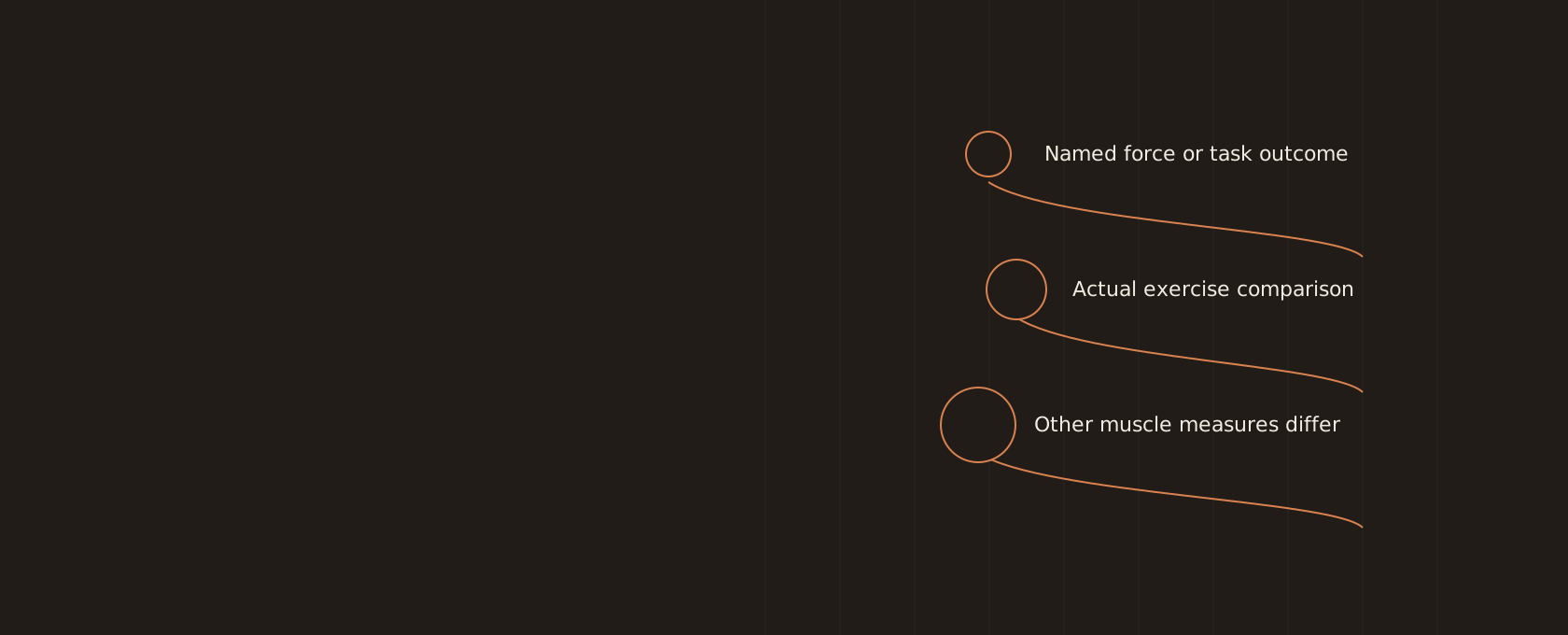
| Study | Design & population | Finding & comparison |
|---|---|---|
| 2019 · Bucht H ↗ | pilot randomized controlled trial Healthy community-dwelling older adults Participants: 23. sauna yoga · 8 weeks | Chair sit-and-reach improved with heated exercise, while several other flexibility, strength and balance comparisons were not statistically clear. Comparison: Similar exercises without moderate heat Small pilot |
| 2019 · Cernych M ↗ | Before-after neuromuscular physiology study Apparently healthy young adults Participants: 16. Finnish sauna-induced whole-body hyperthermia | After temperature recovery, muscle contractility and steadiness changed but the tested submaximal task did not produce greater neuromuscular fatigability. Comparison: Before versus two hours after exposure Small male sample |
| 2020 · Rissanen JA ↗ | Repeated-measures exercise and sauna study Recreationally active, sauna-experienced Participants: 27. Traditional sauna | Strength exercise followed by sauna showed the greatest measured neuromuscular fatigue; sauna alone also temporarily reduced selected force measurements. Comparison: Sauna alone and strength, endurance or combined exercise followed by sauna No matched exercise-without-sauna conditions described |
Is a general strength improvement established?
The cited studies do not establish one uniform effect across strength-related outcomes. Some experiments found selected favorable results, others were null, and some reported residual fatigue or reduced force. The source needs its actual task, comparison and measurement occasion attached.
This is important because the word muscle can cover many different endpoints. A flexibility test, a loaded jump, a sustained contraction and maximum voluntary force are not the same measurement. Nor does a temperature rise or less soreness supply the result of any of those tests.
This page grades the reviewed evidence C for small, task-specific physiological and training comparisons. It does not imply that every heat response is absent or that every favorable finding proves a general benefit. The useful question is which force or performance result changed beyond an appropriate alternative, under which circumstances. The answer remains more limited than a universal claim that sauna makes a person stronger.
What distinguishes force, power and fatigability?
A maximum force test asks a different question from how quickly a muscle contracts or how much a jump deteriorates after exercise. Steadiness concerns another aspect of performance, while a sustained task can assess how function changes under a particular load.
These distinctions are not merely technical vocabulary. A study can find faster contractility, reduced steadiness and no greater task fatigability at the same assessment. None of those results can automatically replace a maximum-strength endpoint. Likewise, a selected power finding need not indicate larger muscle size or better performance in every movement.
A practical evidence table should therefore name the test rather than group everything as improved muscle function. That gives each source a defensible role. The relevant question is whether its outcome matches the strength claim, not whether the title or intervention sounds close enough to the reader’s goal.
What does the older-adult sauna-yoga pilot show?
The randomized pilot compared similar exercises with and without moderate heat. Its clearest favorable finding concerned chair sit-and-reach. Strength and balance showed numerical tendencies rather than clearly established superiority in the indexed results.
The co-intervention matters. The participants performed exercises; the result is not evidence that passive sitting produces the same change. A favorable flexibility test also cannot establish a general strength benefit or fewer falls. Those outcomes require their own measurements and interpretation.
The relatively healthy community-dwelling older sample is useful but limited. It is not a universal estimate for frail individuals or every age group. The study can support further testing of a defined heated-exercise program while leaving strength efficacy and individualized suitability unresolved. Its title should not be used to supply broader certainty than the endpoint-level findings provide.
Did the repeated infrared training study improve every performance test?
It did not establish uniform superiority. The pair-matched female-athlete study reported selected power-related interactions and follow-up comparisons while finding no added hypertrophy effect. Other performance outcomes did not provide the same generalized advantage.
This is a training-program comparison, not randomized passive sauna alone. Both groups completed strength and power exercise, so gains from baseline do not isolate infrared. An added-effect claim needs the appropriate contrast with the shared program rather than crediting the combined group for everything it achieved.
The source therefore belongs in a strength discussion as endpoint-specific evidence. It should not be described as a universal improvement in force, sprinting or muscle growth. A selected favorable analysis can remain scientifically interesting without becoming proof that a device reproduces training adaptation or improves every form of athletic performance.
What did the post-cooling muscle experiment find?
The study assessed young men after body temperature had recovered toward its preheating level. Faster contractile properties and lower steadiness were observed, while the tested sustained submaximal contraction did not produce greater fatigability. That is a mixed residual pattern.
The timing distinguishes this experiment from measurements taken while a participant is still hot. It does not create a public rule about when all functions are restored or later training becomes safe. A temperature reading and one contraction task are not a comprehensive readiness test.
The result should therefore remain specific to the measured properties. Faster contractility does not establish improved maximum strength, and no greater fatigability in one task does not predict every competition. The study adds useful detail about residual physiology while leaving broader sport and individual decisions to evidence suited to those questions.
Can sauna after strength exercise add a demanding exposure?
The exercise-loading experiment reported its greatest measured neuromuscular fatigue after strength work followed by sauna. Selected force reductions were also observed after sauna alone. Those outcomes do not support an assumption that every heat exposure immediately restores strength.
The design nevertheless does not isolate a precise extra sauna penalty after every exercise type. Matched exercise-without-sauna conditions were not described for all loadings, and the sequence began with sauna alone. These limits should accompany the observation rather than disappear behind an unfavorable headline.
The study is useful for defining a scheduling question, not for issuing an exact waiting interval. A force change in one experimental sequence cannot determine how much a different athlete will lose or how long an individual should wait. The endpoint, preceding activity and comparison remain essential to interpreting the result.
Was infrared recovery consistently favorable after strength work?
The earlier infrared comparison reported no recovery differences after its strength session. It found a favorable jump observation at one measurement after endurance exercise. Those outcomes should remain separated by exercise mode and timing.
A finding after endurance work does not establish restored force after resistance training. Nor should the paper’s proposed penetration explanation be treated as independently demonstrated by its performance tests. The source can be discussed for the actual comparison without endorsing every mechanism proposed in its conclusion.
This null strength-recovery result also belongs beside newer positive observations. Omitting it would make the literature look more uniform. The correct synthesis does not simply count favorable titles; it asks which activity, recovery condition and measured task answer the claim. Different designs and populations require a more precise comparison than a single infrared recovery label permits.
What did the favorable basketball comparison actually establish?
The basketball crossover found a smaller subsequent countermovement-jump decline and less reported soreness after infrared exposure than passive recovery. The result concerns a defined resistance session and later assessments in a small male sport-specific group.
That is a useful positive finding without establishing complete restoration of every force or sprint measure. A jump result should retain its name, and subjective soreness should remain distinct from measured performance. The abstract does not justify assigning the same improvement to every neuromuscular outcome.
The comparison also does not demonstrate that a warmer muscle caused the effect or that the routine is best for every athlete. The study tested one recovery alternative. Its contribution is a bounded comparison that can guide further work, while the other null or unfavorable strength-related findings remain relevant rather than being replaced by this favorable result.
Why can the studies differ without one being dismissed?
They involve different participants, preceding activities, modalities and testing occasions. A healthy older-adult exercise pilot, a repeated female training program and a residual laboratory task in young men do not estimate one identical effect. Their shared use of heat does not remove those differences.
A fair comparison starts by matching the question. An acute force response cannot settle a training-period size question, and a flexibility improvement does not reproduce a jump-power finding. The observed directions need their original context before an explanation is proposed.
The reviewed evidence also is not an exhaustive inventory of all human muscle-heating research. Additional studies or populations require their own appraisal before a clinical claim is integrated. This guide does not infer that no other older-adult muscle trial exists. It limits its conclusion to the sources read, keeping both their contributions and gaps identifiable.
| Finding type | Specific question | Strength inference to avoid |
|---|---|---|
| Chair flexibility | Did that range-of-motion test improve? | General maximum-force benefit |
| Loaded jump | Did a selected power analysis differ? | Added hypertrophy or all-task strength |
| Residual contractility | What changed after temperature recovery? | Complete restoration of every function |
| Sustained contraction | Was greater fatigue detected in that task? | A universal recovery or safety rule |
| Acute recovery | Was jump decline or soreness reduced? | Better force in every exercise setting |
Is a strength-focused exposure or waiting rule established?
The sources do not establish one universal program. They test different combinations of exercise, recovery and heat, and they use different endpoints. Combining a temperature, frequency and recovery interval from separate papers would create a new intervention rather than reproduce a validated comparison.
A session planner can organize assumptions, but it cannot identify the heat dose that improves an individual’s force or determine readiness from elapsed time. Neither a favorable measurement nor the return of body temperature supplies complete clearance.
A useful practical question names the next task and asks what evidence directly supports it. The study explorer can help retain that endpoint and comparison. It cannot turn a limited laboratory result into an effective personal training prescription, and this page does not recommend exposure escalation or copying a demanding study routine to pursue a larger response.
What would make a strength claim more informative?
An appropriate comparison would isolate the added heat component, specify the population and measure the actual force or task outcome. Repeated follow-up would help distinguish acute response from training adaptation. Consistent reporting of uncertainty and adverse events would be important beside favorable findings.
The value comes from answering the particular question, not merely collecting more muscle-related variables. A paper can measure several endpoints and still leave the practical strength claim uncertain. Better matching of outcome and intended application is necessary before an average can inform a personal expectation.
This synthesis uses refreshed indexed abstracts and registered findings. Full-text measurement detail, every statistical decision, formal risk of bias, funding and competing interests were not comprehensively reviewed. Unreported details remain unknown. The evidence grade therefore describes a limited source-specific account, not a clinical endorsement or a universal verdict on every heat intervention.
What remains separate about personal heat suitability?
The historical review names unstable angina, recent myocardial infarction and severe aortic stenosis among contraindications and identifies alcohol-related concerns. That source is an older narrative overview, not comprehensive screening for every athlete or clinical group. Discuss relevant health and medication questions with a qualified clinician.
The experimental results do not provide a universal exposure limit or a guarantee of safe training afterward. A selected function test is different from medical eligibility, and a group-average result cannot make that decision for an individual.
The proportionate conclusion is mixed, task-specific evidence. Some outcomes were favorable, others were unestablished or unfavorable under particular conditions. Keeping those distinctions preserves the scientific signal without turning a jump, flexibility or contractility result into a generalized strength promise or personal recipe.
Inspect the assumptions
Explore the session planner.
This planning tool describes a routine. It does not estimate a health benefit or provide medical clearance; the study exposures discussed above remain separate research methods.
Interactive workspace
In-memory checkpoint · no medical clearance
Pause for the personal context.
Check every item that applies or that you are unsure about. Current serious symptoms need appropriate care, not a tool result.
Context, with limits
- Checkpoint
- Complete the acknowledgment
A checklist cannot assess every relevant condition. No answer is medical clearance. Responses are in memory only, and are reset on reload.
Calculated on your device. Theme and unit preferences can be stored locally; health answers, weights and logs remain in memory. A shared settings URL contains its visible planning inputs.
Open the complete tool and methodologyExplore the evidence with a tool.
Questions, considered
Questions about this evidence
Which measurement should support a claim about maximum strength?
The source should assess the relevant force outcome under a suitable comparison. A jump, flexibility test or faster contractile response cannot automatically supply it. The reviewed experiments measured different properties and time windows, so the claimed result should retain its actual test rather than become a generalized muscle-performance promise.
Follow the sourceWhy does the sauna-yoga flexibility signal not establish passive strength benefit?
Both groups performed exercises, and the clearest favorable comparison concerned chair sit-and-reach. Strength and balance superiority was not clearly established. The result therefore does not show the same effect from passive sitting or validate a general strength program for every older adult, especially outside the selected healthy sample.
Follow the sourceCan no greater fatigability be read as better force in every task?
The residual muscle experiment assessed a specific sustained submaximal contraction after temperature recovery. Contractility became faster and steadiness decreased, while that task did not provoke greater fatigability. These outcomes are not interchangeable with maximum strength or sporting performance. The pattern should remain mixed rather than being renamed universal recovery.
Follow the sourceDid the exercise-loading study isolate an exact extra sauna fatigue penalty?
Its conditions did not include matched sauna-free versions of every exercise loading, and sauna alone was performed first. The observed force and fatigue patterns are therefore informative without isolating a precise additional effect for every sequence. They do not establish a personal waiting time or a universal magnitude of lost strength.
Follow the sourceHow can a favorable basketball result coexist with an older strength null?
The preceding activity, participants, timing and outcome tests differed. The basketball study found a smaller jump decline and less soreness, whereas the older infrared comparison did not show recovery differences after strength work. Those source-specific results should stay visible rather than one being used to erase the other or generalize across every test.
Follow the sourceCan a body-temperature return decide whether all muscle functions are restored?
The residual experiment found that some neuromuscular measures still differed when temperature had returned toward baseline. A temperature reading therefore does not describe every function or validate readiness for the next task. The study also did not establish a timing rule that guarantees safe later exercise for every user.
Follow the sourceFollow the evidence
Sources & references
Research summaries in this edition are based on indexed abstracts unless otherwise noted. A source link is not a claim of medical review.
- Sauna Yoga Superiorly Improves Flexibility, Strength, and Balance: A Two-Armed Randomized Controlled Trial in Healthy Older Adults.
Bucht H, Donath L
Volume 16, issue 19, pages E3721 · PMID 31581690
Open-access flag: yes.Abstract-level editorial review - Accelerated muscle contractility and decreased muscle steadiness following sauna recovery do not induce greater neuromuscular fatigability during sustained submaximal contractions.
Cernych M, Baranauskiene N, Vitkauskiene A, Satas A, Brazaitis M
Volume 63, pages 10-19 · PMID 30481721
Open-access flag: not recorded.Abstract-level editorial review - Acute Neuromuscular and Hormonal Responses to Different Exercise Loadings Followed by a Sauna.
Rissanen JA, Häkkinen A, Laukkanen J, Kraemer WJ, Häkkinen K
Volume 34, issue 2, pages 313-322 · PMID 31490429
Open-access flag: not recorded.Abstract-level editorial review - Effects of repeated use of post-exercise infrared sauna on neuromuscular performance and muscle hypertrophy.
Ahokas EK, Hanstock HG, Kyröläinen H, Ihalainen JK
Volume 7, pages 1462901 · PMID 40104529
Open-access flag: yes.Abstract-level editorial review - A post-exercise infrared sauna session improves recovery of neuromuscular performance and muscle soreness after resistance exercise training.
Ahokas EK, Ihalainen JK, Hanstock HG, Savolainen E, Kyröläinen H
Volume 40, issue 3, pages 681-689 · PMID 37398966
Open-access flag: yes.Abstract-level editorial review - Effects of far-infrared sauna bathing on recovery from strength and endurance training sessions in men.
Mero A, Tornberg J, Mäntykoski M, Puurtinen R
Volume 4, pages 321 · PMID 26180741
Open-access flag: yes.Abstract-level editorial review - Benefits and risks of sauna bathing.
Hannuksela ML, Ellahham S
Volume 110, issue 2, pages 118-126 · PMID 11165553
Open-access flag: not recorded.Abstract-level editorial review