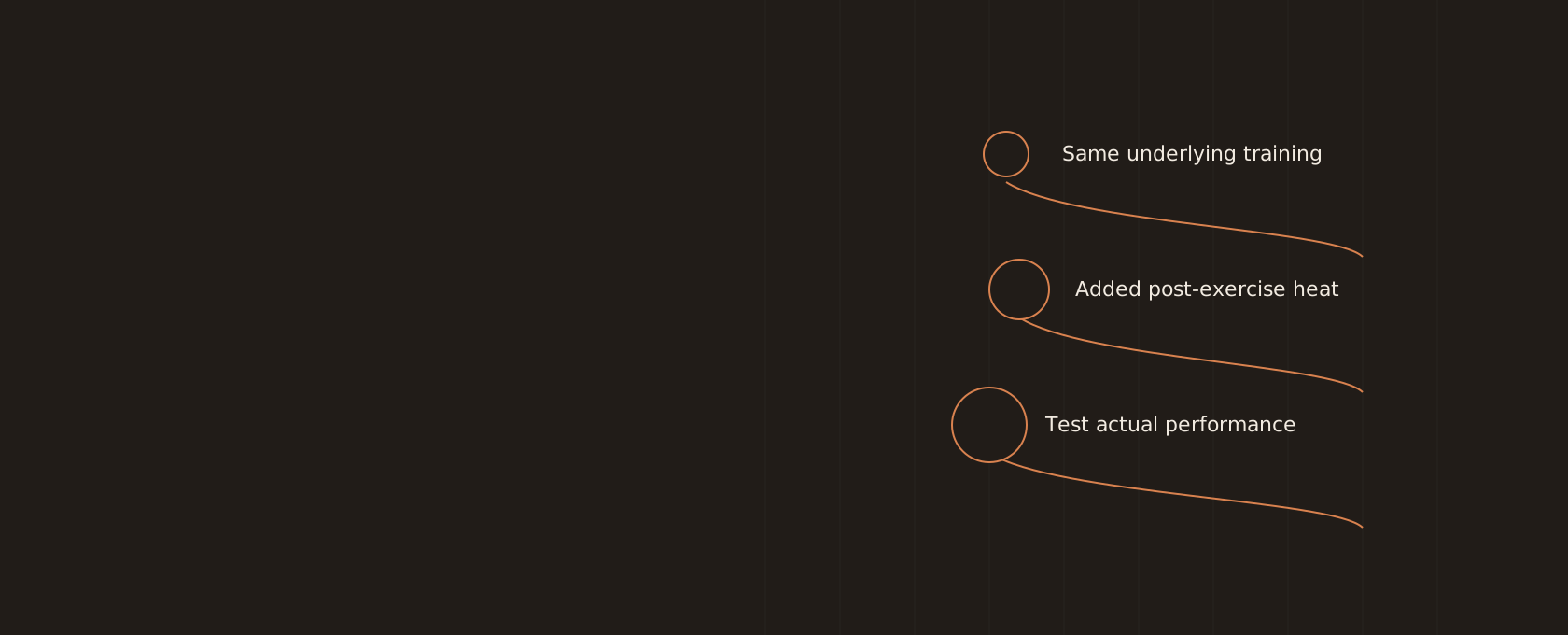
| Study | Design & population | Finding & comparison |
|---|---|---|
| 2025 · Solomon TPJ ↗ | Systematic review and meta-analysis Healthy adults in post-exercise heating trials Participants: 199. Sauna or hot-water immersion | Pooled performance effects were uncertain, and evidence certainty was low to very low despite changes in some physiological measures. Comparison: Same exercise training without post-exercise heating Small underlying trials |
| 2021 · Kirby NV ↗ | controlled endurance-training intervention trained middle-distance runners Participants: 20. post-exercise sauna · 3 weeks; subset continued to 7 weeks | Added sauna improved several tested exercise-capacity markers; extended exposure produced limited additional change. Comparison: normal training without added sauna Small trained sample; no randomization stated in abstract; surrogate performance markers. |
| 2023 · Ashworth E ↗ | partially randomized crossover heat-acclimation experiment military-context participants Participants: 25. sauna versus hot-water immersion · 5 days | Both modalities produced modest heat adaptations; the performance improvement was not statistically significant. Comparison: sauna versus water immersion; 15 participants completed both Only a subset crossed over; small sample; specific loaded walking task. |
What would count as an endurance-performance benefit?
A relevant result is better performance in a defined endurance task compared with an appropriate alternative. A faster time trial, improved sustained workload or longer time to exhaustion can address performance, but those tests are not interchangeable. The task, environment and comparator determine which question was answered.
Aerobic-capacity measures, a lactate-related running speed and exercise temperature can help explain an athlete’s physiology. They do not automatically establish a faster race. The distinction is important when a paper’s title refers to exercise capacity while a later headline promises performance. This guide asks whether the claimed improvement concerns an actual task result or an intermediate measurement, then checks whether adding sauna outperformed the same underlying training without added heat.
What does the performance-focused review conclude?
The systematic review and meta-analysis judged the effect of post-exercise heating on endurance performance uncertain. Its underlying studies used sauna or hot-water immersion after exercise, with comparison groups completing the same training without the added heating. The certainty of the estimates was low to very low.
This is a meaningful limit even though some physiological measures changed. A pooled analysis does not automatically provide strong evidence simply because it is called a meta-analysis. Small studies, risk of bias, imprecision and variation in methods can leave the final estimate uncertain. The appropriate reading is neither a confident performance benefit nor proof that no future program can help. The review identifies a plausible intervention question that still needs better testing.
Why are the favorable runner findings still useful?
The controlled runner study found improvements in selected exercise-capacity and heat-tolerance markers when post-exercise sauna was added to normal endurance training. Comparing with training alone helps address the incremental question more directly than recording changes in one training group. The findings are relevant to athletes and researchers interested in a possible added adaptation.
They remain results from a small, selected group of middle-distance runners. The indexed abstract describes aerobic capacity and lactate-related speed rather than a universal competitive race outcome. Extending the program in a small subset produced limited additional change. Those details discourage a simple story that the first favorable markers guarantee faster racing, or that progressively longer programs necessarily continue to improve every measure.
Did a military task show a clear performance gain?
The military-context experiment reported modest heat adaptations after sauna or hot-water immersion, while the performance improvement was not statistically significant. That result belongs beside the favorable runner markers because it illustrates the gap between physiological response and demonstrated task improvement.
The task involved loaded walking followed by an incremental ramp to exhaustion in a defined hot environment. It was not a running time trial or a study of competitive swimmers. Only a subset completed both heating approaches in the randomized crossover component. The source therefore cannot establish general equivalence of sauna and water for every endurance sport. It contributes a specific comparison in a demanding task, with the uncertainty of its performance result left visible.
What happened when training and blood outcomes were controlled?
The hematological crossover trial did not find clear additional benefit from post-exercise sauna over endurance training alone in its assessed blood and exercise variables. Some hemoglobin-mass changes were within measurement uncertainty. This is an important counterweight to claims that sauna reliably adds endurance benefit through blood-related adaptation.
Both conditions involved exercise without fluid intake, and that restriction also applied to the added sauna sessions. The result does not test every possible routine, but it prevents that specific strategy from becoming established advice. A within-group improvement after training is not enough when similar improvement occurs under the comparison. The relevant question is what the added exposure contributed beyond the shared exercise, rather than whether any measurement changed over the training period.
Can plasma-volume expansion substitute for a performance result?
No. The small cyclist study described a plasma-volume increase during a training-plus-sauna period, with unclear relationships between individual volume changes and heart-rate-based measures. It did not establish that the volume change produced a competitive improvement. A plausible physiological explanation remains different from a directly observed performance effect.
Its very small male sample, lack of a separate independent control described in the abstract and magnitude-based analysis also limit interpretation. The reported uncertainty convention should not be silently relabeled as a standard confidence interval. This guide keeps the finding as supporting physiology rather than converting it to a race-time forecast or a claim that a wearable reading can identify an athlete’s extra endurance benefit.
Can post-exercise sauna ever be followed by worse performance?
The swim-recovery trial found worse next-morning swim performance after the tested sauna recovery condition than after its placebo recovery condition. Reported stress was also higher. This is not merely a failure to find improvement; it is an unfavorable performance comparison under the specific study conditions.
The trial concerned competitive swimmers and triathletes after intensive training, so it does not establish that every sauna program harms endurance. It does show why the next task and recovery interval matter. A long-term acclimation hypothesis cannot be used to dismiss an acute recovery result, because repeated adaptation and readiness the next morning are different questions. The benefit label must not conceal evidence that one added heat exposure may be poorly matched to a particular competition or training schedule.
| Evidence setting | Reported finding | Limit for an endurance claim |
|---|---|---|
| Trained runners | Selected capacity markers improved | Not a guarantee of race performance |
| Military heat task | Modest physiological adaptation; performance uncertain | Task and population are specific |
| Swimming recovery | Worse next-morning performance after tested sauna | Acute readiness differs from long-term adaptation |
| Pooled post-exercise heating | Performance effect uncertain | Small trials and mixed heating methods |
Why do sport, sex and training status change interpretation?
An athlete’s task and baseline training determine how directly a study applies. A finding in trained runners is not automatically evidence for elite skiers, sedentary adults or every recreational endurance participant. The runner sex-comparison study also found different sweating and forearm blood-flow adaptations despite similarities in several measured outcomes.
The skier series adds another caution: lower resting heart rate did not coincide with lower baseline body temperatures, and the physiological-strain result was borderline. Its assessment was not a race-performance test and did not describe a separate non-sauna control. Collectively these studies show why pooling every favorable athletic measurement under one performance label loses useful information. Similar-sounding adaptations need their original sport, endpoint and design attached.
Has an optimal performance routine been established?
No source here establishes a universally effective temperature, duration or weekly schedule for improving endurance. The review combines studies with different heating approaches and protocols. A single ideal dose cannot be inferred merely by selecting the most favorable small experiment or averaging unlike exposure schedules.
A good protocol description keeps exercise training, added heat, timing, comparison and performance assessment together. It also distinguishes preparation for exercise in heat from performance under temperate conditions. Borrowing one study’s session duration and another’s frequency creates a new intervention with untested effects. This is especially important when a reader wants to use a tool: the planner can display an assumed schedule, but it cannot validate that schedule as performance-enhancing.
What conclusion is justified for an athlete today?
The evidence supports interest in a research question rather than a dependable performance promise. Favorable runner markers, uncertain pooled performance estimates, a null training-addition trial and an adverse swim-recovery result all belong in the account. They cannot be collapsed into a single yes or no that ignores the task and timing.
Grade C reflects that emerging, inconsistent evidence. It is not an estimate of an individual athlete’s likely improvement. Discuss intended exposure and relevant medical circumstances with a qualified clinician, and consider the specific training question with an appropriately qualified coach. The safety review is an older narrative source with named contraindications, not a comprehensive clearance process. This synthesis is abstract-level; complete risk-of-bias assessment, funding and conflicts require further source appraisal.
Which competitors are represented in the pooled evidence?
The performance review summarized a registered total of 199 participants, including 156 men and 43 women. Those are participants distributed across underlying studies, not one large trial of a uniform sauna program. The review concerned healthy adults and described young samples, so the pooled result does not automatically represent every age, medical context or training background.
This matters even before interpreting the effect estimate. A small trial in a selected athletic group can contribute valuable information without providing a reliable subgroup answer for everyone else. Pooling different tasks and heating approaches may improve the overview while making the practical question less specific. An average across those settings is not a prediction for a woman training for a particular event or an older recreational athlete considering an unfamiliar routine.
A useful reading keeps the evidence base and the intended application side by side. Identify the sport, training level, environment and outcome of the studies most relevant to the claim. If those do not match the planned use, acknowledge the gap instead of borrowing certainty from the participant total. The review itself judged certainty low to very low, so its size should not be used to make a stronger individualized promise than its conclusions support.
How can a practical evidence ledger prevent overclaiming?
Create separate entries for the event or task you care about and for each intermediate marker. For the runner trial, record the training-only comparison and the capacity endpoints. For the military study, record the loaded task and uncertain performance result. For the swim experiment, record the next-morning timing and unfavorable comparison. This ledger makes apparently conflicting findings easier to interpret because they no longer pretend to answer one identical question.
Then inspect the decision implied by a claim. A change in oxygen uptake may support further testing, but it does not supply a guaranteed time saving. A favorable heat-response measure may matter in a hot test without resolving a temperate race question. A study of repeated exposure also does not establish readiness immediately after one session. Matching claim to task is more useful than tallying positive titles, and it preserves the uncertainty athletes need when deciding whether a proposed routine has actually been tested.
Inspect the assumptions
Explore the session planner.
This planning tool describes a routine. It does not estimate a health benefit or provide medical clearance; the study exposures discussed above remain separate research methods.
Interactive workspace
In-memory checkpoint · no medical clearance
Pause for the personal context.
Check every item that applies or that you are unsure about. Current serious symptoms need appropriate care, not a tool result.
Context, with limits
- Checkpoint
- Complete the acknowledgment
A checklist cannot assess every relevant condition. No answer is medical clearance. Responses are in memory only, and are reset on reload.
Calculated on your device. Theme and unit preferences can be stored locally; health answers, weights and logs remain in memory. A shared settings URL contains its visible planning inputs.
Open the complete tool and methodologyExplore the evidence with a tool.
Questions, considered
Questions about this evidence
Does a higher aerobic-capacity marker establish a faster race?
It is relevant physiology, but it is not the same outcome as competitive performance. The runner study measured selected capacity markers and heat-test responses under a training comparison. A race claim needs a suitable performance task, comparator and uncertainty assessment. Do not convert a marker change into a guaranteed time saving for an individual athlete.
Follow the sourceWhy can a meta-analysis leave the performance question unresolved?
Pooling does not remove weaknesses in the underlying studies. The performance review identified small samples, risk of bias, imprecision and low to very low certainty. It also combined sauna and hot-water interventions. The resulting uncertainty should remain visible rather than being replaced with a confident benefit claim simply because the research used a statistical synthesis.
Follow the sourceWas the swimming result just an absence of a detectable benefit?
No. The tested sauna recovery condition was followed by worse next-morning swim performance than placebo recovery, with higher reported stress. That finding should be described as unfavorable for the specific comparison. It does not settle every endurance-training question, but it matters when assessing a claim about readiness for demanding activity soon after a session.
Follow the sourceCan an endurance-training improvement be attributed entirely to added sauna?
Not when the comparison group also improves under the same exercise program. The relevant question is the additional change beyond training. The hematological crossover trial found no clear added benefit in its assessed blood and exercise variables. Within-group improvement alone would therefore give a misleading impression of what sauna contributed to that particular program.
Follow the sourceDoes a plasma-volume finding provide a personal race-time prediction?
The small cyclist study did not establish that prediction. It examined physiological measurements during training and sauna, and relationships between volume changes and heart-rate measures were unclear. A volume response is not an observed race result or a validated wearable-based performance score. Its study design and statistical uncertainty also require careful interpretation.
Follow the sourceShould favorable athletic papers outweigh a null result by simple vote?
A vote among titles ignores the different tasks, designs and populations. A controlled marker study, a loaded heat task and a next-morning swimming comparison can all be informative without answering the same question. First identify the performance endpoint and comparison relevant to the claim, then assess its precision and limitations rather than counting favorable abstracts.
Follow the sourceFollow the evidence
Sources & references
Research summaries in this edition are based on indexed abstracts unless otherwise noted. A source link is not a claim of medical review.
- The effect of post-exercise heat exposure (passive heat acclimation) on endurance exercise performance: a systematic review and meta-analysis.
Solomon TPJ, Laye MJ
Volume 17, issue 1, pages 4 · PMID 39762944
Open-access flag: yes.Abstract-level editorial review - Intermittent post-exercise sauna bathing improves markers of exercise capacity in hot and temperate conditions in trained middle-distance runners.
Kirby NV, Lucas SJE, Armstrong OJ, Weaver SR, Lucas RAI
Volume 121, issue 2, pages 621-635 · PMID 33211153
Open-access flag: yes.Abstract-level editorial review - Post-exercise, passive heat acclimation with sauna or hot-water immersion provide comparable adaptations to performance in the heat in a military context.
Ashworth E, Cotter J, Kilding A
Volume 66, issue 1, pages 49-60 · PMID 35332846
Open-access flag: not recorded.Abstract-level editorial review - Hematological Adaptations to Post-Exercise Sauna Bathing With No Fluid Intake: A Randomized Cross-Over Study.
Sitkowski D, Cisoń T, Szygula Z, Surała O, Starczewski M, Sadowska D, Malczewska-Lenczowska J
Volume 93, issue 4, pages 795-803 · PMID 34727008
Open-access flag: not recorded.Abstract-level editorial review - Effects of Postexercise Sauna Bathing on Recovery of Swim Performance.
Skorski S, Schimpchen J, Pfeiffer M, Ferrauti A, Kellmann M, Meyer T
Volume 15, issue 7, pages 934-940 · PMID 31869820
Open-access flag: not recorded.Abstract-level editorial review - The Effect of Medium-Term Sauna-Based Heat Acclimation (MPHA) on Thermophysiological and Plasma Volume Responses to Exercise Performed under Temperate Conditions in Elite Cross-Country Skiers.
Pokora I, Sadowska-Krępa E, Wolowski Ł, Wyderka P, Michnik A, Drzazga Z
Volume 18, issue 13, pages 6906 · PMID 34199101
Open-access flag: yes.Abstract-level editorial review - Effect of sauna-based heat acclimation on plasma volume and heart rate variability.
Stanley J, Halliday A, D'Auria S, Buchheit M, Leicht AS
Volume 115, issue 4, pages 785-794 · PMID 25432420
Open-access flag: not recorded.Abstract-level editorial review - Sex differences in adaptation to intermittent post-exercise sauna bathing in trained middle-distance runners.
Kirby NV, Lucas SJE, Cable TG, Armstrong OJ, Weaver SR, Lucas RAI
Volume 7, issue 1, pages 51 · PMID 34297227
Open-access flag: yes.Abstract-level editorial review - Benefits and risks of sauna bathing.
Hannuksela ML, Ellahham S
Volume 110, issue 2, pages 118-126 · PMID 11165553
Open-access flag: not recorded.Abstract-level editorial review