| Study | Design & population | Finding & comparison |
|---|---|---|
| 2025 · Lee E ↗ | randomized controlled trial Sedentary adults with at least one cardiovascular risk factor Participants: 38. postexercise sauna · 8 weeks | Adding sauna after exercise did not produce statistically detectable additional HRV improvements relative to exercise alone. Comparison: Exercise alone; no-intervention control Small trial |
| 2018 · Leicht AS ↗ | Repeated-exposure athlete physiology study Well-trained cyclists Participants: 6. Post-exercise sauna · 10 consecutive days | Heart rate rose and a vagal-related HRV measure fell during initial exposure; repeated-exposure changes were unclear. Comparison: Within-exposure and across-exposure measurements Very small uncontrolled sample |
| 2019 · Laukkanen T ↗ | Single-group before-after physiology study Adults with cardiovascular risk factors Participants: 93. Sauna | Autonomic patterns differed during heating and recovery; the observational within-session changes did not establish durable cardiac protection. Comparison: Before, during and after exposure No randomized control |
HRV describes beat-interval variation
Heart-rate variability, or HRV, concerns variation in the intervals between heartbeats. It is related to cardiac autonomic regulation under the conditions of measurement. It is not the same outcome as heart rate, a personal recovery diagnosis or the occurrence of a cardiovascular event.
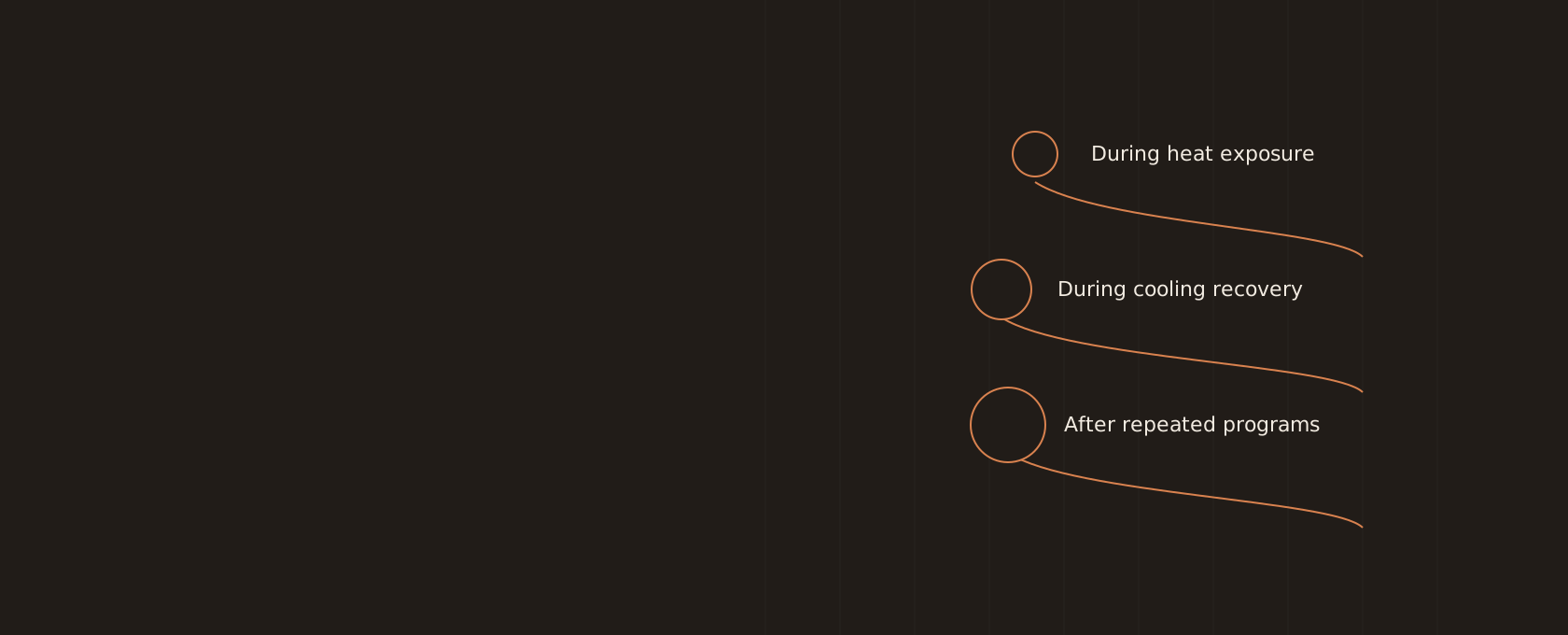
The sauna literature includes different HRV indices, study populations and observation windows. A result during heat exposure may differ from a result after cooling or after a repeated program. This guide organizes the evidence around those distinctions rather than treating the word HRV as a single score that should always rise. The important reading questions are what was measured, when it was measured and what it was compared with. Without those details, a favorable-sounding autonomic claim can be borrowed from one experiment to support an entirely different routine or expectation.
The autonomic interpretation needs conditions
Autonomic regulation involves involuntary nervous-system influences on the heart, including vagal or parasympathetic modulation. HRV methods provide indirect physiological information about those influences. They should not be simplified into a universal good-versus-bad label detached from the state in which a person was tested.
The systematic review found different patterns across whole-body heat stress, local heating and sauna protocols. It also described method-dependent uncertainty in baroreflex findings, another aspect of cardiovascular regulation. That heterogeneity is a useful warning against treating all heating methods or all autonomic tests as interchangeable. A source-specific interpretation names the actual protocol and metric. A broad statement that heat reliably activates recovery would go beyond what these diverse measurements can establish, particularly when direct repeated-program evidence does not show the expected added HRV benefit.
During-sauna cyclist measurements showed heat stress
The small trained-cyclist experiment measured cardiac regulation while participants underwent postexercise sauna. Heart rate rose and a vagal-related variability measure fell during the initial exposure. Across the repeated exposure period, changes were unclear. Those results do not support a simple claim that post-training sauna reliably improves autonomic recovery in athletes.
The timing is crucial. These were measurements during demanding heating, not a quiet resting assessment after complete recovery. A decrease under those conditions should not automatically be interpreted as lasting deterioration, just as completion of repeated sessions should not be taken as proof of adaptation. The sample was very small and lacked a separate non-sauna comparator in the described design. It therefore offers preliminary information about an active heat challenge, with uncertain translation to an athlete’s ordinary resting measurements or training decisions.
A cooling-phase report answered another question
The acute recovery study used a single-group before-and-after design and described increased HRV during the cooling period after sauna. Its interpretation emphasized parasympathetic predominance during recovery. That is a distinct physiological window from measurements made while trained cyclists were still exposed to postexercise heat.
The favorable recovery pattern should remain attached to that design and timing. Without an equivalent unheated comparison, time, rest and recovery-related influences are not fully separated from heat. The report also did not establish that the pattern produced fewer future cardiovascular events or a durable advantage from repeated sauna. A reader can retain the observation without turning it into a recovery guarantee. The apparent difference from the cyclist result is a reason to align measurement conditions before deciding that the findings directly conflict.
The randomized add-on trial found no extra HRV improvement
The multi-arm randomized trial assigned sedentary adults with at least one cardiovascular risk factor to exercise plus postexercise sauna, exercise alone or control. It found no statistically significant difference between the exercise-plus-sauna and exercise-only groups for the measured HRV indices. The main source fact therefore records no detected additional HRV benefit from the sauna addition.
That comparison matters more for an add-on claim than simply asking whether one group changed from baseline. Exercise itself and other time-related changes can affect the comparison. The assigned exercise-only group helps identify what was added by sauna under this program. The result is a useful null finding that should not be omitted because earlier acute reports sounded favorable. It remains limited by the trial’s size, population and duration, rather than establishing that every possible sauna-related physiological effect is absent.
Exercise benefit and sauna add-on benefit are separate
The HRV trial described favorable exercise-versus-control changes in selected indices while finding no additional advantage from sauna over exercise. Those statements are compatible. A combined group can participate in an active program without the added component producing a detectable improvement beyond the shared exercise component.
This distinction prevents a common attribution error. A reader seeing an exercise-plus-sauna program improve from its starting point might credit the whole improvement to sauna, even when the appropriate between-group comparison does not support that conclusion. The question is not whether participants did something physiologically meaningful. It is whether adding sauna changed the defined outcome beyond the alternative program. Keep that contrast explicit before translating a study into a decision about spending time, buying equipment or changing a recovery routine.
A favorable fitness result does not replace an HRV endpoint
A related exercise-plus-sauna trial reported favorable incremental fitness and systolic-pressure outcomes compared with exercise alone. Those outcomes should be described on their own terms. They do not establish an HRV advantage merely because the program also included sauna.
The reverse is equally important: a null HRV comparison does not erase every favorable result for another endpoint. Fitness, blood pressure and beat-interval variability are distinct measurements with different questions and uncertainties. A balanced evidence summary can therefore include both favorable and null findings without forcing them into a single verdict that the whole program worked or failed. The useful conclusion is outcome-specific. Someone interested in HRV should see the direct HRV comparison, rather than receiving a substitute result about another cardiovascular marker because it supports a more attractive narrative.
No detected add-on effect does not mean every true effect is zero
The randomized trial’s null comparison is evidence against claiming an established additional HRV improvement from this program. It is not a proof that every possible sauna-related effect is exactly zero. The sample, follow-up and selected indices limit the scope of the inference, just as they would limit a favorable result.
That distinction should not become a way to evade the finding. An unmeasured benefit remains unmeasured, and a hypothetical alternative protocol cannot replace the tested comparison. When making an HRV claim, start with what the direct trial demonstrated and state the remaining uncertainty plainly. The next study can test a different population or measurement window, but the prospect of future evidence is not present confirmation of a recovery advantage.
A wearable score is not the trial outcome
The studies evaluated defined physiological measurements under research conditions. They do not establish how an individual should interpret a consumer readiness score or change a training session based on a number after sauna. That would add a decision rule and a validation question not addressed by the reported comparisons.
Before applying a paper to personal tracking, check whether the recorded variable and timing match the research. A single display labeled HRV is not enough to show that the same index, procedure or physiological state was evaluated. This page does not provide a threshold for being recovered, stressed or safe. Its purpose is to help a reader recognize when a source has been stretched beyond its tested outcome. The study explorer can reveal those distinctions; it cannot turn an experimental average into an individualized monitoring plan.
There is no established HRV-enhancing sauna protocol
The sources do not establish one universal temperature, duration or weekly routine that reliably improves HRV. The acute recovery report, cyclist exposure and randomized repeated program use different comparisons and answer different questions. Combining appealing features from each would create an untested protocol rather than a synthesis with demonstrated effectiveness.
A favorable experience of relaxation can be valuable to the person experiencing it, but it should not be presented as proof that a specified HRV mechanism has improved. Similarly, a null add-on result does not mean a leisure activity must be abandoned. The research question and personal preference are different matters. When a medical condition or medication affects the decision, a qualified clinician should consider intended exposure; neither an HRV reading nor a study category supplies clearance.
What would make the autonomic evidence clearer
Larger controlled comparisons could separate the effect of heat from ordinary postexercise recovery. Consistent measurement windows and clearly specified HRV indices would make studies easier to compare. Repeated programs in relevant populations would help determine whether any acute response persists and whether a sauna addition changes the outcome beyond exercise alone.
Clinical meaning would still need separate evidence. A change in a physiological index is not itself proof of improved performance, fewer admissions or longer life. The systematic review’s heterogeneity and the randomized null result support Grade C for this source-specific question. The grade reflects emerging, mixed evidence rather than certainty that every response is beneficial or absent. Funding the next experiment or collecting another index would not by itself resolve that clinical translation; the design must address the outcome readers actually want to know about.
Review limits and safety remain visible
This guide uses refreshed indexed abstracts and the site’s verified source facts. It is not a full-text audit of every HRV procedure, analysis decision, funding source or conflict of interest. When those details were not established from the reviewed material, they remain unreported rather than being filled from general expectations about a research group or study design.
The historical safety review cited here names unstable angina, recent myocardial infarction and severe aortic stenosis as contraindications and warns about alcohol. That narrative source is not an exhaustive screening system. A favorable recovery-phase interpretation cannot outweigh an individual’s medical circumstances. The defensible research conclusion is precise: HRV findings depend on timing and methods, and the randomized exercise add-on trial did not detect an additional HRV advantage from sauna in its selected population.
Inspect the assumptions
Explore the session planner.
This planning tool describes a routine. It does not estimate a health benefit or provide medical clearance; the study exposures discussed above remain separate research methods.
Interactive workspace
In-memory checkpoint · no medical clearance
Pause for the personal context.
Check every item that applies or that you are unsure about. Current serious symptoms need appropriate care, not a tool result.
Context, with limits
- Checkpoint
- Complete the acknowledgment
A checklist cannot assess every relevant condition. No answer is medical clearance. Responses are in memory only, and are reset on reload.
Calculated on your device. Theme and unit preferences can be stored locally; health answers, weights and logs remain in memory. A shared settings URL contains its visible planning inputs.
Open the complete tool and methodologyExplore the evidence with a tool.
Questions, considered
Questions about this evidence
Why can HRV during sauna differ from HRV during cooling?
They describe different physiological states. The cyclist study measured demanding postexercise heating, while the acute recovery report emphasized the cooling period. Those observations should not be combined as though both were quiet resting tests at the same time. Align the protocol, metric and observation window before interpreting their differing directions as a direct contradiction.
Follow the sourceWhat is the direct randomized answer to the sauna HRV add-on question?
The exercise-plus-sauna group did not differ significantly from exercise alone in the HRV indices measured. That is the relevant comparison for claiming an additional benefit from sauna in this program. It remains a small selected-population trial, but its null result cannot be replaced by an earlier favorable acute observation when discussing the assigned add-on question.
Follow the sourceDo favorable exercise-versus-control HRV changes belong to sauna?
Not automatically. Exercise was shared by the exercise-only and combined groups. To attribute an extra effect to sauna, the combined program must show an appropriate advantage over exercise alone. The trial did not detect that advantage for its measured HRV indices, even though exercise-versus-control findings were favorable for selected measures.
Follow the sourceDoes better fitness from a combined program establish better HRV?
No. Fitness, systolic pressure and HRV are different outcomes. A favorable exercise-plus-sauna result for one does not supply a missing result for another. The direct HRV trial should be cited when the claim concerns HRV, while the fitness trial belongs to its own endpoint. Preserving both avoids treating a program as uniformly beneficial across every marker.
Follow the sourceCan the autonomic review provide one rule for all passive heat?
Its findings argue against that simplification. Whole-body heating, local methods and sauna protocols showed differing autonomic patterns, and baroreflex interpretation depended on methods. The review concerns healthy-adult physiological evidence rather than a universal recovery prescription. A specific protocol and measurement should remain attached to any claim about vagal or sympathetic modulation.
Follow the sourceShould a post-sauna wearable number decide my next training session?
These studies did not validate a consumer-score decision rule for an individual. Their measurements were taken under defined research conditions, and the timing or index may differ from a personal display. This guide therefore offers no readiness threshold or training adjustment. Discuss medical concerns with a clinician and use the research to clarify its actual scope rather than create an untested instruction.
Follow the sourceFollow the evidence
Sources & references
Research summaries in this edition are based on indexed abstracts unless otherwise noted. A source link is not a claim of medical review.
- Regular postexercise sauna bathing does not improve heart rate variability: A multi-arm randomized controlled trial.
Lee E, Ketelhut S, Wiklund P, Kostensalo J, Kolunsarka I, Hägglund H, Ahtiainen JP
Volume 13, issue 13, pages e70449 · PMID 40611569
Open-access flag: yes.Abstract-level editorial review - Heart rate variability responses to acute and repeated postexercise sauna in trained cyclists.
Leicht AS, Halliday A, Sinclair WH, D'Auria S, Buchheit M, Kenny GP, Stanley J
Volume 43, issue 7, pages 704-710 · PMID 29444412
Open-access flag: not recorded.Abstract-level editorial review - Recovery from sauna bathing favorably modulates cardiac autonomic nervous system.
Laukkanen T, Lipponen J, Kunutsor SK, Zaccardi F, Araújo CGS, Mäkikallio TH, Khan H, Willeit P, Lee E, Poikonen S, Tarvainen M, Laukkanen JA
Volume 45, pages 190-197 · PMID 31331560
Open-access flag: not recorded.Abstract-level editorial review - Cardiovascular autonomic modulation during passive heating protocols: a systematic review.
Ferreira FC, Vaz Padilha MCS, Rocha TMDMS, Lima LS, Carandina A, Bellocchi C, Tobaldini E, Montano N, Soares PPDS, Rodrigues GD
Volume 44, issue 1 · PMID 36343372
Open-access flag: not recorded.Abstract-level editorial review - Effects of regular sauna bathing in conjunction with exercise on cardiovascular function: a multi-arm, randomized controlled trial.
Lee E, Kolunsarka I, Kostensalo J, Ahtiainen JP, Haapala EA, Willeit P, Kunutsor SK, Laukkanen JA
Volume 323, issue 3, pages R289-R299 · PMID 35785965
Open-access flag: yes.Abstract-level editorial review - Cardiovascular and Other Health Benefits of Sauna Bathing: A Review of the Evidence.
Laukkanen JA, Laukkanen T, Kunutsor SK
Volume 93, issue 8, pages 1111-1121 · PMID 30077204
Open-access flag: not recorded.Abstract-level editorial review - Benefits and risks of sauna bathing.
Hannuksela ML, Ellahham S
Volume 110, issue 2, pages 118-126 · PMID 11165553
Open-access flag: not recorded.Abstract-level editorial review