| Study | Design & population | Finding & comparison |
|---|---|---|
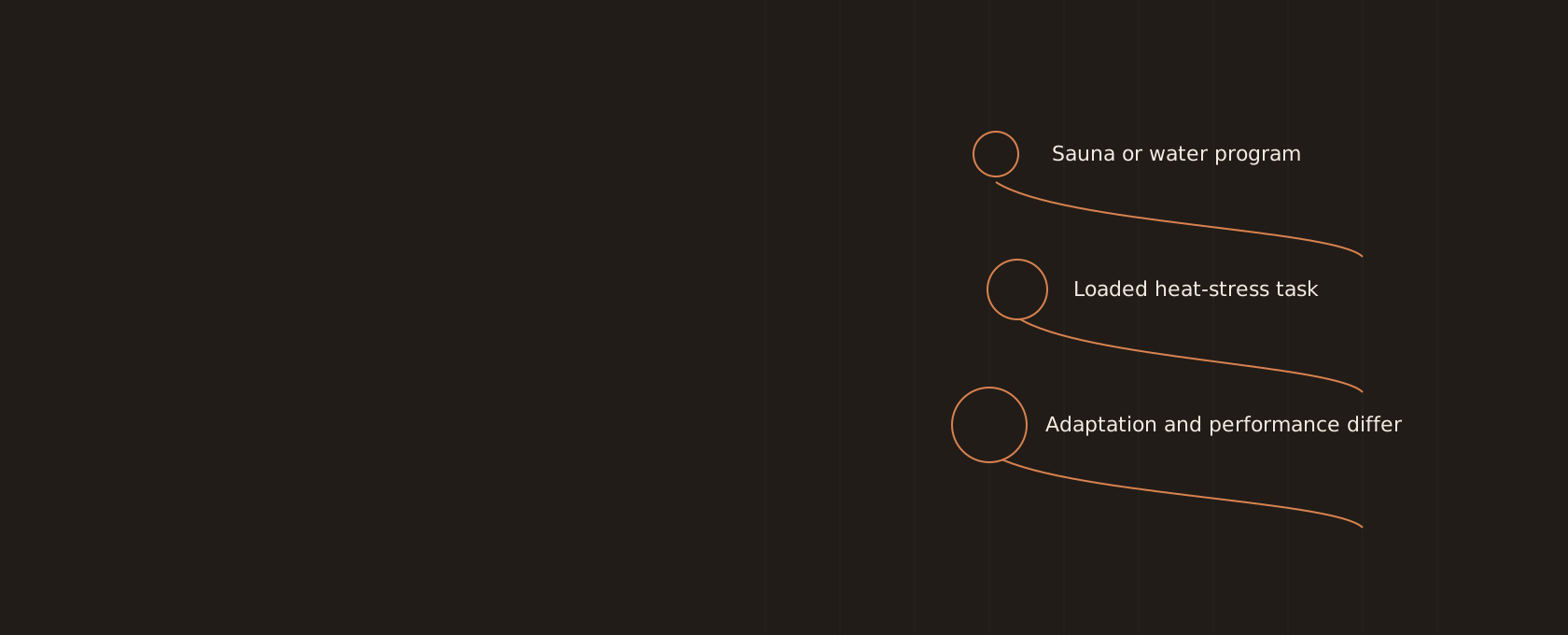
| 2023 · Ashworth E ↗ | partially randomized crossover heat-acclimation experiment military-context participants Participants: 25. sauna versus hot-water immersion · 5 days | Both modalities produced modest heat adaptations; the performance improvement was not statistically significant. Comparison: sauna versus water immersion; 15 participants completed both Only a subset crossed over; small sample; specific loaded walking task. |
| 2021 · Kirby NV ↗ | controlled endurance-training intervention trained middle-distance runners Participants: 20. post-exercise sauna · 3 weeks; subset continued to 7 weeks | Added sauna improved several tested exercise-capacity markers; extended exposure produced limited additional change. Comparison: normal training without added sauna Small trained sample; no randomization stated in abstract; surrogate performance markers. |
| 2025 · Solomon TPJ ↗ | Systematic review and meta-analysis Healthy adults in post-exercise heating trials Participants: 199. Sauna or hot-water immersion | Pooled performance effects were uncertain, and evidence certainty was low to very low despite changes in some physiological measures. Comparison: Same exercise training without post-exercise heating Small underlying trials |
Original publication: Post-exercise, passive heat acclimation with sauna or hot-water immersion provide comparable adaptations to performance in the heat in a military context.
What practical research question motivated the study?
The study examined post-exercise passive heating as preparation for a military-context task in heat. It compared sauna with hot-water immersion, asking whether the approaches produced useful adaptation under the tested program. That is a specific modality question, not a general trial of sauna for every form of athletic performance.
The distinction matters because an operational task involves a particular workload, clothing and environment. A result in that task may inform further military preparation research without describing competitive running, swimming or ordinary leisure use. The paper is best read with its heat-stress test and comparator visible from the beginning, so the word performance retains the actual task rather than becoming a universal benefit label.
Was the whole sample a randomized crossover?
No. The total sample contained twenty-five participants, while fifteen completed both heating approaches in a randomized crossover manner. The paired subset is a meaningful design feature, but it should not be extended to the entire enrolled sample. A short description calling every participant fully crossed over would overstate what the abstract reports.
This affects how a reader reconstructs the comparison and thinks about precision. Within-person comparisons and observations contributed by people completing only one approach are not identical pieces of information. A complete appraisal would inspect the full analysis and handling of those contributions. This summary keeps the reported structure explicit rather than assuming a simpler design from the article’s brief concluding description.
Which exposures were actually compared?
The program used post-exercise sauna at 70°C, equivalent to 158°F, or hot-water immersion at 40°C, equivalent to 104°F, over five days. These were different physical heating approaches under the study conditions. An equal-looking duration or a broadly similar response would not make the air and water environments the same exposure.
The preceding exercise and the program’s observation period belong with the modality labels. The comparison does not establish that a person can exchange any sauna session for any bath and obtain an equivalent result. It also does not define a safe home preparation program. Those practical claims would need their own exposure details, population and evidence rather than being inferred from a shared passive-heating category.
What counted as performance in this experiment?
Participants completed a heat-stress assessment involving loaded walking in military clothing, followed by an incremental task to exhaustion. This is a defined operationally relevant challenge. It differs from a race time, an unloaded treadmill test or a questionnaire about how comfortable heat feels.
The task definition limits both favorable and unfavorable extrapolation. A result here cannot establish what every athlete would do in another sport. Equally, a result from trained runners cannot fill this study’s uncertainty about its own task. The most useful comparison identifies the actual performance test before interpreting physiological changes, because the measurement a reader ultimately cares about may be different from the one this paper assessed.
Which findings support an adaptation interpretation?
The abstract reported modest changes in measured exercise temperature and heart rate after both heating approaches. Those are physiological responses compatible with heat adaptation under the tested conditions. They should be described as changes in those measurements, rather than automatic evidence of better completion of every demanding task.
The distinction preserves the value of the work. An investigator can learn that a heat-response pattern changed even when the performance estimate remains uncertain. The paper does not need to be rewritten as either a complete success or a complete failure. The source contributes a specific adaptation observation and a separately assessed task result, with the difference between them central to its responsible interpretation.
Did the task performance clearly improve?
The reported performance improvement did not reach statistical significance. That means the study did not establish a clear performance advantage under its analysis, despite the physiological changes. A favorable numerical direction should not be presented as a demonstrated operational gain simply because it accompanies lower exercise temperature or heart rate.
Nor does statistical uncertainty prove that improvement is impossible. The small study leaves uncertainty about the effect and its practical size. This page therefore retains the qualitative result already registered in the facts dataset rather than promoting an unregistered numerical estimate. A future study using a suitable comparison and adequate precision could address the remaining task question more directly.
Does comparable adaptation establish universal equivalence?
No. Broadly comparable modest responses in this program do not establish equivalence for all outcomes, populations or exposure schedules. A claim of equivalence also requires attention to how it was defined and tested, which is not established by simply observing similar directions of change.
The study compared two post-exercise heating approaches, without an unheated training control described in the abstract. It therefore cannot answer every question about adding heat beyond the exercise itself. A useful summary keeps the modality comparison distinct from a heat-versus-no-heat efficacy claim. That distinction prevents the results from becoming a general statement that any passive heating method produces the same practical preparation benefit.
| Claim | What the abstract supports | Limit |
|---|---|---|
| Both modalities produced adaptation | Modest physiological responses changed | Not every outcome improved |
| Task performance improved clearly | Not established statistically | Favorable direction is not certainty |
| The entire sample crossed over | Only a subset did | Keep paired and total samples distinct |
| Sauna and water are interchangeable | Not established universally | Exposure and task remain specific |
How does this fit runner and pooled evidence?
The controlled runner study reported selected capacity-marker and heat-test improvements beyond training alone. It tested a different population, exposure program and assessment. Its favorable markers provide context without resolving the military study’s uncertain task performance.
The systematic review of post-exercise heating similarly found performance effects uncertain, with low to very low evidence certainty across its included outcomes. It combined sauna and hot-water work, so its conclusions also require modality and task context. Reading the sources together supports a research interest in passive heating while keeping the limits of actual performance evidence visible. The studies are informative precisely when their different comparisons are preserved.
What remains to be checked in the complete source?
This appraisal uses the indexed abstract and existing verified abstraction. It does not claim a completed full-text review of allocation, paired analysis, adherence, adverse events or formal risk of bias. Those details matter particularly because only part of the sample completed both conditions.
Funding and conflict-of-interest information remain unreported in the abstract-level record. The recorded publisher access was restricted, and unknown details have not been supplied from another experiment. The safety review offers a separate historical context but cannot clear a participant for this program. The defensible conclusion is modest measured adaptation under a specific modality comparison, with no established universal equivalence or reliable performance gain.
Explore the evidence with a tool.
Questions, considered
Questions about this study
Did the military-context sauna study demonstrate significantly better performance?
The reported performance improvement did not reach statistical significance, even though some physiological heat adaptations were observed. Keeping those outcomes separate avoids overstating the findings. Changes in exercise temperature or heart rate can be meaningful research observations without establishing a clear improvement in time to exhaustion.
Follow the sourceWere sauna and hot-water immersion the same exposure in the military study?
No. They were separate post-exercise heating approaches compared within a heat-acclimation program. Water immersion differs physically from heating in air, even when both produce adaptation. The study found broadly comparable modest responses under its conditions, rather than proving that the modalities are interchangeable for every purpose or population.
Follow the sourceDid every participant complete both military heat-acclimation methods?
No. The abstract states that a subset completed both approaches in a randomized crossover manner, while the total participant count was larger. This detail matters when describing the design. It should not be summarized as though the entire sample completed a fully paired comparison of both interventions.
Follow the sourceFollow the evidence
Sources & references
Research summaries in this edition are based on indexed abstracts unless otherwise noted. A source link is not a claim of medical review.
- Post-exercise, passive heat acclimation with sauna or hot-water immersion provide comparable adaptations to performance in the heat in a military context.
Ashworth E, Cotter J, Kilding A
Volume 66, issue 1, pages 49-60 · PMID 35332846
Open-access flag: not recorded.Abstract-level editorial review - Intermittent post-exercise sauna bathing improves markers of exercise capacity in hot and temperate conditions in trained middle-distance runners.
Kirby NV, Lucas SJE, Armstrong OJ, Weaver SR, Lucas RAI
Volume 121, issue 2, pages 621-635 · PMID 33211153
Open-access flag: yes.Abstract-level editorial review - The effect of post-exercise heat exposure (passive heat acclimation) on endurance exercise performance: a systematic review and meta-analysis.
Solomon TPJ, Laye MJ
Volume 17, issue 1, pages 4 · PMID 39762944
Open-access flag: yes.Abstract-level editorial review - Benefits and risks of sauna bathing.
Hannuksela ML, Ellahham S
Volume 110, issue 2, pages 118-126 · PMID 11165553
Open-access flag: not recorded.Abstract-level editorial review