| Study | Design & population | Finding & comparison |
|---|---|---|
| 2019 · Gravel H ↗ | Randomized crossover physiology trial Healthy middle-aged and older adults Participants: 21. Finnish sauna | Neither sauna pattern significantly improved the measured flow-mediated dilation or reactive-hyperemia endpoints acutely. Comparison: Seated time control Small healthy sample |
| 2021 · Gravel H ↗ | acute before-and-after physiological experiment stable coronary artery disease Participants: 22. Finnish sauna | Flow-mediated dilation increased after exposure while reactive hyperemia did not significantly change. Comparison: before versus after Small acute study; stable disease only; no clinical-event comparison. |
| 2023 · Debray A ↗ | randomized controlled trial Stable coronary artery disease Participants: 41. Finnish sauna · 8 weeks | Heat-acclimation measures changed, but endothelial function, stiffness and blood-pressure changes did not favor sauna over control. Comparison: Lifestyle maintenance Small stable-CAD sample |
Endothelial function is a specific question
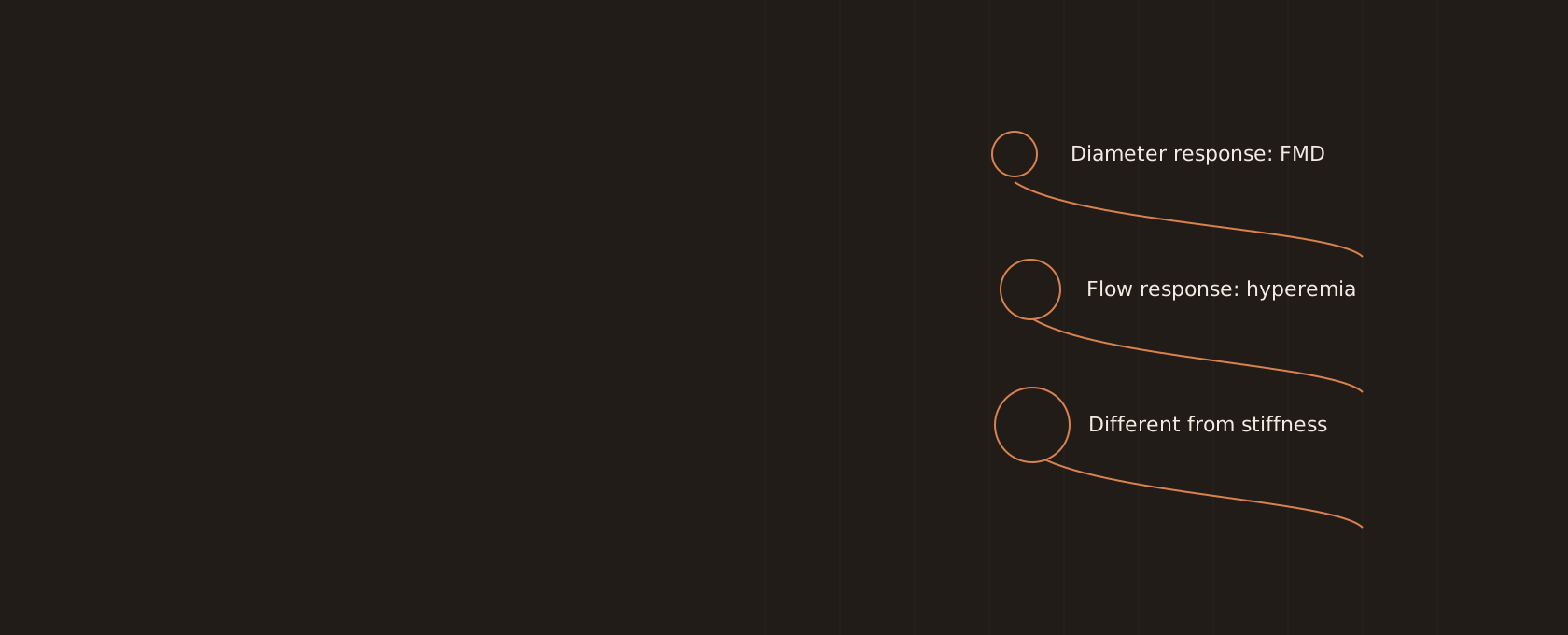
The endothelium is the lining of blood vessels. Research on its function asks how a vessel responds under defined conditions, not simply whether a person feels warm or relaxed after sauna. A prominent test in this literature is brachial artery flow-mediated dilation, usually abbreviated FMD.
The relevant question is whether sauna changes the measured response compared with an appropriate alternative, in a particular population and time window. A general phrase such as better circulation can hide those details. It may refer to blood pressure, pressure-wave travel, a diameter response or a flow response, which are different measurements. This guide focuses on endothelial-related tests and keeps them distinct from the separate arterial-stiffness discussion. The available studies give mixed answers across their actual designs; they do not justify treating any favorable vascular measurement as evidence that all aspects of vessel function improved.
What the dilation test actually measures
FMD assesses the change in an artery’s diameter following a standardized increase in blood flow. In the healthy-adult experiment, researchers measured the brachial artery response around controlled test conditions. The endpoint is a percentage diameter change, not a measure of how many cardiovascular events have been prevented.
That distinction matters when translating the result. A greater measured response can be of mechanistic interest without demonstrating that coronary disease has reversed or that the same change will persist during ordinary life. Interpretation also depends on the test procedure and timing. This summary does not claim a full-text audit of all technical measurement choices. It keeps the measured endpoint visible and avoids replacing it with a broader claim about vascular age or personal prognosis. Those would require different evidence, even if the original physiological result were precise and reproducible.
The controlled healthy-adult study found no acute gain
The randomized crossover study in healthy middle-aged and older adults compared sauna patterns with a seated time-control condition. Neither sauna pattern significantly improved FMD or the measured reactive-hyperemia endpoints. The unheated comparison strengthens interpretation because time, rest and repeat testing can influence measurements even without heating.
The null result should be included whenever sauna is described as reliably improving endothelial function after a typical session. It does not establish that every possible effect is exactly zero or that repeated exposure cannot matter. The study was small and focused on immediate tests. Its useful contribution is narrower: the expected acute improvement was not demonstrated under the tested conditions in this healthy population. Moving beyond that conclusion in either direction would lose the specificity that makes a controlled experiment informative.
An acute coronary-disease experiment had a favorable FMD result
The experiment in adults with stable coronary artery disease reported increased FMD after sauna, while reactive hyperemia did not significantly change. It therefore adds a favorable finding for one test without showing uniform improvement across the vascular measurements. Stable disease also defines its applicability; the study was not evidence for exposure during unstable symptoms.
Its before-and-after design is less able to separate heating from all time-related influences than a matched unheated comparison. The difference from the healthy-adult crossover result might relate to population, timing or protocol, but the abstracts do not establish which explanation is correct. This guide does not invent one. The balanced reading preserves both the observed FMD increase and the design limit. A promising acute result can justify a better-controlled investigation without already establishing a dependable personal benefit.
Repeated sauna did not show the expected clinical-population advantage
A randomized repeated-exposure trial in stable coronary artery disease did not find endothelial or other vascular-marker changes favoring sauna over lifestyle maintenance. Heat-acclimation measures changed, but those adaptations did not amount to a demonstrated endothelial advantage. This is important context for anyone assuming that a favorable acute FMD result must build into a sustained improvement.
The acute and repeated studies ask different questions, even though both involve stable coronary disease. One describes a response around an exposure; the other tests a program against a control over time. The longer trial does not erase the earlier measurement, and the earlier measurement does not override the assigned-program result. Their combination supports uncertainty about translation rather than a simple accumulation story in which every session necessarily adds to vascular improvement.
Reactive hyperemia should not disappear from the summary
Reactive hyperemia is the flow response after a brief interruption of circulation. It probes a different vascular response from the diameter-based FMD test. Both the healthy-adult acute experiment and the stable-coronary acute experiment included related hyperemia measurements, and neither supports describing every measured response as improved.
This is not a minor qualification. A source can have a favorable headline endpoint while another measured endpoint is unchanged. An honest synthesis should state which result supports a proposed mechanism and which remains uncertain. It should also avoid treating an unchanged test as a direct demonstration of harm. These are measurement-specific findings in limited samples. By preserving the null outcomes beside the favorable FMD observation, the reader can see the boundaries of the proposed benefit rather than receiving a selectively positive vascular-health label.
Pressure-wave velocity is a different endpoint
The acute cardiovascular experiment reported lower pressure and pulse-wave velocity after sauna. Pulse-wave velocity concerns the travel of a pressure wave along the arterial path; it is not a substitute measurement of FMD. A favorable result for that marker therefore cannot be used to fill a gap in endothelial evidence.
The distinction also prevents an artificial contradiction. A session can produce a change in a stiffness-related measure without demonstrating an acute improvement in a dilation test. Research should examine how those responses relate rather than assuming they move together. When comparing papers, list the endpoint, population, control condition and timing before deciding how closely their findings correspond. This guide earns a separate place from the arterial-stiffness page because the measured response and the relevant uncertainties are different, even when some of the source publications overlap.
A heat-therapy meta-analysis is context rather than a product estimate
The mixed heat-therapy review reported pooled FMD and blood-pressure changes favoring heating, with certainty varying by outcome. That provides a broader synthesis, but it includes different methods and populations. A pooled heat-therapy result is not automatically a precise estimate for a particular Finnish or infrared sauna routine.
Review date and eligibility also matter. A synthesis describes the studies available and selected for its question, while later direct trials can add disagreement or refine applicability. The stable-coronary randomized result should therefore be read alongside the broader review rather than excluded because the pooled direction was favorable. For a practical choice, ask which exposure and population the analysis actually isolates. A device’s shared use of heat does not supply missing endothelial evidence for that product or validate a proposed session schedule.
There is no validated endothelial-benefit routine here
These sources do not establish a universal exposure schedule for improving endothelial function. The experiments used different populations, exposure patterns and measurement times. Combining a temperature from one source, a frequency from another and a recovery sequence from a third would create a new program without direct evidence for the assembled endothelial claim.
The appropriate practical use is to inspect the research question and clarify expectations. The study explorer can separate designs and source records; the evidence map can show where the outcome is represented. Neither transforms heterogeneous physiological findings into a personal protocol. Grade C reflects emerging and mixed evidence for defined tests, with clinical-event benefit and durability unresolved. If your interest is leisure sauna, do not make an unconfirmed endothelial promise the condition for calling the experience worthwhile. If your interest is medical improvement, discuss that goal with an appropriate clinician.
What would make the evidence clearer
Comparable controlled protocols in independent populations would help distinguish a reproducible endothelial response from differences in testing conditions. Repeated follow-up would address persistence, while studies of patient-important outcomes would be needed before a vascular test could be used to support a clinical-benefit promise. None of those questions is resolved merely by collecting more favorable-looking endpoints.
This page is an abstract-level synthesis of refreshed source records. Full-text measurement methods, all bias concerns and funding or conflicts of interest have not been independently adjudicated; missing disclosure fields remain unreported. The safety review cited separately names unstable angina, recent myocardial infarction and severe aortic stenosis as contraindications and warns about alcohol. It is an older narrative source, not a complete clearance checklist. Personal suitability remains a clinical question even when a research measurement moves in a favorable direction.
Inspect the assumptions
Explore the session planner.
This planning tool describes a routine. It does not estimate a health benefit or provide medical clearance; the study exposures discussed above remain separate research methods.
Interactive workspace
In-memory checkpoint · no medical clearance
Pause for the personal context.
Check every item that applies or that you are unsure about. Current serious symptoms need appropriate care, not a tool result.
Context, with limits
- Checkpoint
- Complete the acknowledgment
A checklist cannot assess every relevant condition. No answer is medical clearance. Responses are in memory only, and are reset on reload.
Calculated on your device. Theme and unit preferences can be stored locally; health answers, weights and logs remain in memory. A shared settings URL contains its visible planning inputs.
Open the complete tool and methodologyExplore the evidence with a tool.
Questions, considered
Questions about this evidence
Why does this guide separate FMD from pulse-wave velocity?
FMD measures an artery’s diameter response to increased flow, while pulse-wave velocity concerns pressure-wave travel. They are different endpoints. A favorable stiffness-related measurement does not establish that a dilation test improved, and a null dilation result does not erase every acute circulatory response. Comparing the actual measurements is more useful than grouping them all under vascular health.
Follow the sourceHow can the acute FMD studies have different findings?
They studied different health populations and used different designs and measurement conditions. The healthy-adult crossover included a seated control and found no significant acute improvement; the stable-coronary experiment reported a before-and-after FMD increase. Those differences are relevant possibilities, but the abstracts do not establish which one explains the disagreement. The conflicting findings should remain visible.
Follow the sourceWhat did unchanged reactive hyperemia add to the evidence?
It showed that the measured vascular responses were not uniformly favorable. Reactive hyperemia assesses flow after an interruption, rather than the diameter change captured by FMD. Keeping its null result beside a favorable FMD observation limits a broad claim of improved vascular function without pretending that the two tests measure the same thing or prove a clinical outcome.
Follow the sourceDid heat acclimation establish endothelial improvement in the repeated trial?
No. The stable-coronary randomized trial showed heat-acclimation changes but did not find vascular-marker improvements favoring sauna over control. Adaptation to heat and an advantage in an endothelial test are separate findings. A physiologically meaningful exposure can therefore occur without demonstrating the particular vascular benefit proposed for that program.
Follow the sourceCan a pooled heat-therapy FMD result describe my preferred sauna?
Only if the analysis isolates an exposure and population relevant to that claim. The broader review combined heat methods and found outcome-dependent certainty. Its pooled direction should not be transferred automatically to a chosen product or routine, especially when later direct sauna trials provide different findings. The eligibility and comparison details matter as much as the summary label.
Follow the sourceWhat benefit has a better dilation test established for an individual?
These experiments do not establish an individual reduction in heart attacks, strokes or mortality from a measured FMD change. They investigate physiological responses under particular conditions. Persistence and clinical translation require their own evidence, so a favorable test should be described as a source-specific observation rather than a personal prognosis or clearance to follow the study exposure.
Follow the sourceFollow the evidence
Sources & references
Research summaries in this edition are based on indexed abstracts unless otherwise noted. A source link is not a claim of medical review.
- Acute effect of Finnish sauna bathing on brachial artery flow-mediated dilation and reactive hyperemia in healthy middle-aged and older adults.
Gravel H, Coombs GB, Behzadi P, Marcoux-Clément V, Barry H, Juneau M, Nigam A, Gagnon D
Volume 7, issue 13, pages e14166 · PMID 31293098
Open-access flag: yes.Abstract-level editorial review - Acute Vascular Benefits of Finnish Sauna Bathing in Patients With Stable Coronary Artery Disease.
Gravel H, Behzadi P, Cardinal S, Barry H, Neagoe PE, Juneau M, Nigam A, Sirois MG, Gagnon D
Volume 37, issue 3, pages 493-499 · PMID 32615263
Open-access flag: not recorded.Abstract-level editorial review - Finnish sauna bathing and vascular health of adults with coronary artery disease: a randomized controlled trial.
Debray A, Gravel H, Garceau L, Bartlett AA, Chaseling GK, Barry H, Behzadi P, Ravanelli N, Iglesies-Grau J, Nigam A, Juneau M, Gagnon D
Volume 135, issue 4, pages 795-804 · PMID 37650138
Open-access flag: not recorded.Abstract-level editorial review - The effect of heat therapy on blood pressure and peripheral vascular function: A systematic review and meta-analysis.
Pizzey FK, Smith EC, Ruediger SL, Keating SE, Askew CD, Coombes JS, Bailey TG
Volume 106, issue 6, pages 1317-1334 · PMID 33866630
Open-access flag: not recorded.Abstract-level editorial review - Acute effects of sauna bathing on cardiovascular function.
Laukkanen T, Kunutsor SK, Zaccardi F, Lee E, Willeit P, Khan H, Laukkanen JA
Volume 32, issue 2, pages 129-138 · PMID 29269746
Open-access flag: not recorded.Abstract-level editorial review - Cardiovascular and Other Health Benefits of Sauna Bathing: A Review of the Evidence.
Laukkanen JA, Laukkanen T, Kunutsor SK
Volume 93, issue 8, pages 1111-1121 · PMID 30077204
Open-access flag: not recorded.Abstract-level editorial review - Benefits and risks of sauna bathing.
Hannuksela ML, Ellahham S
Volume 110, issue 2, pages 118-126 · PMID 11165553
Open-access flag: not recorded.Abstract-level editorial review