| Study | Design & population | Finding & comparison |
|---|---|---|
| 2021 · Kirby NV ↗ | controlled endurance-training intervention trained middle-distance runners Participants: 20. post-exercise sauna · 3 weeks; subset continued to 7 weeks | Added sauna improved several tested exercise-capacity markers; extended exposure produced limited additional change. Comparison: normal training without added sauna Small trained sample; no randomization stated in abstract; surrogate performance markers. |
| 2021 · Kirby NV ↗ | Before-after athlete intervention Trained runners Participants: 26. Post-exercise sauna · 3 weeks | Women and men showed similar improvements in measured heat tolerance and aerobic fitness, but sweating and forearm-flow adaptations differed. Comparison: Before versus after training plus sauna No exercise-only control described in abstract |
| 2025 · Solomon TPJ ↗ | Systematic review and meta-analysis Healthy adults in post-exercise heating trials Participants: 199. Sauna or hot-water immersion | Pooled performance effects were uncertain, and evidence certainty was low to very low despite changes in some physiological measures. Comparison: Same exercise training without post-exercise heating Small underlying trials |
Original publication: Intermittent post-exercise sauna bathing improves markers of exercise capacity in hot and temperate conditions in trained middle-distance runners.
What did the main comparison ask?
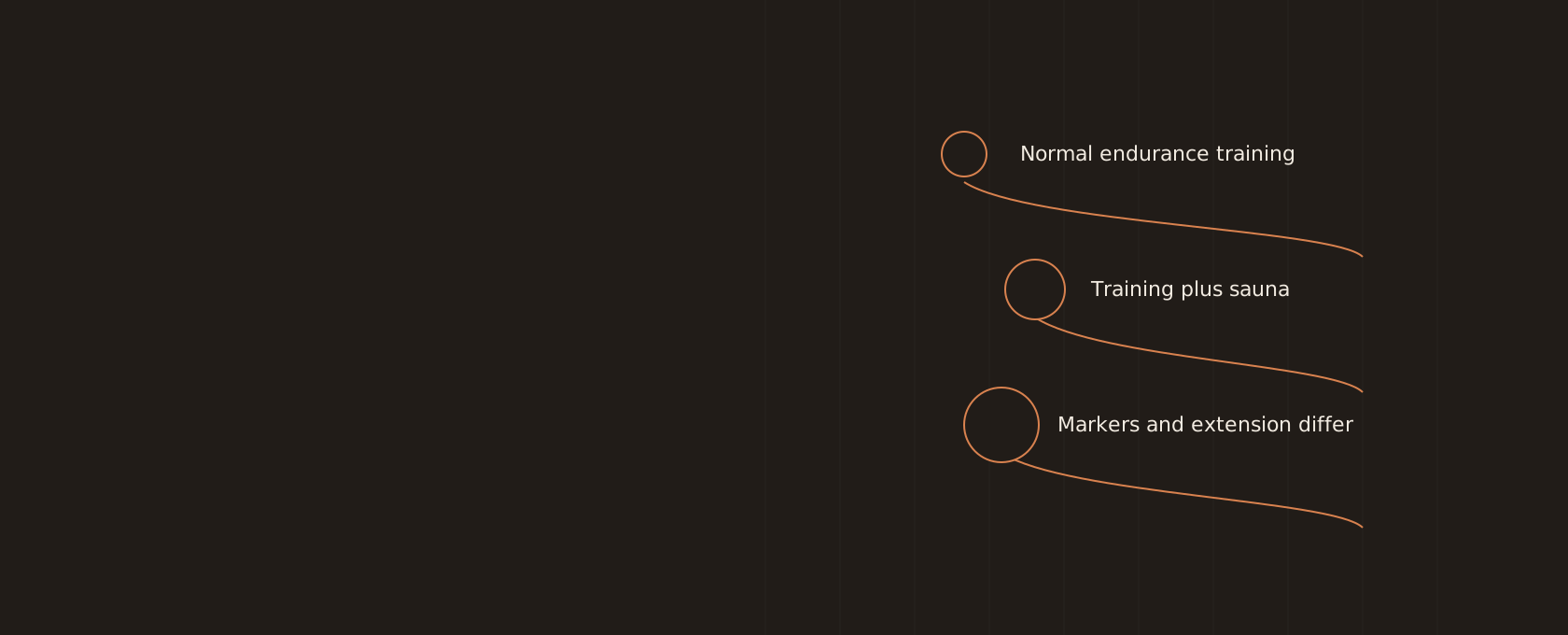
The study asked whether adding intermittent post-exercise sauna improved heat tolerance and selected exercise-capacity markers beyond normal endurance training. This is an incremental question: both groups trained, while one added sauna. The relevant finding is therefore the difference between groups, rather than improvement within the sauna group considered alone.
That design makes the source useful for evaluating an addition to athletic training. It does not test sauna instead of exercise, or establish that someone without a training program would obtain the same result. The indexed abstract describes a controlled comparison but does not state randomized allocation for that main grouping. This summary retains that distinction rather than upgrading the design from the title or a later review.
Who took part, and why does that matter?
The sample consisted of twenty trained middle-distance runners, including thirteen women. These were athletes accustomed to structured exercise, rather than a general population of sauna beginners. Their training background is part of the exposure context, not an incidental detail that disappears when interpreting a favorable marker change.
A small athlete sample including women adds useful representation, but it cannot establish identical responses in every subgroup. It also cannot supply evidence for every age, medical circumstance or sport. The related sex-comparison paper addresses a more specific adaptation question in runners, with its own before-and-after design. Similar research settings do not automatically mean independent replication or a broader population than the source actually enrolled.
What exposure and assessments were used?
The main program added post-exercise sauna across three weeks of normal training. The reported sauna temperature was 101–108°C, equivalent to 213.8–226.4°F. These demanding conditions describe the experiment; they are not a suggested entry point for someone considering recreational use.
The investigators assessed a standardized running heat-tolerance test and separate exercise tests in temperate conditions. Keeping those settings distinct prevents a hot-test response from being confused with performance under another environment. The exposure included the preceding exercise and repeated sessions, not simply a cabin temperature. An attempted home protocol that changes those elements is a different intervention, even if it borrows a numerical detail from the methods.
What does an improved exercise-capacity marker mean?
Selected aerobic-capacity and lactate-related running-speed measures improved more with added sauna than with training alone. These are relevant laboratory outcomes for exercise research. They are not the same as directly demonstrating that every runner completes a competition faster after adding sauna.
The distinction is not a reason to ignore the result. It identifies what the study contributes and what a performance claim would still need. A laboratory marker may motivate a trial using a relevant race or time-trial endpoint, while its clinical or competitive value remains uncertain. This page therefore preserves the source’s capacity language rather than replacing it with a guaranteed individual racing advantage.
What changed during the heat-tolerance test?
The sauna group showed more favorable changes in selected temperature and heart-rate responses during the standardized heat test than the training-only group. Those observations support an acclimation interpretation under the tested conditions. They should remain attached to the exercise workload and environment used for assessment.
A changed response does not establish immunity from heat illness, a safe maximum exposure or a particular individual’s capacity to tolerate a hotter session. It also does not show that every physiological measure changed in the same way. The source is strongest when read as a defined comparison of measured responses, with athletic performance and personal suitability left as separate questions.
Did the longer program keep improving every outcome?
A small subset of the sauna group continued beyond the main comparison. The abstract describes only a further small reduction in peak rectal temperature, with limited additional change in the other physiological variables. The extension does not support a simple assumption that more weeks continually produce more improvement in every marker.
The continuing subset also differs analytically from the main between-group comparison. It was not a newly expanded controlled trial of every outcome. Longer exposure, maintenance after stopping and competitive benefit are separate questions, and the extension does not settle them all. A summary should identify which findings belong to the main program and which belong only to the smaller continuing group.
| Part of the study | Comparison | Inference boundary |
|---|---|---|
| Main program | Training plus sauna versus training alone | Selected between-group marker changes |
| Longer extension | Small continuing sauna subset | Limited further physiological change |
| Race-performance claim | Not a universal race endpoint | Requires a relevant direct performance test |
How does this fit the broader performance evidence?
The performance-focused systematic review judged post-exercise heating effects uncertain, with low to very low certainty. It included sauna and hot-water interventions with varied tasks and methods. A favorable small runner study can contribute to that literature without resolving the pooled uncertainty.
The military comparison provides another useful contrast: physiological heat adaptations occurred without a statistically clear performance improvement in its loaded task. Those results do not erase the runner findings; they show that the performance question depends on what was tested. Read the source as evidence about selected trained-runner markers, rather than a universal answer for endurance sports, hot-weather work or every form of passive heating.
What remains outside this appraisal?
The indexed abstract and verified corpus abstraction were read. This is not a completed full-text assessment of allocation, missing data, training adherence, analysis choices or formal risk of bias. The demanding exposure and small continuing subset make those details important before adopting a stronger interpretation.
Funding and conflict-of-interest information are unreported in the abstract-level abstraction used here. They are not presumed absent. The source has a free full-text link, but access availability and completion of appraisal are different states. Numerical result sizes missing from the registered facts have not been introduced. The defensible conclusion remains selected favorable markers under a specific training comparison, with limited further change in the extension.
Explore the evidence with a tool.
Questions, considered
Questions about this study
Did the runners’ sauna study compare against no exercise?
No. Both groups continued endurance training, and one group added post-exercise sauna. This comparator matters because the question concerns additional changes beyond training itself. Improvements in the sauna group should be interpreted against the training-only group, rather than attributed to sauna without considering the shared exercise program.
Follow the sourceDid extending the runners’ sauna program keep improving every measurement?
No. In the small subset continuing longer, only a further small reduction in peak rectal temperature was reported, while other physiological variables did not change significantly. The findings do not support assuming that progressively more weeks of exposure create continuing improvements in every performance or heat-tolerance measure.
Follow the sourceDo better exercise-capacity markers guarantee faster race performance after sauna?
No. The study tested aerobic-capacity, lactate-related speed and heat-tolerance measures rather than a universal race-performance outcome. Those markers are relevant to training research but do not guarantee a competitive improvement for every runner. The participants were trained middle-distance athletes under the specific intervention conditions.
Follow the sourceFollow the evidence
Sources & references
Research summaries in this edition are based on indexed abstracts unless otherwise noted. A source link is not a claim of medical review.
- Intermittent post-exercise sauna bathing improves markers of exercise capacity in hot and temperate conditions in trained middle-distance runners.
Kirby NV, Lucas SJE, Armstrong OJ, Weaver SR, Lucas RAI
Volume 121, issue 2, pages 621-635 · PMID 33211153
Open-access flag: yes.Abstract-level editorial review - Sex differences in adaptation to intermittent post-exercise sauna bathing in trained middle-distance runners.
Kirby NV, Lucas SJE, Cable TG, Armstrong OJ, Weaver SR, Lucas RAI
Volume 7, issue 1, pages 51 · PMID 34297227
Open-access flag: yes.Abstract-level editorial review - The effect of post-exercise heat exposure (passive heat acclimation) on endurance exercise performance: a systematic review and meta-analysis.
Solomon TPJ, Laye MJ
Volume 17, issue 1, pages 4 · PMID 39762944
Open-access flag: yes.Abstract-level editorial review - Post-exercise, passive heat acclimation with sauna or hot-water immersion provide comparable adaptations to performance in the heat in a military context.
Ashworth E, Cotter J, Kilding A
Volume 66, issue 1, pages 49-60 · PMID 35332846
Open-access flag: not recorded.Abstract-level editorial review - Benefits and risks of sauna bathing.
Hannuksela ML, Ellahham S
Volume 110, issue 2, pages 118-126 · PMID 11165553
Open-access flag: not recorded.Abstract-level editorial review