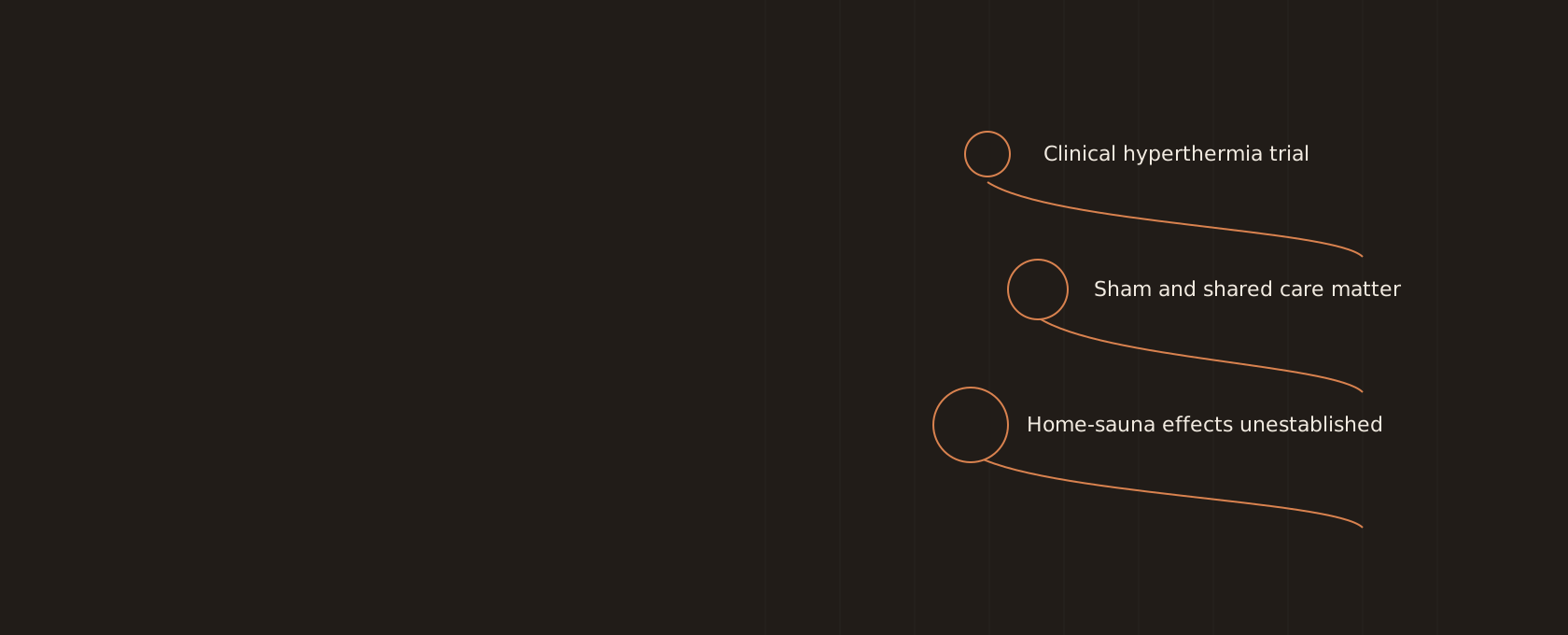
| Study | Design & population | Finding & comparison |
|---|---|---|
| 2016 · Janssen CW ↗ | randomized sham-controlled trial Major depressive disorder; medically healthy; no psychotropic medication Participants: 34. medical whole-body hyperthermia | Depression scores were lower following active medical hyperthermia than sham during follow-up; 29 participants entered the modified efficacy analysis. Comparison: Sham mimicking the procedure without intense heat Small selected population |
| 2025 · Mason AE ↗ | Randomized single-blind acceptability trial Major depressive disorder Participants: 30. Clinical whole-body hyperthermia using infrared device | Both arms improved substantially; the study primarily evaluated acceptability and did not establish an additional antidepressant effect from active heat. Comparison: CBT plus active hyperthermia versus CBT plus sham hyperthermia Small clinical trial |
| 2026 · Magatova N ↗ | qualitative phenomenological interview study regular sauna users Participants: 11. Finnish-style sauna | Interviewees described emotional regulation, connection and reflective experiences associated with sauna rituals. Comparison: Not reported in the reviewed abstract Self-selected users; all white European; perceptions do not establish clinical efficacy. |
Has ordinary sauna been shown to improve clinical depression?
The direct clinical findings considered here concern defined whole-body hyperthermia procedures, not a general home-sauna routine. One small sham-controlled trial reported lower depression scores after active hyperthermia. A later study combining cognitive behavioral therapy with active or sham heat primarily examined acceptability and did not establish an additional symptom benefit from active heat.
Those findings create a research question, not a simple yes for every sauna product. Clinical depression, short-term mood, social connection and enjoyment of a ritual are also different outcomes. This guide keeps the medical procedure, comparison and participant selection attached to the clinical results. Accounts of feeling better after ordinary sauna are presented as a separate kind of evidence, rather than used to fill the gap between an experimental intervention and everyday use.
Why is whole-body hyperthermia different from a product label?
Whole-body hyperthermia, abbreviated WBH, is the intervention category in the clinical papers. It involves a defined research procedure intended to raise body temperature, with eligibility, measurement and comparison conditions. A cabin or device label by itself does not reproduce that full intervention.
The later CBT study used an infrared sauna device, so it would be inaccurate to claim that no sauna-type equipment was involved. The important distinction is between a device and the clinical protocol in which it was used. The papers do not validate every infrared cabin, ordinary session or self-directed schedule for depressive symptoms. Exposure targets, participant characteristics and accompanying care cannot be assumed equivalent merely because two settings share the word infrared.
Who entered the earlier sham-controlled trial?
The earlier trial enrolled medically healthy adults with major depressive disorder who were free of psychotropic medication use. That selection is essential to interpreting the result. It does not establish the same response among people using psychiatric medication, with different medical circumstances or without the diagnosis assessed in the study.
The absence of medication in the sample is an eligibility feature, not advice to stop medication before considering sauna. The research did not test a medication-change strategy or an ordinary leisure program. A reader evaluating a practical claim should ask whether it preserves these enrollment conditions. Removing them makes the result appear more broadly applicable than the sample supports and can turn a clinical research finding into an unsupported action plan.
Why do randomized and analyzed participant counts differ?
The earlier study randomized 34 people, 30 received a study intervention and 29 entered its modified efficacy analysis after providing a post-intervention assessment. These are different denominators. A description that calls all randomized participants the analyzed sample would misstate the source.
The distinction matters because random allocation and the analysis population are related but not identical features of a trial. Exclusions after allocation and missing outcomes need examination in the full methods. This abstract-level summary does not assume their effects were negligible or that every missing observation would support the same conclusion. It preserves the reported counts and identifies the modified analysis, while leaving a formal assessment of how that choice affects bias to a deeper review.
What did the earlier active-versus-sham result show?
Depression scores were lower after active medical hyperthermia than after the sham procedure during follow-up. The sham was designed to resemble the procedure without the intense heat, providing a more informative comparison than observing one active group before and after exposure. The finding is a promising result under those trial conditions.
It does not establish long-term remission, a universally effective session or a personal guarantee. The follow-up covered a limited period and the analyzed sample was small. This guide therefore preserves the qualitative registered result rather than importing an unverified effect size or turning one session into a general schedule. The source’s favorable conclusion remains a reason for further clinical research, with applicability, precision and sustained outcomes still requiring attention.
What was different in the CBT-plus-hyperthermia study?
All participants in the later trial received cognitive behavioral therapy, abbreviated CBT, and were randomized to active or sham WBH in addition. The primary question was study acceptability. This is a different comparison from the earlier trial and should not be presented as a simple independent repeat of the same heat-only efficacy question.
Both arms showed substantial reductions in depressive symptoms. That improvement cannot by itself establish the additional contribution of active heat, because both groups received psychological care and a heat-related procedure. The abstract calls for further research on whether adding WBH to CBT produces an additional effect. A careful summary retains that open question instead of attributing the combined program’s improvement entirely to sauna or heat.
Why does the later study discuss sham credibility?
The later trial reported problems with the sham condition’s credibility. Participants’ beliefs about their allocation matter when interpreting procedures and subjective outcomes. The source also raises the possibility that the sham condition was not biologically inert, which complicates its role as a comparison.
Neither issue licenses a simple conclusion that active heat must work or cannot work. They identify design questions for future trials: what the comparator does, whether the procedure is credible and how the additional intervention effect can be separated from shared care. An acceptability finding can help develop a trial while leaving efficacy unresolved. This is why the page does not use satisfaction with the procedure as a substitute for a demonstrated advantage in depressive-symptom outcomes.
What do ordinary sauna users report about wellbeing?
The interview study of regular Finnish-style sauna users described emotional regulation, reflection, social connection and related perceived experiences. Such accounts can explain what participants value about sauna and help researchers understand the setting. They do not establish a clinical effect on major depressive disorder.
The sample was small and self-selected, and the reported experiences should retain that context. Qualitative research is not a failed version of a randomized trial; it answers a different question. The problem arises only when an account of meaningful personal experience is advertised as a measured clinical intervention effect. A reader can respect those experiences while keeping them separate from symptom-score comparisons, diagnostic outcomes and decisions about established care.
How should the different designs be put together?
Organize them by question rather than by whether the title sounds favorable. The earlier sham-controlled trial addresses a clinical symptom comparison in selected patients. The CBT trial addresses acceptability and an unresolved added-heat question. The interview and social studies address perceived wellbeing and the context of a practice.
The systematic review of dry-sauna research provides a broader caution about small studies, heterogeneous interventions and incomplete adverse-event evidence. It does not convert every clinical WBH or social-sauna finding into an equivalent intervention. This evidence map allows the sources to inform one another without pretending they repeat the same experiment. It also shows why a single blanket claim about sauna and depression loses information that matters to a reader deciding what was actually tested.
| Evidence type | Question it can inform | Unsupported substitution |
|---|---|---|
| Active versus sham clinical WBH | Symptom comparison under selected trial conditions | Every home-sauna routine has the same effect |
| CBT plus active or sham WBH | Acceptability and a further added-effect question | All improvement was caused by active heat |
| User interviews | Meaning and perceived wellbeing | A clinical diagnostic effect |
| Social and ritual studies | Relationships involving identity and wellbeing | Isolated biological heat efficacy |
Which clinical outcomes should stay on separate lines?
The earlier trial reported Hamilton Depression Rating Scale outcomes, while the CBT trial used the Beck Depression Inventory-II in its symptom reporting. Those instruments, diagnostic classifications and acceptability questions are not interchangeable. A favorable change on one scale does not supply an identical numerical change on another, and willingness to recommend a study does not measure the same thing as symptom improvement.
This distinction also prevents an invalid comparison between the trials. Their populations, shared care, procedures and analyses differed along with the reported outcomes. A larger-looking within-group change in one cannot establish that its heat exposure is superior to the other program. The correct question is what happened under the comparison each trial actually made.
An evidence table should therefore retain the instrument, analysis population and observation period beside each result. It should mark the primary acceptability question separately from symptom findings and avoid converting a limited follow-up score into a promise of lasting remission. That structure makes the clinical evidence more useful without manufacturing an individualized outcome.
Does the research establish a home schedule or care change?
It does not establish a validated temperature, duration, frequency or device choice for self-directed depression care. The abstracts do not supply a complete transferable clinical protocol, and a routine assembled from unrelated sauna studies would remain a new intervention. This guide deliberately leaves those missing practical quantities unfilled.
The earlier trial’s medication eligibility and the later trial’s shared CBT are features of the research, not instructions to modify a person’s care. An ordinary session planner cannot reproduce clinical assessment, validate a psychiatric intervention or predict symptom improvement. If a person wants to discuss heat exposure, the relevant conversation is with a qualified clinician who knows their circumstances. A favorable source average does not establish that a new routine is appropriate or that other care can be replaced.
What conclusion remains justified?
Grade C reflects emerging clinical evidence with small selected samples, different procedures and unresolved questions about additional heat effects. The earlier symptom finding deserves attention, while the later acceptability result, shared CBT and sham concerns limit a simple efficacy narrative. Nonclinical wellbeing evidence adds context without supplying clinical confirmation.
This synthesis is based on indexed abstracts and verified source abstractions. Complete trial methods, formal risk of bias, funding and conflict-of-interest disclosures have not been fully appraised; unreported information remains unknown. The historical safety review supplies general sauna cautions, not psychiatric clearance or a complete checklist for every condition. The defensible result is interest in a bounded research area, with no established home-sauna depression program and no basis here for changing clinician-directed care.
Inspect the assumptions
Explore the session planner.
This planning tool describes a routine. It does not estimate a health benefit or provide medical clearance; the study exposures discussed above remain separate research methods.
Interactive workspace
In-memory checkpoint · no medical clearance
Pause for the personal context.
Check every item that applies or that you are unsure about. Current serious symptoms need appropriate care, not a tool result.
Context, with limits
- Checkpoint
- Complete the acknowledgment
A checklist cannot assess every relevant condition. No answer is medical clearance. Responses are in memory only, and are reset on reload.
Calculated on your device. Theme and unit preferences can be stored locally; health answers, weights and logs remain in memory. A shared settings URL contains its visible planning inputs.
Open the complete tool and methodologyExplore the evidence with a tool.
Questions, considered
Questions about this evidence
Does use of an infrared device make the CBT trial a home-sauna test?
The device was part of a defined clinical research procedure with shared CBT, eligibility conditions and active-versus-sham allocation. That does not validate every infrared cabin or ordinary session for depressive symptoms. The relevant evidence concerns the complete intervention and comparison, not equipment terminology separated from the clinical protocol.
Follow the sourceWhy should the earlier trial retain three different participant denominators?
Randomized, intervention-receiving and analyzed participants are different groups in the source. The trial randomized more people than entered its modified efficacy analysis. Preserving those distinctions helps readers assess missing outcomes and interpretation; it avoids describing the result as if every randomized participant supplied the same follow-up information.
Follow the sourceCan improvement in both CBT groups identify active heat as the cause?
Both groups received CBT and a heat-related procedure, so within-group improvement does not isolate an additional active-heat effect. The trial primarily evaluated acceptability and called for further research into the added contribution of WBH. Its symptom changes should not be attributed entirely to heat or converted into an established sauna-only intervention.
Follow the sourceDo accounts of better wellbeing establish a clinical depression effect?
They describe perceived experiences among regular users, not a randomized comparison for major depressive disorder. The interview findings can explain valued aspects of sauna without supplying clinical efficacy. Keep personal meaning, everyday mood and diagnosed depressive-symptom outcomes separate instead of using one as a substitute for the evidence required by another.
Follow the sourceCan social-sauna wellbeing findings predict an effect from solitary heat exposure?
The social studies examined identity, ritual and related relationships with wellbeing. They did not isolate heat from those surrounding experiences or validate the same outcome for solitary home use. Their context is informative, but it should not be removed when discussing what the findings can support about a different setting.
Follow the sourceDoes the earlier trial support stopping medication before using a sauna?
No medication-change strategy was tested. The absence of psychotropic medication was part of the selected enrollment conditions, not an instruction for readers. The study does not establish that changing prescribed care makes ordinary sauna effective or appropriate. Decisions about existing care and intended heat exposure belong with a qualified clinician familiar with the individual.
Follow the sourceFollow the evidence
Sources & references
Research summaries in this edition are based on indexed abstracts unless otherwise noted. A source link is not a claim of medical review.
- Whole-Body Hyperthermia for the Treatment of Major Depressive Disorder: A Randomized Clinical Trial.
Janssen CW, Lowry CA, Mehl MR, Allen JJ, Kelly KL, Gartner DE, Medrano A, Begay TK, Rentscher K, White JJ, Fridman A, Roberts LJ, Robbins ML, Hanusch KU, Cole SP, Raison CL
Volume 73, issue 8, pages 789-795 · PMID 27172277
Open-access flag: not recorded.Abstract-level editorial review - A Randomized Trial Testing a Novel Mind and Body Intervention for Depression: Cognitive Behavioral Therapy (CBT) and Whole-Body Hyperthermia (WBH).
Mason AE, Hartogensis W, Chowdhary A, Siwik CJ, Pandya LS, Jung E, Lupesko-Persky O, Hartley E, Hopkins L, Roberts S, Borovinsky J, Nelson JC, Lowry CA, Patrick RP, Moran PJ, Raison CL, Hecht FM
Volume 14, pages 27536130251387714 · PMID 41146956
Open-access flag: yes.Abstract-level editorial review - Mental Well-Being and Regular Sauna Bathing: A Phenomenological Study of Psychological Experiences and Perceived Impact.
Magatova N, Hunt DF, Lay J
, pages 10497323261462404 · PMID 42479061
Open-access flag: not recorded.Abstract-level editorial review - Sauna culture improves physical and mental wellbeing in the UK through social connection and ritual.
Newson M, McGrath R, Mosina I, Reason G, Peitz L
Volume 394, pages 119061 · PMID 41679164
Open-access flag: not recorded.Abstract-level editorial review - Clinical Effects of Regular Dry Sauna Bathing: A Systematic Review.
Hussain J, Cohen M
Volume 2018, pages 1857413 · PMID 29849692
Open-access flag: yes.Abstract-level editorial review - Benefits and risks of sauna bathing.
Hannuksela ML, Ellahham S
Volume 110, issue 2, pages 118-126 · PMID 11165553
Open-access flag: not recorded.Abstract-level editorial review
Can social and ritual findings isolate a heat effect?
The UK social studies linked sauna-related identity, ritual and synchrony with wellbeing. Their longitudinal and cross-sectional components add useful information about how a social practice may be experienced. They were not randomized heat-versus-no-heat tests of a clinical depression intervention.
That distinction helps explain why a sauna session can be meaningful without proving that thermal exposure alone caused a clinical change. The setting includes people, expectations and repeated ritual as well as heat. These studies cannot identify how much of the reported wellbeing relationship would transfer to solitary home use or a different community. They broaden the social context of the evidence, while leaving the clinical and biological heat questions separate.