| Study | Design & population | Finding & comparison |
|---|---|---|
| 2016 · Janssen CW ↗ | randomized sham-controlled trial Major depressive disorder; medically healthy; no psychotropic medication Participants: 34. medical whole-body hyperthermia | Depression scores were lower following active medical hyperthermia than sham during follow-up; 29 participants entered the modified efficacy analysis. Comparison: Sham mimicking the procedure without intense heat Small selected population |
| 2025 · Mason AE ↗ | Randomized single-blind acceptability trial Major depressive disorder Participants: 30. Clinical whole-body hyperthermia using infrared device | Both arms improved substantially; the study primarily evaluated acceptability and did not establish an additional antidepressant effect from active heat. Comparison: CBT plus active hyperthermia versus CBT plus sham hyperthermia Small clinical trial |
| 2026 · Magatova N ↗ | qualitative phenomenological interview study regular sauna users Participants: 11. Finnish-style sauna | Interviewees described emotional regulation, connection and reflective experiences associated with sauna rituals. Comparison: Not reported in the reviewed abstract Self-selected users; all white European; perceptions do not establish clinical efficacy. |
Original publication: Whole-Body Hyperthermia for the Treatment of Major Depressive Disorder: A Randomized Clinical Trial.
What specific question did the trial test?
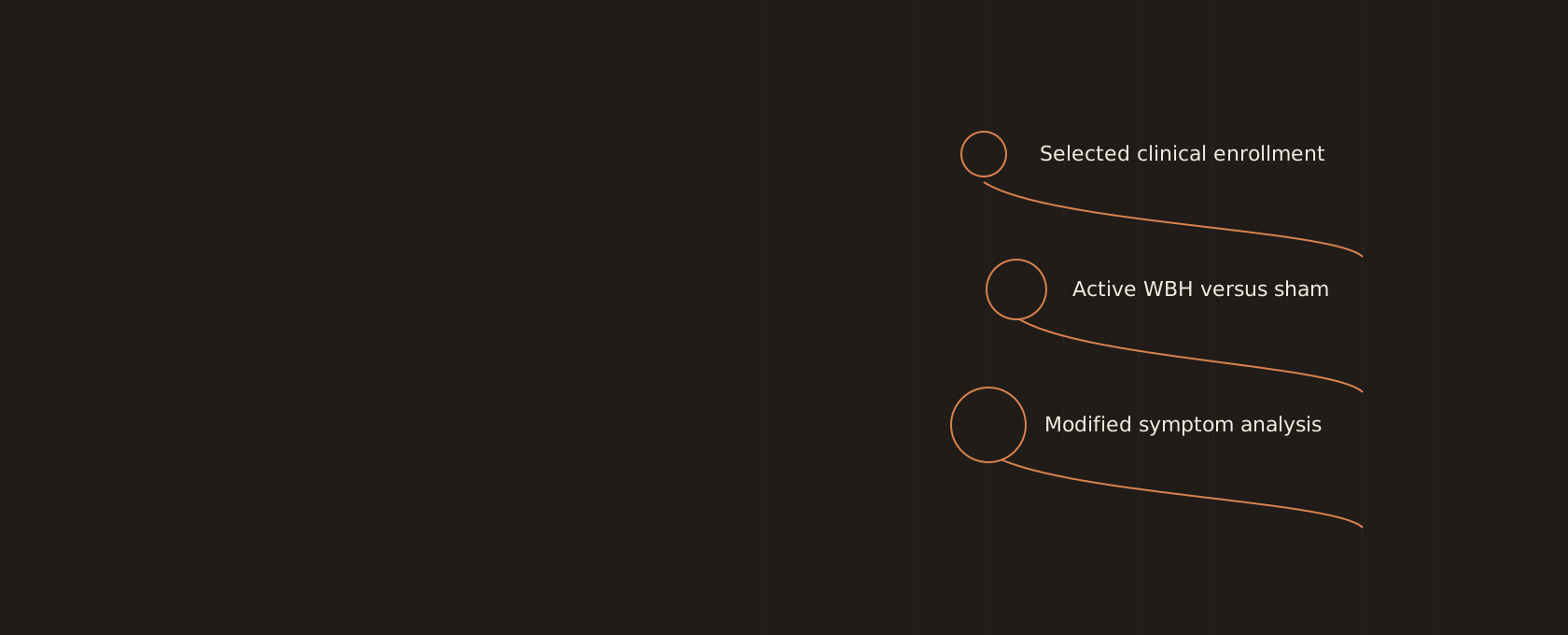
The trial compared a single active whole-body hyperthermia procedure with a sham procedure in selected adults with major depressive disorder. It asked whether the active intervention produced a different subsequent depression-score result, rather than simply recording improvement after one open exposure.
The sham comparison is central because a clinical visit includes more than heat alone. Procedure, expectation and attention can matter when interpreting a symptom outcome. This trial attempted a more informative contrast than an uncontrolled before-and-after observation. Its contribution remains a defined clinical research comparison, not proof that every setting described as sauna has the same effect or that an ordinary user can reproduce the intervention independently.
How did the participant criteria limit applicability?
Participants were medically healthy adults with major depressive disorder who were not using psychotropic medication. Those criteria define the group in which the active-versus-sham comparison was made. They do not establish the same response in people with different medical circumstances, medication use or diagnostic status.
A medication-free study sample must not become a suggestion to discontinue medication. The investigators did not test that action as a route to better outcomes. The clinical question also differs from whether a person enjoys or feels calmer after leisure sauna. Preserving enrollment conditions protects the source from becoming a general recommendation detached from the selected participants and procedure.
Why are the participant-flow counts essential?
The source randomized 34 people, 30 received a study intervention and 29 provided a post-intervention assessment and entered the modified efficacy analysis. Each count describes a different stage of the trial. Combining them into one analyzed sample would erase information needed for interpretation.
The allocation label does not by itself establish how exclusions or missing outcomes affected the result. A formal review should inspect the full participant flow and analysis decisions. This page records the reported denominator rather than assuming everyone randomized contributed the same information. The favorable symptom comparison therefore remains attached to the modified analysis population, with any stronger claim about missing data reserved for a complete methodological assessment.
| Trial stage | Reported count | Interpretation |
|---|---|---|
| Randomized | 34 | Allocation population |
| Received an intervention | 30 | Exposure count differs from randomized count |
| Modified efficacy analysis | 29 | Outcome finding belongs to this analyzed population |
| New home-sauna user | Not tested as such | Do not substitute a different procedure or population |
What was the comparison designed to resemble?
The sham was intended to mimic the procedure without the intense heat, and outcome-related staff procedures were blinded to allocation as described in the abstract. These are useful features for a symptom comparison, but the design label should not be treated as proof that every participant’s experience or expectation was identical.
A full appraisal would inspect the intervention methods, credibility measures and handling of expectations. This summary does not claim to have resolved those questions from the brief record alone. The appropriate interpretation acknowledges what the sham attempted while keeping the actual clinical comparison visible. It is not equivalent to comparing an ordinary home sauna with no activity.
What did the registered result show?
Depression scores were lower following active WBH than following sham during the reported follow-up. That is a favorable between-group symptom finding under the tested clinical conditions. It is more specific than a general statement that heat improves mood and should retain the selected sample and analysis population.
This summary uses the verified qualitative result without adding effect-size quantities absent from the facts registry. A group score difference is not a guarantee for an individual, a finding about every depression-related outcome or evidence that another device delivers the same intervention. The result supports further clinical investigation while leaving the practical transfer questions unresolved.
Does the follow-up establish lasting remission?
The trial followed outcomes across a limited post-intervention period. That permits discussion of persistence within the observation window, not an unlimited claim about long-term remission, maintenance or recurrence. A single-session design also does not establish an optimal repeated schedule.
Those questions require their own data. The source cannot validate a weekly home program simply because it observed a favorable result after one clinical procedure. Nor should a limited score comparison be converted into a promise about future clinical status. The useful conclusion keeps the timing attached to the measurement and identifies long-term durability and routine selection as separate evidence needs.
Is the later CBT trial an identical replication?
No. In the later study, all participants received cognitive behavioral therapy and were randomized to active or sham WBH in addition. Its primary question was acceptability, and both arms improved substantially. It did not establish an additional symptom effect from active heat.
The different shared care and comparison prevent the later paper from becoming a simple repetition of the earlier intervention. Its sham-credibility concerns also add design questions rather than settling the entire efficacy issue. Read together, the trials define an emerging clinical research area. They should not be compressed into a claim that every heat program has repeatedly demonstrated an identical depression benefit.
Why are sauna wellbeing interviews a different evidence category?
Regular users in the qualitative sauna study described valued emotional, reflective and social experiences. That research can explain how a practice is perceived without testing a clinical WBH intervention or establishing a diagnostic effect. It is relevant context, not an alternative confirmation of the sham-controlled symptom result.
The distinction allows both kinds of research to remain useful. A personal account of wellbeing need not be dismissed, and a clinical trial need not be generalized to every pleasant heat experience. A source map should identify whether the question concerns lived experience, a symptom-scale comparison or a defined clinical diagnosis before applying one finding to another setting.
What has not been independently assessed here?
The indexed abstract and verified corpus abstraction were read. This is not a completed full-text appraisal of allocation, exclusions, masking, adverse events or formal risk of bias. The selected population and modified analysis make those details important before assigning a stronger interpretation.
Funding and conflict-of-interest disclosures remain unreported in the abstract-level record used here, rather than assumed absent. The historical safety review supplies separate general context but cannot provide psychiatric clearance. The defensible conclusion is a favorable clinical WBH symptom comparison in a small selected analyzed sample, with limited follow-up and no validated ordinary sauna routine. It does not supply a basis for changing existing care independently.
Explore the evidence with a tool.
Questions, considered
Questions about this study
Was the Janssen depression trial a study of a home sauna?
No. It evaluated medical whole-body hyperthermia against a sham procedure in selected participants with major depressive disorder. That exposure and research setting differ from ordinary home sauna use. Its promising symptom results do not validate a do-it-yourself depression protocol or show that any infrared cabin reproduces the intervention.
Follow the sourceDid everyone randomized in the whole-body hyperthermia trial enter the efficacy analysis?
No. Fewer participants received an intervention than were randomized, and the modified efficacy analysis included those providing a later assessment. Those distinctions matter when describing sample size and uncertainty. A headline should identify the randomized population and the analyzed population rather than using the larger number without explanation.
Follow the sourceDoes the hyperthermia trial establish long-term depression remission?
No. The trial followed depression-rating scores over a limited period after one procedure. Lower scores relative to sham do not establish durable remission, effectiveness in every clinical population or equivalence to established care. The participants were also selected and medication-free, which narrows how directly the findings apply to other patients.
Follow the sourceFollow the evidence
Sources & references
Research summaries in this edition are based on indexed abstracts unless otherwise noted. A source link is not a claim of medical review.
- Whole-Body Hyperthermia for the Treatment of Major Depressive Disorder: A Randomized Clinical Trial.
Janssen CW, Lowry CA, Mehl MR, Allen JJ, Kelly KL, Gartner DE, Medrano A, Begay TK, Rentscher K, White JJ, Fridman A, Roberts LJ, Robbins ML, Hanusch KU, Cole SP, Raison CL
Volume 73, issue 8, pages 789-795 · PMID 27172277
Open-access flag: not recorded.Abstract-level editorial review - A Randomized Trial Testing a Novel Mind and Body Intervention for Depression: Cognitive Behavioral Therapy (CBT) and Whole-Body Hyperthermia (WBH).
Mason AE, Hartogensis W, Chowdhary A, Siwik CJ, Pandya LS, Jung E, Lupesko-Persky O, Hartley E, Hopkins L, Roberts S, Borovinsky J, Nelson JC, Lowry CA, Patrick RP, Moran PJ, Raison CL, Hecht FM
Volume 14, pages 27536130251387714 · PMID 41146956
Open-access flag: yes.Abstract-level editorial review - Mental Well-Being and Regular Sauna Bathing: A Phenomenological Study of Psychological Experiences and Perceived Impact.
Magatova N, Hunt DF, Lay J
, pages 10497323261462404 · PMID 42479061
Open-access flag: not recorded.Abstract-level editorial review - Benefits and risks of sauna bathing.
Hannuksela ML, Ellahham S
Volume 110, issue 2, pages 118-126 · PMID 11165553
Open-access flag: not recorded.Abstract-level editorial review