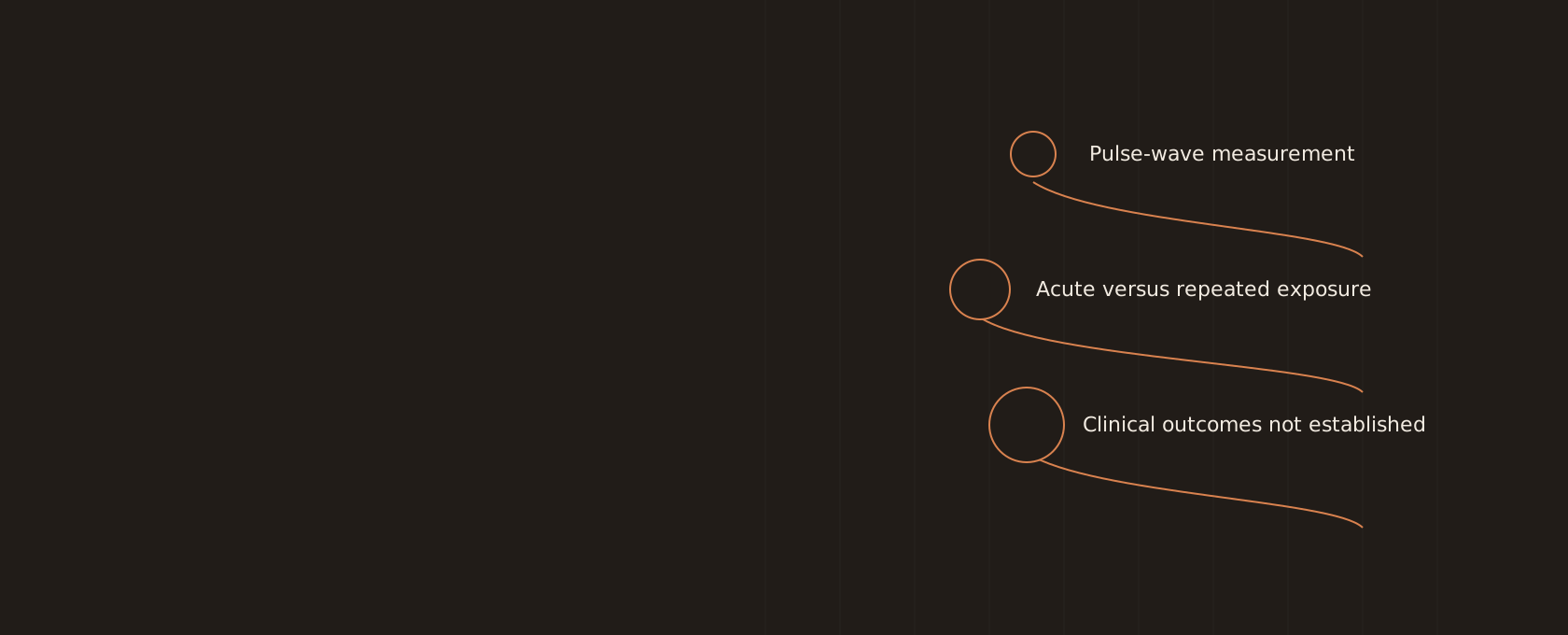
| Study | Design & population | Finding & comparison |
|---|---|---|
| 2018 · Lee E ↗ | nonrandomized acute experimental study Asymptomatic adults with cardiovascular risk factors Participants: 102. Finnish sauna · Acute plus 30-minute recovery | Pressure-wave speed and blood pressure fell immediately after exposure; some changes persisted during the short recovery observation. Comparison: Within-person pre-exposure measurement No randomized comparison |
| 2018 · Laukkanen T ↗ | Single-session experimental before-after study At least one cardiovascular risk factor Participants: 102. Sauna | Blood pressure and pulse-wave velocity fell after exposure, but the study did not establish durable changes or fewer cardiovascular events. Comparison: Before, immediately after and recovery No unheated comparator described |
| 2023 · Debray A ↗ | randomized controlled trial Stable coronary artery disease Participants: 41. Finnish sauna · 8 weeks | Heat-acclimation measures changed, but endothelial function, stiffness and blood-pressure changes did not favor sauna over control. Comparison: Lifestyle maintenance Small stable-CAD sample |
Can sauna make arteries less stiff?
Some acute sauna experiments reported lower pulse-wave velocity after exposure, while a repeated Finnish-sauna trial in stable coronary artery disease did not find a stiffness advantage over control. These findings concern different observation periods and comparisons. They support interest in a vascular response to heat, but do not establish that sauna reliably reverses arterial aging or prevents cardiovascular events.
Pulse-wave velocity describes how rapidly a pressure wave travels through an arterial pathway. It is a vascular measurement, not a direct count of clinical events. A change recorded around a heat exposure needs to be interpreted in that physiological setting. When a headline turns it into “younger arteries,” it adds a conclusion the measurement alone does not supply. This page focuses on what was measured, when it was measured and whether a comparison group supports a lasting effect.
What does pulse-wave velocity tell us?
The arterial-compliance study used pressure-wave measurements to examine an acute response. A lower wave speed was reported after sauna. This is relevant to stiffness-related physiology, but the word “arterial” does not make every vascular test equivalent. Wave-speed measures, endothelial-function tests and clinical-event outcomes each answer different questions. Their findings should retain their own names rather than being bundled into one generic claim of better circulation.
Measurement timing is equally important. Before exposure, immediately afterward and during recovery are distinct states in an acute protocol. A temporary difference may be scientifically useful without showing that resting vascular properties have permanently changed. To investigate durability, a repeated-intervention design needs assessments that address its intended follow-up question. The acute study’s strength is its defined observation of a response; the limitation is trying to use that response as a substitute for outcomes measured after a longer assigned program.
What did the arterial-compliance experiment do?
The nonrandomized study enrolled 102 asymptomatic adults with cardiovascular risk factors. It used a 30-minute exposure at 73°C, equivalent to 163.4°F, with measurements around the session and recovery. The authors reported reductions in pressure-wave speed and blood pressure, with some changes persisting during the short recovery observation. Those conditions describe a research exposure and should not be read as a starting-session recommendation.
The comparison was within the same participants across time, rather than a randomized sauna-versus-unheated contrast. That limits isolation of the heat effect from rest, measurement order or other influences over the observation window. The verified abstraction also flags an apparent inconsistency in an abstract ejection-time unit; this guide does not reuse that quantity. Retaining an uncertain detail as uncertain is preferable to silently repairing it. A source can contribute a useful finding without every reported element being suitable for confident reproduction on an educational page.
What happened in stable coronary artery disease?
The randomized Finnish-sauna trial in stable coronary artery disease tested repeated exposure against lifestyle maintenance. It enrolled 41 adults and used an eight-week program. Heat-acclimation measures changed, but the chosen endothelial-function, stiffness and blood-pressure changes did not favor sauna over control. This is important evidence against assuming that repeated sessions necessarily produce a vascular advantage in every selected population.
The trial does not prove that no person or alternative program can ever show a response. It does constrain the claim for its actual conditions. A randomized null result should receive space alongside favorable acute findings because its comparison addresses a different and practically important question. Someone considering a home sauna for a durable stiffness change should know that observing an immediate response is not enough. The research needs an advantage over the relevant comparator at the intended assessment point, and this trial did not demonstrate that advantage in its stable-coronary-disease sample.
Is endothelial function another name for stiffness?
No. The acute flow-mediated-dilation study examined a different set of vascular responses, with a seated time-control comparison in healthy middle-aged and older adults. It did not find significant improvement in its measured dilation or reactive-hyperemia endpoints after the tested sauna patterns. That result is relevant context, but it should not be relabeled as a pulse-wave-velocity result.
Separating the endpoints avoids two common errors. A favorable stiffness-related measure cannot be used to promise improved endothelial function, and a null endothelial measure does not erase every other physiological observation. Different tests may respond differently, especially when the exposure, population or timing varies. A useful summary names each endpoint and records its actual direction. Readers then see why “vascular health” can conceal several research questions that have not all produced the same answer. The evidence map is designed to make those outcome distinctions easier to inspect, rather than merging them into a single success rating.
Would a stiffness change mean fewer heart attacks?
Not by itself. The mortality cohorts examined later fatal outcomes in relation to established sauna habits. The vascular experiments measured intermediate physiological outcomes under different conditions. A change in a marker is not the same observation as fewer events, even when there is a plausible connection between the two. The studies need to be read at the level of the endpoint they actually assessed.
The cohorts also leave causal explanations open because sauna habits were unassigned. Combining their mortality association with an acute marker response does not close that gap. It creates a hypothesis linking different pieces of evidence, which can be useful for designing research. It does not establish a complete preventive mechanism. This is why the page does not translate a measured wave-speed change into an event-risk percentage or a number of years of vascular aging reversed. Neither the original designs nor the verified source abstractions supply that calculation.
What can be learned from the study exposures?
The acute experiment and repeated coronary-disease trial tested different schedules in different participants. Their methods show what researchers investigated; they do not identify a universal stiffness-improving routine. A broad heat-therapy meta-analysis adds context across populations and heating methods, but its pooled conclusion cannot be assumed to describe every Finnish-sauna or infrared setting.
When comparing protocols, keep the exposure and assessment together. Note temperature, time, repetition, recovery, participant selection and the comparison condition. Missing details in an indexed abstract should remain missing until the full source is read. Do not borrow an attractive session length from one paper, a frequency from another and an outcome from a third to create a synthetic evidence-based program. Such a combination has not been tested merely because each component appeared somewhere in the literature. A planner can make assumptions explicit, but it cannot supply the clinical evidence for an assembled protocol.
What belongs in a useful vascular evidence table?
A useful table needs an endpoint column and an assessment-time column, alongside the population and comparison. An acute wave-speed report belongs on a different row from a controlled dilation experiment. A repeated program in stable coronary disease belongs on another row because both the participant selection and the inference differ. Organizing the information this way prevents a broad “vascular benefits” heading from doing more work than the actual results.
The direction of the result also needs a plain description. Record a favorable before-and-after observation as such, not as superiority to an unheated group that was not present. Record a null between-group result without converting it to proof that every possible program is ineffective. Then add overlap uncertainty where related acute publications may share participants. This is a more informative picture than tallying positive papers against negative ones: the balance of evidence depends on what was tested and how it was compared, rather than on a vote among titles. The table and linked summaries here are intended to support that reading process.
How should a reader use this evidence?
Treat it as emerging evidence about defined vascular measurements, with meaningful disagreement between acute observations and a repeated controlled trial. The grade is C because the evidence does not establish a durable stiffness benefit across populations. A reassuring feeling after heat, a lower pressure reading and a wave-speed change are different observations; none should be interpreted as medical clearance.
If your interest comes from a cardiovascular diagnosis or a test result, bring the actual report and intended sauna exposure to a qualified clinician. The older safety review names unstable angina, recent myocardial infarction and severe aortic stenosis as contraindications and discusses alcohol-related concerns. It does not provide a complete screening process for every condition. The practical value of this page is a clearer question: has a studied program improved the measurement that matters to my situation beyond a relevant comparator? Keeping that question precise helps avoid spending time or money on a promise that a short-term physiological experiment did not make.
Inspect the assumptions
Explore the session planner.
This planning tool describes a routine. It does not estimate a health benefit or provide medical clearance; the study exposures discussed above remain separate research methods.
Interactive workspace
In-memory checkpoint · no medical clearance
Pause for the personal context.
Check every item that applies or that you are unsure about. Current serious symptoms need appropriate care, not a tool result.
Context, with limits
- Checkpoint
- Complete the acknowledgment
A checklist cannot assess every relevant condition. No answer is medical clearance. Responses are in memory only, and are reset on reload.
Calculated on your device. Theme and unit preferences can be stored locally; health answers, weights and logs remain in memory. A shared settings URL contains its visible planning inputs.
Open the complete tool and methodologyExplore the evidence with a tool.
Questions, considered
Questions about this evidence
Does lower pulse-wave velocity mean my arteries became younger?
The experiment reported a stiffness-related physiological measurement around heat exposure. That does not establish a reversal of arterial aging or an individual change in biological age. Timing and comparison matter: an acute within-person observation is different from a sustained advantage over control. This guide retains the measured endpoint instead of adding an age-reversal interpretation that the study did not establish.
Follow the sourceWere the acute compliance and cardiovascular papers independent?
Their similar sample descriptions and exposures raise a participant-overlap question. Without full-methods confirmation, this review does not count them automatically as separate replications. Distinct publications may add analyses while drawing on related observations. A useful evidence table keeps that uncertainty visible, rather than using the number of titles as the number of independent groups confirming a vascular response.
Follow the sourceDid repeated sauna improve stiffness in the coronary-disease trial?
The randomized trial did not find stiffness changes favoring sauna over its control condition. Its heat-acclimation changes therefore should not be described as improvement in every vascular outcome. That null finding belongs to the tested stable-coronary-disease population and program. It constrains a universal claim without proving that no alternative exposure or population could ever show a response.
Follow the sourceAre endothelial function and arterial stiffness interchangeable?
No. The acute dilation study measured flow-mediated dilation and reactive hyperemia, which are distinct from the pressure-wave measures discussed in the compliance report. Its null findings provide vascular context but cannot be relabeled as pulse-wave-velocity results. Likewise, a favorable wave-speed observation does not establish that endothelial function improved. Each endpoint needs its own result, timing and comparator.
Follow the sourceCan a vascular marker change establish fewer cardiovascular events?
A marker response and a clinical-event outcome are different observations. The mortality cohorts described associations with established habits, while the acute experiments measured physiology around a session. Combining them can suggest a hypothesis, but does not establish a complete preventive pathway. This page therefore does not convert wave-speed changes into event-risk percentages or an individual number of years of aging reversed.
Follow the sourceHow should I compare different sauna stiffness protocols?
Record the actual endpoint, assessment timing, population, exposure and comparison group. Keep acute and repeated programs separate, and mark missing abstract details rather than filling them with customary sauna advice. A routine assembled from one paper's temperature and another's frequency has not thereby been tested. The research describes specific methods; it does not identify a universal stiffness-improving protocol.
Follow the sourceFollow the evidence
Sources & references
Research summaries in this edition are based on indexed abstracts unless otherwise noted. A source link is not a claim of medical review.
- Sauna exposure leads to improved arterial compliance: Findings from a non-randomised experimental study.
Lee E, Laukkanen T, Kunutsor SK, Khan H, Willeit P, Zaccardi F, Laukkanen JA
Volume 25, issue 2, pages 130-138 · PMID 29048215
Open-access flag: not recorded.Abstract-level editorial review - Acute effects of sauna bathing on cardiovascular function.
Laukkanen T, Kunutsor SK, Zaccardi F, Lee E, Willeit P, Khan H, Laukkanen JA
Volume 32, issue 2, pages 129-138 · PMID 29269746
Open-access flag: not recorded.Abstract-level editorial review - Finnish sauna bathing and vascular health of adults with coronary artery disease: a randomized controlled trial.
Debray A, Gravel H, Garceau L, Bartlett AA, Chaseling GK, Barry H, Behzadi P, Ravanelli N, Iglesies-Grau J, Nigam A, Juneau M, Gagnon D
Volume 135, issue 4, pages 795-804 · PMID 37650138
Open-access flag: not recorded.Abstract-level editorial review - Cardiovascular and Other Health Benefits of Sauna Bathing: A Review of the Evidence.
Laukkanen JA, Laukkanen T, Kunutsor SK
Volume 93, issue 8, pages 1111-1121 · PMID 30077204
Open-access flag: not recorded.Abstract-level editorial review - Acute effect of Finnish sauna bathing on brachial artery flow-mediated dilation and reactive hyperemia in healthy middle-aged and older adults.
Gravel H, Coombs GB, Behzadi P, Marcoux-Clément V, Barry H, Juneau M, Nigam A, Gagnon D
Volume 7, issue 13, pages e14166 · PMID 31293098
Open-access flag: yes.Abstract-level editorial review - Association between sauna bathing and fatal cardiovascular and all-cause mortality events.
Laukkanen T, Khan H, Zaccardi F, Laukkanen JA
Volume 175, issue 4, pages 542-548 · PMID 25705824
Open-access flag: not recorded.Abstract-level editorial review - Sauna bathing is associated with reduced cardiovascular mortality and improves risk prediction in men and women: a prospective cohort study.
Laukkanen T, Kunutsor SK, Khan H, Willeit P, Zaccardi F, Laukkanen JA
Volume 16, issue 1, pages 219 · PMID 30486813
Open-access flag: yes.Abstract-level editorial review - The effect of heat therapy on blood pressure and peripheral vascular function: A systematic review and meta-analysis.
Pizzey FK, Smith EC, Ruediger SL, Keating SE, Askew CD, Coombes JS, Bailey TG
Volume 106, issue 6, pages 1317-1334 · PMID 33866630
Open-access flag: not recorded.Abstract-level editorial review - Benefits and risks of sauna bathing.
Hannuksela ML, Ellahham S
Volume 110, issue 2, pages 118-126 · PMID 11165553
Open-access flag: not recorded.Abstract-level editorial review