| Study | Design & population | Finding & comparison |
|---|---|---|
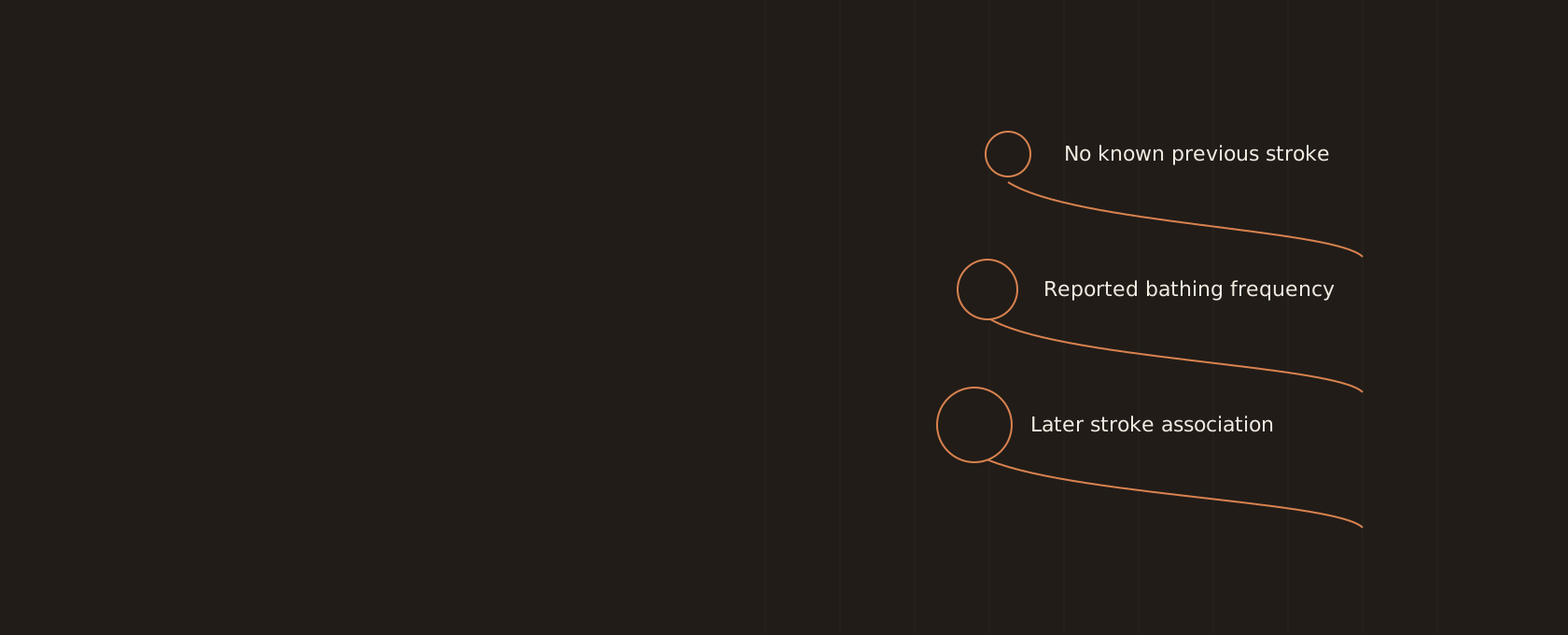
| 2018 · Kunutsor SK ↗ | prospective cohort No known previous stroke Participants: 1628. habitual sauna | For 4–7 versus 1 session weekly, the cardiovascular-risk-adjusted stroke HR was 0.39 (95% CI 0.18–0.84); additional physical-activity and socioeconomic adjustment yielded 0.38 (0.18–0.81). These are associations in the 1,628-person Finnish cohort, not assigned exposure effects. Comparison: Once-weekly sauna Observational exposure cannot establish prevention |
| 2015 · Laukkanen T ↗ | prospective cohort Population-based sample Participants: 2315. habitual sauna | The adjusted sudden-cardiac-death HR for 4–7 versus 1 weekly session was 0.37 (95% CI 0.18–0.75). Higher frequency was associated with several mortality outcomes. In the duration analysis, longer sessions were associated with fatal cardiovascular endpoints but not all-cause mortality; the abstract does not provide an exact all-cause HR to reuse. Comparison: Once-weekly sauna; duration below 11 minutes for duration analyses Not a comparison with never-users |
| 2017 · Zaccardi F ↗ | prospective cohort Without hypertension at baseline Participants: 1621. habitual sauna | After the fuller reported adjustment, incident-hypertension HRs versus once-weekly sauna were 0.83 (95% CI 0.59–1.18) for 2–3 sessions and 0.53 (0.28–0.98) for 4–7. The middle-frequency estimate was compatible with no association. Comparison: Once-weekly sauna Not a randomized prevention intervention |
Is sauna associated with a lower risk of stroke?
A Finnish prospective cohort found an association between frequent sauna bathing and lower subsequent stroke risk. Its population included women as well as men without a known previous stroke. This is useful evidence about existing habits and later events. It does not show that assigning someone to a new sauna routine prevents stroke, nor does it establish a safe routine for a person who has already had one.
The distinction between an observed association and a preventive intervention is central to this guide. Sauna frequency was not randomly assigned. People with different habits can differ in health, activity, resources and other behaviors that also relate to outcomes. Adjustment can address measured differences, but cannot guarantee that the remaining association comes from heat exposure itself. A favorable estimate therefore deserves attention and further study while remaining separate from a personal prevention recommendation.
Who was represented in the stroke study?
The stroke cohort included 1,628 Finnish adults aged 53–74 who had no known previous stroke. Its inclusion of women is important because the older mortality cohort commonly discussed alongside it enrolled men. These populations should not be collapsed into a vague claim about everyone who uses sauna. The age range, country and baseline stroke history define the actual study setting.
Inclusion of both sexes does not establish that the association is identical in every subgroup. An overall estimate combines information across the enrolled sample, and subgroup conclusions need their own analysis and precision. Likewise, a population without known previous stroke does not directly answer questions about rehabilitation or recurrence after stroke. If your practical question concerns recovery, disability, medication or safety following an event, this cohort is not the experiment that tested those decisions. Its relevance is to an observed first-event association in the defined population.
What was frequent bathing compared with?
The main frequency comparison used once-weekly bathing as the reference. This matters because a frequent-versus-weekly contrast is different from starting sauna versus never using it. A person who reads only “lower stroke risk” may imagine the latter comparison even though the study did not make it. The reference category should travel with every quoted estimate.
Frequency also describes a reported habit, not a prescribed combination of temperature, humidity, minutes and cooling. The verified source abstraction does not supply a complete experimental sauna dose. Filling those missing details with a familiar recommendation would create a protocol the cohort never assigned. You can use the study explorer to inspect the frequency categories and source record, but no tool on this site converts them into a validated stroke-prevention schedule. The question remains what different existing habits were associated with over follow-up, with all the limits of observational exposure measurement.
How large was the reported association?
For 4–7 sessions per week compared with one, the cardiovascular-risk-adjusted hazard ratio for stroke was 0.39, with a 95% confidence interval of 0.18–0.84. With additional physical-activity and socioeconomic adjustment, it was 0.38, with an interval of 0.18–0.81. These are model-specific associations from the same cohort, not independent confirmations and not two different personal benefit estimates.
A hazard ratio compares estimated event rates over follow-up under the model. It is not an absolute probability of avoiding stroke, and the confidence interval is not the range of benefit every bather can expect. The association may be compatible with a potentially important relationship while still being limited by residual confounding and uncertain transport to another population. Reporting the interval alongside the estimate also makes the uncertainty visible. A simple percentage without the reference group, model and interval would remove information a reader needs to assess the finding.
Does the evidence mean the same thing for every stroke?
The study considered stroke outcomes including ischemic and hemorrhagic events. Its overall result should not be presented as a separately established preventive effect for every subtype. The source review identifies a low hemorrhagic-event count as a limitation. Sparse subtype information makes a broad statement especially easy to overread: the headline outcome may contain more information than a smaller component does on its own.
This guide therefore does not manufacture subtype-specific estimates from the overall hazard ratio. It also avoids interpreting a lack of clear evidence in a small category as proof of no relationship. Both errors replace uncertainty with unwarranted precision. When a reader asks specifically about a previous hemorrhagic stroke or a particular clinical risk, the appropriate question extends beyond this cohort’s overall association. The result can inform research discussion, but the accessible evidence does not settle individualized suitability or the balance of risks for that circumstance.
Could blood pressure explain the association?
Blood-pressure and circulatory findings provide possible context, not a demonstrated explanation for fewer strokes. A separate cohort examined new hypertension in initially nonhypertensive men. An acute experiment measured pressure and vascular changes around a sauna session. Those studies address different populations, time scales and endpoints from the stroke cohort. Linking their titles into a plausible story does not establish a causal pathway.
To show that sauna prevented stroke through a pressure change, evidence would need to connect a changed exposure, a relevant intermediate change and later events under suitable assumptions. The existing association does not accomplish that simply because blood pressure is a familiar cardiovascular measure. Acute physiology may motivate an intervention study; it does not replace one. Keep mechanistic plausibility as a reason to investigate, while reserving claims about stroke prevention for evidence that can actually address that outcome. This separation prevents an attractive explanation from being mistaken for an established result.
How does the stroke paper fit the wider literature?
Other Finnish cohort analyses describe associations with fatal cardiovascular outcomes. They make the wider cardiovascular research question interesting, but a mortality endpoint is different from incident stroke. Cohort publications may also share research settings or participants. Their number should not be described as the number of independent replications of the stroke finding without checking the underlying samples.
Controlled vascular trials offer another kind of evidence. A Finnish-sauna trial in stable coronary artery disease did not find superiority over control in its chosen vascular measures. That result does not directly refute the stroke association, because it did not test stroke incidence. It does show why physiological improvement should not be assumed across all tested settings. A balanced synthesis keeps both the observational signal and the controlled null result visible, while acknowledging that neither answers every question posed by the other design. More citations do not remove differences in the research question.
Is there a stroke-prevention sauna protocol?
This evidence does not establish one. The cohort observed habitual frequency rather than assigning a preventive program with a specified temperature, session duration and cooling sequence. It did not test whether replacing established prevention care with sauna would be beneficial. A page that supplied such a program would be going beyond the research it cites.
If you are discussing recreational sauna with a clinician, describe your own history and intended exposure. Someone with a previous event, cardiovascular condition or relevant medication needs advice that fits that context, rather than a general population association. The older safety review lists unstable angina, recent myocardial infarction and severe aortic stenosis as contraindications and identifies alcohol concerns. It is not a complete checklist for post-stroke decisions. The safety screener can organize issues to discuss, but cannot decide that a person is suitable merely because their circumstances are not named on this page.
How should a stroke headline be translated?
Translate a headline into a sentence with four parts: the people, the habit comparison, the outcome and the design. Here, the people were Finnish adults without a known previous stroke; the comparison concerned reported sauna frequencies; the endpoint was later stroke; and the design was prospective observation. If the headline instead describes a prescribed prevention program, a never-user comparison or stroke rehabilitation, it has moved beyond the actual research question.
Check the uncertainty next. A hazard ratio without its confidence interval conceals precision, and an overall stroke finding without subtype context can sound broader than the event information allows. Finally, keep neighboring evidence in its own place. A cohort about developing hypertension is useful context for cardiovascular research, but its endpoint does not become stroke simply because the two topics are related. These checks take more attention than remembering a single percentage, but they preserve what the study genuinely contributes: an association worth testing further, with clear boundaries around what has and has not been examined.
What would make the conclusion more convincing?
Independent populations, clearer repeated exposure measurements and intervention evidence would address different uncertainties. Replication would test whether the association appears outside the original setting. Better habit measurement could examine how changes over time affect interpretation. A suitable intervention would address what happens when exposure is deliberately changed, rather than relying on differences between existing users. Each would add something specific; none can be replaced by simply publishing another analysis of the same baseline categories.
The grade here is C: an emerging, source-specific observational signal for stroke, with causal prevention unestablished. The systematic review helps place that signal in the broader dry-sauna literature, but it does not supply a missing randomized stroke endpoint. For a careful reader, the useful conclusion is precise: frequent bathing was associated with lower stroke risk in this Finnish cohort of adults without known previous stroke. The evidence does not yet justify converting that statement into a personal risk reduction, a recurrence recommendation or an exposure target.
Inspect the assumptions
Explore the session planner.
This planning tool describes a routine. It does not estimate a health benefit or provide medical clearance; the study exposures discussed above remain separate research methods.
Interactive workspace
In-memory checkpoint · no medical clearance
Pause for the personal context.
Check every item that applies or that you are unsure about. Current serious symptoms need appropriate care, not a tool result.
Context, with limits
- Checkpoint
- Complete the acknowledgment
A checklist cannot assess every relevant condition. No answer is medical clearance. Responses are in memory only, and are reset on reload.
Calculated on your device. Theme and unit preferences can be stored locally; health answers, weights and logs remain in memory. A shared settings URL contains its visible planning inputs.
Open the complete tool and methodologyExplore the evidence with a tool.
Questions, considered
Questions about this evidence
Did the stroke cohort represent people after a previous stroke?
The cohort enrolled adults without a known previous stroke. Its association therefore does not directly answer questions about recurrence, rehabilitation or sauna suitability after an event. Those questions involve a different clinical context. A reader with a previous stroke should discuss intended exposure with a qualified clinician rather than interpreting this first-event population finding as personal clearance.
Follow the sourceDoes including women establish the same association for everyone?
It broadens the enrolled population compared with the male-only mortality cohort, but an overall result does not establish identical effects in every subgroup. Subgroup interpretation needs its own event information and precision. The study still concerned Finnish adults with defined baseline characteristics, using existing habits rather than assigned exposure. Inclusion is valuable representation, not a guarantee of universal applicability.
Follow the sourceWhat does the stroke hazard ratio describe?
It describes a model-based comparison of event rates over follow-up between sauna-frequency groups. It is not an absolute personal probability of avoiding stroke or evidence that changing a routine produces the same reduction. The reference group, adjustment model and confidence interval belong with the estimate. Removing those details makes an observational association look more certain and individually predictive than it is.
Follow the sourceCan the overall stroke result be applied to hemorrhagic stroke?
The overall estimate should not be presented as a separately established effect for every subtype. The source review identifies limited hemorrhagic-event information, which restricts subtype interpretation. This guide does not manufacture a subtype estimate from the combined result. Uncertainty in a smaller category also should not be turned into proof that no relationship is possible in that category.
Follow the sourceDo blood-pressure studies explain why stroke risk was lower?
They provide relevant context but do not establish the causal pathway. An acute pressure experiment, a cohort about new hypertension and a study of later stroke assess different outcomes over different periods. A plausible sequence connecting them is a research hypothesis. Demonstrating that pathway requires more than placing favorable findings beside one another or treating a temporary physiological response as event prevention.
Follow the sourceWhat sauna schedule has been shown to prevent stroke?
This cohort did not assign or validate such a schedule. It observed reported habitual frequency and later outcomes, with once-weekly bathing as the reference. It cannot supply a tested starting temperature, duration, cooling sequence or personal exposure target for prevention. A practical routine assembled from unrelated studies would remain untested, even when each borrowed detail appears somewhere in the literature.
Follow the sourceFollow the evidence
Sources & references
Research summaries in this edition are based on indexed abstracts unless otherwise noted. A source link is not a claim of medical review.
- Sauna bathing reduces the risk of stroke in Finnish men and women: A prospective cohort study.
Kunutsor SK, Khan H, Zaccardi F, Laukkanen T, Willeit P, Laukkanen JA
Volume 90, issue 22, pages e1937-e1944 · PMID 29720543
Open-access flag: not recorded.Abstract-level editorial review - Association between sauna bathing and fatal cardiovascular and all-cause mortality events.
Laukkanen T, Khan H, Zaccardi F, Laukkanen JA
Volume 175, issue 4, pages 542-548 · PMID 25705824
Open-access flag: not recorded.Abstract-level editorial review - Sauna Bathing and Incident Hypertension: A Prospective Cohort Study.
Zaccardi F, Laukkanen T, Willeit P, Kunutsor SK, Kauhanen J, Laukkanen JA
Volume 30, issue 11, pages 1120-1125 · PMID 28633297
Open-access flag: not recorded.Abstract-level editorial review - Acute effects of sauna bathing on cardiovascular function.
Laukkanen T, Kunutsor SK, Zaccardi F, Lee E, Willeit P, Khan H, Laukkanen JA
Volume 32, issue 2, pages 129-138 · PMID 29269746
Open-access flag: not recorded.Abstract-level editorial review - Cardiovascular and Other Health Benefits of Sauna Bathing: A Review of the Evidence.
Laukkanen JA, Laukkanen T, Kunutsor SK
Volume 93, issue 8, pages 1111-1121 · PMID 30077204
Open-access flag: not recorded.Abstract-level editorial review - Sauna bathing is associated with reduced cardiovascular mortality and improves risk prediction in men and women: a prospective cohort study.
Laukkanen T, Kunutsor SK, Khan H, Willeit P, Zaccardi F, Laukkanen JA
Volume 16, issue 1, pages 219 · PMID 30486813
Open-access flag: yes.Abstract-level editorial review - Finnish sauna bathing and vascular health of adults with coronary artery disease: a randomized controlled trial.
Debray A, Gravel H, Garceau L, Bartlett AA, Chaseling GK, Barry H, Behzadi P, Ravanelli N, Iglesies-Grau J, Nigam A, Juneau M, Gagnon D
Volume 135, issue 4, pages 795-804 · PMID 37650138
Open-access flag: not recorded.Abstract-level editorial review - Benefits and risks of sauna bathing.
Hannuksela ML, Ellahham S
Volume 110, issue 2, pages 118-126 · PMID 11165553
Open-access flag: not recorded.Abstract-level editorial review - Clinical Effects of Regular Dry Sauna Bathing: A Systematic Review.
Hussain J, Cohen M
Volume 2018, pages 1857413 · PMID 29849692
Open-access flag: yes.Abstract-level editorial review