| Study | Design & population | Finding & comparison |
|---|---|---|
| 2015 · Laukkanen T ↗ | prospective cohort Population-based sample Participants: 2315. habitual sauna | The adjusted sudden-cardiac-death HR for 4–7 versus 1 weekly session was 0.37 (95% CI 0.18–0.75). Higher frequency was associated with several mortality outcomes. In the duration analysis, longer sessions were associated with fatal cardiovascular endpoints but not all-cause mortality; the abstract does not provide an exact all-cause HR to reuse. Comparison: Once-weekly sauna; duration below 11 minutes for duration analyses Not a comparison with never-users |
| 2018 · Kunutsor SK ↗ | prospective cohort Population-based male cohort Participants: 2277. habitual sauna | High fitness combined with frequent sauna use was associated with lower cardiovascular and overall mortality than the low-fitness/low-frequency category. Comparison: Joint fitness/frequency categories Observational joint analysis |
| 2018 · Laukkanen JA ↗ | prospective cohort General male cohort Participants: 2291. habitual sauna | The joint high-fitness/high-frequency group had lower estimated sudden-death hazard than the low/low reference group; the low-fitness/high-frequency comparison was imprecise. Comparison: Joint fitness/frequency categories Observation not prevention trial |
Does frequent sauna use mean a longer life?
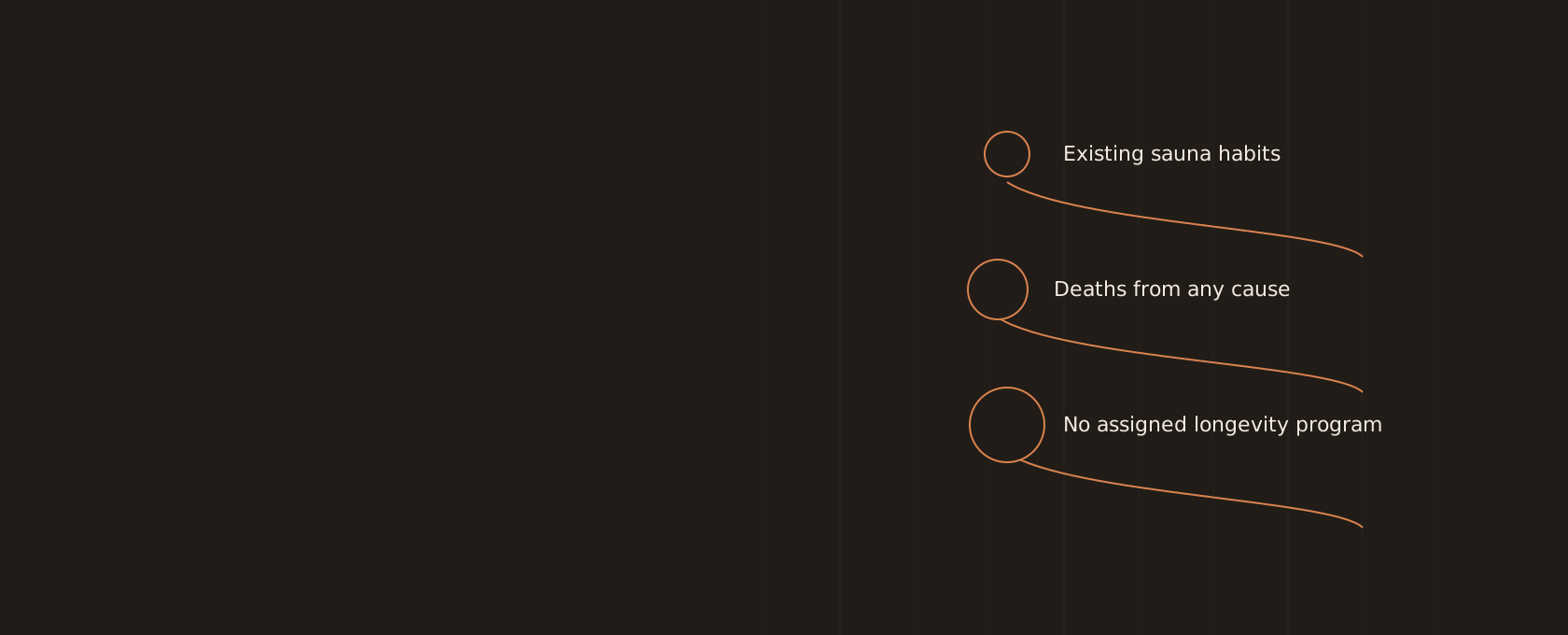
Frequent sauna bathing has been associated with lower all-cause mortality in Finnish observational research. That is an association with death from any cause during follow-up, not a measurement of extra years an individual can gain. The original study followed existing habits rather than assigning people to begin sauna. A reader can take the finding seriously while leaving the intervention question open.
All-cause mortality differs from cardiovascular mortality and sudden cardiac death. It combines causes into one endpoint, which avoids relying on a single disease label but does not explain the mechanism behind an association. A reduction in one cause of death does not automatically establish the same relationship for death from every cause. The numerical estimate for a cardiovascular endpoint cannot be relabeled as an all-cause result. Keeping these distinctions is especially important when a short social-media summary quotes a dramatic number without the original endpoint.
What did the original mortality cohort compare?
The original report included 2,315 Finnish men aged 42–60 at enrollment. Sauna frequency and duration were assessed at baseline, and subsequent mortality outcomes were examined. The reference for the main frequency comparisons was once-weekly bathing. This is a comparison among people with different established sauna habits; it does not directly compare starting sauna with remaining a never-user.
That reference group changes the practical interpretation. A person who has never used sauna cannot assume the cohort estimates describe what will happen after buying a cabin and using it frequently. Existing frequent bathers may differ in familiarity, fitness, health, resources or other behaviors. Statistical adjustment addresses measured characteristics under a chosen model. It cannot reproduce random assignment or guarantee that relevant differences were fully captured. The finding is therefore a reason to study a possible relationship, rather than an instruction that more sessions will extend a particular life.
Why is there no headline percentage here?
The verified abstract reports a specific adjusted estimate for sudden cardiac death and describes associations with several mortality outcomes. It does not provide an exact all-cause hazard ratio that this site’s abstract-level review can reuse. Rather than importing a familiar number from a secondary summary, this guide leaves that estimate unquoted. The correct response to an unverified quantity is to keep the qualitative finding and show the review boundary.
A hazard ratio compares the estimated event rate over follow-up under the statistical model. It is not the percentage of people guaranteed to avoid death, an absolute risk reduction or a count of life-years gained. Even when the exact ratio is available in a full paper, those interpretations remain different. An individual forecast would need a suitable baseline risk, a valid model for that person and evidence that changing exposure changes the outcome. The cohort association does not supply those steps simply because its follow-up was long.
Do longer sessions tell the same story as frequency?
Not in every analysis. The original abstract distinguishes the frequency findings from the duration findings. Longer sessions were associated with fatal cardiovascular endpoints in its duration analysis, but not with all-cause mortality. This is a useful counterweight to the idea that every way of increasing exposure must produce the same favorable association.
Frequency and duration are related features of a habit, yet they ask different questions in the analysis. A comparison of session categories is not a controlled experiment in staying longer. Someone reading only the positive duration findings could miss the endpoint where that pattern was absent. The responsible interpretation preserves the mismatch rather than building a temperature-times-minutes longevity score. Neither the weekly tracker nor another planning tool can transform these observational categories into a validated personal survival calculator. Log a habit if useful, but do not interpret the total as a measured biological age or a promised number of added years.
Does accounting for fitness settle the question?
Fitness analyses are informative because they address an obvious alternative explanation: people with favorable sauna habits might also have favorable fitness. The joint-association paper examined sauna frequency alongside cardiorespiratory fitness in relation to cardiovascular and all-cause mortality. It adds a different analytical question to the original frequency report. It does not create an independently assigned sauna exposure.
Joint categories can show how combinations of measured characteristics relate to outcomes. They cannot establish the extra survival benefit an already-fit person would obtain by adding sauna. Related analyses of sudden cardiac death also concern a more specific endpoint, so their estimates should not be substituted for all-cause mortality. When reading an attractive joint association, ask whether the comparison changed more than one characteristic at once. A low-risk combination may differ in fitness as well as bathing habits; its contrast is not automatically the isolated contribution of heat.
What do later inflammation analyses contribute?
The inflammation-and-mortality cohort paper brings a measured inflammatory marker into the analysis of sauna habits and death from any cause. A separate longitudinal paper examined inflammation and oxidative-stress measures in relation to sauna bathing. These questions can help organize possible explanations, but a marker association is not a demonstrated pathway through which sauna extends life.
To establish mediation, researchers would need more than a plausible sequence of associations. Exposure, intermediate change and later outcome would need to support the proposed causal interpretation under defensible assumptions. A baseline joint-category result can also reflect differences in underlying health. It should not become a personal target to change a laboratory value through heat. Here, the later papers are presented as extensions that sharpen research questions. Their shared research setting and possible participant overlap also matter: a larger bibliography does not necessarily mean the same relationship has been reproduced in many independent populations.
How much independent confirmation is there?
The broader mortality literature includes a cardiovascular-mortality cohort with women as well as men. That broadens representation for its cardiovascular question, while retaining an observational design. It does not directly answer every all-cause question posed by the original male cohort. Outcome specificity and participant independence need to be checked separately; neither can be inferred from the number of publication titles.
The dry-sauna systematic review offers a wider map of clinical research, but the presence of many small experiments is not the same as randomized evidence on long-term mortality. A trial can measure fitness, symptoms or vascular function without having the duration or events needed to assess survival. This guide therefore separates three levels: a long-term association, plausible physiological responses and assigned changes in selected intermediate outcomes. They can motivate one another without becoming interchangeable proof. The all-cause finding remains most applicable to the population and habitual exposure actually observed.
Does this apply to infrared, steam or occasional use?
The cohort evidence does not establish the same mortality association for every product described as a sauna. Traditional Finnish bathing, infrared exposure and other passive heating methods can differ in environment and physiological response. A study comparing infrared exposure with exercise in healthy women is a physiology experiment, not an infrared survival study. Its findings cannot fill the long-term outcome gap by analogy alone.
Occasional unfamiliar use is another exposure question. A habitual baseline category observed over follow-up is not a controlled schedule for a beginner, and reported baseline habits may change. The original cohort does not provide a validated starting temperature, session length or cooling plan for increasing life expectancy. If a source does not test that practical protocol, an editorial page should not invent one. This is why the practical conclusion is framed around interpreting evidence and making a safe leisure decision, rather than presenting a longevity program with increasingly ambitious heat targets.
How can a longevity claim be checked quickly?
Begin by finding the outcome in the original results, rather than searching for a matching percentage in another article. If the quoted value belongs to sudden cardiac death, write that endpoint beside it. Then check whether the summary kept the once-weekly reference and the male Finnish population. A statement that changes any of those details is answering a different question from the source, even if its numerical value was copied accurately.
Next ask what the claim adds. “Associated with lower mortality” describes a model result. “Adds years to your life” adds an individual causal prediction. “Works even if you do nothing else” adds a claim about other behaviors. The original observational design does not establish those additions. A joint fitness analysis can examine categories without isolating a new sauna intervention, and a later cardiovascular paper can extend the literature without providing an all-cause life-expectancy forecast. This quick audit is useful when comparing marketing copy, podcasts or personal notes: preserve the observed result, then remove the promises that were attached after the paper was written.
What decision can the evidence support today?
It can support an informed interest in sauna and a more precise conversation about expectations. If you enjoy it and want to discuss suitability, explain your health history and intended exposure to a qualified clinician. Do not use a cohort association as clearance or as a reason to change prescribed care. The older safety review names specific cardiac contraindications and alcohol-related concerns; those points are warnings, not a complete list that can certify everyone else as suitable.
For research reading, keep an endpoint ledger: death from any cause, fatal cardiovascular disease and sudden cardiac death each get their own line. Record the comparator and study population before recording the result. Mark overlapping cohort analyses as related rather than independent replications. The evidence grade is B for the observed all-cause association in its source setting, with causal longevity benefit unresolved. That scope is more useful than a universal promise. It lets the finding remain interesting while preventing it from becoming a forecast the research was never designed to make.
Inspect the assumptions
Explore the session planner.
This planning tool describes a routine. It does not estimate a health benefit or provide medical clearance; the study exposures discussed above remain separate research methods.
Interactive workspace
In-memory checkpoint · no medical clearance
Pause for the personal context.
Check every item that applies or that you are unsure about. Current serious symptoms need appropriate care, not a tool result.
Context, with limits
- Checkpoint
- Complete the acknowledgment
A checklist cannot assess every relevant condition. No answer is medical clearance. Responses are in memory only, and are reset on reload.
Calculated on your device. Theme and unit preferences can be stored locally; health answers, weights and logs remain in memory. A shared settings URL contains its visible planning inputs.
Open the complete tool and methodologyExplore the evidence with a tool.
Questions, considered
Questions about this evidence
How many extra years of life did the sauna cohort establish?
It did not establish an individual gain in life-years from beginning sauna. The original report observed baseline bathing habits and later mortality outcomes in Finnish men. A relative association over follow-up is different from a causal life-expectancy estimate. Turning it into extra years would require assumptions and evidence that this observational comparison does not supply for an individual reader.
Follow the sourceWhy is a sudden-cardiac-death estimate unsuitable here?
Sudden cardiac death is a specific endpoint, while all-cause mortality includes death from any cause. An estimate for the former cannot be relabeled as the latter. The verified abstract describes associations with several outcomes but does not provide an exact all-cause hazard ratio for reuse here. This guide preserves the qualitative finding without importing an unverified quantity from another summary.
Follow the sourceWere frequent sauna users compared with people who never bathed?
The principal frequency reference in the original mortality analysis was once-weekly sauna. It compared established habits among bathers, rather than assigning never-users to start a program. That matters for anyone considering a new routine: differences among existing users do not directly establish the effect of changing exposure. Familiarity, other habits and health differences remain relevant to interpretation.
Follow the sourceWas longer session duration associated with every mortality endpoint?
No. The original abstract distinguishes its duration findings from the frequency analysis. Longer sessions were associated with fatal cardiovascular endpoints, but not all-cause mortality in that duration analysis. This difference argues against assuming that every way of increasing sauna exposure has the same relationship with every outcome. It does not establish a recommended duration for gaining a longevity benefit.
Follow the sourceDo joint fitness analyses isolate sauna's survival contribution?
They examine combinations of measured fitness and sauna habits. Those categories can add useful information about observed risk, but exposure is still unassigned. A favorable joint category may differ in both characteristics and other factors. Its contrast does not tell an already-fit individual how much additional survival benefit would result from adding sauna to their own routine.
Follow the sourceCan Finnish mortality findings be transferred to infrared cabins?
The long-term Finnish association does not establish the same mortality effect for every heat technology. Infrared physiology research addresses different exposures and outcomes, often over a short observation window. Shared use of the word sauna does not make those studies equivalent. A source-specific reading keeps traditional bathing, infrared exposure and the mortality endpoint distinct instead of filling outcome gaps by analogy.
Follow the sourceFollow the evidence
Sources & references
Research summaries in this edition are based on indexed abstracts unless otherwise noted. A source link is not a claim of medical review.
- Association between sauna bathing and fatal cardiovascular and all-cause mortality events.
Laukkanen T, Khan H, Zaccardi F, Laukkanen JA
Volume 175, issue 4, pages 542-548 · PMID 25705824
Open-access flag: not recorded.Abstract-level editorial review - Joint associations of sauna bathing and cardiorespiratory fitness on cardiovascular and all-cause mortality risk: a long-term prospective cohort study.
Kunutsor SK, Khan H, Laukkanen T, Laukkanen JA
Volume 50, issue 2, pages 139-146 · PMID 28972808
Open-access flag: not recorded.Abstract-level editorial review - Combined Effect of Sauna Bathing and Cardiorespiratory Fitness on the Risk of Sudden Cardiac Deaths in Caucasian Men: A Long-term Prospective Cohort Study.
Laukkanen JA, Laukkanen T, Khan H, Babar M, Kunutsor SK
Volume 60, issue 6, pages 635-641 · PMID 29551418
Open-access flag: not recorded.Abstract-level editorial review - Inflammation, sauna bathing, and all-cause mortality in middle-aged and older Finnish men: a cohort study.
Kunutsor SK, Jae SY, Kurl S, Kauhanen J, Laukkanen JA
Volume 37, issue 12, pages 1225-1231 · PMID 36255556
Open-access flag: yes.Abstract-level editorial review - Longitudinal associations of sauna bathing with inflammation and oxidative stress: the KIHD prospective cohort study.
Kunutsor SK, Laukkanen T, Laukkanen JA
Volume 50, issue 5, pages 437-442 · PMID 29897261
Open-access flag: not recorded.Abstract-level editorial review - Sauna bathing is associated with reduced cardiovascular mortality and improves risk prediction in men and women: a prospective cohort study.
Laukkanen T, Kunutsor SK, Khan H, Willeit P, Zaccardi F, Laukkanen JA
Volume 16, issue 1, pages 219 · PMID 30486813
Open-access flag: yes.Abstract-level editorial review - Clinical Effects of Regular Dry Sauna Bathing: A Systematic Review.
Hussain J, Cohen M
Volume 2018, pages 1857413 · PMID 29849692
Open-access flag: yes.Abstract-level editorial review - Cardiovascular and Other Health Benefits of Sauna Bathing: A Review of the Evidence.
Laukkanen JA, Laukkanen T, Kunutsor SK
Volume 93, issue 8, pages 1111-1121 · PMID 30077204
Open-access flag: not recorded.Abstract-level editorial review - Infrared sauna as exercise-mimetic? Physiological responses to infrared sauna vs exercise in healthy women: A randomized controlled crossover trial.
Hussain JN, Cohen MM, Mantri N, O'Malley CJ, Greaves RF
Volume 64, pages 102798 · PMID 34954348
Open-access flag: not recorded.Abstract-level editorial review - Benefits and risks of sauna bathing.
Hannuksela ML, Ellahham S
Volume 110, issue 2, pages 118-126 · PMID 11165553
Open-access flag: not recorded.Abstract-level editorial review - Finnish sauna bathing and vascular health of adults with coronary artery disease: a randomized controlled trial.
Debray A, Gravel H, Garceau L, Bartlett AA, Chaseling GK, Barry H, Behzadi P, Ravanelli N, Iglesies-Grau J, Nigam A, Juneau M, Gagnon D
Volume 135, issue 4, pages 795-804 · PMID 37650138
Open-access flag: not recorded.Abstract-level editorial review