| Study | Design & population | Finding & comparison |
|---|---|---|
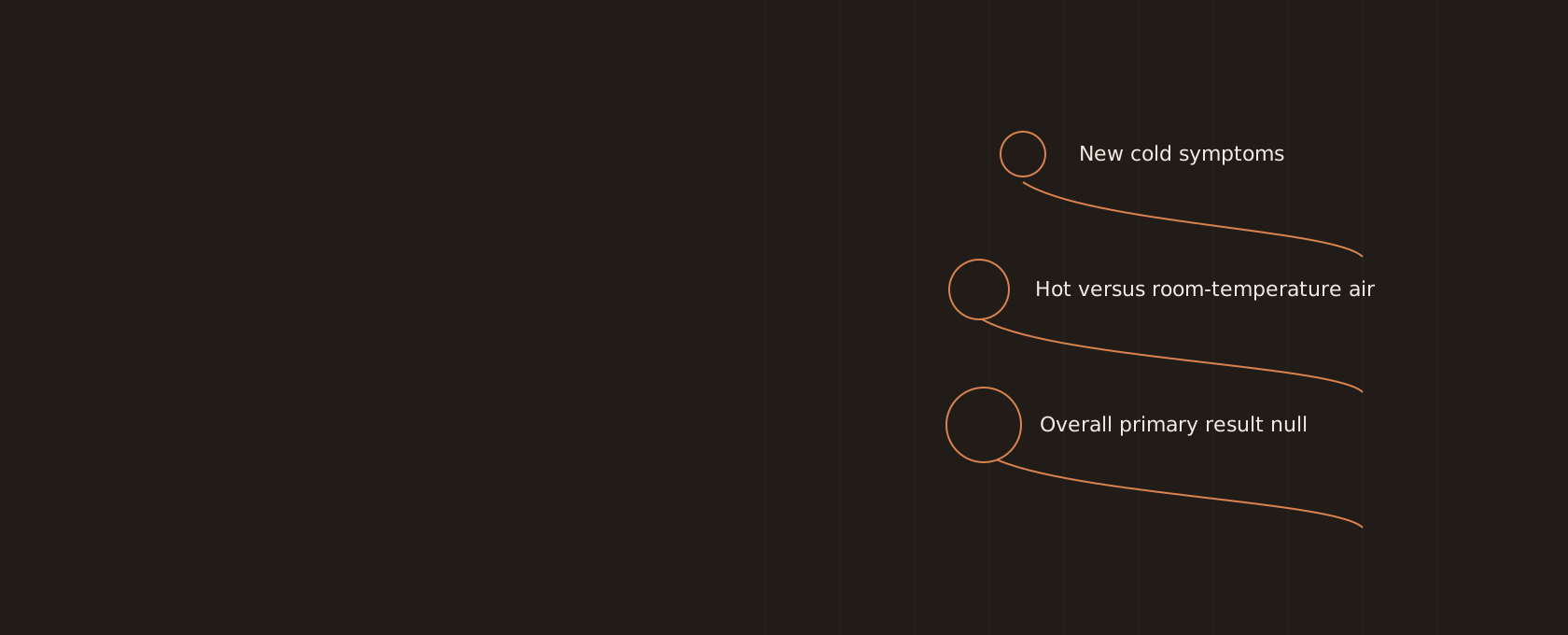
| 2010 · Pach D ↗ | randomized single-blind controlled trial New common-cold symptoms Participants: 157. hot dry air inhalation inside sauna | Hot-air inhalation did not significantly improve the primary overall symptom-severity measure, despite a few isolated secondary differences. Comparison: Room-temperature dry air inhalation in sauna Air-inhalation intervention differs from ordinary sauna |
| 2017 · Kunutsor SK ↗ | prospective cohort Middle-aged male population Participants: 1935. habitual sauna | Higher frequency was associated with lower incidence of a combined respiratory-disease endpoint; specific pneumonia estimates became less precise at high frequency. Comparison: At most once-weekly sauna Composite outcome spans different illnesses |
| 2017 · Kunutsor SK ↗ | prospective cohort Middle-aged male population Participants: 2210. habitual sauna | With the most extensive reported adjustment, pneumonia HRs versus ≤1 weekly session were 0.72 (95% CI 0.57–0.90) for 2–3 sessions and 0.63 (0.39–1.00) for ≥4. The high-frequency interval reached the no-association boundary, and these remain cohort associations. Comparison: At most once-weekly sauna Adjustment affects precision |
Original publication: Visiting a sauna: does inhaling hot dry air reduce common cold symptoms? A randomised controlled trial.
The intervention was inhaled air, not a habit
The randomized trial compared hot dry air with dry air at room temperature applied to people with a newly acquired common cold. It used a symptom-severity outcome. This differs from observing baseline sauna habits and counting later diagnoses over years.
The original title asks whether inhaling hot dry air reduces common-cold symptoms. The comparison should remain just as specific in a summary. It is not a general sauna-versus-no-sauna test and cannot answer whether habitual bathing prevents colds or pneumonia. Its strength is a direct assigned comparison for a defined symptom question. Its limit is that the intervention and endpoint do not represent every claim made about heat and respiratory health.
Both groups were in a sauna setting
Participants in both groups were studied inside a hot sauna, while the inhaled air differed in temperature. The protocol also used clothing to shape the experimental conditions. These details matter because a reader might otherwise imagine one group taking an ordinary sauna and another remaining entirely outside it.
The appropriate inference concerns the tested air-inhalation contrast within that setting. A null comparison cannot simply be described as proof that every kind of sauna exposure has no respiratory effect. Equally, the experiment does not justify reproducing the protocol as personal care. The unusual controlled setup belongs to the interpretation of the research, not a recommendation for someone with symptoms.
The primary overall symptom result was null
The study did not find a significant between-group difference in its primary measure summarizing symptom severity over time. That is the result retained in the registered fact record and should lead the appraisal. It does not support a claim that hot dry air reliably improved the overall course of the common cold under these conditions.
A nonsignificant result is not proof that the true effect is exactly zero, but it is also not a positive efficacy finding. The uncertainty should not be replaced by a confident recommendation based on how plausible heat may feel. This summary does not add unregistered numerical symptom effects. It preserves the main conclusion and the specific comparison from which it arose.
Isolated secondary differences do not replace the main outcome
The abstract reports a few differences on individual secondary measures or occasions. Those should be interpreted alongside the null overall symptom endpoint rather than selected as evidence that the trial was broadly successful. Different outcomes and repeated observations can yield different results.
The useful reading question is which endpoint was intended to summarize the clinical course and which findings were narrower. A particular day’s score or a participant rating cannot automatically stand in for overall symptom burden. This does not require ignoring the secondary observations. It requires keeping their role and limits visible. The source does not establish a universally beneficial hot-air program merely because some comparisons reached statistical significance.
The overall summary follows symptom burden across the observation period rather than identifying the most favorable individual occasion. That makes its null result important for the question posed by the trial. A narrower difference can be reported transparently while remaining insufficient to support the broader claim of improved overall symptoms.
Habitual respiratory cohorts ask a different question
The respiratory KIHD cohort related reported sauna frequency to later hospital-diagnosed COPD, asthma or pneumonia. Its favorable composite association does not contradict or overturn a null symptom result from this trial. The designs, populations, exposures and outcomes differ.
The distinction works in both directions. A cohort association with future diagnoses cannot establish that inhaling hot air helps after symptoms start. The trial’s null inhalation comparison cannot settle whether established habits have a long-term association in another population. Bringing the sources together is useful when it prevents these substitutions. It is less useful if they are forced into a single yes-or-no verdict about all respiratory effects of sauna.
Pneumonia is not an ordinary-cold symptom score
The pneumonia-only cohort examined hospital-diagnosed events rather than common-cold symptoms during a short intervention. Its baseline-frequency association therefore cannot supply a missing positive result for hot-air inhalation. A diagnosis outcome and a symptom-severity trajectory are different endpoints.
This is especially important when respiratory headlines use broad language about fighting infections. The present trial did not establish a pneumonia intervention or a protective effect against a different infection. It also does not define how heat should be used by someone with a current illness. The source should be applied to its actual question, with the symptom population and inhaled-air comparison kept visible rather than expanded into unsupported respiratory-care advice.
What would make a broader claim testable
A different respiratory claim would need its own appropriate trial. Prevention would require an exposure comparison before illness and a defined incident outcome. A claim about another acute condition would require that condition and a clinically meaningful endpoint, rather than borrowing this common-cold design.
The trial’s emerging grade reflects an informative assigned comparison with a null primary result and a narrow protocol. It should not be marketed as favorable evidence, but neither should its limits be disguised as an exact universal zero. Clear specification of the claim is the practical lesson: identify whether the question concerns prevention, symptoms, lung function or a hospital diagnosis before choosing which source can answer it.
Source access and personal medical questions
The indexed abstract was refreshed and checked against the corpus and registered result. The original PubMed entry and DOI identify the publication. A full-text assessment of blinding, all analysis choices, funding and conflicts of interest has not been completed for this appraisal. Unreported disclosure details remain unknown.
This summary does not recommend sauna or hot-air inhalation during illness. The separate historical safety review names specific cardiac contraindications and alcohol-related concerns, not a complete screening system for people with respiratory symptoms. A qualified clinician should address relevant medical questions. The evidence conclusion here is limited and clear: the tested hot-air comparison did not demonstrate an overall common-cold symptom benefit on its main outcome.
Explore the evidence with a tool.
Questions, considered
Questions about this study
Did the hot-air common-cold trial improve its overall symptom outcome?
No. The primary comparison of symptom severity over time did not significantly favor hot-air inhalation. A few secondary differences were reported, but they do not change the primary null result. A summary should avoid presenting selected daily scores or participants’ impressions as proof that sauna resolves a cold.
Follow the sourceWas the common-cold trial simply ordinary sauna versus no sauna?
No. Both groups sat inside a hot sauna wearing winter coats, while the inhaled air differed in temperature. This unusual design focused on hot-air inhalation at the throat. Its findings should not be described as a direct test of every ordinary sauna routine, although they challenge a specific hot-air symptom claim.
Follow the sourceDid the hot-air cold study examine preventing future colds?
No. Participants already had newly acquired cold symptoms. The trial assessed symptom severity during the existing illness, not how often future infections occurred. Prevention studies and symptom-treatment studies answer different questions, so favorable or unfavorable results in one category should not be presented as the other without explanation.
Follow the sourceFollow the evidence
Sources & references
Research summaries in this edition are based on indexed abstracts unless otherwise noted. A source link is not a claim of medical review.
- Visiting a sauna: does inhaling hot dry air reduce common cold symptoms? A randomised controlled trial.
Pach D, Knöchel B, Lüdtke R, Wruck K, Willich SN, Witt CM
Volume 193, issue 11-12, pages 730-734 · PMID 21143077
Open-access flag: not recorded.Abstract-level editorial review - Sauna bathing reduces the risk of respiratory diseases: a long-term prospective cohort study.
Kunutsor SK, Laukkanen T, Laukkanen JA
Volume 32, issue 12, pages 1107-1111 · PMID 28905164
Open-access flag: not recorded.Abstract-level editorial review - Frequent sauna bathing may reduce the risk of pneumonia in middle-aged Caucasian men: The KIHD prospective cohort study.
Kunutsor SK, Laukkanen T, Laukkanen JA
Volume 132, pages 161-163 · PMID 29229091
Open-access flag: not recorded.Abstract-level editorial review - Benefits and risks of sauna bathing.
Hannuksela ML, Ellahham S
Volume 110, issue 2, pages 118-126 · PMID 11165553
Open-access flag: not recorded.Abstract-level editorial review