| Study | Design & population | Finding & comparison |
|---|---|---|
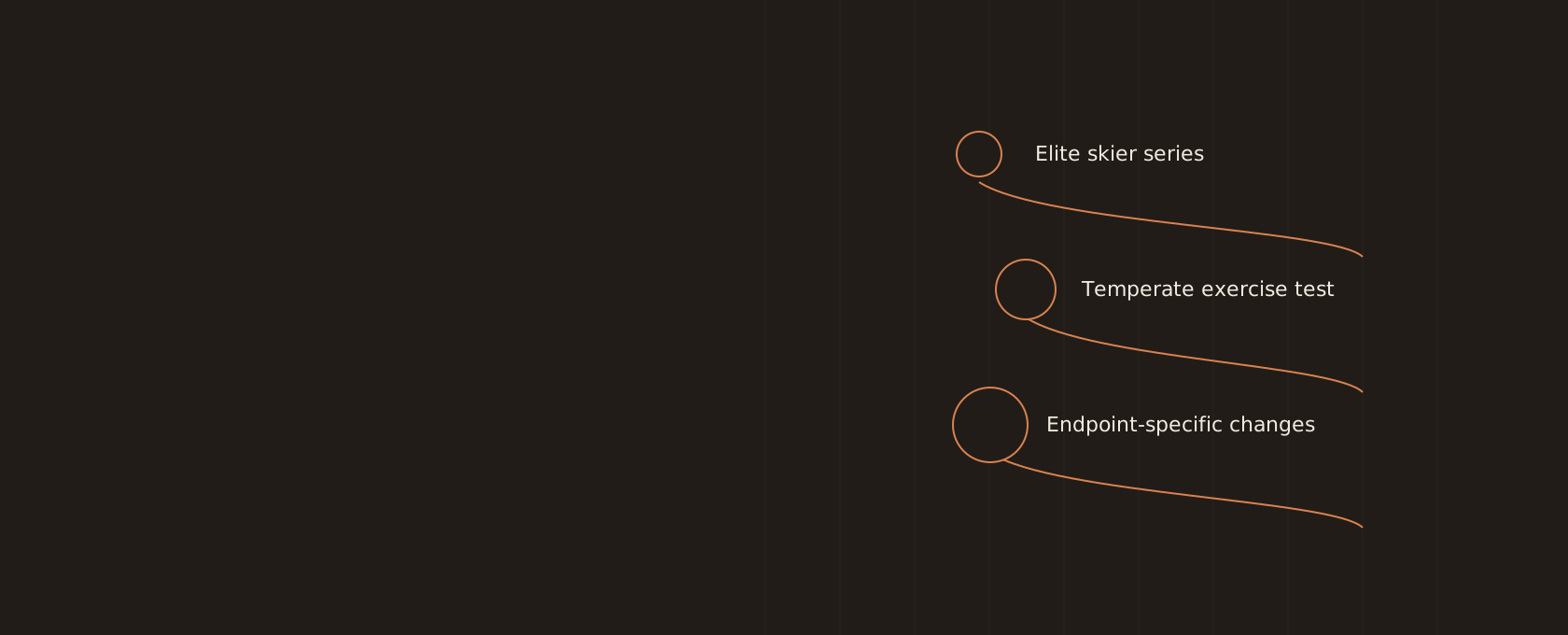
| 2021 · Pokora I ↗ | Uncontrolled before-after physiology study Elite cross-country skiers Participants: 14. Sauna · 10 sauna baths | Resting heart rate fell after the series, but baseline body temperatures did not change; the physiological-strain result was borderline rather than conventionally significant. Comparison: Within-person measurements before versus after sauna series Small elite-athlete sample |
| 2015 · Stanley J ↗ | Small longitudinal athlete physiology study Well-trained male cyclists Participants: 7. Post-exercise sauna · 10days training plus sauna within35days monitoring | Plasma volume increased during the sauna period, but associations between individual volume changes and heart-rate measures were unclear. The abstract uses 90% confidence limits and magnitude-based inferences, not 95% confidence intervals. Comparison: Baseline training and subsequent exposure periods; no independent control described Very small male athlete sample. |
| 2020 · Skorski S ↗ | Randomized-order crossover trial Competitive swimmers and triathletes Participants: 20. Post-exercise sauna | Next-morning swim performance was worse after sauna than placebo recovery following intensive training, and reported stress was higher. Comparison: Seated placebo recovery with deidentified massage oil Small athlete sample |
Original publication: The Effect of Medium-Term Sauna-Based Heat Acclimation (MPHA) on Thermophysiological and Plasma Volume Responses to Exercise Performed under Temperate Conditions in Elite Cross-Country Skiers.
Did the sauna series establish better racing performance?
No race-performance endpoint was established. The study examined thermophysiological and selected blood-related responses to an exercise test under temperate conditions. That setting is different from an actual competition or a direct test of performance in an extreme hot environment.
The publication’s title identifies medium-term sauna-based heat acclimation and responses in elite cross-country skiers. A claim about improved racing would go beyond those measurements. The source is useful for describing physiological observations around a series and for identifying what a later controlled performance trial might test. Its athlete population makes the question relevant to sport, but relevance is not the same as demonstration of a competitive advantage. Readers should therefore begin with the measured exercise-test responses rather than assume that an elite-athlete study must have proved an improvement in the outcome athletes ultimately care about.
What was compared before and after the series?
The investigators assessed the skiers around an exercise test before and after a series of sauna baths. This within-person approach can describe changes across the study period. The indexed abstract does not describe an independent group completing the same training and testing without the sauna series.
Without that concurrent comparison, the influence of training, time, test familiarity and the new exposure cannot be cleanly separated. These are limitations of attribution, not explanations established as the cause of the observed changes. The paper can contribute a pattern worth examining while leaving the causal share of sauna uncertain. Its before-and-after structure should remain visible in any summary, including when a result is statistically detectable. A measured pre-post difference does not by itself provide the missing control condition or turn the series into a randomized assessment of added benefit.
Did baseline body temperatures change?
The abstract reports that baseline internal, body and skin temperatures did not change after the series. That null finding is part of the main result and should not disappear behind a favorable account of acclimation. A study can report changes in some responses while leaving other measured characteristics unchanged.
It is also important to distinguish a baseline value from the response during exercise or recovery. These measurement occasions address different questions. The source does not establish that every dimension of thermal adaptation improved, nor that an unchanged baseline temperature means no physiological response occurred. The appropriate account names each result and time point. That gives readers a more informative picture than a general statement that the athletes became better adapted to heat, which would conceal how limited and endpoint-specific the tested response actually was.
How should the physiological-strain result be described?
The retained source record identifies the physiological-strain result as borderline rather than conventionally significant. It should not be rewritten as a clearly established improvement. The paper also reports a lower resting heart rate, which is a different endpoint and should be described separately.
Borderline evidence is a reason to preserve uncertainty, not to round the interpretation toward a preferred conclusion. A fuller appraisal would inspect the estimate, variability, planned analysis and the number of outcomes considered. The abstract does not allow this page to resolve all those issues. Nor does a correlation among physiological measurements prove a pathway causing improved performance. The useful description keeps the observations distinct: resting rate, temperature results, strain and plasma-volume-related measurements. Combining them into a uniform success story would overstate what the reported comparisons establish.
What does testing in temperate conditions leave open?
The exercise test was performed under temperate environmental conditions. Its results do not automatically describe competition in unusually hot conditions or every cross-country skiing environment. The thermal context is a substantive part of the experiment rather than an incidental detail.
The sample consisted of elite skiers, whose training background also differs from recreational users, beginners and sedentary adults. An effect in a selected athlete group cannot supply the same estimate for someone whose baseline fitness and heat experience differ. Conversely, a study in less active adults cannot replace the sport-specific evidence simply because it uses sauna. The most useful comparison keeps both environmental and participant contexts attached. Future work could test a particular performance question in an appropriate setting, but that would add evidence rather than merely extend the wording of this physiology report.
How do the cyclist and swim studies help interpret this?
A small cyclist study observed plasma-volume expansion during a sauna period while finding uncertain relationships with heart-rate tracking. Like the skier study, it illustrates that physiological adaptation and useful individual monitoring are separate questions. It also does not supply the absent race result for the skiers.
A randomized-order swimmer recovery trial found worse next-morning performance after its sauna recovery condition compared with a placebo recovery setting. Its short-term recovery question is different from acclimation across a series. The result nevertheless cautions against assuming that any added postexercise heat is automatically helpful for the next performance demand. These sources should not be merged into an overall athlete benefit score. They concern different sports, exposures, comparators and intervals, and each contributes a distinct limitation to a simple promise of improved performance.
What should remain uncertain for athletes and coaches?
The evidence grade is C for a small uncontrolled physiological study. A lower resting rate is an observed finding, unchanged baseline temperatures remain null findings, and borderline strain evidence remains uncertain. None is a demonstrated improvement in race time or an established schedule for every athlete.
The indexed abstract and refreshed source record underpin this appraisal. Full-text methods, detailed training control, formal risk of bias, funding and conflicts of interest were not assessed. Those financial details remain unreported because they were not established in the reviewed material. This source description is not a recovery or acclimation prescription. Medical conditions and medication questions still require an individual clinical discussion; being a trained athlete does not turn a research protocol into universal personal clearance for repeated heat exposure.
Explore the evidence with a tool.
Questions, considered
Questions about this study
Did the 2021 cross-country skier study show lower baseline body temperature?
No. The sauna series did not change baseline internal, overall body or skin temperature in the elite skiers. Resting heart rate did decrease. The distinction matters because changes in cardiovascular responses can occur without demonstrating a lower resting core temperature or better race results.
Follow the sourceWas the skier heat-acclimation study conducted during exercise in hot weather?
The exercise test took place under temperate conditions. Researchers compared responses before and after a series of sauna baths, including blood measurements during recovery. This addresses adaptation measured in a comfortable environment; it does not directly establish how the same athletes would perform in a hot competition.
Follow the sourceHow strong was the physiological-strain finding in PMID 34199101?
The abstract reported a borderline physiological-strain result rather than a clearly established reduction under the usual significance threshold. It also described altered plasma-volume restoration. With a small specialist sample and no separate comparison group described, these observations warrant cautious interpretation rather than a general training recommendation.
Follow the sourceFollow the evidence
Sources & references
Research summaries in this edition are based on indexed abstracts unless otherwise noted. A source link is not a claim of medical review.
- The Effect of Medium-Term Sauna-Based Heat Acclimation (MPHA) on Thermophysiological and Plasma Volume Responses to Exercise Performed under Temperate Conditions in Elite Cross-Country Skiers.
Pokora I, Sadowska-Krępa E, Wolowski Ł, Wyderka P, Michnik A, Drzazga Z
Volume 18, issue 13, pages 6906 · PMID 34199101
Open-access flag: yes.Abstract-level editorial review - Effect of sauna-based heat acclimation on plasma volume and heart rate variability.
Stanley J, Halliday A, D'Auria S, Buchheit M, Leicht AS
Volume 115, issue 4, pages 785-794 · PMID 25432420
Open-access flag: not recorded.Abstract-level editorial review - Effects of Postexercise Sauna Bathing on Recovery of Swim Performance.
Skorski S, Schimpchen J, Pfeiffer M, Ferrauti A, Kellmann M, Meyer T
Volume 15, issue 7, pages 934-940 · PMID 31869820
Open-access flag: not recorded.Abstract-level editorial review - Benefits and risks of sauna bathing.
Hannuksela ML, Ellahham S
Volume 110, issue 2, pages 118-126 · PMID 11165553
Open-access flag: not recorded.Abstract-level editorial review