| Study | Design & population | Finding & comparison |
|---|---|---|
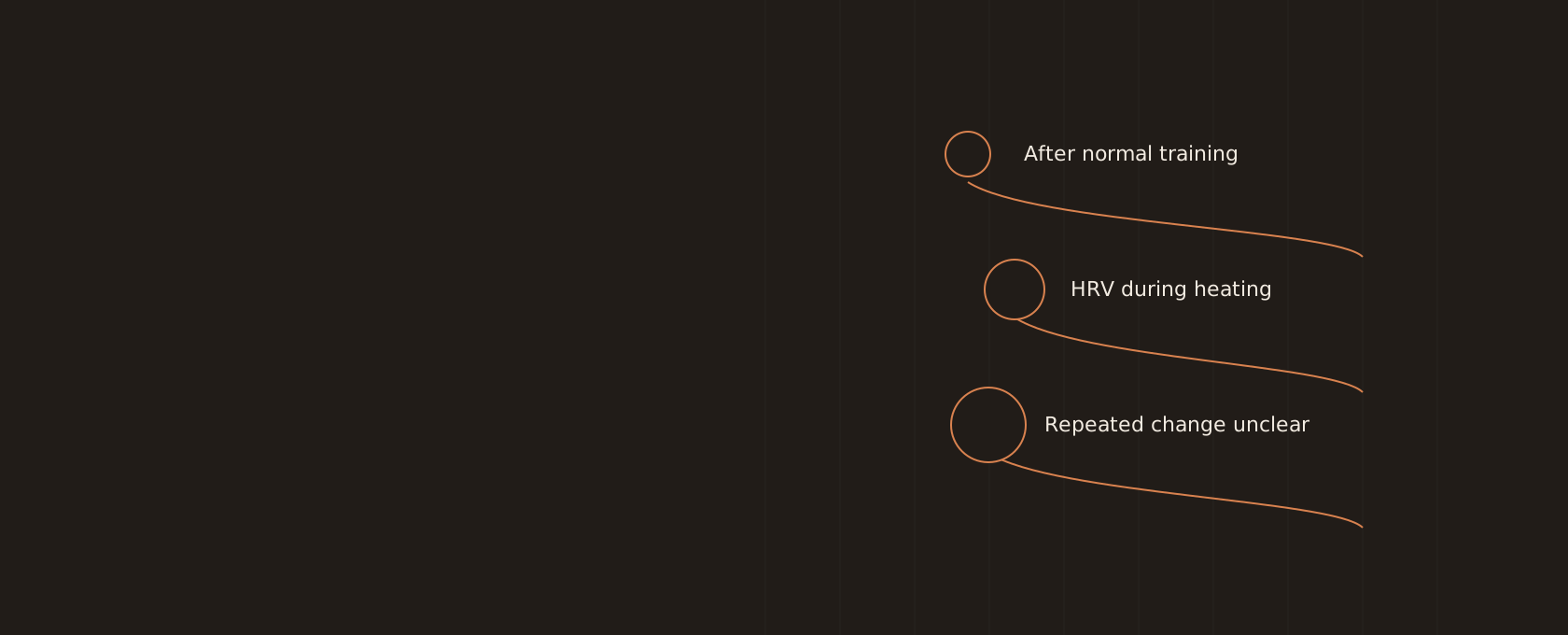
| 2018 · Leicht AS ↗ | Repeated-exposure athlete physiology study Well-trained cyclists Participants: 6. Post-exercise sauna · 10 consecutive days | Heart rate rose and a vagal-related HRV measure fell during initial exposure; repeated-exposure changes were unclear. Comparison: Within-exposure and across-exposure measurements Very small uncontrolled sample |
| 2025 · Lee E ↗ | randomized controlled trial Sedentary adults with at least one cardiovascular risk factor Participants: 38. postexercise sauna · 8 weeks | Adding sauna after exercise did not produce statistically detectable additional HRV improvements relative to exercise alone. Comparison: Exercise alone; no-intervention control Small trial |
| 2023 · Ferreira FC ↗ | Systematic review Healthy adults Whole-body heating, local heating and sauna | Autonomic responses differed by heating approach, and baroreflex findings remained method-dependent rather than uniformly favorable. Comparison: Across eligible physiological studies Protocol heterogeneity |
Original publication: Heart rate variability responses to acute and repeated postexercise sauna in trained cyclists.
The question concerns cardiac control during heat
This paper examined heart rate and heart-rate variability during acute and repeated postexercise sauna exposure in trained cyclists. Heart-rate variability, or HRV, concerns variation in the intervals between heartbeats. It can provide information about cardiac autonomic modulation under specified measurement conditions, but it is not a direct score for overall recovery or health.
The original publication is Heart rate variability responses to acute and repeated postexercise sauna in trained cyclists. Its setting matters because measurements taken while someone is hot after training describe an active physiological challenge. They should not be silently exchanged for a quiet resting measurement after cooling. The study’s distinctive question is how cardiac regulation behaves during the heating sequence and whether that pattern changes with repeated exposure.
Why trained cyclists are a narrow population
The sample was a very small group of well-trained male cyclists. That gives the experiment a specific athletic context while limiting precision and representation. The participants’ baseline conditioning and preceding exercise differ from a person using sauna recreationally without training or from a sedentary adult entering a combined lifestyle program.
The described design lacked a separate non-sauna comparison group. Repeated measurements within the cyclists can show patterns, but they do not reveal exactly what would have happened over the same period with training alone. Training load, recovery and measurement variability remain relevant alternatives. The paper should therefore be read as preliminary athlete physiology, rather than evidence that an assigned sauna addition improves autonomic recovery beyond an otherwise identical training routine.
The initial exposure showed a heat-stress response
During the initial exposure, heart rate increased and the reported vagal-related HRV measure decreased across the bout. Vagal activity refers to parasympathetic influences on the heart; the study used a particular variability measure as an indirect indicator. The source interpretation retains the direction without converting it into a simple diagnosis of benefit or harm.
A falling variability measure while heat load rises is not evidence that a person’s usual resting HRV has permanently deteriorated. Equally, it cannot be relabeled as improved recovery merely because sauna is often used after exercise. The measurement belongs to the conditions in which it was taken. This is why the term postexercise is not sufficient on its own: a measurement during subsequent sauna and one after complete recovery describe different physiological states.
Repeated exposure did not establish a clear adaptation
The abstract describes changes across repeated exposure as unclear. That wording should remain visible in any summary of the paper. It does not justify a claim that repeated sauna reliably raised HRV, nor does it establish that every autonomic adaptation was absent.
An unclear result can arise when the available observations do not support a sufficiently precise or consistent conclusion under the analysis used. Here, the small uncontrolled sample is especially relevant. A reader should resist treating repeated participation itself as proof of adaptation: people can complete a series of exposures without the measured outcome showing a clear directional change. The appropriate next research question is whether a larger controlled comparison under defined training conditions would identify a reproducible effect.
The analytical approach also deserves attention
The authors used magnitude-based inferences to describe changes. This summary does not reinterpret their verbal certainty labels as conventional confidence in a clinical benefit. The complete statistical procedure would need full-text evaluation before a formal judgment about the strength of the analysis.
That limitation is separate from the narrow measurement setting. Even a more precise estimate during heat would still require caution when translated to resting recovery or future performance. Keeping the analytical and practical limits distinct is useful: one concerns how the observed data were evaluated, while the other concerns what outcome those data actually represent. Neither can be solved by presenting a large-looking change as an automatic sign that the athlete has become better recovered.
A randomized add-on trial asks a different question
The later multi-arm trial in sedentary adults with cardiovascular risk factors compared exercise plus sauna with exercise alone and control. It did not detect additional HRV improvement from adding sauna to exercise. Its assigned comparison is useful context because it directly tests an incremental program effect.
The population differs from trained cyclists, so the null result is not an exact replication of this experiment. It nevertheless prevents the athlete paper from being used as a broad claim that postexercise sauna reliably improves HRV. The studies measure related variables under different designs and conditions. Their coexistence points toward more specific questions about timing, population and the comparator rather than a universal verdict based on whether one report sounds favorable.
The autonomic review warns against merging heat methods
A systematic review found that autonomic responses differed across passive-heating approaches and that baroreflex findings depended on methods and protocols. This is relevant to the cyclist study because the physiological state during demanding whole-body heat should not automatically be assumed equivalent to local heating or a recovery-phase sauna measurement.
A review can organize those distinctions without providing a single prediction for an individual athlete. Its healthy-adult evidence and mixed methods do not establish that every HRV index changes in the same direction or that any observed shift produces better performance. Reading the cyclist paper alongside the review therefore favors specificity: name the heating approach, the timing and the actual metric before interpreting autonomic language as a practical training benefit.
What was verified and what remains unread
The live indexed abstract was checked against the included corpus and registered fact statement. The source links identify the original PubMed record and DOI. Full-text participant procedures, funding, conflicts of interest and a formal statistical risk-of-bias assessment have not been completed here. Unreported disclosure fields remain unknown rather than being treated as evidence of no interests.
The safety review cited separately names unstable angina, recent myocardial infarction and severe aortic stenosis as contraindications and warns about alcohol. It does not validate this athlete protocol for unsupervised use. The study’s emerging grade reflects a narrow, preliminary physiological contribution: demanding heat altered the initial cardiac-regulation pattern, while a reliable repeated-exposure advantage remained unestablished.
Explore the evidence with a tool.
Questions, considered
Questions about this study
Did repeated post-exercise sauna clearly improve HRV in the cyclist study?
No. Changes across the repeated-exposure period were unclear in the abstract. During the initial sauna bout, heart rate increased and the reported variability measure decreased. The study therefore cannot support a simple claim that adding post-training sauna reliably improves autonomic recovery in trained cyclists.
Follow the sourceWhat makes the cyclist HRV paper preliminary evidence?
It involved a very small group, lacked a separate non-sauna comparator in the described design and focused on physiological measurements during demanding heating. Those features limit precision and causal interpretation. The authors concluded that the implications for cardiac control in athletes still needed to be established.
Follow the sourceCan HRV measured during sauna be compared directly with resting recovery HRV?
Not without attention to conditions and timing. The cyclist study measured changes while participants were undergoing substantial heat stress after training. A resting measurement after cooling addresses a different physiological state. Treating the two as interchangeable can create apparent contradictions or unsupported claims about improved recovery.
Follow the sourceFollow the evidence
Sources & references
Research summaries in this edition are based on indexed abstracts unless otherwise noted. A source link is not a claim of medical review.
- Heart rate variability responses to acute and repeated postexercise sauna in trained cyclists.
Leicht AS, Halliday A, Sinclair WH, D'Auria S, Buchheit M, Kenny GP, Stanley J
Volume 43, issue 7, pages 704-710 · PMID 29444412
Open-access flag: not recorded.Abstract-level editorial review - Regular postexercise sauna bathing does not improve heart rate variability: A multi-arm randomized controlled trial.
Lee E, Ketelhut S, Wiklund P, Kostensalo J, Kolunsarka I, Hägglund H, Ahtiainen JP
Volume 13, issue 13, pages e70449 · PMID 40611569
Open-access flag: yes.Abstract-level editorial review - Cardiovascular autonomic modulation during passive heating protocols: a systematic review.
Ferreira FC, Vaz Padilha MCS, Rocha TMDMS, Lima LS, Carandina A, Bellocchi C, Tobaldini E, Montano N, Soares PPDS, Rodrigues GD
Volume 44, issue 1 · PMID 36343372
Open-access flag: not recorded.Abstract-level editorial review - Benefits and risks of sauna bathing.
Hannuksela ML, Ellahham S
Volume 110, issue 2, pages 118-126 · PMID 11165553
Open-access flag: not recorded.Abstract-level editorial review