| Study | Design & population | Finding & comparison |
|---|---|---|
| 2015 · Sutkowy P ↗ | Acute comparative biomarker experiment Healthy male volunteers Participants: 25. Single dry sauna or whole-body cryostimulation | Heat and cold exposures produced differing acute antioxidant-enzyme patterns. Biomarker changes do not establish reduced disease risk or favor one exposure for long-term health. Comparison: Distinct heat and cold exposure groups Small separate groups. |
| 2020 · Gryka D ↗ | Before-after study comparing activity groups Healthy; trained and untrained groups Participants: 20. Finnish sauna · 10 baths over 3 weeks | Selected oxidative-balance and nitric-oxide markers changed, with some differences between trained and untrained men; clinical outcomes were not measured. Comparison: Trained versus untrained; within-person measurements Small groups |
| 2018 · Kunutsor SK ↗ | cross-sectional and longitudinal cohort analysis Population cohort Participants: 2269. habitual sauna · Baseline and 11-year measurements | Greater frequency was associated with lower inflammatory-marker levels in several analyses, but sauna frequency was not associated with GGT. Comparison: Once-weekly sauna Observational markers |
Original publication: Single whole-body cryostimulation procedure versus single dry sauna bath: comparison of oxidative impact on healthy male volunteers.
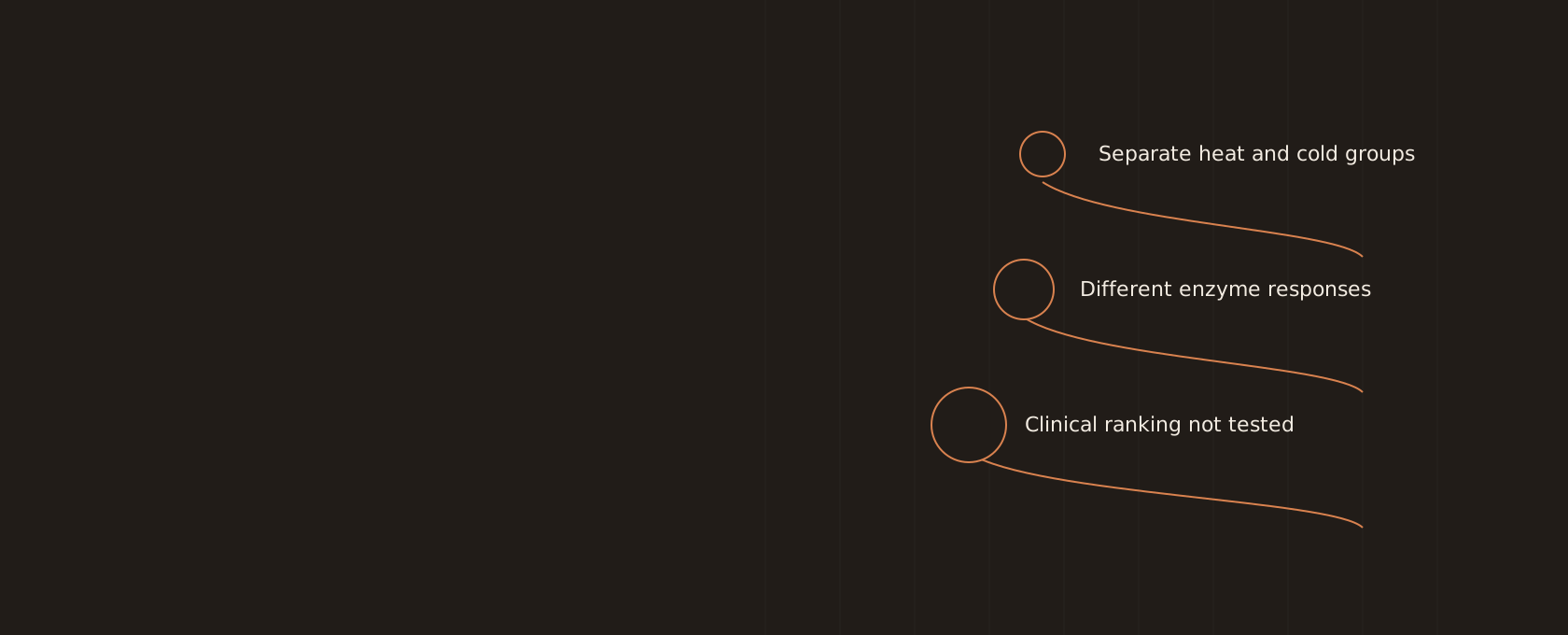
Did the experiment identify a healthier heat or cold option?
It did not measure a clinical outcome capable of establishing that ranking. The investigators assessed short-term oxidative and antioxidant blood measurements after distinct heat and cold exposures. The result describes patterns in those measurements, not a comparison of later illness, recovery success or lifespan.
This is important because a laboratory difference can easily become a product or activity recommendation. A higher enzyme activity after one exposure does not establish that the exposure is better for every person or goal. The source is useful when its actual endpoints remain visible. It can help researchers investigate responses to thermal challenges without answering the broader question of which activity a reader should choose. The scientific contribution does not require converting an acute biomarker comparison into a universal health verdict.
Were the same people tested under every exposure?
The abstract describes separate small groups of healthy men receiving dry sauna or whole-body cryostimulation. It is not presented as a large within-person crossover experiment in which every participant underwent both conditions. That distinction matters because people in the groups can differ independently of the assigned exposure.
This appraisal does not add random allocation where the indexed description does not establish it. A complete methods review would assess selection, baseline comparability and how the contrasts were analyzed. The small separate groups can still supply observations, but their structure limits the causal strength of an informal comparison. A reader should therefore avoid treating the result as a definitive ranking even before considering the gap between a blood measurement and a clinical outcome. Design and endpoint both limit the conclusion, in different ways.
The report sampled blood immediately before each exposure and again shortly afterward. This narrow window helps define an acute response but does not address persistence or cumulative effects from a longer program.
Which antioxidant-enzyme patterns were reported?
The abstract reports an increase in superoxide dismutase activity after both exposures. Glutathione peroxidase activity increased after cryostimulation, while catalase activity increased after sauna. It also reports a difference in superoxide dismutase activity between the exposure groups. These are named enzyme findings, not one uniform antioxidant response.
This page does not attach unregistered numerical effect sizes to those directions. The value is the selective pattern. Saying both activities improve antioxidant defenses would remove the differences and assign a benefit not directly assessed. Saying all responses were null would also misstate the paper. The appropriate summary preserves what changed, which exposure it followed and what remains outside the measured endpoint. That specificity gives a reader more useful information than either a uniformly positive label or a simplified tie between heat and cold.
Does more enzyme activity prove less oxidative damage?
That conclusion does not follow automatically from the activity measurement. The experiment included several oxidative-related tests, but the abstract’s reported enzyme results should not be treated as a comprehensive demonstration that tissue damage fell. A response to a challenge can be scientifically interesting without establishing a beneficial clinical consequence.
The source’s own discussion concerns disturbance of oxidant-antioxidant balance under extreme environmental conditions. This page does not turn that into a claim that every thermal response is harmful either. The point is to keep interpretation at the level the data support. A complete account would need the full set of measurements, their uncertainty and a relevant outcome before choosing a health label. Neither an enzyme name nor a favorable-sounding direction substitutes for those missing connections.
Can cryostimulation findings be applied to a cold plunge?
Not as an established equivalence. Whole-body cryostimulation is the specific cold exposure compared in this paper. A water-immersion routine is another intervention with different conditions. A shared description as cold does not make their measured responses interchangeable.
The same discipline applies to dry sauna and every device marketed as heat exposure. The paper tested a defined single procedure, not the full range of modalities or a contrast-therapy sequence. It cannot show that combining heat and cold produces the sum of their separate marker changes. A personal routine assembled from the two group results would be a new intervention, rather than a comparison validated by this study. This page therefore offers no sequence for maximizing antioxidant activity or ranking different recreational recovery methods from this biomarker experiment.
How do repeated-sauna and cohort marker studies fit?
A repeated-sauna study in trained and untrained men reported selected nitric-oxide and oxidative-balance changes, with differences across measurements and groups. Its design and outcomes differ from this single heat-versus-cold comparison. It does not supply a clinical benefit missing from the enzyme experiment.
The KIHD marker analysis associated frequency with several inflammatory measures but not with GGT. That observation cautions against using one marker as a complete oxidative-stress account, and its habitual observational design cannot identify the effect of assigning a new thermal challenge. Together, these sources favor endpoint-specific reading. An acute enzyme pattern, a repeated-exposure marker result and a habitual-use association contribute different questions. Combining them into a general assertion that sauna prevents oxidative disease would erase their distinctions rather than resolve their uncertainties.
What should remain uncertain after this appraisal?
The grade is C for a small acute biomarker comparison. It supports discussing differing enzyme patterns under the tested conditions, while leaving attribution, persistence, clinical importance and individual applicability uncertain. Neither a preferred health option nor general heat-cold equivalence is established.
The indexed abstract and bibliographic record were reviewed and refreshed. Full-text methods, complete oxidative-marker results, formal risk of bias, funding and conflicts of interest were not comprehensively assessed. Financial details remain unreported here rather than assumed absent. The exposure is a research description, not a personal protocol. A person with relevant medical conditions or medication concerns needs a separate clinical discussion, and the historical safety source is not a complete individual screening system. The proper use of this paper is to sharpen a biomarker question rather than prescribe a thermal challenge.
Explore the evidence with a tool.
Questions, considered
Questions about this study
Does the sauna versus cryostimulation biomarker study identify a healthier option?
It does not identify a universally healthier option. The experiment measured short-term oxidative and antioxidant markers after distinct heat or cold exposures in healthy men. Differences in those markers are not equivalent to demonstrated differences in recovery, disease risk, lifespan or suitability for a particular person.
Follow the sourceWere the heat and cold groups large in the oxidative-marker experiment?
They were small groups of healthy male volunteers, with different participants receiving the dry-sauna and cryostimulation exposures. The abstract reports biochemical measurements shortly after a single procedure. This design limits precision and applicability and should not be portrayed as a large comparative clinical outcomes trial.
Follow the sourceDoes an increase in antioxidant-enzyme activity automatically mean a clinical benefit?
It does not automatically establish a benefit. Enzyme activity is part of the physiological response to a challenge, and its interpretation depends on other measurements and context. The heat-and-cold experiment did not directly measure long-term clinical outcomes, so a favorable health conclusion cannot be supplied from that marker alone.
Follow the sourceFollow the evidence
Sources & references
Research summaries in this edition are based on indexed abstracts unless otherwise noted. A source link is not a claim of medical review.
- Single whole-body cryostimulation procedure versus single dry sauna bath: comparison of oxidative impact on healthy male volunteers.
Sutkowy P, Woźniak A, Rajewski P
Volume 2015, pages 406353 · PMID 25866782
Open-access flag: yes.Abstract-level editorial review - The influence of Finnish sauna treatments on the concentrations of nitric oxide, 3-nitrotyrosine and selected markers of oxidative status in training and non-training men.
Gryka D, Pilch WB, Czerwińska-Ledwig OM, Piotrowska AM, Klocek E, Bukova A
Volume 33, issue 2, pages 173-185 · PMID 31950931
Open-access flag: not recorded.Abstract-level editorial review - Longitudinal associations of sauna bathing with inflammation and oxidative stress: the KIHD prospective cohort study.
Kunutsor SK, Laukkanen T, Laukkanen JA
Volume 50, issue 5, pages 437-442 · PMID 29897261
Open-access flag: not recorded.Abstract-level editorial review - Benefits and risks of sauna bathing.
Hannuksela ML, Ellahham S
Volume 110, issue 2, pages 118-126 · PMID 11165553
Open-access flag: not recorded.Abstract-level editorial review