| Study | Design & population | Finding & comparison |
|---|---|---|
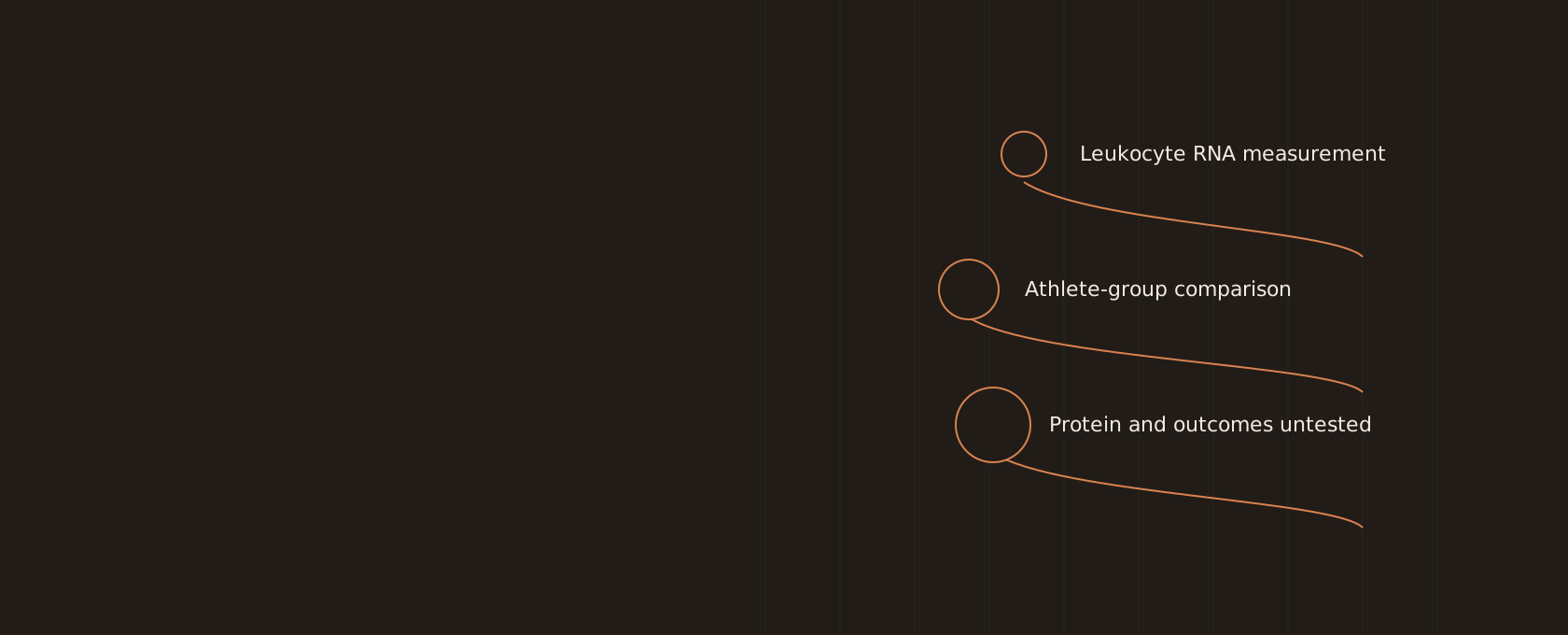
| 2017 · Zychowska M ↗ | Acute comparative physiology study Athletes and non-athletes Participants: 18. Finnish sauna | Leukocyte messenger-RNA responses differed between the groups, with higher expression of the tested genes reported in non-athletes after the heat challenge. Comparison: Athletes versus non-athletes before and after the same heat exposure Very small groups. |
| 2023 · Pilch W ↗ | trained-versus-untrained repeated-exposure experiment healthy men Participants: 20. Finnish sauna · ten baths | Some immune and hormonal responses differed by training status and exposure timing. Comparison: trained versus untrained; first versus last bath Biomarkers only; no infection endpoint; small male groups. |
| 2018 · Laukkanen JA ↗ | narrative review Epidemiological and experimental populations primarily Finnish sauna | This review surveys associations, interventions and mechanisms, while identifying remaining uncertainty; it does not constitute a new outcome trial. Comparison: Varied across studies Narrative synthesis |
Original publication: Effects of sauna bathing on stress-related genes expression in athletes and non-athletes.
What did the gene-expression experiment measure?
It measured leukocyte messenger RNA for selected genes encoding heat-shock proteins and immune-response mediators before and after sauna. Messenger RNA is a molecular readout related to gene expression. The assay did not directly measure every protein made from those messages, its activity or a later clinical outcome.
That distinction defines the paper’s contribution. The experiment can inform a question about how selected blood cells respond to a heat challenge. It cannot establish that an equivalent protein increase occurred throughout the body or that the molecular response improved health. A useful summary therefore names the sampled cells and measurement level before describing the result. The words gene expression should not disappear as the finding is translated for readers, because removing them can change an acute molecular observation into a much stronger biological claim.
Did athletes and non-athletes respond identically?
They did not. The abstract reports differing leukocyte mRNA levels, with the tested genes expressed at higher levels after the challenge in the non-athlete group. That is the source-specific result. It does not identify one group as universally healthier or one response as inherently preferable.
Each group was small, and training background was an existing characteristic rather than a randomized intervention. Group labels cannot exclude every other difference affecting the response. The source can motivate research on participant background without establishing that training alone caused the observed pattern. It also does not supply an estimate for every athlete or non-athlete. A more informative interpretation retains the sample and acute comparison rather than treating the difference as an individualized measure of adaptation, fitness, cellular resilience or the ability to benefit from sauna.
The comparison included eighteen participants, split between the athlete and non-athlete groups. This is preliminary molecular evidence rather than a large test of population differences.
Why does the measurement compartment matter?
Blood leukocytes are the cells in which gene expression was assessed. The paper did not directly sample every organ or establish the same expression pattern in muscle, heart or brain tissue. A finding in the measured compartment cannot simply be extended to all tissues.
The molecular level matters as well. Messenger-RNA expression, a circulating protein concentration and a protein’s functional effect are distinct measurements. Evidence connecting them needs to be established rather than assumed. The present experiment did not complete that chain through a clinical endpoint. This is a useful boundary when a heat-shock claim is presented as if a transcript measurement already proves better tissue maintenance throughout the body. The source gives a more specific result and should remain useful on those terms, without requiring a larger promise to make it scientifically interesting.
Does more expression establish a better response?
No clinical ranking follows from the difference alone. An acute stress-related response can be measured without showing that its magnitude predicts improved recovery, fewer infections or longer life. The experiment did not assess those endpoints or identify an optimal level of expression.
A possible mechanism is not a verified benefit. A reader should ask what outcome would establish the proposed advantage, whether the study measured it and whether the comparison can support attribution. In this paper, the answer remains at the molecular-response stage. The source does not validate a personal test for how effectively someone has used sauna. Nor does it show that a person should pursue a larger response. Those applications would require a separate measurement and decision rule rather than a favorable interpretation of one group’s higher mRNA values.
Can the abstract provide a complete practical heat dose?
It cannot. The indexed abstract describes a specific challenge but does not state the duration of each heat exposure. Missing details should remain unknown rather than be filled from a typical practice or another sauna paper.
A source can provide enough information to understand its research question without supplying a full public routine. This study also did not compare several complete exposure schedules to identify an optimum. Combining its reported environment with another paper’s duration or frequency would create a new intervention untested for the molecular or clinical claim. This page therefore does not present a protocol for maximizing heat-shock expression. The appropriate methods use is to recognize which conditions were specified, which were not and which further details would need checking before attempting a fuller scientific comparison.
Does serum HSP70 research supply the missing protein result?
A separate trained-versus-untrained study measured serum HSP70 during a sauna series, but its indexed results do not provide a clear directional protein finding. That study therefore does not license a general statement that the gene-expression difference here became a particular protein increase.
A broader sauna review discusses proposed mechanisms and areas of uncertainty, which can help organize these research levels. A review is not an additional molecular experiment or a demonstration that the proposed pathway explains a clinical association. The sources can be read together while retaining their different roles. The present paper contributes leukocyte transcript data, the serum-assay paper contributes a repeated-exposure measurement question, and the review organizes hypotheses. None should be used to invent a missing link between transcript, protein, function and long-term health.
What conclusion remains after those boundaries are kept?
The grade is C for a small acute comparison of molecular responses. It supports reporting that the groups differed in the tested leukocyte mRNA measures after the challenge. It does not establish a universal physiological advantage, protein-dose target or clinical benefit from increasing heat exposure.
This appraisal read the indexed abstract and independently refreshed bibliographic information. Full-text methods, complete assay detail, formal risk of bias, funding and competing-interest disclosures were not comprehensively reviewed. Those financial details remain unreported rather than inferred. A person considering sauna with a medical condition or medication question needs a separate clinical discussion. The historical safety review supplies context, not a personalized clearance decision. A molecular observation should help define the next research question without becoming an exposure prescription or an assurance that every form of stress-related expression is beneficial.
Explore the evidence with a tool.
Questions, considered
Questions about this study
What did the athlete gene-expression sauna study actually measure?
The investigators measured leukocyte messenger RNA for selected heat-shock and inflammatory-response genes before and after sauna exposure. This is a molecular response study. It does not directly measure fewer infections, better recovery or longer life, so those outcomes cannot be inferred from the reported gene-expression changes.
Follow the sourceDid athletes and non-athletes have identical gene responses to the sauna challenge?
They did not. The abstract reports differences between the groups, with greater expression of the tested genes in non-athletes after the same heat challenge. Each group contained nine participants. The result concerns this small acute experiment and does not establish a universal advantage of either response pattern.
Follow the sourceCan the gene-expression sauna experiment supply a general home-sauna protocol?
It cannot establish a broadly appropriate personal routine. The experiment used a specific Finnish-sauna heat challenge to compare molecular responses in athletes and non-athletes. Its abstract does not give the duration of each exposure, and it did not test long-term clinical benefits or individualized safety limits.
Follow the sourceFollow the evidence
Sources & references
Research summaries in this edition are based on indexed abstracts unless otherwise noted. A source link is not a claim of medical review.
- Effects of sauna bathing on stress-related genes expression in athletes and non-athletes.
Zychowska M, Półrola P, Chruściński G, Zielińska J, Góral-Półrola J
Volume 24, issue 1, pages 104-107 · PMID 28378983
Open-access flag: not recorded.Abstract-level editorial review - The effects of a single and a series of Finnish sauna sessions on the immune response and HSP-70 levels in trained and untrained men.
Pilch W, Szarek M, Olga CL, Anna P, Żychowska M, Ewa SK, Andraščíková Š, Pałka T
Volume 40, issue 1, pages 2179672 · PMID 36813265
Open-access flag: not recorded.Abstract-level editorial review - Cardiovascular and Other Health Benefits of Sauna Bathing: A Review of the Evidence.
Laukkanen JA, Laukkanen T, Kunutsor SK
Volume 93, issue 8, pages 1111-1121 · PMID 30077204
Open-access flag: not recorded.Abstract-level editorial review - Benefits and risks of sauna bathing.
Hannuksela ML, Ellahham S
Volume 110, issue 2, pages 118-126 · PMID 11165553
Open-access flag: not recorded.Abstract-level editorial review