| Study | Design & population | Finding & comparison |
|---|---|---|
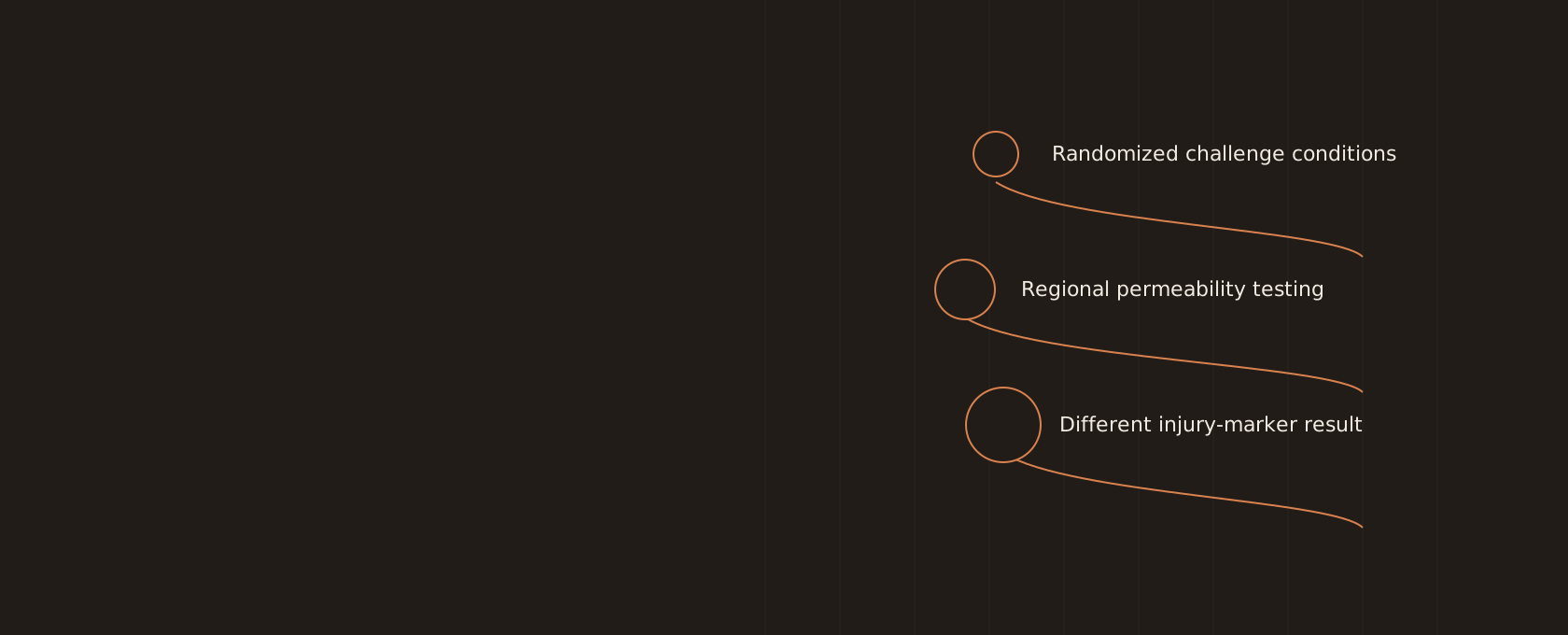
| 2021 · Roca Rubio MF ↗ | Randomized-order crossover challenge study Healthy adults Participants: 20. Sauna-induced dehydration · Acute challenge | A deliberately dehydrating sauna challenge increased upper-intestinal permeability and selected inflammatory markers without changes in the reported enterocyte-injury markers. Comparison: NSAID condition and negative control Deliberate substantial dehydration |
| 2020 · Behzadi P ↗ | Randomized-order crossover physiology study Healthy middle-aged and older adults Participants: 20. Finnish sauna | Selected cytokines increased after sauna, whereas CRP did not change; the response depended on exposure pattern and marker. Comparison: Seated time control Acute response |
| 2022 · Karolkiewicz J ↗ | pilot randomized controlled trial Untrained healthy young men Participants: 15. postexercise dry Finnish sauna · 4 weeks | Adding sauna to cycling did not measurably change the selected microbiota, barrier markers or hsCRP relative to cycling alone. Comparison: Identical cycling without sauna Pilot sample |
Original publication: Sauna dehydration as a new physiological challenge model for intestinal barrier function.
Why did researchers deliberately use a dehydration challenge?
The purpose was to evaluate a physiological challenge model for intestinal-barrier research. A challenge model intentionally produces a measurable stress response so researchers can investigate relevant outcomes. It is not automatically an intervention intended to improve the state being measured.
That distinction organizes the entire paper. The source did not ask whether a public sauna routine improves digestive wellbeing or helps people manage a chronic intestinal condition. It examined responses to a deliberately dehydrating exposure alongside comparison conditions. This summary therefore does not provide target losses or a sequence for recreating the challenge. The useful contribution is evidence about what the experimental condition elicited and how the investigators measured it. Describing that purpose accurately prevents a laboratory model from becoming a recommendation merely because its title contains a familiar leisure activity.
What does the randomized-order design contribute?
Participants experienced a sauna-dehydration condition, a drug-related challenge and a negative control in randomized order. These comparisons help researchers examine whether the measured response differs across the selected experimental settings. The negative control provides a reference beyond assuming that any repeated measurement would remain unchanged.
Randomized order does not make the experiment representative of every public sauna setting or eliminate all questions about carryover and standardization. A complete appraisal would inspect the visit intervals, procedures and analysis. The drug-related condition is also part of the research design, not an alternative for readers to try or a basis for changing medication. Keeping all conditions identified by their purpose makes the design intelligible without turning a comparison of stress models into a practical menu of exposures. This page evaluates the reported measurements rather than recommending either challenge.
What did the intestinal-permeability assessment find?
The deliberately dehydrating sauna condition increased measured permeability in upper-intestinal regions. The investigators assessed permeability using a urinary recovery test involving multiple sugars. This is a defined measurement outcome under an experimental condition, not a comprehensive diagnosis of a chronic digestive disorder.
The finding should remain attached to the relevant regions and exposure. It does not show that all parts of the intestine respond identically or that every sauna visit produces the same effect. A more comfortable or differently hydrated routine is a different exposure question. The source helps establish that the challenge elicited a measurable barrier-related response; it does not quantify a universal risk from ordinary use. A careful summary can describe increased permeability without importing a broader disease label or claiming that the result represents every person’s everyday intestinal function.
Was greater permeability the same as demonstrated cell injury?
No. The abstract reports that the measured enterocyte-injury markers did not change even though permeability increased. Enterocytes are intestinal lining cells. The distinction is important because permeability measurements and injury-related blood signals are different outcomes rather than interchangeable descriptions.
A lack of change in those markers does not prove that every possible injury response was absent. Equally, increased permeability cannot be expanded automatically into a claim of extensive tissue damage. The defensible account names what was assessed and how it changed. This paper is especially useful for teaching that discipline because it reports different patterns across related outcomes. It gives researchers reason to investigate the response, while leaving clinical meaning and persistence to further work. The abstract alone does not establish a later symptom burden or long-term diagnosis caused by the exposure.
Did all inflammatory measurements increase?
The source reports increases in selected inflammatory signals and no change in several others. The registered qualitative result therefore keeps the term selected rather than describing a uniform inflammatory response. This page does not add unregistered numerical effects or treat the panel as one all-purpose score.
Different blood signals can answer related but distinct questions, and their sampling occasion matters. An immediate challenge response cannot establish a sustained resting level or the course of an inflammatory illness. An acute sauna cytokine study in another healthy population also found marker-specific patterns rather than one universal direction. That context supports precise reporting, not an assumption that the experiments are direct replications. The dehydrating challenge is a distinctive exposure, so a finding from another visit pattern cannot replace or erase its actual result.
How does this differ from a repeated exercise-plus-sauna trial?
A randomized pilot in young men compared cycling with the same exercise program plus sauna and did not detect added changes in selected gut measurements or high-sensitivity CRP. That is a different question from intentionally producing a dehydration challenge to investigate permeability.
The exposures, participants, timing and measurements should remain visible before deciding whether the papers conflict. A null added-program result does not show that a deliberately stressful challenge cannot elicit a response. Conversely, a response under the challenge does not determine the outcome of every exercise-recovery routine. These comparisons are more informative when they clarify the purpose of each experiment. Shared sauna terminology is not enough to combine them into a general account of gut improvement or gut harm. Neither publication supplies a personal exposure plan or a validated dehydration target for a reader.
What does this appraisal establish and leave open?
The grade is C for a small controlled challenge experiment assessing acute physiological outcomes. The study supports discussing increased permeability and selected inflammatory signals under its defined conditions, alongside unchanged reported injury markers. It does not establish a wellness benefit, chronic disease effect or universal risk estimate for normal sauna use.
The indexed abstract and source record were reviewed and refreshed. Complete laboratory methods, formal risk of bias, funding and conflicts of interest were not assessed in full text. Those financial details remain unreported here rather than inferred. Personal suitability is another question: a healthy-volunteer experiment does not provide clinical clearance for someone with symptoms, a diagnosis or a medication concern. Discuss intended use with a qualified clinician where relevant, and treat this paper as a methodological investigation rather than instructions to reproduce its stress response.
Explore the evidence with a tool.
Questions, considered
Questions about this study
Was the 2021 sauna gut-barrier study designed as a wellness routine?
No. Researchers deliberately used dehydration as a physiological challenge to test intestinal-barrier measurements. This was a laboratory model, not a recommendation to pursue fluid loss. The design compared sauna dehydration with a drug-related challenge and a negative control in healthy volunteers under research conditions.
Follow the sourceWhat happened to intestinal permeability in PMID 34330970?
The dehydrating sauna condition increased measured permeability in the stomach-duodenal and small-intestinal regions. Selected inflammatory markers also rose, while the reported enterocyte-injury markers did not change. These different measurements should be described separately; increased permeability does not automatically demonstrate extensive intestinal-cell damage or a chronic disorder.
Follow the sourceCan the gut-barrier experiment be generalized to a short comfortable sauna visit?
That generalization is uncertain because the exposure deliberately produced substantial dehydration. A routine session with different duration, hydration and temperature may impose a different challenge. The paper is useful for understanding a potential stress response, but it does not quantify the risk from every ordinary sauna visit.
Follow the sourceFollow the evidence
Sources & references
Research summaries in this edition are based on indexed abstracts unless otherwise noted. A source link is not a claim of medical review.
- Sauna dehydration as a new physiological challenge model for intestinal barrier function.
Roca Rubio MF, Eriksson U, Brummer RJ, König J
Volume 11, issue 1, pages 15514 · PMID 34330970
Open-access flag: yes.Abstract-level editorial review - Impact of Finnish sauna bathing on circulating markers of inflammation in healthy middle-aged and older adults: A crossover study.
Behzadi P, Gravel H, Neagoe PE, Barry H, Sirois MG, Gagnon D
Volume 52, pages 102486 · PMID 32951736
Open-access flag: not recorded.Abstract-level editorial review - No effects of a 4-week post-exercise sauna bathing on targeted gut microbiota and intestinal barrier function, and hsCRP in healthy men: a pilot randomized controlled trial.
Karolkiewicz J, Nieman DC, Cisoń T, Szurkowska J, Gałęcka M, Sitkowski D, Szygula Z
Volume 14, issue 1, pages 107 · PMID 35710395
Open-access flag: yes.Abstract-level editorial review - Benefits and risks of sauna bathing.
Hannuksela ML, Ellahham S
Volume 110, issue 2, pages 118-126 · PMID 11165553
Open-access flag: not recorded.Abstract-level editorial review