| Study | Design & population | Finding & comparison |
|---|---|---|
| 2019 · Laukkanen T ↗ | Single-group before-after physiology study Adults with cardiovascular risk factors Participants: 93. Sauna | Autonomic patterns differed during heating and recovery; the observational within-session changes did not establish durable cardiac protection. Comparison: Before, during and after exposure No randomized control |
| 2025 · Lee E ↗ | randomized controlled trial Sedentary adults with at least one cardiovascular risk factor Participants: 38. postexercise sauna · 8 weeks | Adding sauna after exercise did not produce statistically detectable additional HRV improvements relative to exercise alone. Comparison: Exercise alone; no-intervention control Small trial |
| 2022 · Hussain JN ↗ | randomized crossover trial Healthy women Participants: 10. infrared sauna · Acute | Infrared heating raised temperature, but its acute response pattern differed from exercise and appeared mainly thermoregulatory. Comparison: Rest; moderate indoor cycling Ten women |
Original publication: Recovery from sauna bathing favorably modulates cardiac autonomic nervous system.
Was the autonomic response uniform throughout the visit?
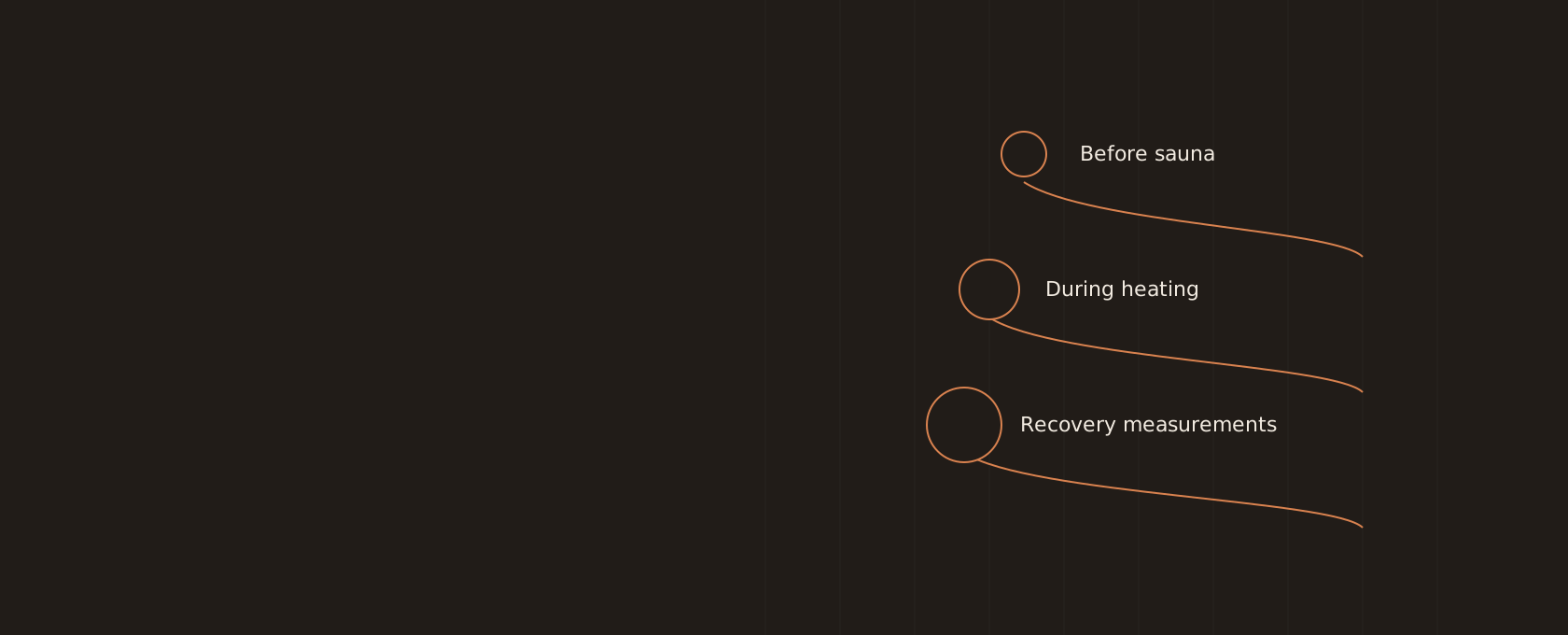
No. Heating and recovery showed different patterns, which is the central distinction in this paper. The investigators followed heart rate and heart-rate variability around a sauna session in adults with cardiovascular risk factors. An account limited to the favorable recovery period would not describe the whole exposure.
The paper concerns recovery from sauna bathing and cardiac autonomic modulation. The recovery phase is essential to interpretation because it identifies a period after heating, rather than a continuous state throughout the visit. A reader encountering a favorable summary without timing context might assume that every measurement moved similarly from entry to exit. The source does not establish that. Its contribution is a closer description of the phases, which can help researchers ask more precise questions about immediate responses and help readers understand why a measurement taken in the hot room cannot stand in for a measurement recorded after cooling.
The same timing distinction should be retained in diagrams: a recovery measurement should appear after the heating phase, with no arrow implying that the observed pattern continues indefinitely or establishes a future event reduction.
What can a before-and-after study reveal?
The researchers measured participants before, during and after exposure in a single-group design. This can describe how values change during the observed visit and help locate a physiological response in time. It is useful for examining a possible mechanism and for planning later controlled work.
It does not offer the same inference as assigning comparable participants to sauna and a time-matched control. Without that contrast, changes related to resting, elapsed time or other aspects of the visit cannot be fully separated from heating. These are limitations of the inference, rather than proof that a specific alternative produced the result. The paper should be read as a detailed acute observation, not a completed causal experiment. The distinction also prevents an observed change within people from being described as a demonstrated advantage over an untested alternative activity or recovery routine. The necessary control comparison would need to be made directly.
What happened during heating and during recovery?
The retained source finding is that autonomic patterns differed between phases. Heating transiently reduced the vagal component, while recovery displayed a different HRV pattern. The vagal component refers to a measured aspect of parasympathetic cardiac regulation; it is not a universal score for relaxation or health.
The study also described a lower resting heart rate at the end of recovery than before sauna. That observation belongs to the measured recovery interval. It does not show that the participants acquired a permanently lower resting rate or that a future cardiac event was prevented. Attaching each result to its time point is therefore part of reporting the result accurately. A caption about recovery should identify recovery, while a description of heating should retain what happened during heating. Combining these phases into one favorable post-sauna state would remove information that the researchers specifically collected and that readers need to understand the physiological sequence.
What can this teach a reader who tracks HRV?
The study illustrates why timing matters, without validating every consumer monitoring routine. A value recorded during heating answers a different question from one recorded after cooling. Combining both into one score hides that changing context. An immediate reading around exposure is also different from a consistently assessed resting baseline.
The publication used research measurements under its protocol. It did not establish a universal method for judging a wearable readiness score, choosing a training day or deciding how long to stay in heat. Translating the response into those decisions would require additional evidence. The useful application is interpretive: identify when a value was measured and avoid assuming it represents all phases of a session. A person can use that distinction to ask better questions about a device reading while recognizing that the research did not determine a personal threshold or a complete recovery plan for athletes.
Did the later randomized trial confirm a durable HRV gain?
A later multi-arm trial did not detect additional HRV improvement when postexercise sauna was added to exercise. That is relevant context because it tested a repeated program against an active comparator. It prevents a transient recovery response from being treated as automatic evidence of sustained added benefit.
The papers need not be forced into a contradiction. Their timing, participants and comparisons differ. An acute autonomic response could occur even if a particular repeated program does not improve resting indices beyond exercise. Another crossover study in healthy women also showed that infrared heating and cycling had differing response patterns. It does not replicate the present protocol, but illustrates why modalities should not be treated as physiologically interchangeable. Across these sources, the precise question matters: what happens around a visit, whether added sauna changes a repeated program’s outcome, and whether different activities produce the same immediate response are distinct comparisons.
What remains between this observation and cardiac protection?
A lasting clinical explanation would require more than an interesting autonomic pattern. The exposure would need to cause the response, the response would need to recur or persist meaningfully, and it would need to help explain a relevant health outcome. This acute single-group study does not establish that entire sequence.
The C grade reflects its useful physiological observation and the absence of a randomized control for this comparison. Adults with cardiovascular risk factors are a defined population, not a proxy for every user or every cardiac diagnosis. The indexed abstract was read and refreshed. Complete methods, formal risk of bias and participant overlap with related physiological publications remain to be assessed in full text. Funding and competing-interest details were not established by the abstract. The protocol is a research description rather than a suggested home exposure. Personal suitability, particularly with cardiovascular disease or medication use, requires a separate discussion with a qualified clinician.
Explore the evidence with a tool.
Questions, considered
Questions about this study
Did the heart-rate-variability recovery study find the same pattern inside and outside the sauna?
No. The heating phase transiently reduced the vagal component, whereas recovery showed a different heart-rate-variability pattern. This timing distinction matters because a measurement taken after cooling cannot describe the entire exposure. The study examined immediate autonomic responses rather than a stable change established after months of use.
Follow the sourceWas PMID 31331560 a randomized test of long-term autonomic benefit?
No. It used a single-group before-and-after approach around one sauna exposure. Participants had cardiovascular risk factors, and their heart-rate measures were tracked through heating and recovery. The authors called for randomized research to determine whether such changes help explain longer-term associations with cardiovascular health.
Follow the sourceDoes lower recovery heart rate prove reduced future cardiac risk in this study?
No. A lower value during the observed recovery period is an acute physiological finding. The study did not measure subsequent cardiac events attributable to sauna. It is reasonable to discuss the response as a possible mechanism, while keeping that hypothesis separate from evidence of lasting clinical protection.
Follow the sourceFollow the evidence
Sources & references
Research summaries in this edition are based on indexed abstracts unless otherwise noted. A source link is not a claim of medical review.
- Recovery from sauna bathing favorably modulates cardiac autonomic nervous system.
Laukkanen T, Lipponen J, Kunutsor SK, Zaccardi F, Araújo CGS, Mäkikallio TH, Khan H, Willeit P, Lee E, Poikonen S, Tarvainen M, Laukkanen JA
Volume 45, pages 190-197 · PMID 31331560
Open-access flag: not recorded.Abstract-level editorial review - Regular postexercise sauna bathing does not improve heart rate variability: A multi-arm randomized controlled trial.
Lee E, Ketelhut S, Wiklund P, Kostensalo J, Kolunsarka I, Hägglund H, Ahtiainen JP
Volume 13, issue 13, pages e70449 · PMID 40611569
Open-access flag: yes.Abstract-level editorial review - Infrared sauna as exercise-mimetic? Physiological responses to infrared sauna vs exercise in healthy women: A randomized controlled crossover trial.
Hussain JN, Cohen MM, Mantri N, O'Malley CJ, Greaves RF
Volume 64, pages 102798 · PMID 34954348
Open-access flag: not recorded.Abstract-level editorial review - Benefits and risks of sauna bathing.
Hannuksela ML, Ellahham S
Volume 110, issue 2, pages 118-126 · PMID 11165553
Open-access flag: not recorded.Abstract-level editorial review