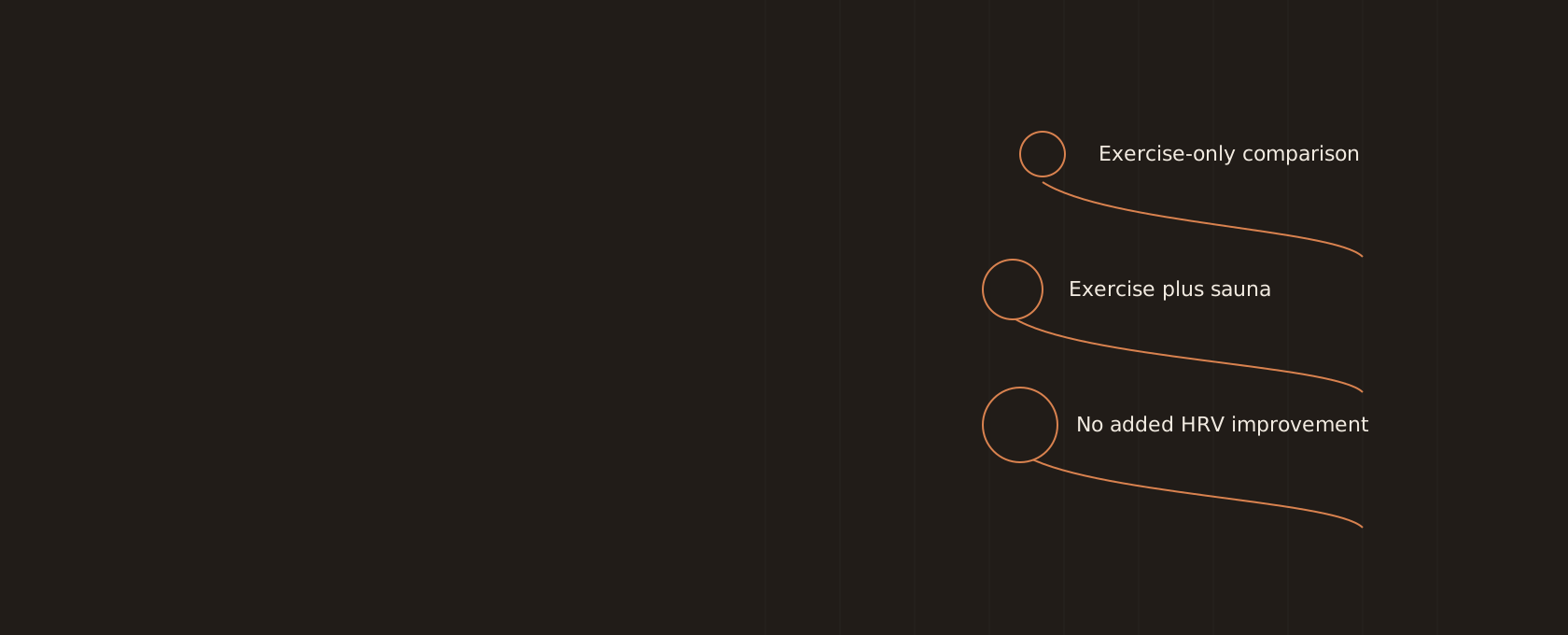
| Study | Design & population | Finding & comparison |
|---|---|---|
| 2025 · Lee E ↗ | randomized controlled trial Sedentary adults with at least one cardiovascular risk factor Participants: 38. postexercise sauna · 8 weeks | Adding sauna after exercise did not produce statistically detectable additional HRV improvements relative to exercise alone. Comparison: Exercise alone; no-intervention control Small trial |
| 2019 · Laukkanen T ↗ | Single-group before-after physiology study Adults with cardiovascular risk factors Participants: 93. Sauna | Autonomic patterns differed during heating and recovery; the observational within-session changes did not establish durable cardiac protection. Comparison: Before, during and after exposure No randomized control |
| 2022 · Lee E ↗ | randomized controlled trial Low activity with at least one cardiovascular risk factor Participants: 47. postexercise sauna · 8 weeks | Relative to exercise alone, exercise plus sauna produced an additional fitness change of +2.7 mL/kg/min (95% CI +0.2 to +5.3) and a systolic-pressure difference of −8.0 mmHg (−14.6 to −1.4). This small combined-program trial did not test sauna alone or clinical-event prevention. Comparison: Exercise alone; control Small eight-week multi-arm trial |
Original publication: Regular postexercise sauna bathing does not improve heart rate variability: A multi-arm randomized controlled trial.
What did adding sauna accomplish for HRV?
The trial did not detect an additional improvement in measured heart-rate-variability indices when sauna followed exercise. That is the direct answer to its added-intervention question. It is more specific than saying sauna does nothing and more cautious than assuming a relaxing visit must improve an autonomic measure over time.
The original publication reports that regular postexercise sauna bathing did not improve HRV in its multi-arm randomized trial. Keeping this null finding in the evidence base matters. A research guide that includes favorable short-term physiology while omitting this active comparison would leave an incomplete impression of the support for a repeated routine. The title should also remain attached to the trial’s actual participants and outcome. A finding about HRV is not a verdict on every experience a sauna user values, but it is directly relevant when the promised benefit is an added HRV improvement beyond an exercise program.
In particular, a claim that the two programs are equivalent would require a prespecified equivalence question and suitable analysis. This summary does not infer such a design from an ordinary report that a between-group difference was not statistically significant.
Why are the exercise-only and control groups essential?
Participants were randomized to exercise with postexercise sauna, exercise alone or a control condition. The exercise-only group is crucial for determining whether sauna added something beyond the exercise program. Comparing only the combined group with an inactive control would make the individual components difficult to separate.
The interpretation therefore depends on the contrast being discussed. A difference between exercise and control is not automatically evidence for sauna. An absence of a detected difference between the combined and exercise-only groups is directly relevant to the added sauna question. Clear group labels prevent an effect in one comparison from being assigned to a different component. The study is valuable precisely because it includes that distinction. Readers should ask what an intervention adds to an established program, rather than assume that a favorable result for a package demonstrates the independent value of each part of the package.
Which people and program does the finding represent?
The participants were sedentary adults with at least one cardiovascular risk factor. That baseline status is relevant when a trial is discussed using the language of athletic recovery. It did not establish the effect in elite endurance athletes, highly trained strength athletes or every healthy person already using sauna.
The source also tested a repeated combined program rather than an isolated visit. The exercise context, sauna timing and assessment period belong to the exposure, rather than being background details to discard. A personal routine with different training demands or heat conditions would pose another question. Preserving those boundaries does not make the study less useful; it shows where the comparison is most direct. For someone asking about sauna after exercise, the publication is relevant evidence, but resemblance in timing does not erase differences in baseline activity, health, monitoring or the outcome being pursued.
What does HRV measure, and what does it leave out?
Heart-rate variability describes variation between heartbeats under specified measurement conditions. Here it was a physiological outcome assessed before and after the program. It was not a direct measure of subsequent cardiovascular events, survival, perceived enjoyment or every aspect of recovery.
The boundary works in both directions. A favorable HRV change would not by itself show disease prevention, and a null difference does not demonstrate that no other response occurred. The most reliable account identifies the measured indices and comparison, then resists replacing them with a more dramatic endpoint. This matters when consumer devices encourage people to treat an autonomic number as a general health score. The trial did not validate every wearable or establish a personal target for tracking readiness. Its contribution concerns the program’s group-level research measurements, which should be interpreted on their own terms before anyone attempts an application to an individual device reading.
How does it fit acute findings and other trial endpoints?
An earlier before-and-after study described different autonomic patterns during sauna heating and subsequent recovery. Those observations concerned an immediate response around a visit. The randomized trial instead asked whether regular added sauna improved HRV beyond exercise alone. A transient response and a sustained between-group difference are not interchangeable.
A related exercise-and-sauna trial reported favorable fitness and systolic-pressure changes relative to exercise alone. Those are distinct endpoints and retain their combined-program context. A publication about one endpoint cannot overwrite another endpoint’s null result. The research need not be forced into an all-beneficial or all-ineffective classification. Programs can have differing measured results across outcomes, and study timing can change the question. The correct task is to evaluate the estimates, uncertainty and design relevant to each claim. The present finding remains useful beside favorable physiology because it tests a specific, practical added-intervention promise.
Does a null result establish that the groups are identical?
No statistically detectable added improvement is not proof of exact equality. A small trial can leave uncertainty about modest differences. That uncertainty should not be converted either into guaranteed equivalence or permission to assume a hidden benefit. This study did not establish the added HRV advantage; that is already a meaningful result.
A full appraisal would inspect estimate precision, adherence, missing data, measurement standardization and planned analyses. The indexed abstract does not settle all those questions. The C grade reflects a small randomized trial addressing a defined physiological outcome. The source record was refreshed, but a full-text risk-of-bias assessment was not completed. Funding and competing interests were not established in the reviewed abstract and remain unreported. Finally, an efficacy result is not personal medical clearance. People with conditions or medication questions need an appropriate clinical discussion rather than interpreting trial participation or a null HRV result as proof of individual heat safety.
Explore the evidence with a tool.
Questions, considered
Questions about this study
Did postexercise sauna add HRV benefit in the recent multi-arm trial?
The trial did not detect additional improvement in the measured HRV indices when sauna was added to regular exercise. That is a useful null finding alongside earlier positive short-term reports. It addresses this combined program and physiological outcome, rather than proving that every possible sauna effect is absent.
Follow the sourceWas the postexercise HRV trial conducted in competitive athletes?
No. Participants were sedentary adults with at least one cardiovascular risk factor. Their baseline status differs from highly trained athletes, and the intervention combined exercise with sauna. Applying this result to an athlete’s recovery routine requires that population and training distinction, even though the measured variable is commonly discussed in sport.
Follow the sourceDoes an HRV result directly measure fewer heart attacks or longer life?
No. HRV describes variation between heartbeats under measurement conditions. The trial evaluated that physiological outcome, not clinical cardiovascular events or lifespan. A change, or a null change, in HRV should therefore be interpreted on its own terms rather than automatically translated into a disease-prevention claim for sauna users.
Follow the sourceFollow the evidence
Sources & references
Research summaries in this edition are based on indexed abstracts unless otherwise noted. A source link is not a claim of medical review.
- Regular postexercise sauna bathing does not improve heart rate variability: A multi-arm randomized controlled trial.
Lee E, Ketelhut S, Wiklund P, Kostensalo J, Kolunsarka I, Hägglund H, Ahtiainen JP
Volume 13, issue 13, pages e70449 · PMID 40611569
Open-access flag: yes.Abstract-level editorial review - Recovery from sauna bathing favorably modulates cardiac autonomic nervous system.
Laukkanen T, Lipponen J, Kunutsor SK, Zaccardi F, Araújo CGS, Mäkikallio TH, Khan H, Willeit P, Lee E, Poikonen S, Tarvainen M, Laukkanen JA
Volume 45, pages 190-197 · PMID 31331560
Open-access flag: not recorded.Abstract-level editorial review - Effects of regular sauna bathing in conjunction with exercise on cardiovascular function: a multi-arm, randomized controlled trial.
Lee E, Kolunsarka I, Kostensalo J, Ahtiainen JP, Haapala EA, Willeit P, Kunutsor SK, Laukkanen JA
Volume 323, issue 3, pages R289-R299 · PMID 35785965
Open-access flag: yes.Abstract-level editorial review - Benefits and risks of sauna bathing.
Hannuksela ML, Ellahham S
Volume 110, issue 2, pages 118-126 · PMID 11165553
Open-access flag: not recorded.Abstract-level editorial review