| Study | Design & population | Finding & comparison |
|---|---|---|
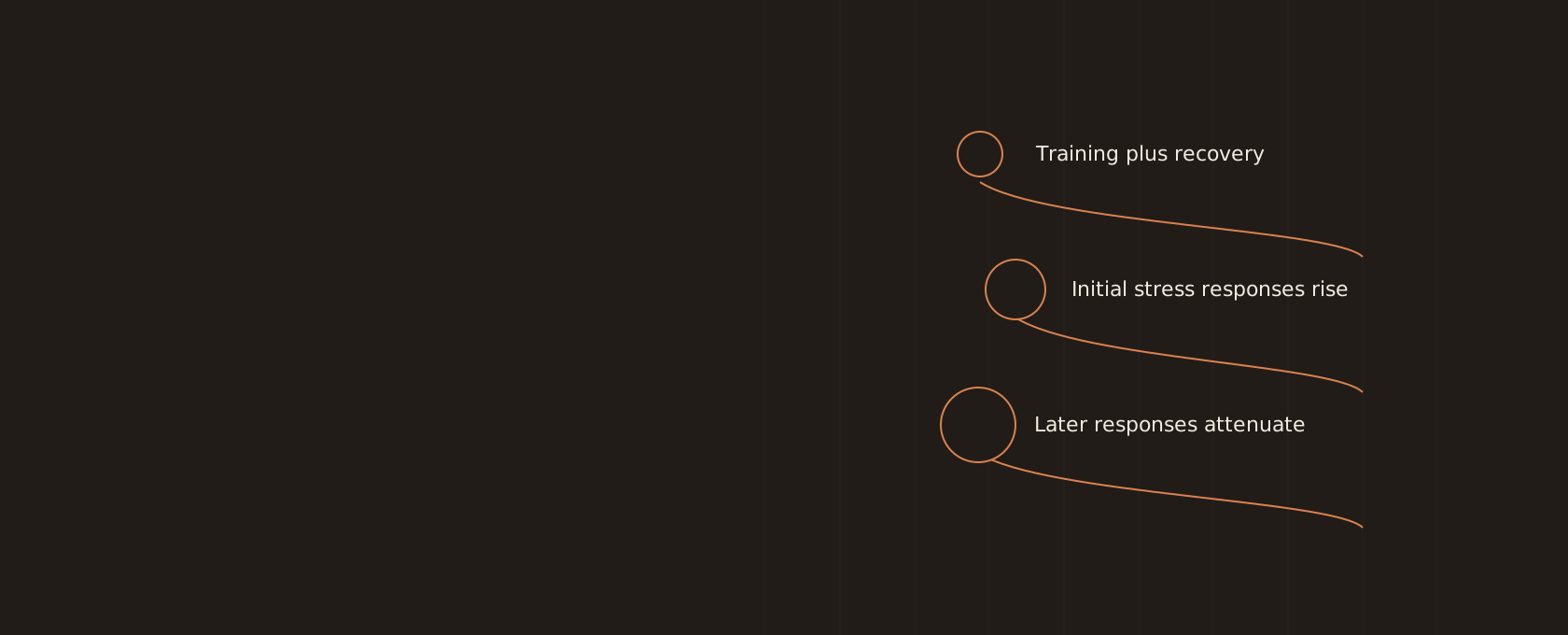
| 2025 · Ahokas EK ↗ | pair-matched controlled training study team-sport athletes Participants: 40. post-exercise infrared sauna · 6 weeks | Initial infrared recovery increased stress markers; some responses were smaller after repeated exposure. Comparison: passive recovery after training Training and heat occurred together; not proof of reduced chronic stress. |
| 2017 · Aggon E ↗ | Acute repeated-measure physiology study Healthy elite male wrestlers Participants: 14. Sauna; protocol not fully reported | The abstract reports lower cortisol after sauna but no significant insulin change. This acute hormonal result is not evidence of improved insulin sensitivity or sustained stress reduction. Comparison: Rest, wrestling exercise and sauna on separate measurement occasions Small athlete-only population. |
| 2025 · Ahokas EK ↗ | pair-matched controlled training study team-sport athletes Participants: 40. infrared sauna · 6 weeks | Infrared recovery did not add significant hypertrophy gains; some power-related measures showed interactions. Comparison: same strength/power training without infrared recovery Pair-matched groups; multiple performance outcomes; not proof of generalized gains. |
Original publication: Salivary cortisol response to post-exercise infrared sauna declines over time.
The question was how repeated recovery exposure changed responses
The investigators studied cortisol and autonomic responses to postexercise infrared sauna during a training program. They compared an infrared-recovery group with passive recovery and assessed experimental sessions near the beginning and end of the program. The title describes a response declining over time, not a universal reduction from ordinary baseline stress.
This distinction is essential because the early results were not uniformly calming. The registered interpretation records initially elevated physiological stress responses and less pronounced responses after repeated exposure. That pattern can be consistent with adjustment under the tested conditions without demonstrating improved mental health, a general endocrine benefit or a routine appropriate for someone who does not share the athletes’ training context.
The groups were pair-matched rather than described as randomized
The participants were female team-sport athletes placed in pair-matched infrared and control groups. They undertook structured exercise, with the recovery procedure differing afterward. The abstract does not describe random allocation, so the study should not be labeled a randomized trial on the basis of having a comparison group.
The passive-recovery condition is still useful because it provides a reference for a complete training-plus-recovery setting. The result cannot automatically describe sauna without prior exercise, other participant groups or clinical endocrine conditions. Selection, matching and adherence would require fuller appraisal. The source is most informative when its actual design and population are retained rather than replaced with a broad claim about all sauna users.
Later attenuation is not the same as a lasting below-baseline benefit
Some cortisol and autonomic responses became less pronounced at the later assessment. This supports a question about physiological adjustment to repeated exposure under the training conditions. It does not establish that every hormone concentration fell below its ordinary level or that chronic psychological stress improved.
The distinction prevents a misleading use of the title. A smaller response to a repeated challenge is different from a validated program for reducing everyday stress or managing an endocrine condition. The source does not supply that clinical endpoint. The appropriate conclusion keeps the early and later experimental sessions visible, along with the comparison group and training context, rather than extracting the word declines as a stand-alone health claim.
Other hormone studies used different samples and timing
The wrestler experiment reported a lower cortisol concentration after a later sauna occasion and unchanged insulin. Its male elite-athlete sample, separate exercise and sauna measurements, and blood testing differ from the salivary postexercise design here. Their results cannot be combined as if they were the same measurement under the same conditions.
A useful synthesis asks which specimen, time point, preceding activity and comparator support each result. It does not average direction across unlike settings into a universal hormonal effect. The two studies can inform related questions while leaving the reason for their differing patterns unconfirmed. This uncertainty is more useful than an invented mechanism that makes every finding fit a single stress-reduction narrative.
What an added-heat claim would need to show
The passive-recovery comparison helps examine an addition within the tested exercise program. It does not establish an optimum dose or identify what would happen if a different person increased heat exposure. The observed adjustment is specific to the selected protocol and population.
A stronger clinical claim would need a relevant participant group, an appropriate comparison and outcomes directly addressing the proposed benefit. Chronic perceived stress, endocrine disease and training performance are not established simply by measuring cortisol. The emerging grade here reflects a controlled but limited physiological study, with initial stress responses and later attenuation both retained. No personal regimen for changing hormone levels can be derived from that pattern alone.
Review scope and personal suitability
The live indexed abstract was checked against the corpus and registered source finding. The PubMed entry and DOI provide the original bibliographic source. Full-text matching procedures, model choices, funding and conflicts of interest have not been independently audited. Unreported financial details remain unknown.
The separate historical safety review provides named cardiac contraindications and alcohol cautions rather than exhaustive clearance for athletes. Discuss relevant conditions and medications with a clinician. This summary does not recommend copying a research exposure or pursuing larger responses. Its conclusion is conditional: the tested postexercise infrared addition initially imposed measurable physiological stress, with some responses attenuating later, without establishing a general psychological or endocrine benefit.
Explore the evidence with a tool.
Questions, considered
Questions about this study
Did post-exercise infrared sauna immediately lower cortisol in the athlete study?
No. Early in the intervention, the infrared group showed increases in cortisol-related measures rather than a simple immediate reduction. Responses differed later in the training period. The paper should not be summarized as proof that infrared sauna always lowers stress hormones after exercise.
Follow the sourceWhat changed over time in the infrared cortisol experiment?
The cortisol and autonomic responses to the post-exercise exposure became less pronounced across the training intervention. This is consistent with physiological adjustment under the tested conditions. It does not establish that repeated infrared use improves every form of stress or produces the same response outside trained female athletes.
Follow the sourceWere the cortisol participants representative of all sauna users?
No. The study involved female team-sport athletes undergoing a structured training intervention, with infrared exposure added after exercise. Both training status and timing matter. The results cannot directly describe responses in sedentary adults, people with endocrine disorders or users taking a sauna without preceding exercise.
Follow the sourceFollow the evidence
Sources & references
Research summaries in this edition are based on indexed abstracts unless otherwise noted. A source link is not a claim of medical review.
- Salivary cortisol response to post-exercise infrared sauna declines over time.
Ahokas EK, Kyröläinen H, Ihalainen JK, Hanstock HG
Volume 12, issue 3, pages 281-295 · PMID 40926789
Open-access flag: yes.Abstract-level editorial review - The Effect of Wrestling Training and Sauna Practice on Cortisol and Insulin Hormones.
Aggon E, Kiyici F, Ucan I, Colak M, Agirbas O, Hackney AC
Volume 7, issue 3, pages 303-310 · PMID 41994329
Open-access flag: yes.Abstract-level editorial review - Effects of repeated use of post-exercise infrared sauna on neuromuscular performance and muscle hypertrophy.
Ahokas EK, Hanstock HG, Kyröläinen H, Ihalainen JK
Volume 7, pages 1462901 · PMID 40104529
Open-access flag: yes.Abstract-level editorial review - Benefits and risks of sauna bathing.
Hannuksela ML, Ellahham S
Volume 110, issue 2, pages 118-126 · PMID 11165553
Open-access flag: not recorded.Abstract-level editorial review