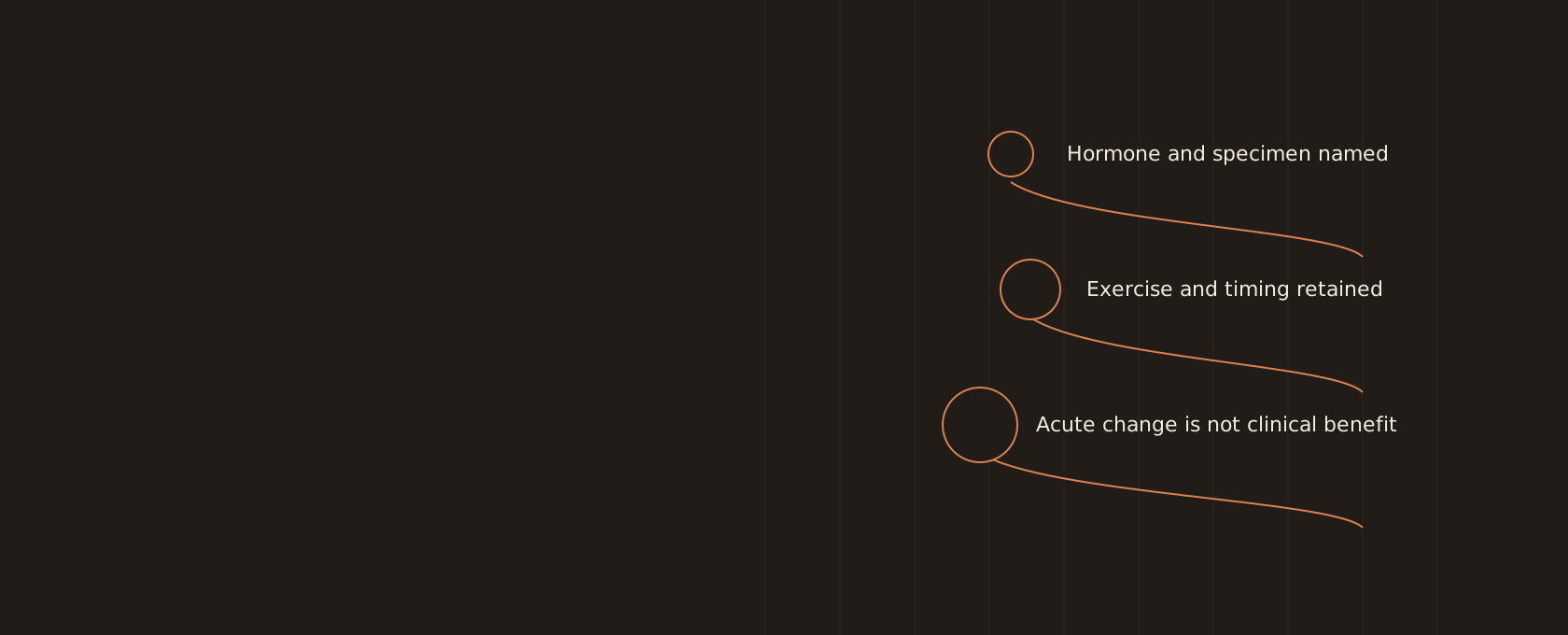
| Study | Design & population | Finding & comparison |
|---|---|---|
| 2017 · Aggon E ↗ | Acute repeated-measure physiology study Healthy elite male wrestlers Participants: 14. Sauna; protocol not fully reported | The abstract reports lower cortisol after sauna but no significant insulin change. This acute hormonal result is not evidence of improved insulin sensitivity or sustained stress reduction. Comparison: Rest, wrestling exercise and sauna on separate measurement occasions Small athlete-only population. |
| 2025 · Ahokas EK ↗ | pair-matched controlled training study team-sport athletes Participants: 40. post-exercise infrared sauna · 6 weeks | Initial infrared recovery increased stress markers; some responses were smaller after repeated exposure. Comparison: passive recovery after training Training and heat occurred together; not proof of reduced chronic stress. |
| 2020 · Rissanen JA ↗ | Repeated-measures exercise and sauna study Recreationally active, sauna-experienced Participants: 27. Traditional sauna | Strength exercise followed by sauna showed the greatest measured neuromuscular fatigue; sauna alone also temporarily reduced selected force measurements. Comparison: Sauna alone and strength, endurance or combined exercise followed by sauna No matched exercise-without-sauna conditions described |
There is no single favorable hormone response
The reviewed studies do not show a uniform direction for every hormone. One small wrestler experiment reported lower cortisol after sauna and no significant insulin change. A repeated postexercise infrared program initially elevated stress-related measures, with some responses less pronounced later. Another loading experiment found hormone changes before sauna and a different observation in sauna alone.
Grade C reflects this limited, context-dependent physiological evidence. It does not mean that every response was null, nor that each measured change was a benefit. A hormone concentration, psychological stress, insulin sensitivity and muscle growth are different outcomes. The question is what was measured, under which comparison and at what time. Without those details, a claim that sauna improves hormones can sound scientific while leaving the actual endpoint and its clinical meaning undefined.
A concentration is not a complete endocrine outcome
A blood or saliva sample describes a measurement at a particular occasion. It does not by itself establish that a person’s endocrine health improved, that a chronic condition changed or that a long-term psychological outcome followed. Those claims require relevant measurements and a design suited to them.
The distinction matters for both favorable and unfavorable directions. A transient decrease is not automatically a clinical improvement, and an increase during an experimental challenge is not automatically a diagnosis of harm. The athlete papers studied specified physiological responses rather than every aspect of health. The direct glucose crossover study also measured insulin and a composite sensitivity index separately, showing why the word insulin should not stand in for all metabolic outcomes. The source needs to establish the particular benefit being claimed rather than rely on the familiarity of a hormone name.
The wrestler study used separate exercise and sauna occasions
The elite male wrestlers were assessed at rest, after wrestling and after a later sauna occasion following rest. This was not the same immediate postexercise infrared routine used in the female-athlete program. The timing should remain attached to the result.
The study reported lower cortisol after sauna but no significant insulin change. Acute wrestling also did not significantly change those measures in the described analysis. These findings are specific to a small healthy elite-athlete sample. The abstract does not establish a randomized sequence or provide a complete transferable exposure program. It therefore cannot show that every recreational user will have the same response or identify a personal hormone target. A source summary should preserve the separate occasions instead of converting the result into a general rule about sauna after any exercise.
Lower cortisol does not establish lasting psychological benefit
The acute cortisol decrease in wrestlers is a reported result worth retaining. It does not demonstrate sustained improvement in perceived stress, mood or clinical endocrine health. The experiment did not establish those outcomes by observing a short-term concentration change.
A practical claim needs the relevant follow-up and comparison. A person seeking relief from ongoing stress is asking a different question from how a laboratory value differed after a selected athlete exposure. The study also does not validate interpreting an individual’s test or deciding how far to reduce a value. This guide does not turn a source-specific cortisol observation into a regimen. The useful contribution is a bounded physiological finding, with its sample and measurement occasions visible rather than a stronger psychological promise borrowed from the hormone’s familiar association with stress.
Specimen and sampling time change the question
The female-athlete paper used salivary cortisol around exercise visits and the next morning, while the wrestler and loading experiments used blood hormone measurements under different sequences. Those observations should not be treated as the same numerical endpoint sampled in the same state.
A careful comparison records the preceding activity, when heat occurred, when the sample was obtained and the recovery condition. An early response, a morning-after observation and a later training assessment answer different questions. The abstracts do not establish one explanation for every difference among the studies. It would be speculative to invent a mechanism that makes every result evidence of the same benefit. The evidence is more useful when the physiological context is retained and the direction alone is not used to classify a protocol as universally favorable.
Exercise had already changed hormones before sauna
The exercise-loading study measured participants after exercise but before sauna. Growth hormone, testosterone and cortisol had already risen at that point. Sauna after the loadings did not further change the recorded hormonal responses. This intermediate measurement prevents the whole post-routine result from being credited to heat.
The experiment compared complete routines, not matched versions of every exercise bout with and without sauna. Its sequence also began with sauna alone rather than fully randomizing every possible condition. These features matter to attribution and should not be hidden by the presence of several groups of measurements. A hormone recorded after exercise plus sauna is not necessarily an additional sauna effect. The relevant comparison needs to establish what changed beyond the preceding activity, rather than treating the final sample as though all prior influences were absent.
The standalone testosterone finding was transient
Sauna alone showed a post-session testosterone concentration increase in the loading experiment. That is different from the lack of further hormonal change after the exercise loadings. It should remain visible so the study is not simplified into a blanket hormonal null.
The result does not establish sustained endocrine benefit, muscle growth or a personal strategy for altering testosterone. The same experiment reported selected force reductions after sauna alone, illustrating why a concentration and functional performance cannot be substituted for one another. A favorable-looking hormone direction does not imply that every outcome improved. This guide supplies no target response or exposure escalation. The scientific observation is acute and condition-specific, and any claim about lasting adaptation would need directly relevant follow-up and comparison evidence.
Insulin concentration is not insulin sensitivity or glucose benefit
The wrestler study found no significant insulin change. That cannot be interpreted as improved insulin sensitivity or diabetes management. A separate acute infrared crossover study in older adults with type 2 diabetes directly measured postchallenge glucose, insulin and a composite sensitivity index.
In that clinical experiment, glucose excursion was higher after heating, while insulin and composite sensitivity did not differ between conditions. The observation is unfavorable for that acute glucose comparison and should not be hidden behind the words unchanged insulin. It also does not establish universal chronic harm. The point is endpoint specificity: a hormone measurement cannot supply a missing glucose result or a benefit in a different population. A clinical metabolic claim requires the relevant outcome and comparator, not an inference from an athlete’s isolated insulin concentration.
Training outcomes do not follow automatically from hormone directions
The repeated infrared performance and hypertrophy study in female team-sport athletes did not find an added hypertrophy advantage, though some power-related outcomes showed interactions. A hormone response therefore should not be used as a substitute for directly measured muscle growth or generalized performance improvement.
That training paper also closely resembles the female cortisol study in sample, exposure and program description. Participant overlap should be checked in full text before counting them as independent replications. Different outcome publications can add useful detail without adding new people. The cautious synthesis keeps hormone, hypertrophy and performance questions on separate lines and acknowledges possible shared data. Neither a transient laboratory result nor a favorable selected power measure establishes a broad endocrine or training-benefit program for every sauna user.
The evidence does not identify a hormone-focused routine
These sources do not establish a temperature, session duration or frequency for improving endocrine health across populations. The wrestler occasion, postexercise infrared program and traditional loading experiment are different interventions or observations. A routine assembled from their attractive details would be new and untested.
The study explorer can help identify sampling and comparison details, while a session tool can display assumptions. Neither validates a hormone benefit from the entered settings or interprets an individual’s test. A person with a condition or medication question should discuss intended exposure with a qualified clinician. This page does not recommend changing care, copying a demanding experiment or pursuing a larger hormone response. Enjoying sauna and making a verified clinical claim are different matters; the research question should remain specific rather than using a broad endocrine label to fill its gaps.
Review limits and a proportionate conclusion
This synthesis uses refreshed indexed abstracts and verified findings, including the supplemental loading-sequence interpretation. Full-text methods, formal risk of bias, participant overlap, funding and conflicts of interest were not comprehensively assessed. Details absent from the reviewed material remain unknown rather than being inferred from a favorable title.
The historical safety review names unstable angina, recent myocardial infarction and severe aortic stenosis as contraindications and warns about alcohol, but is not an exhaustive screening system. The justified conclusion is emerging, context-dependent evidence for acute hormone responses, with mixed directions and limited clinical translation. The findings do not establish a general stress intervention, an insulin-sensitivity benefit or a sustained endocrine program. Preserving those limits makes the physiological research useful without turning transient concentrations into a personal medical promise.
Inspect the assumptions
Explore the session planner.
This planning tool describes a routine. It does not estimate a health benefit or provide medical clearance; the study exposures discussed above remain separate research methods.
Interactive workspace
In-memory checkpoint · no medical clearance
Pause for the personal context.
Check every item that applies or that you are unsure about. Current serious symptoms need appropriate care, not a tool result.
Context, with limits
- Checkpoint
- Complete the acknowledgment
A checklist cannot assess every relevant condition. No answer is medical clearance. Responses are in memory only, and are reset on reload.
Calculated on your device. Theme and unit preferences can be stored locally; health answers, weights and logs remain in memory. A shared settings URL contains its visible planning inputs.
Open the complete tool and methodologyExplore the evidence with a tool.
Questions, considered
Questions about this evidence
Why can two sauna cortisol studies report different directions?
They used different populations, activity sequences, sampling occasions and specimens. The wrestler experiment reported a lower acute concentration after a separate sauna occasion, while the female-athlete program initially increased stress-related responses and later showed attenuation. Their directions should remain attached to those conditions rather than averaged into one universal stress-reduction claim.
Follow the sourceDid sauna add the hormone rises seen after exercise in the loading study?
The intermediate measurement showed that several hormones had already risen after exercise before sauna. The subsequent sauna did not further change those recorded responses. Crediting the whole final concentration to heat would therefore misattribute part of the sequence. The experiment also lacked matched sauna-free recovery for every exercise loading.
Follow the sourceWhat does the standalone testosterone increase establish?
It is a transient post-session concentration result in the tested active male sample, not demonstrated muscle growth or sustained endocrine improvement. Other selected force outcomes fell after sauna alone. The hormone direction cannot replace a functional outcome or identify a personal heat routine for altering testosterone over time.
Follow the sourceDoes unchanged insulin mean that glucose handling improved?
No such substitution is supported. In the direct acute diabetes crossover, glucose excursion was higher after heating while insulin and composite sensitivity did not differ. In the wrestler study, insulin was another short-term concentration measurement. The endpoint, population and comparator are necessary before making a clinical metabolic claim.
Follow the sourceCan smaller later cortisol responses prove better everyday stress or more muscle?
The later attenuation occurred within a selected exercise-and-infrared program. It did not establish chronic psychological benefit, and the related female training report did not find added hypertrophy. Hormonal adjustment and those clinical or functional outcomes require separate measurements. Possible participant overlap also should be checked before counting the papers as independent confirmations.
Follow the sourceWhat should be recorded before repeating a sauna hormone claim?
Record the hormone, specimen, sampling window, preceding activity, population and comparison. Then identify whether the claimed clinical outcome was actually measured. A transient concentration difference is not a personal diagnosis or a validated treatment schedule. These distinctions preserve the useful physiological finding without turning it into an unsupported instruction.
Follow the sourceFollow the evidence
Sources & references
Research summaries in this edition are based on indexed abstracts unless otherwise noted. A source link is not a claim of medical review.
- The Effect of Wrestling Training and Sauna Practice on Cortisol and Insulin Hormones.
Aggon E, Kiyici F, Ucan I, Colak M, Agirbas O, Hackney AC
Volume 7, issue 3, pages 303-310 · PMID 41994329
Open-access flag: yes.Abstract-level editorial review - Salivary cortisol response to post-exercise infrared sauna declines over time.
Ahokas EK, Kyröläinen H, Ihalainen JK, Hanstock HG
Volume 12, issue 3, pages 281-295 · PMID 40926789
Open-access flag: yes.Abstract-level editorial review - Acute Neuromuscular and Hormonal Responses to Different Exercise Loadings Followed by a Sauna.
Rissanen JA, Häkkinen A, Laukkanen J, Kraemer WJ, Häkkinen K
Volume 34, issue 2, pages 313-322 · PMID 31490429
Open-access flag: not recorded.Abstract-level editorial review - A Single Sauna Session Does Not Improve Postprandial Blood Glucose Handling in Individuals with Type 2 Diabetes Mellitus: A Cross-Over, Randomized, Controlled Trial.
Schenaarts L, Hendriks FK, Fuchs CJ, Sluijsmans WE, Snijders T, van Loon LJ
Volume 132, issue 11, pages 622-630 · PMID 39209309
Open-access flag: yes.Abstract-level editorial review - Effects of repeated use of post-exercise infrared sauna on neuromuscular performance and muscle hypertrophy.
Ahokas EK, Hanstock HG, Kyröläinen H, Ihalainen JK
Volume 7, pages 1462901 · PMID 40104529
Open-access flag: yes.Abstract-level editorial review - Benefits and risks of sauna bathing.
Hannuksela ML, Ellahham S
Volume 110, issue 2, pages 118-126 · PMID 11165553
Open-access flag: not recorded.Abstract-level editorial review