| Study | Design & population | Finding & comparison |
|---|---|---|
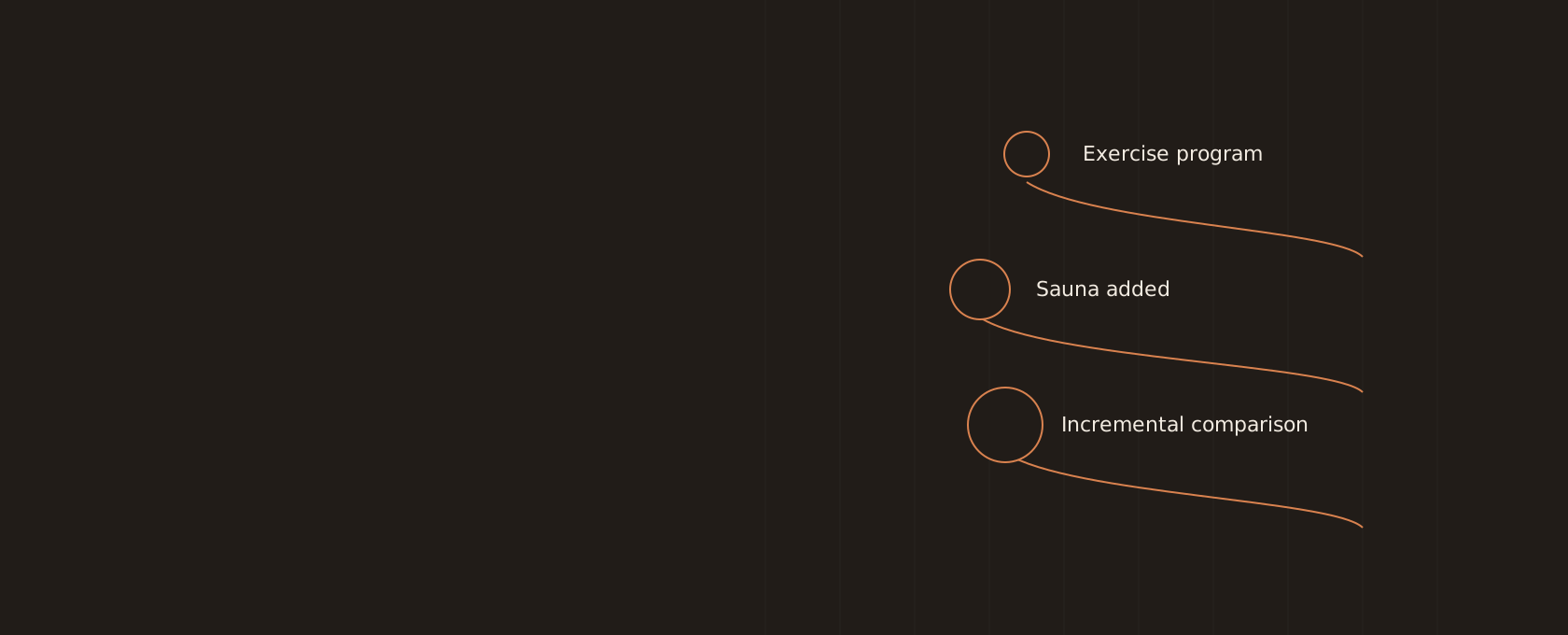
| 2022 · Lee E ↗ | randomized controlled trial Low activity with at least one cardiovascular risk factor Participants: 47. postexercise sauna · 8 weeks | Relative to exercise alone, exercise plus sauna produced an additional fitness change of +2.7 mL/kg/min (95% CI +0.2 to +5.3) and a systolic-pressure difference of −8.0 mmHg (−14.6 to −1.4). This small combined-program trial did not test sauna alone or clinical-event prevention. Comparison: Exercise alone; control Small eight-week multi-arm trial |
| 2023 · Debray A ↗ | randomized controlled trial Stable coronary artery disease Participants: 41. Finnish sauna · 8 weeks | Heat-acclimation measures changed, but endothelial function, stiffness and blood-pressure changes did not favor sauna over control. Comparison: Lifestyle maintenance Small stable-CAD sample |
| 2017 · Zaccardi F ↗ | prospective cohort Without hypertension at baseline Participants: 1621. habitual sauna | After the fuller reported adjustment, incident-hypertension HRs versus once-weekly sauna were 0.83 (95% CI 0.59–1.18) for 2–3 sessions and 0.53 (0.28–0.98) for 4–7. The middle-frequency estimate was compatible with no association. Comparison: Once-weekly sauna Not a randomized prevention intervention |
Original publication: Effects of regular sauna bathing in conjunction with exercise on cardiovascular function: a multi-arm, randomized controlled trial.
The intervention question was an add-on question
This randomized trial asked whether sauna added to regular exercise changed cardiovascular outcomes beyond exercise alone. That comparator is its defining strength and its essential boundary. A claim about the combined program can be supported without pretending that the experiment measured the effect of sauna used in isolation.
The original publication is Effects of regular sauna bathing in conjunction with exercise on cardiovascular function: a multi-arm, randomized controlled trial. In conjunction with is doing necessary work in that title. Participants could differ in response to a structured program from people who already exercise extensively or who use sauna without exercise. The trial therefore offers a specific test of supplementation within a lifestyle intervention, rather than a general estimate of what any reader gains from entering a sauna.
Who entered and how the groups were compared
The participants had low physical activity and at least one traditional cardiovascular risk factor. They were assigned to exercise with postexercise sauna, exercise alone or a control condition. The comparison between the combined and exercise-only groups is the appropriate place to look for an incremental effect of adding sauna to that program.
A reader should distinguish that contrast from comparing the combined group with control. The latter includes the effect of exercise and cannot attribute the whole difference to sauna. The multi-arm design helps separate those questions, but the overall sample remained small and the intervention relatively short. Generalizing the findings to highly trained athletes, people with unstable cardiovascular disease or every alternative sauna schedule would require evidence beyond the participants and conditions actually tested.
The reported incremental changes
Relative to exercise alone, the combined program produced an additional fitness change of +2.7 mL/kg/min, with a 95% confidence interval of +0.2 to +5.3. The corresponding systolic-pressure difference was −8.0 mmHg, with an interval of −14.6 to −1.4. These are the comparisons and uncertainty ranges retained in the verified fact record.
The intervals matter because a small study can leave substantial uncertainty around the size of the underlying effect. Fitness and systolic pressure are also separate endpoints; one should not be used as a synonym for the other. The estimates describe average differences between assigned programs under the trial conditions. They do not predict an individual participant’s response, and they should not be converted into a personal percentage reduction in heart attacks, strokes or mortality.
What randomization helps establish
Assigning participants to programs reduces the problem of people choosing an exposure because of their existing habits or health. That gives this trial a stronger basis for evaluating the tested add-on intervention than a simple comparison of habitual sauna frequency. The design does not, however, answer every causal question a reader might wish to ask.
The sauna component followed exercise, so the result belongs to that sequence and program context. Adherence, co-interventions and other details would need full-text assessment before a formal bias judgment. A trial can support the value of a specific assigned combination without identifying which physiological pathway produced the difference. The careful inference is about the comparison tested, not a broad claim that every sauna technology produces the same effect or can replace the exercise component.
Why the null coronary-disease trial belongs beside it
A separate randomized study of repeated Finnish sauna in stable coronary artery disease did not find vascular-marker improvements favoring sauna over lifestyle maintenance. It differed in population and did not test the same exercise add-on question. Including that result prevents a favorable combined-program trial from becoming a universal cardiovascular promise.
The two trials invite closer questions about baseline disease, activity and intervention context. Their abstracts do not identify a single proven explanation for the different findings, and this summary does not supply one. Instead, the distinction helps readers decide which source is relevant to which claim. A person seeking evidence about sauna alone in established coronary disease should not receive only the exercise-combination result; a person asking about an exercise add-on should see the direct comparison here.
How the hypertension cohort differs
The Finnish hypertension cohort followed men initially without hypertension and compared existing sauna frequencies. Its outcome was later new hypertension, rather than a short-term change in a risk marker after allocation to a combined exercise program. The observational and experimental findings can be relevant to the same broad research area without estimating the same effect.
A favorable direction in both does not establish that a particular weekly sauna frequency is optimal. The cohort categories describe habits, while the trial tested an assigned program with exercise. Nor does a blood-pressure change establish the mechanism responsible for any long-term cohort association. Maintaining the design and endpoint labels makes the synthesis more precise: there is prospective association evidence about new diagnosis and small randomized evidence about incremental marker changes in a combined intervention.
What a practical reader should take from the result
The trial supports further investigation of sauna as an addition to exercise under defined conditions. It does not support dropping exercise and expecting the same outcomes from heat alone. It also does not establish that longer, hotter or more frequent exposure would yield larger benefits, because an optimal dose-response relationship was not determined by this comparison.
For a planning conversation, the useful questions concern the actual program, the reader’s baseline activity and health, and whether the outcomes being discussed are fitness markers or clinical events. Reproducing a study’s schedule is not automatically an appropriate personal protocol. The emerging evidence grade reflects a promising assigned comparison with limited size and scope. It preserves the favorable result while leaving personal exposure decisions and clinical management to an appropriate assessment.
Review scope, original source and safety
The live indexed abstract was checked against the stored corpus and model-specific fact statement. The reference links identify the original PubMed record and DOI. This is an abstract-level appraisal; complete adherence data, adverse-event procedures, funding and conflicts of interest were not independently audited from full text. Unknown disclosure fields remain unknown rather than being filled with assumptions.
The cited narrative safety review names unstable angina, recent myocardial infarction and severe aortic stenosis as contraindications and warns about alcohol. Those cautions do not constitute a comprehensive eligibility checklist. A small exercise-plus-sauna trial cannot supply clearance for a different clinical situation. Its contribution is narrower and useful: it tests whether adding sauna changed selected outcomes beyond exercise alone in the people studied.
Explore the evidence with a tool.
Questions, considered
Questions about this study
What did sauna add to exercise in the cardiovascular multi-arm trial?
Compared with exercise alone, the combined group showed greater improvement in measured fitness and systolic-pressure change, alongside lower total cholesterol. These are encouraging short-term findings in sedentary adults with risk factors. The study did not test sauna alone or measure whether the program prevented heart attacks or prolonged life.
Follow the sourceWhy is the exercise-only group important in the combined sauna trial?
It helps distinguish what was added by the postexercise sauna program from improvements associated with training itself. An inactivity comparison alone could not answer that question. Even with this useful design, the small sample and brief intervention leave uncertainty about durability, individual response and the effect of other exposure schedules.
Follow the sourceDoes the combined cardiovascular trial establish the best sauna dose?
No. It tested one postexercise program and the authors called for further research on exposure duration and frequency. A favorable result from a fixed schedule does not identify a universal optimum. Different populations, sauna conditions and baseline cardiovascular status may yield different responses and need their own direct evidence.
Follow the sourceFollow the evidence
Sources & references
Research summaries in this edition are based on indexed abstracts unless otherwise noted. A source link is not a claim of medical review.
- Effects of regular sauna bathing in conjunction with exercise on cardiovascular function: a multi-arm, randomized controlled trial.
Lee E, Kolunsarka I, Kostensalo J, Ahtiainen JP, Haapala EA, Willeit P, Kunutsor SK, Laukkanen JA
Volume 323, issue 3, pages R289-R299 · PMID 35785965
Open-access flag: yes.Abstract-level editorial review - Finnish sauna bathing and vascular health of adults with coronary artery disease: a randomized controlled trial.
Debray A, Gravel H, Garceau L, Bartlett AA, Chaseling GK, Barry H, Behzadi P, Ravanelli N, Iglesies-Grau J, Nigam A, Juneau M, Gagnon D
Volume 135, issue 4, pages 795-804 · PMID 37650138
Open-access flag: not recorded.Abstract-level editorial review - Sauna Bathing and Incident Hypertension: A Prospective Cohort Study.
Zaccardi F, Laukkanen T, Willeit P, Kunutsor SK, Kauhanen J, Laukkanen JA
Volume 30, issue 11, pages 1120-1125 · PMID 28633297
Open-access flag: not recorded.Abstract-level editorial review - Benefits and risks of sauna bathing.
Hannuksela ML, Ellahham S
Volume 110, issue 2, pages 118-126 · PMID 11165553
Open-access flag: not recorded.Abstract-level editorial review