| Study | Design & population | Finding & comparison |
|---|---|---|
| 2021 · Kunutsor SK ↗ | prospective cohort General male cohort Participants: 2275. habitual sauna | Higher measured fitness and reported sauna frequency were associated with lower pneumonia incidence; the combined high categories had the lowest estimated hazard. Comparison: Joint fitness/frequency categories No COVID-19 outcomes measured |
| 2017 · Kunutsor SK ↗ | prospective cohort Middle-aged male population Participants: 2210. habitual sauna | With the most extensive reported adjustment, pneumonia HRs versus ≤1 weekly session were 0.72 (95% CI 0.57–0.90) for 2–3 sessions and 0.63 (0.39–1.00) for ≥4. The high-frequency interval reached the no-association boundary, and these remain cohort associations. Comparison: At most once-weekly sauna Adjustment affects precision |
| 2024 · Kunutsor SK ↗ | cross-sectional and longitudinal cohort analysis Population cohort Participants: 2012. habitual sauna · Fitness measured at baseline and 11 years | Frequency was associated with fitness at baseline; the longitudinal association was statistically clear only for the middle-frequency category. Session duration was not significantly related to fitness. Comparison: Once-weekly sauna Observational association rather than assigned training |
Original publication: High fitness levels, frequent sauna bathing and risk of pneumonia in a cohort study: Are there potential implications for COVID-19?
The study combined measured characteristics
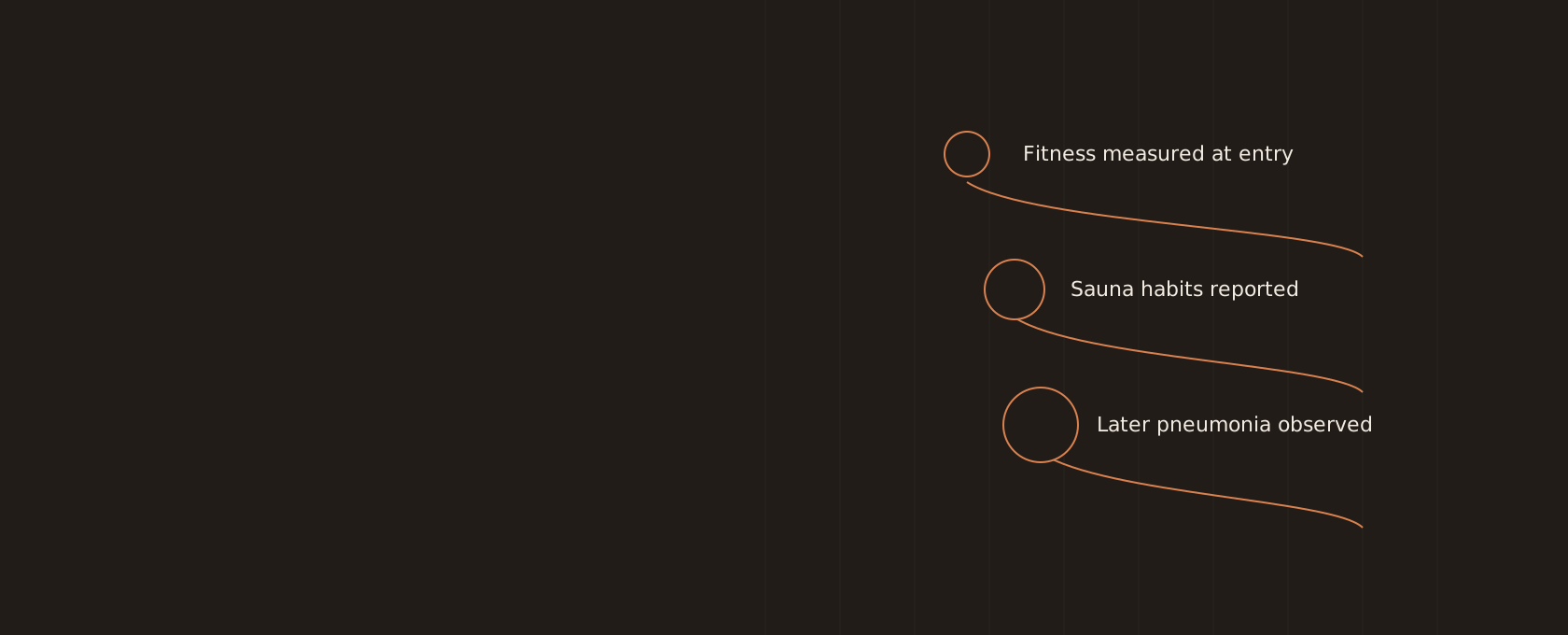
The investigators examined separate and joint associations of cardiorespiratory fitness and sauna frequency with later pneumonia. Fitness was objectively assessed, while sauna habits were reported at baseline. Participants were grouped by the characteristics they already had, rather than assigned to fitness training or a sauna intervention.
The title asks whether there are possible implications for COVID-19. That question is not the endpoint the cohort measured. The actual outcome was incident pneumonia over follow-up. A responsible source summary should therefore introduce the study through its observed characteristics and pneumonia outcome, keeping the title’s speculative question separate from demonstrated findings. This avoids turning an interesting contextual discussion into a claim that a heat routine has established antiviral efficacy.
The male cohort limits direct transfer
The sample consisted of middle-aged men in the KIHD setting. The estimates describe that population and its baseline measurements. They do not directly establish the same associations in women, children, people already experiencing respiratory illness or every population with different access to sauna and health care.
Objective fitness testing improves the description of one characteristic, but it does not randomize it. Fitness can share underlying determinants with activity, health and other behaviors. Reported sauna habits bring additional measurement uncertainty and may change after baseline. The correct interpretation preserves these different measurement types. It does not treat a directly tested fitness value as proof that the joint relationship with pneumonia is causal.
The combined high category had a lower estimate
The registered result records lower pneumonia incidence associated with higher fitness and higher sauna frequency, with the lowest estimated hazard in the combined high category. That is a useful description of the observed pattern. This summary does not add new numerical joint-category effects beyond the registered source interpretation.
A lower point estimate in a combined category is not automatically proof of synergy between interventions. It can reflect differences in both measured characteristics and other factors that accompany them. The reference category also matters: comparing people low in both characteristics with those high in both does not isolate what changes when only sauna is added. A practical add-on claim would require an appropriate contrast and stronger causal evidence than the position of one category in an observational table.
A joint category does not assign a lifestyle program
Someone asking whether sauna adds protection to an exercise routine wants an intervention comparison. This cohort instead compares existing fitness and sauna-frequency combinations. Those are related questions, but they are not identical, and one should not silently answer the other.
Even a measured fitness characteristic is not the same intervention as prescribing training. People may reach a similar tested level through different histories, and the observed group can differ from a new participant beginning a program. The study therefore generates useful hypotheses about combined characteristics without establishing a personal schedule. Statistical adjustment addresses measured confounders, not the full counterfactual question of what would happen if an individual deliberately changed one behavior while other relevant conditions remained comparable.
The pneumonia endpoint should not become COVID-19 efficacy
The study did not measure COVID-19 prevention, severity or recovery. Its discussion of possible implications is a proposal for further research, not a result. A pneumonia association cannot establish an effect against a particular new infection merely because that infection can involve pneumonia.
This boundary is especially important when communicating a paper whose title contains an attention-grabbing contemporary disease. Readers should ask which events were recorded, when the cohort observations occurred and whether the claimed intervention was actually tested. Here the appropriate statement remains an association with pneumonia in an existing male cohort. Neither the title nor the biologically plausible idea of improved general health supplies the missing disease-specific evidence. This summary offers no acute-illness heat recommendation.
Fitness association is not proof sauna creates fitness
The separate KIHD fitness analysis directly tested fitness and related it to reported sauna habits. Its longitudinal category pattern was not uniform, and session duration was not significantly associated with fitness. That source therefore does not establish that sauna caused the fitness differences used in this pneumonia analysis.
The distinction prevents a circular mechanism story: sauna is assumed to improve fitness, higher fitness is associated with fewer pneumonia events, and the combined category is then treated as confirmation of the entire causal chain. The studies do not experimentally establish that sequence. Each contributes an observational question with its own endpoint. The emerging grade reflects the resulting limited source-specific evidence, rather than a clinically validated combined prevention program.
Source verification and disclosure limits
The indexed abstract was refreshed and compared with the included corpus and fact registry. The original PubMed entry and DOI provide the bibliographic source. Full-text measurement procedures, missing-data decisions, funding and conflicts of interest have not been independently audited here. Unreported financial fields remain unknown.
Safety remains separate from the favorable joint association. The cited historical review names unstable angina, recent myocardial infarction and severe aortic stenosis as contraindications and warns about alcohol. It is not comprehensive clearance, particularly for someone considering heat during illness. The study’s defensible contribution is an observed combination of fitness, sauna habits and later pneumonia risk, with no demonstrated COVID-19 effect and no assigned preventive routine.
Explore the evidence with a tool.
Questions, considered
Questions about this study
Did the fitness-and-pneumonia study measure COVID-19 protection?
No. It recorded pneumonia outcomes in an existing prospective cohort and raised COVID-19 as a question for future research. That distinction is essential: a paper discussing possible implications did not establish prevention, reduced severity or clinical benefit for COVID-19. Its actual endpoint and observational design should remain explicit.
Follow the sourceHow was fitness assessed in the joint pneumonia analysis?
Fitness was objectively measured, while sauna habits were self-reported at baseline. These measurements describe different aspects of participants’ lives and may share underlying health differences. Their joint association with pneumonia is informative, but does not establish that adding sauna to a fitness program produces the same change in pneumonia risk.
Follow the sourceDoes the lowest pneumonia hazard in the combined high group prove synergy?
No. A lower estimate in people who were both fitter and more frequent sauna users does not, by itself, establish a causal interaction between interventions. The study observed existing characteristics. Claims of biological synergy or guaranteed additional protection would require stronger evidence than a favorable comparison across those participant categories.
Follow the sourceFollow the evidence
Sources & references
Research summaries in this edition are based on indexed abstracts unless otherwise noted. A source link is not a claim of medical review.
- High fitness levels, frequent sauna bathing and risk of pneumonia in a cohort study: Are there potential implications for COVID-19?
Kunutsor SK, Laukkanen JA
Volume 51, issue 3, pages e13490 · PMID 33426640
Open-access flag: yes.Abstract-level editorial review - Frequent sauna bathing may reduce the risk of pneumonia in middle-aged Caucasian men: The KIHD prospective cohort study.
Kunutsor SK, Laukkanen T, Laukkanen JA
Volume 132, pages 161-163 · PMID 29229091
Open-access flag: not recorded.Abstract-level editorial review - Enhancing Cardiorespiratory Fitness Through Sauna Bathing: Insights From the Kuopio Ischemic Heart Disease Prospective Study.
Kunutsor SK, Isiozor NM, Kurl S, Laukkanen JA
Volume 44, issue 4, pages 295-300 · PMID 38836690
Open-access flag: not recorded.Abstract-level editorial review - Benefits and risks of sauna bathing.
Hannuksela ML, Ellahham S
Volume 110, issue 2, pages 118-126 · PMID 11165553
Open-access flag: not recorded.Abstract-level editorial review