| Study | Design & population | Finding & comparison |
|---|---|---|
| 2019 · Ketelhut S ↗ | Acute within-person sauna and exercise comparison Healthy adults Participants: 19. Sauna | Blood pressure and heart rate rose during sauna and fell afterward, showing that during-exposure and recovery measurements can differ. Comparison: Submaximal dynamic exercise response Small sample |
| 2018 · Laukkanen T ↗ | Single-session experimental before-after study At least one cardiovascular risk factor Participants: 102. Sauna | Blood pressure and pulse-wave velocity fell after exposure, but the study did not establish durable changes or fewer cardiovascular events. Comparison: Before, immediately after and recovery No unheated comparator described |
| 2021 · Lee E ↗ | Acute crossover comparison Non-naive sauna users with cardiovascular risk factors Participants: 72. Sauna and exercise-plus-sauna | The two conditions produced broadly comparable acute vascular changes, with blood-pressure differences depending on when measurements were taken. Comparison: Duration-matched exercise-plus-sauna versus sauna alone Acute endpoints |
Original publication: The blood pressure and heart rate during sauna bath correspond to cardiac responses during submaximal dynamic exercise.
The study measured what happens inside the session
This experiment examined blood pressure and heart rate during a sauna exposure and during subsequent rest. That timing is its central contribution. A study measuring only values after a session can miss the physiological load experienced while the participant is still heating.
The original publication is The blood pressure and heart rate during sauna bath correspond to cardiac responses during submaximal dynamic exercise. Its exercise comparison concerns selected acute cardiovascular measurements. It is not a trial comparing the full effects of a sauna habit with an exercise-training program. Keeping that distinction visible prevents a paper about transient cardiac load from becoming an unsupported claim that sitting in heat reproduces all the benefits or demands of physical activity.
Who took part and what was compared
The sample consisted of healthy adult volunteers, including women. Participants underwent an acute sauna exposure followed by rest, and the resulting pressure and heart-rate patterns were compared with responses during submaximal dynamic exercise testing. These are physiological observations in a small selected sample.
The design does not establish how someone with unstable cardiovascular disease, substantially different medication use or different heat familiarity would respond. It also does not create a personal threshold at which a session becomes safe or unsafe. The useful comparison is narrower: how did the measured cardiovascular responses change over time, and how did those selected responses relate to an exercise test? Eligibility, exposure procedures and broader safety evaluation would require more than the indexed abstract.
Pressure and heart rate rose during heating
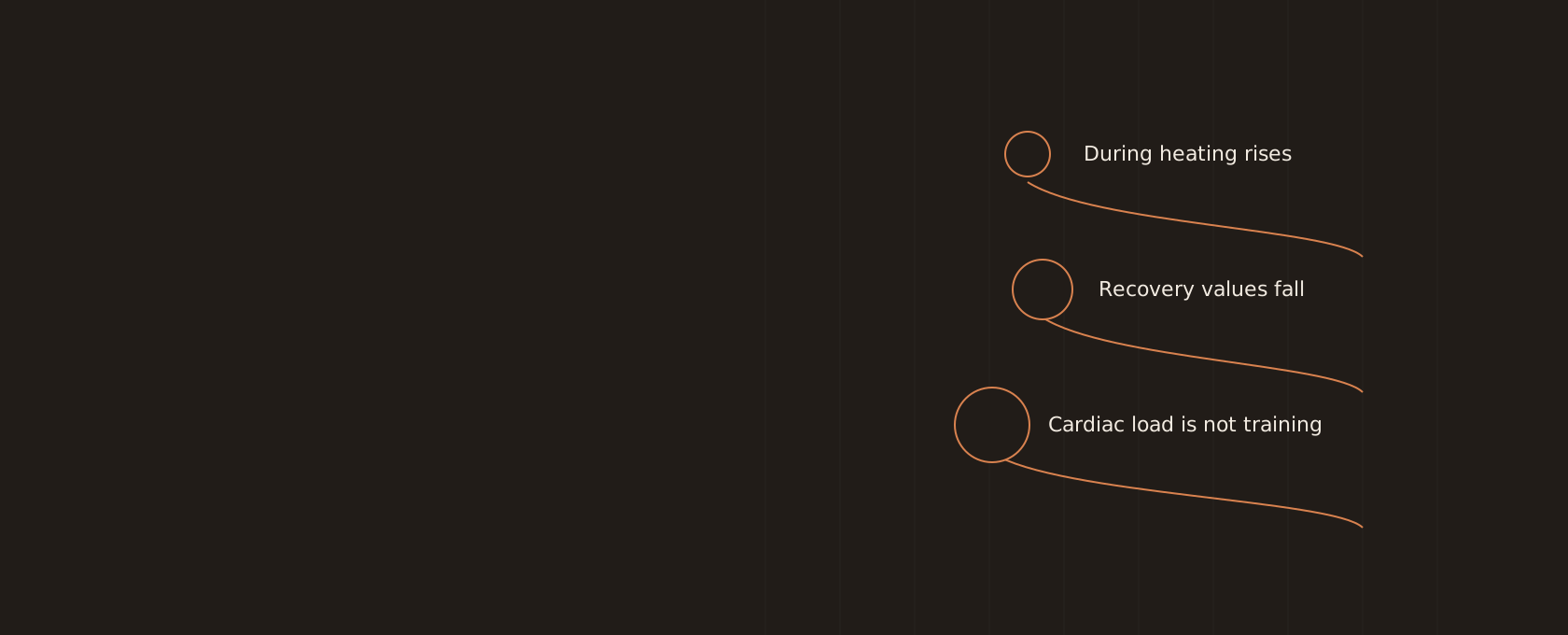
The registered result is that blood pressure and heart rate increased during the sauna exposure. Afterward, both declined during recovery. This pattern should be stated without replacing it with a general slogan that sauna always lowers pressure.
An increase during heating and a decrease afterward are not mutually inconsistent findings. They describe different points on a physiological time course. Someone summarizing only the recovery result could leave readers with the impression that cardiac load was low throughout the session, which this experiment does not support. Conversely, focusing only on the rise would omit the recovery observation. The complete source-specific interpretation keeps both phases visible and avoids judging the entire exposure from a single selected time point.
Why post-session reports can sound different
The acute cardiovascular-function paper reported lower blood pressure after sauna relative to before exposure. It asked about measurements around a different protocol and sample. Its post-session result should not be assumed to describe pressure continuously during heating, nor should the present paper be used to deny that pressure can fall afterward.
The studies can therefore contribute complementary timing information rather than a simple contradiction. To compare them, identify whether values were recorded before, during, immediately after or later in recovery, then check participant and exposure differences. This approach is more informative than categorizing one paper as evidence that sauna raises pressure and the other as evidence that it lowers pressure without stating when either measurement occurred.
A cardiac-load proxy is not the activity itself
The authors compared selected pressure and heart-rate responses with submaximal exercise responses. A product of systolic pressure and heart rate was used as a proxy related to cardiac oxygen demand. Such a proxy can help characterize cardiovascular load, but it does not measure every biological effect of the activity.
In particular, a similar cardiac response does not show the same muscular work, movement practice, fitness adaptation or long-term outcome. The experiment did not assign a sauna-training program and test it against an exercise-training program. Any claim that sauna replaces exercise would therefore add an outcome and a comparison absent from the study. The appropriate use of the exercise analogy is to describe selected acute demands, not to declare whole activities interchangeable.
An alternative-routine comparison has a separate purpose
The crossover study comparing sauna alone with exercise followed by sauna matched overall duration and observed acute vascular changes. That design provides another perspective on complete routines, but it also lacks the exercise-only contrast needed to isolate a postexercise sauna addition.
Reading it beside the present cardiac-load experiment helps distinguish several often-confused questions. Similar selected responses during heat and exercise are not the same as similar responses between complete duration-matched routines, and neither is a demonstration of equal long-term training benefit. Each design has a legitimate place when its actual comparison remains visible. The evidence becomes less useful when a resemblance between measurements is extended into a replacement claim about activities the experiment did not evaluate over time.
What to ask before translating the result
First identify the outcome: pressure, heart rate and a cardiac-demand proxy were measured, rather than disease events or improved fitness after training. Next identify timing: the during-exposure pattern and recovery pattern differ. Finally identify the people: the observation came from a small healthy-adult sample.
These checks keep the experiment useful for physiological understanding without turning it into an individual risk calculator. A person who experiences a lower reading after sauna cannot infer from that number that the session placed little demand on the circulation. Equally, a rise during heating does not let this small study diagnose an adverse event in someone else. Personal symptoms and medical decisions require an appropriate clinical assessment rather than a direct translation from an experimental average.
Review boundaries and safety context
The indexed abstract was refreshed and compared with the stored corpus and fact interpretation. The original PubMed record and DOI are linked. This is not a full-text assessment of technical measurement choices, funding or competing interests, and unreported details have not been invented.
The historical safety review names unstable angina, recent myocardial infarction and severe aortic stenosis as contraindications, and identifies alcohol-related risks. Its narrative discussion is not comprehensive clearance for every reader who lacks those diagnoses. The emerging grade for this experiment concerns a narrow but important observation about time-dependent cardiovascular load. It supports careful interpretation of a session’s phases, rather than a personal exposure prescription or an exercise-equivalence promise.
Explore the evidence with a tool.
Questions, considered
Questions about this study
Did blood pressure fall while participants were inside the sauna in PMID 31126559?
No. Blood pressure increased progressively during the heating period and decreased afterward. That timing helps explain why studies measuring only post-sauna values can appear different from studies measuring people while hot. A recovery-phase reduction should not be assumed to describe cardiovascular load throughout the session itself.
Follow the sourceDoes the sauna-versus-exercise cardiac comparison mean sauna replaces exercise?
No. The comparison concerned blood pressure, heart rate and a proxy for cardiac oxygen demand during acute exposure. Similarity in those measures does not establish the same muscular work, fitness adaptation or long-term health effects. The endpoints describe cardiac load rather than equivalence between complete activities.
Follow the sourceWho was represented in the acute cardiac-load sauna experiment?
It enrolled a small group of healthy adult volunteers, including women, and observed a single sauna exposure followed by rest. The result is useful for understanding time-dependent cardiovascular responses. It does not establish suitability for people with unstable cardiovascular disease or define a safe exposure threshold for individual users.
Follow the sourceFollow the evidence
Sources & references
Research summaries in this edition are based on indexed abstracts unless otherwise noted. A source link is not a claim of medical review.
- The blood pressure and heart rate during sauna bath correspond to cardiac responses during submaximal dynamic exercise.
Ketelhut S, Ketelhut RG
Volume 44, pages 218-222 · PMID 31126559
Open-access flag: not recorded.Abstract-level editorial review - Acute effects of sauna bathing on cardiovascular function.
Laukkanen T, Kunutsor SK, Zaccardi F, Lee E, Willeit P, Khan H, Laukkanen JA
Volume 32, issue 2, pages 129-138 · PMID 29269746
Open-access flag: not recorded.Abstract-level editorial review - Standalone sauna vs exercise followed by sauna on cardiovascular function in non-naïve sauna users: A comparison of acute effects.
Lee E, Kostensalo J, Willeit P, Kunutsor SK, Laukkanen T, Zaccardi F, Khan H, Laukkanen JA
Volume 4, issue 4, pages e393 · PMID 34622026
Open-access flag: yes.Abstract-level editorial review - Benefits and risks of sauna bathing.
Hannuksela ML, Ellahham S
Volume 110, issue 2, pages 118-126 · PMID 11165553
Open-access flag: not recorded.Abstract-level editorial review