| Study | Design & population | Finding & comparison |
|---|---|---|
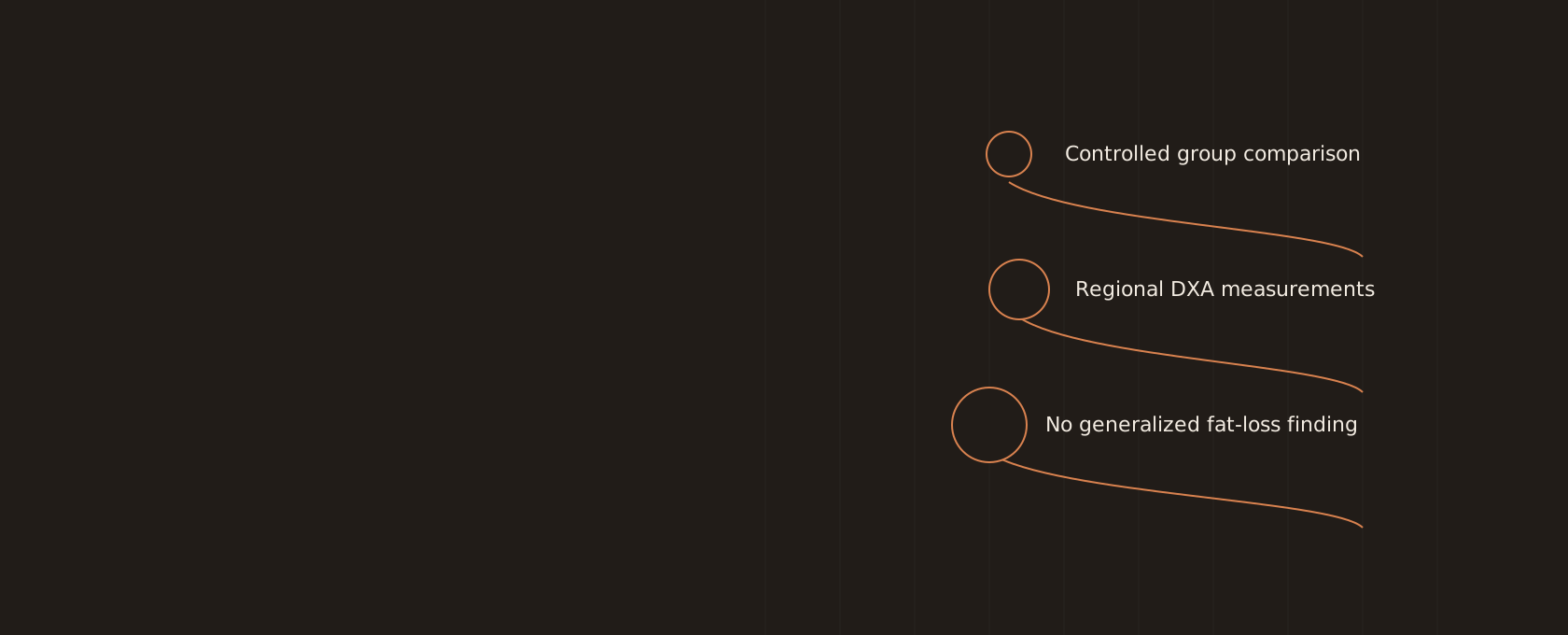
| 2021 · Toro V ↗ | controlled body-composition experiment healthy Participants: 23. high-temperature sauna · 12 sessions | Selected regional DXA measurements changed; the abstract does not establish generalized fat loss. Comparison: control versus sauna; post-exposure and follow-up measurements Small sample; regional multiple outcomes; unusual values merit full-text checking. |
| 2019 · Podstawski R ↗ | Acute repeated-exposure physiology study Overweight, sedentary, infrequent sauna users Participants: 45. Dry sauna | Physiological strain increased across repeated exposures and correlated with body size; the observed immediate body-mass decrease does not establish fat loss. Comparison: Repeated exposures and correlations with body size No separate control described |
| 2020 · Choi HS ↗ | Uncontrolled before-after intervention Adults with BMI at least 25 Participants: 38. Dry sauna · Twice daily for 4 consecutive days | Quality-of-life scores improved, but body composition, BMI, blood pressure and heart rate did not change significantly. Comparison: Baseline versus two days after last session No untreated comparator described |
Original publication: Effects of Twelve Sessions of High-Temperature Sauna Baths on Body Composition in Healthy Young Men.
Did the study demonstrate generalized fat loss?
No such conclusion is established by the abstract. The reported favorable outcomes concern selected regional muscle-related and bone measurements, rather than a demonstrated reduction of body fat across the participants. The paper therefore cannot be used as evidence that a sauna series produces generalized fat loss.
Its title describes body composition after a series of high-temperature baths in healthy young men. Body composition is a broad research category, not a synonym for fat loss. A study within that category may assess different regions and compartments. The useful reading task is to identify which measurements actually changed, which comparisons support that statement and whether the finding persists. Beginning with those questions prevents an attractive body-composition label from being rewritten into a weight-management result that the investigators did not report.
What does the controlled comparison establish?
Participants were divided into sauna and control groups, with measurements around the intervention and a later assessment. An available control is useful for interpreting change over time because not every difference between measurements needs to be caused by the added exposure.
The indexed abstract does not establish randomized allocation, so this summary does not add that claim. It also does not provide enough detail to resolve every issue concerning comparability, measurement standardization or the analysis of changes between groups. A full assessment would examine those matters before attributing a regional difference solely to heat. The appropriate account can recognize a controlled structure while retaining the uncertainty left by the brief report. Controlled and randomized are not interchangeable descriptions, and neither term would eliminate the need to inspect how the body-composition outcomes were measured.
The experiment enrolled twenty-three healthy young men. That small selected sample limits how precisely the regional results can be interpreted and how broadly they can be applied.
Why should limb-specific findings remain limb-specific?
The abstract reports outcomes in particular leg regions. A result in one limb or compartment is not automatically a whole-body response. It cannot establish that every muscle gained tissue, that overall fat decreased or that bone health improved throughout the body.
This becomes especially important when several regional measurements are examined. A complete appraisal would inspect the full set of outcomes, their uncertainty and the planned analytical approach rather than selecting only the changes emphasized in the abstract. This page does not claim that selective reporting occurred; it identifies what a source summary must check before broadening the conclusion. The retained finding is deliberately regional. That wording protects the useful observation while preventing it from acquiring a larger anatomical scope simply through repetition in later articles or promotional summaries.
Why are exact regional change figures not repeated here?
Some figures and percentage descriptions in the abstract are unusual enough to require checking against the full paper. The registry therefore retains a cautious qualitative finding rather than treating every printed quantity as ready for reuse. This page follows that boundary and does not reconstruct a numerical effect from the abstract.
A discrepancy that cannot be resolved from the material read should remain unresolved. Choosing a plausible interpretation, silently changing a percentage or borrowing an uncertainty value from another outcome would manufacture a more precise result than the evidence supports. The appropriate next step is a full-text check of units, definitions, analysis and source tables. Until that is completed, the paper can inform the existence of regional measurements without supplying a reliable numerical promise about how much tissue a sauna user will gain or lose.
Do post-exposure and later assessments answer the same question?
They do not. A measurement after the series and a later measurement describe different occasions. The body-composition interpretation depends on knowing which comparison produced the reported finding. An immediate assessment cannot establish persistence indefinitely, and a later regional result still does not demonstrate a global change.
A careful review also needs compatible measurement conditions across visits. The indexed abstract does not settle every detail about preparation, hydration state, analysis or repeated scanning. Those questions should not be filled from assumptions about how a laboratory normally operates. They matter to distinguishing a measurement difference from a durable tissue change. This appraisal does not claim that hydration explains the reported results; it identifies missing information that must be assessed before attaching a physiological explanation to a regional DXA observation.
What do other sauna weight studies add?
An acute study in sedentary overweight men reported an immediate body-mass decrease and rising physiological strain during repeated exposure. That is a different outcome from regional DXA measurements after a program. The immediate change does not establish lasting fat reduction and cannot supply a weight-loss result missing from the present paper.
A short uncontrolled Korean study reported improved quality-of-life scores without significant changes in body composition or BMI. Its population and design differ again. Together, these sources show why a favorable outcome somewhere in a paper does not demonstrate the particular outcome a reader hopes for. Regional DXA findings, a scale change around heating and subjective wellbeing should remain distinct. They can all be described without being combined into an unsupported conclusion that sauna reliably reduces body fat.
What is the proportionate conclusion and review boundary?
The grade is C for emerging findings from a small controlled experiment with region-specific outcomes. Its contribution is a set of measurements deserving further appraisal, not a validated weight-loss program or evidence that sauna universally builds muscle and bone. The unusual numerical reporting further limits the precision appropriate to this abstract-level summary.
The indexed abstract and bibliographic record were read and refreshed. Full-text methods, detailed measurement reliability, formal risk of bias and complete funding or competing-interest disclosures were not assessed. Those financial details remain unreported here rather than presumed absent. The source exposure is not a suggested home challenge. Anyone considering sauna with a medical condition or medication question needs a separate clinical discussion; the ability to participate in a young healthy research sample does not establish personal suitability for a reader.
Explore the evidence with a tool.
Questions, considered
Questions about this study
Did the twelve-session body-composition study establish that sauna melts fat?
No. The abstract reports selected regional muscle and bone measurements, rather than a demonstrated generalized reduction in body fat. Those findings should not be reworded as a weight-loss result. The small controlled study also needs full-text appraisal before interpreting the meaning of its regional DXA changes.
Follow the sourceWhy should the body-composition paper’s regional findings remain specific?
Changes reported for one limb or measurement are not automatically evidence of a whole-body effect. The abstract presents several regional outcomes in a small sample. Summaries should identify what was measured instead of converting selected findings into a broad claim that sauna builds muscle or improves bone health everywhere.
Follow the sourceDid the body-composition abstract establish an optimal number of sauna sessions?
No. It describes one tested program and its measurements, not a dose-ranging comparison that identifies an optimum. The findings cannot establish that the same session count produces comparable changes in other populations. The selected regional results also require checking against full-text methods and measurement uncertainty.
Follow the sourceFollow the evidence
Sources & references
Research summaries in this edition are based on indexed abstracts unless otherwise noted. A source link is not a claim of medical review.
- Effects of Twelve Sessions of High-Temperature Sauna Baths on Body Composition in Healthy Young Men.
Toro V, Siquier-Coll J, Bartolomé I, Pérez-Quintero M, Raimundo A, Muñoz D, Maynar-Mariño M
Volume 18, issue 9, pages 4458 · PMID 33922289
Open-access flag: yes.Abstract-level editorial review - Correlations between Repeated Use of Dry Sauna for 4 x 10 Minutes, Physiological Parameters, Anthropometric Features, and Body Composition in Young Sedentary and Overweight Men: Health Implications.
Podstawski R, Borysławski K, Clark CCT, Choszcz D, Finn KJ, Gronek P
Volume 2019, pages 7535140 · PMID 30800676
Open-access flag: yes.Abstract-level editorial review - Repeated Dry Sauna Therapy Improves Quality of Life in Obese Korean People.
Choi HS, Kwon H, Cho KH, Thuc LC, Park SY, Kim NH, Kim WJ, Kim YK, Jeon WS, Lee JA, Kim HC, Cho EH
Volume 41, issue 5, pages 312-317 · PMID 32434303
Open-access flag: yes.Abstract-level editorial review - Benefits and risks of sauna bathing.
Hannuksela ML, Ellahham S
Volume 110, issue 2, pages 118-126 · PMID 11165553
Open-access flag: not recorded.Abstract-level editorial review