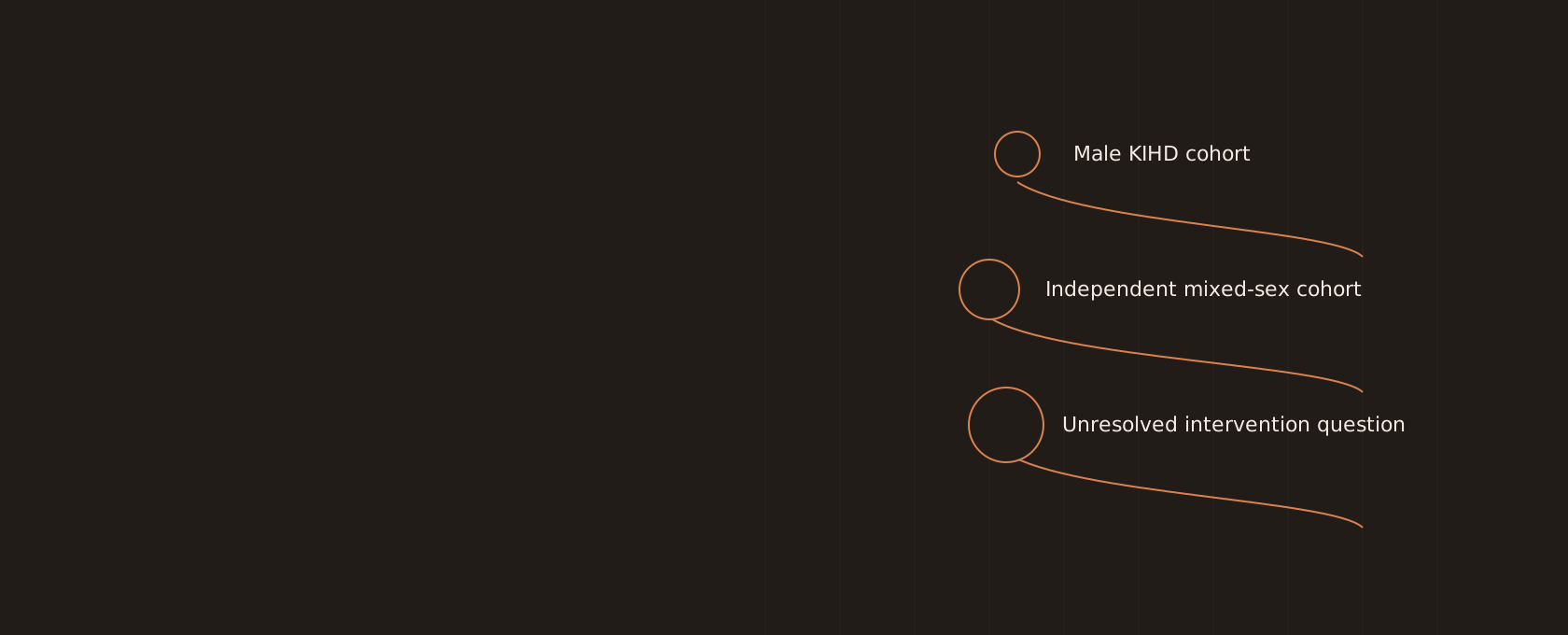
| Study | Design & population | Finding & comparison |
|---|---|---|
| 2017 · Laukkanen T ↗ | prospective cohort Apparently healthy at enrollment Participants: 2315. habitual sauna | For 4–7 versus 1 session weekly, adjusted HRs were 0.34 (95% CI 0.16–0.71) for dementia and 0.35 (0.14–0.90) for Alzheimer disease. Results describe observed habits in Finnish men, not randomized prevention. Comparison: Once-weekly sauna Shared KIHD cohort with other reports |
| 2020 · Knekt P ↗ | Prospective population cohort No dementia diagnosis at baseline Participants: 13994. Sauna habits assessed by questionnaire | More frequent sauna use was associated with lower dementia incidence, with a weaker association across the entire follow-up than during the initial period. Comparison: 9–12 monthly visits versus none or fewer than 4 monthly Observational exposure |
| 2015 · Laukkanen T ↗ | prospective cohort Population-based sample Participants: 2315. habitual sauna | The adjusted sudden-cardiac-death HR for 4–7 versus 1 weekly session was 0.37 (95% CI 0.18–0.75). Higher frequency was associated with several mortality outcomes. In the duration analysis, longer sessions were associated with fatal cardiovascular endpoints but not all-cause mortality; the abstract does not provide an exact all-cause HR to reuse. Comparison: Once-weekly sauna; duration below 11 minutes for duration analyses Not a comparison with never-users |
Does the evidence establish dementia prevention?
It establishes an observational association, not a proven preventive intervention. The most relevant studies followed people with established sauna habits and recorded later dementia diagnoses. They did not assign a new schedule to otherwise comparable people and test whether the assignment reduced diagnoses. That difference defines what the evidence can support.
The result is still worth understanding. Prospective follow-up provides a clearer time sequence than asking people with a diagnosis to recall what they used to do. A separate population can also help assess whether an association appears beyond the original participants. These strengths should be recognized without converting them into randomization. The useful question is not whether the studies count as evidence, but evidence for which statement.
This guide grades the observed association B, with the scope attached. It does not give the same grade to a claim that sauna prevents dementia. Readers should keep the exposure, comparison group, population and diagnosis outcome together. Once those elements are removed, an apparently simple percentage can become a promise that the underlying research never tested.
How might heat relate to brain health, and what is untested?
Possible vascular and other physiological pathways are discussed in broader sauna reviews. Such proposals help researchers decide which mechanisms to investigate. They do not establish that a particular pathway explains the dementia association, or that an acute response after heating changes a person’s later diagnosis.
A complete causal account would require several links. The exposure would need to change the proposed mediator, that change would need to be relevant over time, and the mediator would need to help explain the clinical outcome. A plausible narrative is not a substitute for evidence at each link. The dementia cohorts observed habits and diagnoses; they did not complete an experimental demonstration of that chain.
The distinction also prevents a transfer between unrelated outcomes. Feeling relaxed, performing differently on a brief task and receiving a later dementia diagnosis are separate observations. A paper about one cannot provide the missing estimate for another. Mechanistic discussion is most useful when it sharpens a research question rather than becoming an explanation presented as settled. At present, these pathways should remain identified possibilities in a source-led account, with uncertainty about their role in dementia retained.
What did the male KIHD study measure?
The KIHD dementia analysis began with apparently healthy middle-aged Finnish men and their reported sauna frequency. It examined later dementia and Alzheimer disease diagnoses. This is a specific setting and population, not a universal sample of people considering heat therapy.
For 4–7 sessions weekly versus one weekly session, the adjusted dementia hazard ratio was 0.34, with a 95% confidence interval of 0.16–0.71. The corresponding Alzheimer disease estimate was 0.35, with a 95% confidence interval of 0.14–0.90. Those figures retain the verified outcome and comparator. They do not describe the absolute number of diagnoses an individual can avoid by starting sauna.
A hazard ratio summarizes a relative event-rate relationship during follow-up under the analysis model. A value below the no-difference reference indicates a lower estimated hazard in that comparison. It is not a guarantee that an individual will remain unaffected, and its confidence interval does not address every source of bias. The male enrollment also means this analysis alone cannot directly establish the association in women. That limitation is a reason to look for a different population, rather than assume the numerical result is automatically universal.
| Publication | Population and comparison | Main interpretive limit |
|---|---|---|
| KIHD dementia analysis | Finnish men; frequent versus weekly habitual bathing | No assignment of a preventive program |
| Finnish Mobile Clinic analysis | Women and men; different monthly frequency reference | Association varied across follow-up |
| Broader reviews | Mixed designs and outcomes | Synthesis is not another independent cohort |
Why does the reference group change the practical meaning?
The male KIHD comparison used weekly sauna users as the reference. It did not compare frequent use with never using sauna. That detail must stay beside the result because it changes the question being answered. The study compares established frequency patterns among bathers rather than testing the effect of starting.
For a nonuser, the practical decision is whether beginning a routine changes future outcomes compared with remaining a nonuser. For a weekly user, it may be whether increasing frequency changes those outcomes. Neither intervention is identical to observing differences between people who already have different habits. Frequency categories also do not specify the rest of a personal protocol.
This reference-group discipline is important across the site. The original KIHD mortality study also concerned existing sauna habits, while the stroke cohort included women and men and addressed a different endpoint. These related publications cannot supply a dementia-prevention prescription simply because their overall topics overlap. Reading the comparison first helps avoid attaching one paper’s population or endpoint to another paper’s estimate. The resulting account is more useful for decisions because it shows exactly where an observational finding stops short of an intervention question.
What does the separate Finnish cohort add?
The Finnish Mobile Clinic Follow-up Survey provides an independent population that included women and men. That matters because multiple KIHD papers can share participants. A genuinely separate cohort adds something different from another analysis of the same men, even when both reports originate in Finland.
Its questionnaire-based exposure comparison also differed. Monthly frequency categories included a lower-frequency reference of nonusers and infrequent users, rather than simply reproducing the male KIHD weekly-bather reference. The association was stronger in earlier follow-up and weaker over the entire observation period. Selecting only the more favorable time window would misrepresent the publication.
This study therefore broadens the observational evidence while adding its own interpretive questions. It does not make the two estimates interchangeable, demonstrate identical effects in women and men, or establish a prevention program. A fair synthesis can say that the direction of association appeared in separate Finnish populations while keeping the differences in reference group, follow-up and representation visible. The evidence becomes broader, but its design remains observational. That combination is more informative than either declaring independent confirmation of a causal benefit or dismissing the second cohort as merely another KIHD paper.
Could changing health influence sauna habits before diagnosis?
It could be relevant, and the design does not eliminate the question. A diagnosis is recorded at a particular point, but the relationship between earlier health, behavior and later diagnosis may be more complicated than a simple exposure-then-disease story. Differences that precede the recorded outcome could influence how often a person uses sauna.
This is the concern described as reverse causality: a developing health process may affect the apparent exposure instead of the exposure being the only influence on the later outcome. This guide does not claim that reverse causality explains either cohort’s association. It identifies an alternative interpretation requiring careful assessment, particularly when habits were measured at baseline.
A fuller appraisal would examine analyses designed to address timing, repeat measurements and the robustness of estimates after appropriate exclusions. The abstracts do not allow every such issue to be resolved here. The weaker association across the full follow-up in the separate cohort also deserves investigation rather than a single confident explanation. Changing habits, changing health and other factors remain possibilities. Keeping them open prevents the apparent time sequence from being mistaken for proof that starting sauna causes a reduction in future dementia diagnoses.
Are dementia, Alzheimer disease and cognitive performance equivalent?
They are not interchangeable outcomes. The male KIHD paper reported dementia and Alzheimer disease separately, with their own estimates. A result concerning diagnosed dementia cannot simply be relabeled as an effect on every aspect of brain function. A short task, an experience of relaxation and a long-term clinical diagnosis require different measurements.
This boundary matters when reading a page devoted to dementia rather than a general wellness collection. A study involving an acute change in mood or task performance would not reproduce these diagnosis endpoints. Conversely, an association with diagnoses years later does not tell us whether someone remembers information better after a session.
It also clarifies why citation counts can mislead. A review may discuss many neurological or cardiovascular topics while drawing on overlapping original populations. The review does not create an additional cohort. A systematic review of dry sauna trials likewise brings together varied interventions and outcomes, rather than supplying a single dementia-prevention estimate. A sound synthesis identifies the study design and actual endpoint before deciding how directly a source answers this page’s question.
Is there a study-based schedule a reader should adopt?
No dementia-prevention schedule is established by these cohorts. The male KIHD frequency categories describe reported habits. They are not instructions assigning temperature, duration, rounds and cooling to a new user. Filling in those missing elements from a different sauna study would create a protocol that was never tested for this outcome.
The separate population’s monthly categories further show why translating the literature into a single universal dose is premature. Different exposure definitions and observation windows are part of the evidence, rather than inconveniences to average away. A review of dry sauna interventions also identified unresolved questions about optimal exposure for different types and populations.
For a reader who already enjoys sauna, this evidence can inform the limits of a health claim without demanding an escalation of heat or frequency. For a reader considering it specifically to prevent dementia, the distinction is more consequential: the observational association is not a reason to promise a diagnosis benefit from a prescribed schedule. Use the study explorer and the linked source summaries to inspect the comparisons. A planning or session tool organizes assumptions; it cannot turn uncertain dementia evidence into personal medical advice.
What should guide the personal decision and further review?
Personal safety requires a separate discussion from the dementia association. A historical safety review names unstable angina, recent myocardial infarction and severe aortic stenosis among contraindications and identifies alcohol-related concerns. That is not a complete self-screening list. A person with a medical condition or medication question should discuss intended sauna use with a qualified clinician rather than infer clearance from a favorable cohort estimate.
This page is an original synthesis of indexed abstracts and registered findings. It does not claim a clinical review, completed full-text risk-of-bias assessment or comprehensive examination of funding and conflicts. Those financial details were not established in the reviewed abstracts. The review date records editorial work rather than an invented medical endorsement.
The priority for better evidence is clear specification: the population, a measured exposure, an appropriate comparator, repeated assessment where relevant and the diagnosis endpoint. Independent studies outside the same settings would also help determine applicability. Until then, the proportionate conclusion is an association worth investigating, accompanied by uncertainty about causation and how any result would apply to an individual. Neither a large relative ratio nor repeated headlines resolves those missing questions.
Inspect the assumptions
Explore the session planner.
This planning tool describes a routine. It does not estimate a health benefit or provide medical clearance; the study exposures discussed above remain separate research methods.
Interactive workspace
In-memory checkpoint · no medical clearance
Pause for the personal context.
Check every item that applies or that you are unsure about. Current serious symptoms need appropriate care, not a tool result.
Context, with limits
- Checkpoint
- Complete the acknowledgment
A checklist cannot assess every relevant condition. No answer is medical clearance. Responses are in memory only, and are reset on reload.
Calculated on your device. Theme and unit preferences can be stored locally; health answers, weights and logs remain in memory. A shared settings URL contains its visible planning inputs.
Open the complete tool and methodologyExplore the evidence with a tool.
Questions, considered
Questions about this evidence
Why is a lower dementia hazard not a personal prevention estimate?
The ratio compares groups with established habits under an observational model. It does not measure what happens when a particular reader starts sauna or changes frequency. Individual absolute risk and unmeasured differences remain relevant, so the cohort estimate cannot forecast a personal number of diagnoses avoided.
Follow the sourceWould switching from weekly sauna to daily use reproduce the cohort comparison?
Not necessarily. The male cohort observed existing frequency groups rather than assigning weekly users to a new schedule. Its comparison also does not define every element of a heat protocol. An intervention that changes a habit would require direct evidence before the same outcome estimate could be attached to it.
Follow the sourceCan every KIHD paper count as a newly studied population?
No. Different papers can examine different endpoints or combinations of factors in overlapping participants. That expands the analysis without necessarily adding independent people. The Finnish Mobile Clinic dementia study is useful because it supplies a separate population, rather than merely another outcome report from the original male cohort.
Follow the sourceWhat does the mixed-sex cohort add without resolving causality?
It broadens representation and provides another Finnish population in which to examine the association. Its reference groups and follow-up pattern differ from the male study. Those contributions strengthen the observational discussion while leaving exposure unassigned, so they do not establish that prescribing a routine prevents later dementia.
Follow the sourceCould early changes in health affect the sauna association?
That remains a relevant interpretive possibility. Health changes preceding a recorded diagnosis could influence bathing habits, making the direction of the relationship more complicated. This is a concern about reverse causality, not an explanation proved here. Baseline reports and long observation periods require careful methods to investigate it.
Follow the sourceWhat should I bring to a clinician after reading a dementia headline?
Bring the actual source and describe your current sauna habits, medical conditions and medications. Ask separately about safety and about the strength of the claimed benefit. The dementia cohorts do not provide personal clearance or establish a prevention schedule, and a relative association should not substitute for that discussion.
Follow the sourceFollow the evidence
Sources & references
Research summaries in this edition are based on indexed abstracts unless otherwise noted. A source link is not a claim of medical review.
- Sauna bathing is inversely associated with dementia and Alzheimer's disease in middle-aged Finnish men.
Laukkanen T, Kunutsor S, Kauhanen J, Laukkanen JA
Volume 46, issue 2, pages 245-249 · PMID 27932366
Open-access flag: not recorded.Abstract-level editorial review - Does sauna bathing protect against dementia?
Knekt P, Järvinen R, Rissanen H, Heliövaara M, Aromaa A
Volume 20, pages 101221 · PMID 33088678
Open-access flag: yes.Abstract-level editorial review - Association between sauna bathing and fatal cardiovascular and all-cause mortality events.
Laukkanen T, Khan H, Zaccardi F, Laukkanen JA
Volume 175, issue 4, pages 542-548 · PMID 25705824
Open-access flag: not recorded.Abstract-level editorial review - Sauna bathing reduces the risk of stroke in Finnish men and women: A prospective cohort study.
Kunutsor SK, Khan H, Zaccardi F, Laukkanen T, Willeit P, Laukkanen JA
Volume 90, issue 22, pages e1937-e1944 · PMID 29720543
Open-access flag: not recorded.Abstract-level editorial review - Cardiovascular and Other Health Benefits of Sauna Bathing: A Review of the Evidence.
Laukkanen JA, Laukkanen T, Kunutsor SK
Volume 93, issue 8, pages 1111-1121 · PMID 30077204
Open-access flag: not recorded.Abstract-level editorial review - Clinical Effects of Regular Dry Sauna Bathing: A Systematic Review.
Hussain J, Cohen M
Volume 2018, pages 1857413 · PMID 29849692
Open-access flag: yes.Abstract-level editorial review - Benefits and risks of sauna bathing.
Hannuksela ML, Ellahham S
Volume 110, issue 2, pages 118-126 · PMID 11165553
Open-access flag: not recorded.Abstract-level editorial review