| Study | Design & population | Finding & comparison |
|---|---|---|
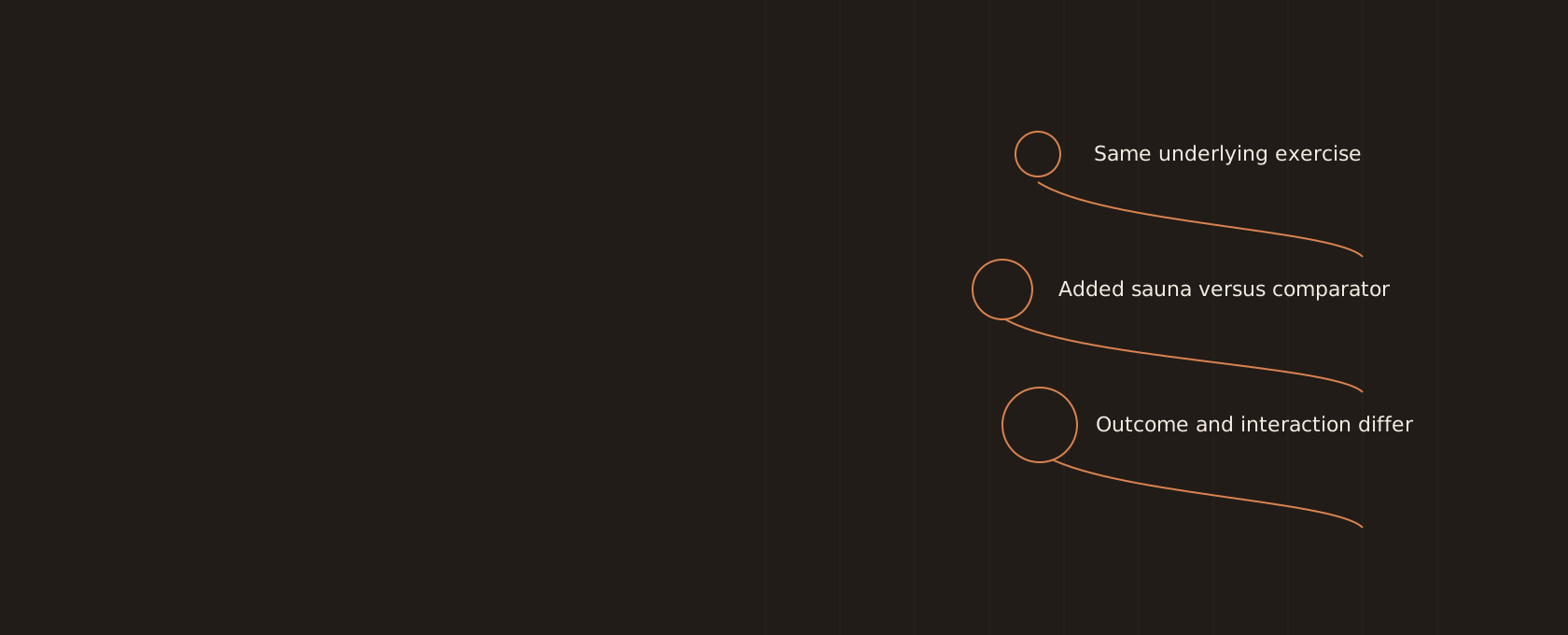
| 2022 · Lee E ↗ | randomized controlled trial Low activity with at least one cardiovascular risk factor Participants: 47. postexercise sauna · 8 weeks | Relative to exercise alone, exercise plus sauna produced an additional fitness change of +2.7 mL/kg/min (95% CI +0.2 to +5.3) and a systolic-pressure difference of −8.0 mmHg (−14.6 to −1.4). This small combined-program trial did not test sauna alone or clinical-event prevention. Comparison: Exercise alone; control Small eight-week multi-arm trial |
| 2025 · Lee E ↗ | randomized controlled trial Sedentary adults with at least one cardiovascular risk factor Participants: 38. postexercise sauna · 8 weeks | Adding sauna after exercise did not produce statistically detectable additional HRV improvements relative to exercise alone. Comparison: Exercise alone; no-intervention control Small trial |
| 2022 · Sitkowski D ↗ | randomized crossover trial Physical education students Participants: 13. postexercise Finnish sauna · Two 4-week periods; 10-week washout | Sauna with fluid restriction did not add clear benefit over endurance training in the assessed blood and exercise outcomes. Comparison: Cycling without subsequent sauna Very small male sample |
Does combining sauna and exercise create an established extra benefit?
The answer depends on the outcome and comparison. A small multi-arm randomized trial reported favorable added fitness and systolic-pressure changes when sauna followed exercise. Other controlled outcomes and studies did not show the same additional advantage. The evidence should not become a universal claim that every combination improves every result.
The first question is what the source compared. Training plus heat versus the same training alone addresses an incremental program question. A joint cohort category, an acute before-and-after response and a complete factorial experiment address different questions. This guide separates them before interpreting benefit, so a positive measurement does not become proof of sauna alone, a biological interaction or prevention of clinical events.
What did the randomized combined-program trial study?
The cardiovascular trial enrolled low-activity adults with at least one cardiovascular risk factor. It compared exercise plus sauna with exercise alone and a control condition over a defined program. The added-sauna comparison is therefore more direct than simply observing that one combined group improved from its own starting value.
The sample and time horizon were limited. These were selected adults rather than every athlete, medical population or recreational user. A favorable group result cannot establish how an individual would respond or whether a different exercise load and heat setting is suitable. The intervention should remain attached to the actual participants, shared training and measured endpoints rather than a generic wellness-program label.
The main program lasted eight weeks, which is an observation horizon rather than evidence about indefinite maintenance or later clinical events. The assessed marker changes should keep that time window attached. A future long-term trial would ask another question, not simply extend the practical promise of the short program without additional outcome data.
Why is the exercise-only group essential?
Both relevant groups performed exercise, so the question is what the added sauna contributed beyond that shared program. Improvement within the combined group alone would not isolate the addition, because training itself can change outcomes. The between-group comparison is the central result.
This distinction also limits a common extrapolation. A favorable added effect does not show that sauna can replace exercise or reproduce the combined program without it. The study did not test that substitution. A clear evidence summary names the comparison before the favorable finding, rather than leaving readers to infer whether the result belongs to exercise, heat, both or a difference in the underlying training.
Does an added effect prove synergy between exercise and heat?
Not automatically. Establishing an added-program difference is not the same as demonstrating that the two components interact beyond an appropriate reference model. A complete factorial question would require suitable comparisons for the components and their combination, together with a defined interaction analysis.
The multi-arm trial did not include a sauna-alone arm. It therefore cannot by itself map every component contribution or establish a general synergy claim. The absence of that arm does not erase the observed exercise-plus-sauna comparison; it specifies what the design cannot answer. The same caution applies when a narrative review uses combination language: the primary design and analysis must support the particular interaction being claimed.
| Comparison type | Question it addresses | Missing extension |
|---|---|---|
| Exercise plus sauna versus exercise alone | What did the added program change? | Sauna alone reproduces the effect |
| Complete component and combination comparisons | A defined interaction question | Any added effect automatically proves synergy |
| Joint cohort profiles | How existing characteristics relate to outcomes | An assigned exercise-plus-sauna effect |
| Acute sequence experiment | Responses around a loading condition | Sustained training or clinical-event benefit |
Which added changes were reported in the main trial?
Relative to exercise alone, the combined group had an additional fitness change of 2.7 mL/kg/min, with a 95% confidence interval of 0.2–5.3. The systolic-pressure difference was −8.0 mmHg, with an interval of −14.6 to −1.4. These registered estimates belong to the tested program and comparison, not a universal sauna-only effect.
Fitness and systolic pressure are also different endpoints. Neither is a direct count of prevented cardiovascular events. A reader should preserve the measured quantity, units, uncertainty and participant selection before applying the numbers elsewhere. This guide does not turn them into an individual prognosis, infer every other outcome improved or combine them into a single score for the value of heat.
Did additional heart-rate-variability improvement appear too?
The post-exercise HRV trial did not detect an additional improvement in the assessed variability indices relative to exercise alone. That null comparison belongs beside the favorable cardiovascular measures. A result for fitness or systolic pressure cannot be relabeled as a result for every autonomic measurement.
The HRV source also involved selected adults with risk factors and a defined program. It does not prove that no possible sauna effect exists, but it constrains the specific claim tested. These reports should retain their individual endpoints and analysis populations. Similar schedules and participant descriptions also require an overlap check before separate publications are counted as fully independent confirmations.
What did the hematological crossover trial add?
The small crossover trial found no clear added benefit from sauna beyond endurance training in the assessed blood and exercise outcomes. Some hemoglobin-related changes were within measurement uncertainty. That prevents the blood-adaptation hypothesis from being presented as uniformly supported across combined programs.
The experiment used a no-fluid condition during exercise and sauna. Those methods describe the study and are not advice to copy fluid restriction. Its result does not test every routine, but it supplies an important controlled comparison under its actual conditions. A within-group improvement shared with training alone would not establish the additional heat benefit. The causal question is the difference made by the added component, not whether any measurement changed.
Do acute blood-pressure changes establish a training benefit?
The acute hemodynamic experiment compared sauna alone with sauna after different exercise sequences. Blood-pressure and plasma-volume responses depended on timing and sequence, while high-sensitivity CRP did not change at the measured points. These are immediate or short-recovery measurements rather than a trial of sustained training adaptation.
The abstract did not describe matching exercise-without-sauna arms for every loading condition. A change after exercise plus sauna therefore cannot isolate all of the extra contribution of heat. The source can help characterize a combined response without proving that the same sequence improves long-term fitness, clinical outcomes or every person’s recovery. Acute physiology and repeated-program effectiveness need separate evidence.
What do joint fitness-and-sauna mortality categories contribute?
The cohort analysis associated the combined high-fitness, frequent-sauna profile with lower mortality than the low-fitness, lower-frequency reference. It observed existing characteristics rather than assigning an exercise-plus-sauna program. The comparison does not tell a fit individual how much survival benefit would result from adding heat.
Measured fitness is not equivalent to a prescribed training intervention, and joint categories can differ in more than one characteristic. Their shared reference should remain visible. These analyses can motivate intervention research without establishing the extra causal benefit of a new routine. They should not be presented as long-term clinical confirmation of the small trial’s fitness and pressure changes.
Were all joint mortality comparisons equally precise?
The sudden-cardiac-death analysis found a lower estimate in the combined high-fitness, frequent-sauna category, while the lower-fitness, frequent-sauna comparison was imprecise. That variation belongs in the summary. It does not support a claim that sauna reliably compensates for lower fitness or produces the same association in every profile.
The endpoint was also more specific than all-cause mortality. A result for sudden cardiac death should not be substituted for every event or for the short-term measurements in a clinical program. The source provides observational context with uncertainty, not a randomized interaction test or a personal training decision rule.
Can the lifestyle review prove the combination works?
The narrative review considers sauna alongside fitness, activity and other characteristics across mixed underlying designs. It helps organize questions and proposed mechanisms. It does not create a new experimental population or automatically establish an interaction simply because the title asks about additional benefits.
A careful reading follows each conclusion back to the relevant primary comparison. Observational joint associations, controlled additions and acute responses require different interpretation. Their coexistence in a review cannot fill a missing arm or resolve participant overlap. The review is valuable as context when those distinctions remain clear, rather than as independent proof that every combined lifestyle program has a universal extra effect.
Why do population and publication independence matter?
The controlled program in low-activity adults, the small male crossover experiment and the middle-aged male cohorts involve different participants and outcomes. A finding in one does not establish the same response in competitive athletes, every clinical group or all users of another heat modality.
Separate titles can also report related participants or different endpoints from a program. Independence must be checked in the full methods before a bibliography becomes a count of replications. A changed sample size does not by itself establish a new population. This guide therefore keeps direct trial findings, null endpoints and observational context on separate lines instead of adding them into one apparent large experiment.
Has an optimal combined routine been established?
The sources do not identify a universal sequence, temperature, duration or weekly frequency that optimizes a clinical or performance outcome. They used different training, exposure and assessment conditions. Borrowing the most attractive detail from each would create an untested intervention rather than reproduce a validated program.
A session planner can display assumptions and a heat log can record visits. Neither confirms that fitness, autonomic recovery or event risk changed as intended. The evidence also does not show that adding increasingly intense heat gives a larger useful effect. The appropriate practical use is to match a claim to its actual comparator and endpoint, with suitability considered separately from numerical precision.
What can be concluded without a personal prescription?
Grade C reflects limited, endpoint-specific evidence for some added-program changes alongside null and mixed findings. The controlled fitness and systolic-pressure observations deserve attention without becoming sauna-alone efficacy, synergy or clinical-event prevention. Joint mortality categories and acute measurements add context rather than closing those gaps.
This appraisal uses indexed abstracts and verified source abstractions. Full methods, overlap between reports, formal risk of bias, funding and conflict-of-interest disclosures have not been comprehensively assessed; unreported details remain unknown. The historical safety review gives limited general cautions, not complete individual clearance. Discuss intended exercise and heat exposure with a qualified clinician when a condition or medication is relevant, without copying unusual research restrictions or changing prescribed care independently.
Inspect the assumptions
Explore the session planner.
This planning tool describes a routine. It does not estimate a health benefit or provide medical clearance; the study exposures discussed above remain separate research methods.
Interactive workspace
In-memory checkpoint · no medical clearance
Pause for the personal context.
Check every item that applies or that you are unsure about. Current serious symptoms need appropriate care, not a tool result.
Context, with limits
- Checkpoint
- Complete the acknowledgment
A checklist cannot assess every relevant condition. No answer is medical clearance. Responses are in memory only, and are reset on reload.
Calculated on your device. Theme and unit preferences can be stored locally; health answers, weights and logs remain in memory. A shared settings URL contains its visible planning inputs.
Open the complete tool and methodologyExplore the evidence with a tool.
Questions, considered
Questions about this evidence
Can a trial without sauna alone establish that heat replaces exercise?
The main comparison tested adding sauna to a shared exercise program. It did not test substituting sauna for exercise or reproduce every component contribution. A favorable incremental result should retain that comparator, rather than becoming a standalone heat effect or evidence that a reader can omit the underlying training and obtain the same outcome.
Follow the sourceIs every favorable added-program difference proof of biological synergy?
An incremental comparison and an interaction claim are different. The latter needs appropriate component comparisons and a defined analysis. The trial lacked a sauna-alone arm, so it cannot by itself establish every component effect or a universal synergy. The observed result remains useful without expanding it beyond the actual design.
Follow the sourceWhy does the HRV null result remain relevant beside favorable fitness findings?
They concern different endpoints. The HRV trial did not detect added improvement relative to exercise alone, while the cardiovascular trial reported selected fitness and pressure changes. One outcome cannot supply the result of another. A balanced synthesis keeps both findings visible and checks whether reports share participants before counting independent confirmation.
Follow the sourceDid the no-fluid crossover protocol establish a strategy worth copying?
The study found no clear added benefit in its assessed blood and exercise variables beyond training alone. Fluid restriction was a research condition, not a validated personal strategy. Its presence does not justify deliberately adding stress or withholding drinks in pursuit of adaptation, and the results do not establish an optimal combined routine.
Follow the sourceCan an acute loading response stand in for a lasting training outcome?
The hemodynamic experiment measured timing- and sequence-dependent responses around exercise and sauna, without matching exercise-only arms described for every condition. That comparison cannot establish sustained training benefit or clinical-event prevention. Keep acute physiology separate from repeated-program outcomes and identify what the control actually allows the source to attribute to heat.
Follow the sourceDo joint mortality profiles tell a fit person the survival gain from adding sauna?
The cohort compared existing fitness and sauna categories rather than assigning a new routine. Differences in the combined profiles cannot isolate a personal causal survival gain. The lower-fitness comparison also was not equally precise across endpoints. These findings can guide research questions without becoming an individual program, compensation claim or prevention forecast.
Follow the sourceFollow the evidence
Sources & references
Research summaries in this edition are based on indexed abstracts unless otherwise noted. A source link is not a claim of medical review.
- Effects of regular sauna bathing in conjunction with exercise on cardiovascular function: a multi-arm, randomized controlled trial.
Lee E, Kolunsarka I, Kostensalo J, Ahtiainen JP, Haapala EA, Willeit P, Kunutsor SK, Laukkanen JA
Volume 323, issue 3, pages R289-R299 · PMID 35785965
Open-access flag: yes.Abstract-level editorial review - Regular postexercise sauna bathing does not improve heart rate variability: A multi-arm randomized controlled trial.
Lee E, Ketelhut S, Wiklund P, Kostensalo J, Kolunsarka I, Hägglund H, Ahtiainen JP
Volume 13, issue 13, pages e70449 · PMID 40611569
Open-access flag: yes.Abstract-level editorial review - Hematological Adaptations to Post-Exercise Sauna Bathing With No Fluid Intake: A Randomized Cross-Over Study.
Sitkowski D, Cisoń T, Szygula Z, Surała O, Starczewski M, Sadowska D, Malczewska-Lenczowska J
Volume 93, issue 4, pages 795-803 · PMID 34727008
Open-access flag: not recorded.Abstract-level editorial review - Acute Hemodynamic Responses to Combined Exercise and Sauna.
Rissanen JA, Häkkinen K, Laukkanen JA, Häkkinen A
Volume 41, issue 12, pages 824-831 · PMID 32599642
Open-access flag: not recorded.Abstract-level editorial review - Joint associations of sauna bathing and cardiorespiratory fitness on cardiovascular and all-cause mortality risk: a long-term prospective cohort study.
Kunutsor SK, Khan H, Laukkanen T, Laukkanen JA
Volume 50, issue 2, pages 139-146 · PMID 28972808
Open-access flag: not recorded.Abstract-level editorial review - Combined Effect of Sauna Bathing and Cardiorespiratory Fitness on the Risk of Sudden Cardiac Deaths in Caucasian Men: A Long-term Prospective Cohort Study.
Laukkanen JA, Laukkanen T, Khan H, Babar M, Kunutsor SK
Volume 60, issue 6, pages 635-641 · PMID 29551418
Open-access flag: not recorded.Abstract-level editorial review - Does the Combination of Finnish Sauna Bathing and Other Lifestyle Factors Confer Additional Health Benefits? A Review of the Evidence.
Kunutsor SK, Laukkanen JA
Volume 98, issue 6, pages 915-926 · PMID 37270272
Open-access flag: not recorded.Abstract-level editorial review - Benefits and risks of sauna bathing.
Hannuksela ML, Ellahham S
Volume 110, issue 2, pages 118-126 · PMID 11165553
Open-access flag: not recorded.Abstract-level editorial review