| Study | Design & population | Finding & comparison |
|---|---|---|
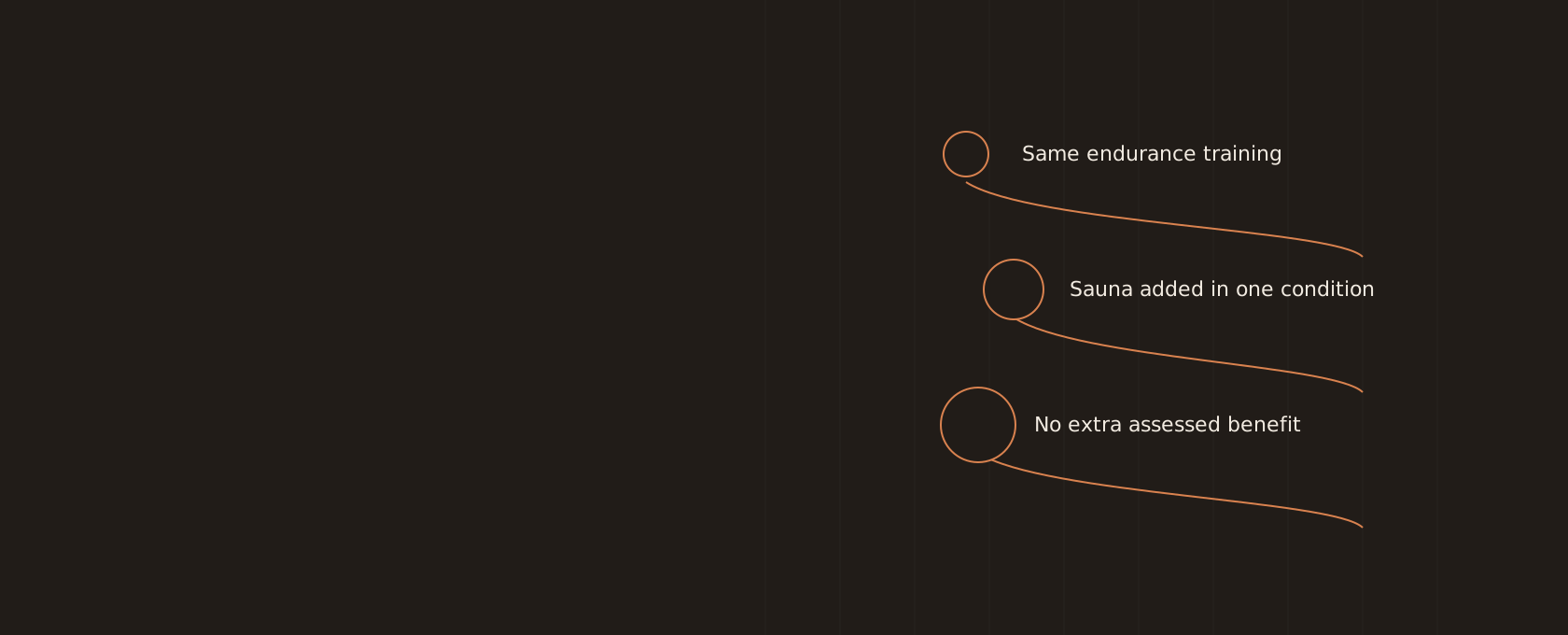
| 2022 · Sitkowski D ↗ | randomized crossover trial Physical education students Participants: 13. postexercise Finnish sauna · Two 4-week periods; 10-week washout | Sauna with fluid restriction did not add clear benefit over endurance training in the assessed blood and exercise outcomes. Comparison: Cycling without subsequent sauna Very small male sample |
| 2015 · Stanley J ↗ | Small longitudinal athlete physiology study Well-trained male cyclists Participants: 7. Post-exercise sauna · 10days training plus sauna within35days monitoring | Plasma volume increased during the sauna period, but associations between individual volume changes and heart-rate measures were unclear. The abstract uses 90% confidence limits and magnitude-based inferences, not 95% confidence intervals. Comparison: Baseline training and subsequent exposure periods; no independent control described Very small male athlete sample. |
| 2021 · Pokora I ↗ | Uncontrolled before-after physiology study Elite cross-country skiers Participants: 14. Sauna · 10 sauna baths | Resting heart rate fell after the series, but baseline body temperatures did not change; the physiological-strain result was borderline rather than conventionally significant. Comparison: Within-person measurements before versus after sauna series Small elite-athlete sample |
Original publication: Hematological Adaptations to Post-Exercise Sauna Bathing With No Fluid Intake: A Randomized Cross-Over Study.
Did the extra sauna exposure improve the training result?
The study did not establish additional benefit in its assessed blood and exercise variables beyond endurance training alone. That answer concerns the added component, not whether the participants responded to training at all. Some outcomes changed under both conditions.
The paper is relevant because it compared the same general exercise program with and without postexercise sauna. It therefore asks a more direct incremental question than an uncontrolled description of athletes starting several practices at once. The result should not be summarized as every measure remaining unchanged, nor as confirmation that sauna enhanced blood-related adaptation simply because a value increased during the combined program. The appropriate contrast is what the added exposure contributed beyond the shared exercise, with measurement uncertainty retained as part of the finding.
What does the randomized crossover structure contribute?
Participants completed both training conditions in a randomized crossover design, separated by a washout period. This allows within-person comparisons while addressing the order in which conditions were experienced. It is a useful design for a small study, but it does not automatically settle every carryover or training-period issue.
A full appraisal would examine the interval between conditions, how comparable training was maintained, adherence and the analysis. The sample consisted of male physical-education students, not every athlete or general sauna user. Those boundaries should remain visible even though randomization strengthens the comparison. The study can directly inform the tested addition under its conditions while leaving other exercise programs, populations and heat routines unanswered. A different routine is another research question rather than a result that can be inferred by adjusting one detail informally.
Why must the fluid-restriction condition remain explicit?
No fluid was ingested during the exercise sessions or the added sauna sessions under the reported protocol. That condition is part of the experiment and affects what question the result represents. It should not be removed from the methods when the paper is cited.
It also is not advice. The trial did not establish that withholding drinks is a beneficial personal adaptation strategy, and its null added-benefit conclusion supplies no reason to create such a routine. This summary deliberately does not provide a target dehydration level, loss percentage or sequence to reproduce the exposure. A controlled research procedure can be scientifically informative without being appropriate public practice. The useful reading task is to understand the tested condition and its limitations, rather than interpret publication of a method as a recommendation to copy it.
Which blood measurements should remain distinct?
The investigators assessed total hemoglobin mass, intravascular volumes and other blood-related variables. These are different measurements, not synonyms for a single score of blood adaptation. A change in concentration cannot automatically provide a mass or volume result that was not established.
This distinction matters when the study is discussed alongside plasma-volume research. The relevant outcome and its method need to remain attached to the claim. A general statement that sauna improved the blood would conceal both the measurement differences and the absence of a demonstrated added effect in the trial. The source can contribute to understanding how training and heat are studied without proving a universal adaptation mechanism. This page therefore uses the registered qualitative result and does not insert unverified numerical volume or hemoglobin advantages.
Why do shared changes and typical error matter?
The abstract reports blood and exercise changes irrespective of intervention type, while noting measurement uncertainty for hemoglobin-mass changes. A value moving over a period does not necessarily show a meaningful added sauna response, particularly when the comparison changed similarly.
Typical error concerns how precisely the method can distinguish a change from measurement variation. This summary does not relabel every numerical difference as a useful physiological adaptation or reconstruct an unregistered effect size. The important scientific question is both whether a change was detectable and whether it differed appropriately between conditions. The trial did not establish the extra benefit needed for a strong sauna-addition claim. That result remains useful even if some within-condition observations were favorable, because the shared exercise was itself an active part of the experiment.
Did improved exercise measurements demonstrate a sauna effect?
The reported exercise-capacity improvements occurred under both interventions. They therefore cannot be assigned entirely to sauna. An endurance-training program can change performance-related measurements without the additional heat contributing a detectable advantage.
The same principle limits interpretation of a combined wellness routine outside research. A starting-to-ending gain does not identify which component caused it. Here, the comparison condition supplies information that a simple before-and-after account would lack. The useful result is not a universal statement that sauna can never matter, but an absence of established additional benefit under the program tested. Other settings would need their own appropriate comparison. This page does not convert uncertainty about alternative routines into a positive finding the present study did not report.
How do cyclist and skier plasma-volume reports relate?
A small cyclist study observed plasma-volume expansion during a sauna period but found individual tracking relationships with heart-rate measures unclear. Its uncontrolled sequence differs from this randomized training comparison. It cannot supply the added benefit missing from the present trial.
An elite-skier before-and-after study assessed physiological and volume-related responses under temperate exercise conditions. It did not demonstrate a race-performance endpoint or isolate sauna with an independent comparison. These sources contribute distinct questions about response, monitoring and application. Their results should not be pooled informally into a guaranteed blood-adaptation or performance benefit. A plausible mechanism can motivate further work, while the direct comparison here still deserves its own place as a null added-program result. The bibliography is informative only when the differences in endpoint and design remain clear.
What is the proportionate conclusion and review boundary?
The grade is C for a small randomized crossover in a selected male training sample. It is direct evidence against calling this experimental strategy an established added benefit for the assessed outcomes. It does not prove that every possible program is exactly equivalent or provide a public dehydration prescription.
This appraisal read the indexed abstract and independently refreshed bibliographic information. Full-text protocol detail, formal risk of bias, complete statistical decisions and financial disclosures were not comprehensively assessed. Funding and competing interests remain unreported rather than presumed absent. Where medical conditions or medications affect intended heat exposure, suitability requires a separate clinical discussion. The laboratory method should remain a method description, with no inference that more fluid loss or a more demanding session produces better adaptation.
Explore the evidence with a tool.
Questions, considered
Questions about this study
Did sauna with fluid restriction add training benefits in the hematology trial?
The study did not find additional benefit in its assessed blood and exercise variables beyond endurance training alone. Some hemoglobin changes were within measurement uncertainty. The unusual fluid-restriction condition is part of the experiment, not advice to withhold drinks during or after ordinary sauna use or athletic training.
Follow the sourceWas the hematology sauna trial a sauna-only intervention?
No. Both conditions involved endurance cycling, with sauna added in one condition and fluid intake restricted during the sessions. The study therefore examines an addition to a specific training program. Its result cannot isolate an everyday sauna-only routine or be used to recommend dehydration as a performance strategy.
Follow the sourceWhy does measurement error matter for the sauna hemoglobin findings?
A measured change can be too small to distinguish confidently from normal test variability. The authors noted that some hemoglobin-mass changes fell within typical error, while clear additional sauna benefit was absent. Reporting every numerical shift as a meaningful adaptation would overstate what this small crossover study can establish.
Follow the sourceFollow the evidence
Sources & references
Research summaries in this edition are based on indexed abstracts unless otherwise noted. A source link is not a claim of medical review.
- Hematological Adaptations to Post-Exercise Sauna Bathing With No Fluid Intake: A Randomized Cross-Over Study.
Sitkowski D, Cisoń T, Szygula Z, Surała O, Starczewski M, Sadowska D, Malczewska-Lenczowska J
Volume 93, issue 4, pages 795-803 · PMID 34727008
Open-access flag: not recorded.Abstract-level editorial review - Effect of sauna-based heat acclimation on plasma volume and heart rate variability.
Stanley J, Halliday A, D'Auria S, Buchheit M, Leicht AS
Volume 115, issue 4, pages 785-794 · PMID 25432420
Open-access flag: not recorded.Abstract-level editorial review - The Effect of Medium-Term Sauna-Based Heat Acclimation (MPHA) on Thermophysiological and Plasma Volume Responses to Exercise Performed under Temperate Conditions in Elite Cross-Country Skiers.
Pokora I, Sadowska-Krępa E, Wolowski Ł, Wyderka P, Michnik A, Drzazga Z
Volume 18, issue 13, pages 6906 · PMID 34199101
Open-access flag: yes.Abstract-level editorial review - Benefits and risks of sauna bathing.
Hannuksela ML, Ellahham S
Volume 110, issue 2, pages 118-126 · PMID 11165553
Open-access flag: not recorded.Abstract-level editorial review