| Study | Design & population | Finding & comparison |
|---|---|---|
| 2020 · Rissanen JA ↗ | Repeated-measures acute exercise and sauna study Healthy, slightly prehypertensive Participants: 27. Sauna alone or after exercise | Blood-pressure and plasma-volume responses depended on exercise sequence and timing; high-sensitivity CRP did not change at the measured points. Comparison: Endurance, strength or combined exercise followed by sauna; sauna alone No matching exercise-only arms described |
| 2022 · Lee E ↗ | randomized controlled trial Low activity with at least one cardiovascular risk factor Participants: 47. postexercise sauna · 8 weeks | Relative to exercise alone, exercise plus sauna produced an additional fitness change of +2.7 mL/kg/min (95% CI +0.2 to +5.3) and a systolic-pressure difference of −8.0 mmHg (−14.6 to −1.4). This small combined-program trial did not test sauna alone or clinical-event prevention. Comparison: Exercise alone; control Small eight-week multi-arm trial |
| 2020 · Rissanen JA ↗ | Repeated-measures exercise and sauna study Recreationally active, sauna-experienced Participants: 27. Traditional sauna | Strength exercise followed by sauna showed the greatest measured neuromuscular fatigue; sauna alone also temporarily reduced selected force measurements. Comparison: Sauna alone and strength, endurance or combined exercise followed by sauna No matched exercise-without-sauna conditions described |
Original publication: Acute Hemodynamic Responses to Combined Exercise and Sauna.
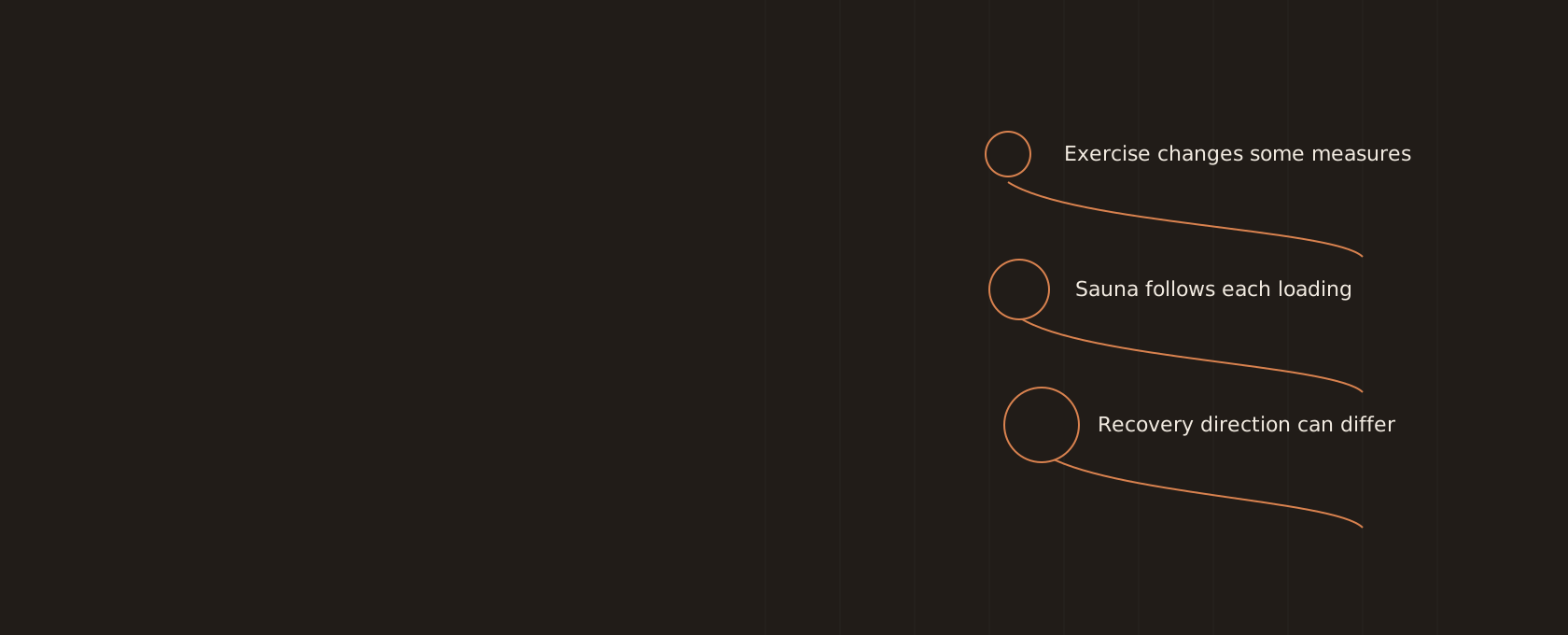
The study compared complete loading routines
This experiment examined blood pressure, plasma volume and immune-related measurements around sauna alone or sauna following different exercise routines. The participants were men whom the authors described as healthy and slightly prehypertensive. That description identifies the study sample; it does not supply a current diagnostic threshold or establish relevance to every person with high blood pressure.
The exercise conditions included endurance work, strength work and their combination, each followed by sauna. The investigators therefore studied whole loading sequences. The question was how responses differed across those sequences and sampling points, rather than whether a regular sauna habit prevented disease. Keeping the complete exposure visible matters because the exercise preceding the sauna had already changed some measurements before heating was assessed.
The reported comparisons do not isolate every component
A sauna-only condition provides information about heating without the preceding exercise load. It is not equivalent to taking each exercise condition and comparing sauna recovery with otherwise identical recovery without sauna. The indexed abstract does not describe that matched exercise-only comparison for each loading sequence.
Consequently, a favorable result after endurance exercise followed by sauna cannot automatically be assigned to the sauna component or called an interaction between the two. Exercise itself, recovery and the combined sequence are different possible explanations. This does not make the measured sequence uninformative: it describes what happened under that routine. It does limit claims about how much additional benefit a person would obtain by adding heat to an existing workout.
Measurements before sauna are part of the result
The investigators measured participants before loading, after exercise, after sauna, during nearby recovery and on the following day. The after-exercise assessment is especially informative because it preceded sauna within the combined routines. It establishes that some physiological responses were already present before the heating component could contribute.
An account starting only at the end of the sauna would lose that distinction. A change measured after the complete sequence might continue an exercise response, differ from it or emerge later in recovery. Each interpretation depends on the relevant comparison. The abstract gives a useful outline of this timing, but it does not provide the full measurement procedures, complete variability or every between-condition statistical comparison needed to reconstruct the analysis.
The pressure pattern depended on routine and timing
The endurance-plus-sauna condition showed the most favorable reported systolic-pressure pattern among the tested routines, including differences extending into the following day. Standalone sauna and the combined endurance-and-strength sequence also had reported systolic decreases at a nearby recovery assessment. Diastolic pressure declined after the loading routines at the reported immediate assessment.
These findings should retain their outcome labels and assessment windows. They do not demonstrate one identical pressure response after every form of exercise or at every later measurement. Nor does an acute reduction establish durable hypertension management, a reduction in clinical events or suitability for an individual. The full sequence remains the exposure being described, and statistical change within a sequence does not establish the independent increment from sauna.
Plasma-volume direction changed during recovery
Plasma volume fell after exercise in the exercise conditions and at selected immediate post-sauna assessments. Later, the endurance-containing sequences showed increases on the following day. The same experiment can therefore contribute both a decrease and an increase, depending on the loading routine and the sampling point being discussed.
That pattern argues against describing the study with a single direction of fluid response. It also prevents interpreting a recovery measurement as evidence of permanent expansion or improved endurance performance. The paper measured acute physiological changes, not a demonstrated long-term training adaptation. Its findings are not a reason to pursue dehydration, alter a medical fluid plan or repeat a research loading sequence as a personal program.
White cells and CRP did not give one common result
White-cell measurements increased after exercise in the exercise-plus-sauna conditions and remained elevated at reported later nearby assessments. High-sensitivity C-reactive protein did not change at the measured points. Those are distinct observations, rather than a common finding that every immune-related marker improved or that systemic inflammation was reduced.
The pre-sauna white-cell finding is particularly relevant to attribution: the change was already observable after the exercise load. An unchanged CRP result does not erase that response, while the white-cell change does not turn CRP into a positive finding. Neither measurement establishes fewer infections or a clinical anti-inflammatory effect. Their value here is in describing the acute loading response with the marker and sampling context attached.
Related studies should retain their own questions
The multi-arm exercise-and-sauna trial provides useful methodological context because it included an exercise-only comparator during a repeated program. Its comparison can address an added-program question more directly than this acute loading experiment. That difference does not transfer its fitness or pressure findings automatically to the acute routines or create a sauna-only arm where none was tested.
A separate loading-sequence publication examined hormones and neuromuscular performance. It illustrates why related measurements need their own endpoints and timing. This abstract-only appraisal did not establish whether participants overlapped between those publications, so they should not be counted as confirmed independent replications. Together, the papers frame different research questions rather than interchangeable demonstrations of a universal recovery benefit.
The conclusion remains an acute source appraisal
The indexed abstract and bibliographic record were reviewed. Full-text methods, allocation order, carryover handling, formal risk of bias, funding and competing interests were not established by this appraisal. Unreported details remain unreported. The male sample and acute follow-up also limit direct generalization to different populations and chronic clinical outcomes.
The historical safety review provides context on cardiac contraindications and alcohol-related concerns, rather than comprehensive medical clearance for exercise followed by heat. The practical contribution of this study is narrower: responses after a complete routine depended on the physiological measurement and its timing. A personal exposure schedule, clinical treatment decision or claim of lasting performance improvement requires information beyond the comparison reported here.
Explore the evidence with a tool.
Questions, considered
Questions about this study
Which routine showed the largest blood-pressure changes in PMID 32599642?
The endurance-exercise-plus-sauna sequence showed the most favorable pressure changes among the tested routines. That result concerns a complete combined exposure, not the independent contribution of sauna. Without the same endurance session followed by sauna-free recovery, the abstract cannot separate the exercise effect from any additional heating effect.
Follow the sourceDid the combined exercise-and-sauna experiment show an acute CRP reduction?
No. High-sensitivity C-reactive protein did not change at the reported measurement points, even though other responses did. White-cell changes were also described around exercise-plus-sauna conditions. These separate markers should not be collapsed into a blanket claim that the routine acutely reduced systemic inflammation.
Follow the sourceWhy did plasma-volume timing matter in the exercise-and-sauna study?
Plasma volume fell around some exercise and heating phases but increased the following day after routines containing endurance work. A measurement taken immediately after the sauna would therefore tell a different story from a later recovery measurement. The pattern underscores why fluid-related endpoints require explicit sampling times.
Follow the sourceFollow the evidence
Sources & references
Research summaries in this edition are based on indexed abstracts unless otherwise noted. A source link is not a claim of medical review.
- Acute Hemodynamic Responses to Combined Exercise and Sauna.
Rissanen JA, Häkkinen K, Laukkanen JA, Häkkinen A
Volume 41, issue 12, pages 824-831 · PMID 32599642
Open-access flag: not recorded.Abstract-level editorial review - Effects of regular sauna bathing in conjunction with exercise on cardiovascular function: a multi-arm, randomized controlled trial.
Lee E, Kolunsarka I, Kostensalo J, Ahtiainen JP, Haapala EA, Willeit P, Kunutsor SK, Laukkanen JA
Volume 323, issue 3, pages R289-R299 · PMID 35785965
Open-access flag: yes.Abstract-level editorial review - Acute Neuromuscular and Hormonal Responses to Different Exercise Loadings Followed by a Sauna.
Rissanen JA, Häkkinen A, Laukkanen J, Kraemer WJ, Häkkinen K
Volume 34, issue 2, pages 313-322 · PMID 31490429
Open-access flag: not recorded.Abstract-level editorial review - Benefits and risks of sauna bathing.
Hannuksela ML, Ellahham S
Volume 110, issue 2, pages 118-126 · PMID 11165553
Open-access flag: not recorded.Abstract-level editorial review