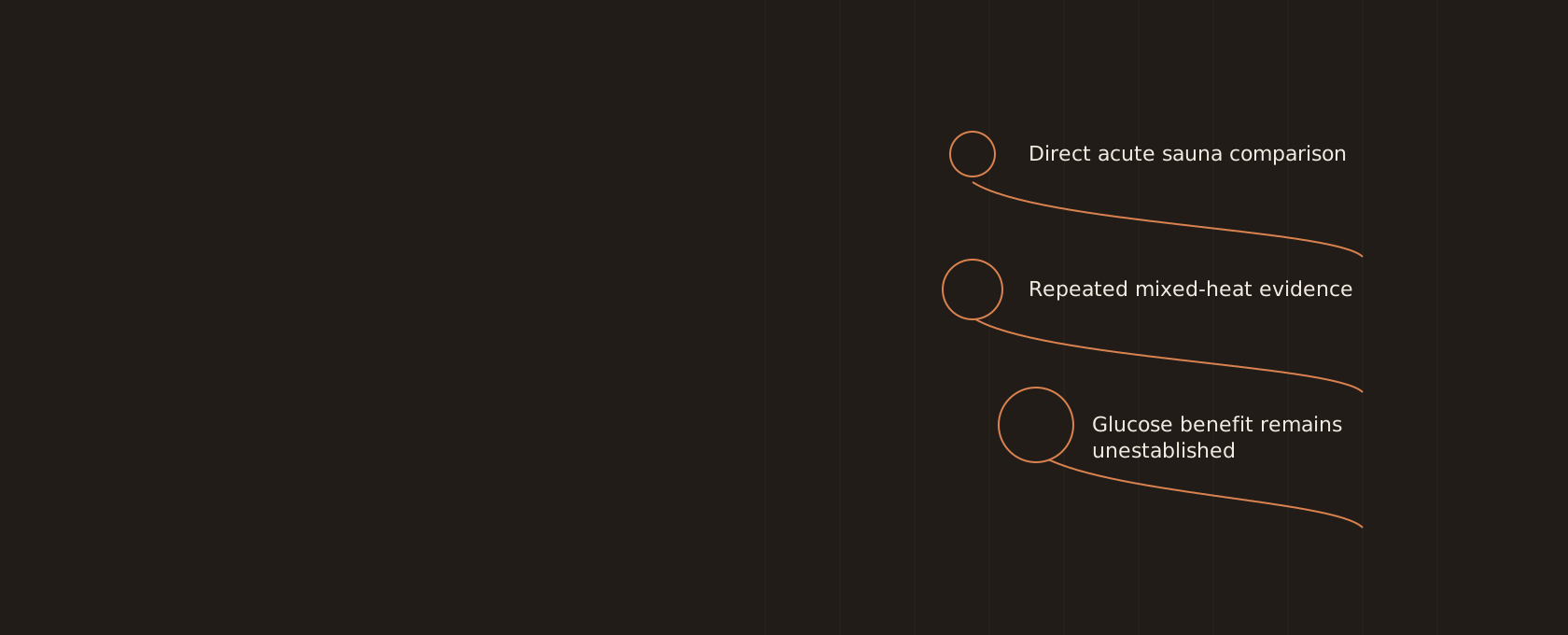
| Study | Design & population | Finding & comparison |
|---|---|---|
| 2024 · Schenaarts L ↗ | randomized controlled crossover trial Type 2 diabetes Participants: 12. infrared sauna · Acute; glucose tolerance test immediately afterward | The heated infrared session did not improve postchallenge glucose handling compared with the thermoneutral visit. Comparison: Thermoneutral infrared room at 21°C Small older diabetic sample |
| 2021 · Sebők J ↗ | Systematic review and meta-analysis Type 2 diabetes Passive heat therapy | The pooled HbA1c, fasting-glucose and triglyceride changes were not statistically significant despite the favorable wording of the paper title. Comparison: Pre-intervention versus post-intervention measurements Small evidence base |
| 2025 · Hamaya R ↗ | Systematic review and meta-analysis of randomized trials Adults across healthy and clinical populations Mixed passive heating, including water immersion, sauna, hot yoga and local heating · 2–15 weeks | Most pooled markers did not improve significantly; blood-pressure subgroup findings required caution because interventions and study populations differed. Comparison: Trial control conditions High heterogeneity |
What is the direct answer to a glucose-benefit claim?
Improved glucose control from sauna is not established by the cited evidence. The most directly relevant acute infrared trial did not find better postchallenge handling after the heated condition. Reviews of passive-heating programs also leave important glycemic claims unconfirmed. This is not a consistent body of evidence for a specific sauna program.
The answer needs its outcome attached. A response after a glucose challenge, a fasting measurement and a longer-term marker are different questions. So are an acute visit and a repeated intervention. A general promise can seem more persuasive when findings from those settings are blended, but blending them does not create the missing comparison.
The C grade describes limited and varied research, not a confirmed glucose-management benefit. It allows discussion of a scientifically reasonable question while retaining null results and uncertainty. It does not identify a personal temperature, schedule, meal strategy or change in clinical care that follows from the available findings.
Why do the glycemic endpoints need to remain separate?
The direct infrared study assessed handling of a glucose challenge after the visits. The diabetes review summarized fasting glucose and HbA1c among its main outcomes. These endpoints are related to glycemic questions but are not interchangeable measurements collected under identical circumstances.
An acute result cannot determine every longer-term response. Equally, the possibility of a repeated-program effect does not turn an acute null finding into a positive one. A useful evidence claim specifies the participant group, actual outcome, timing and comparison before describing benefit. Those details make it possible to see whether the study answers the reader’s question.
This matters particularly when a laboratory marker is substituted for a clinical result. A change in one measure would not automatically establish fewer complications or successful management in an individual. The cited work should therefore be read at the level of its own outcomes, rather than converted into a broad score for whether heat is metabolically beneficial.
What did the direct heated-versus-thermoneutral trial test?
The same participants experienced heated and thermoneutral infrared conditions before glucose testing in a randomized crossover comparison. That structure helps distinguish an acute heating effect from simply resting in the research environment. It also reduces some differences that would arise if unrelated people received the separate conditions.
The heated visit produced a higher incremental area under the plasma-glucose curve, or iAUC, during the subsequent glucose challenge than the thermoneutral visit. This measure summarizes the glucose response above baseline across the test. Plasma-insulin concentrations and the whole-body composite insulin-sensitivity index did not differ between conditions. The finding is therefore an unfavorable acute glucose comparison, rather than merely an absence of detected benefit.
That result remains specific to the small older type 2 diabetes sample, the tested infrared exposure and the immediate challenge. It does not establish that every repeated sauna program causes chronic glycemic harm or that every device produces the same response. The appropriate interpretation keeps the unfavorable acute observation visible without expanding its population or time frame. An attractive result from a different modality cannot replace this direct comparison.
The trial enrolled twelve participants, including ten men and two women. That sample gives a direct clinical comparison but limited precision and representation. It should not be mistaken for a large pragmatic trial of routine home use across the range of adults living with diabetes.
Who does that acute result most directly represent?
The trial enrolled older adults with type 2 diabetes, with limited female representation. That is direct clinical-population evidence for its specific question. It deserves attention rather than being replaced with an inference from young healthy volunteers simply because a different study appears more favorable.
The population boundary also works in the opposite direction. The study does not determine the exact response in younger adults, other metabolic diagnoses or every person with type 2 diabetes. Selection, health status, medication context and study supervision require closer inspection before applying the findings to an individual.
This page therefore does not use participation as a safety checklist or assume that a home session matches the experiment. The efficacy question is what happened to the measured glucose outcome under the comparison. The suitability question is whether a particular person’s intended exposure is appropriate. Those decisions need distinct evidence and, where relevant, an individualized clinical discussion.
What did the earlier diabetes heat review actually find?
Despite a favorable title, the diabetes-focused systematic review reported no statistically significant pooled HbA1c or fasting-glucose change. Triglyceride change was also nonsignificant. The source therefore should not be summarized as established glucose improvement merely because its title or concluding interpretation sounds positive.
Its evidence base was small and involved passive heat rather than a new sauna-only trial. The summarized pre-intervention versus post-intervention comparisons also leave uncertainty about attribution. Pooling such observations does not automatically isolate the effect of heat from other changes in the study setting.
The useful conclusion is qualified. A nonsignificant result is not proof that every true effect is exactly zero, but an uncertain estimate is not a demonstrated benefit either. Further work may answer a better specified question. Until then, the outcome-level findings should remain more prominent than a broad favorable label, particularly when a reader is considering an intervention for a clinical condition.
What does the broader randomized-trial synthesis add?
A newer review of non-acute randomized passive-heating trials reported no significant pooled improvement for most assessed cardiometabolic and vascular markers, including glycemic outcomes. That adds controlled-program context beyond the earlier pre-post synthesis. It does not establish a universal glucose benefit.
The eligible interventions included several heat approaches, such as water bathing, sauna, local heating and hot yoga. Healthy and clinical populations also differed. Those differences matter to a claim about a particular traditional or infrared sauna routine. A pooled result across unlike interventions cannot be treated as a precise sauna-only estimate.
Some systolic-pressure subgroups were more favorable, but they do not answer the glucose question. The outcome and subgroup need to remain attached. This guide also does not reproduce an internally inconsistent overall pressure interval from the abstract. That reporting issue needs verification rather than a silent correction, and it provides no missing glycemic result for the present topic.
| Evidence setting | Question answered | Limit on a sauna glucose claim |
|---|---|---|
| Acute infrared crossover | Postchallenge handling after heated versus thermoneutral visits | Does not establish a repeated-program effect |
| Diabetes heat review | Pooled pre-post glycemic measurements | Small mixed passive-heat evidence base |
| Randomized-program review | Non-acute mixed-heating outcomes | Not a precise sauna-only estimate |
| Exercise-plus-sauna trial | Selected fitness and pressure outcomes | Different outcomes cannot substitute for glucose |
Can water-heating findings or warming substitute for sauna evidence?
Not without a relevant direct comparison. The mixed-modality reviews concern interventions with differing environments and procedures. A finding attributed to passive heat in general should not be transferred automatically to a selected home sauna. The question is what exposure was actually tested, not whether both settings can warm the body.
A randomized infrared-versus-cycling experiment in healthy women offers another useful distinction. It found an acute response pattern more consistent with thermoregulation than reproducing exercise-like activation. That study did not establish improved diabetes outcomes. It illustrates why becoming warmer does not itself demonstrate a metabolic or exercise benefit.
The direct diabetes trial is therefore not overridden by the existence of a temperature response or by a general discussion of heat. A source must show that the target outcome changed under an appropriate comparison. The present evidence does not permit a reader to replace that requirement with the assumption that all passive heating has equivalent glycemic effects.
Do favorable exercise-plus-sauna results prove a glucose effect?
No such inference follows. A separate randomized exercise-plus-sauna trial reported favorable changes in selected fitness and systolic-pressure outcomes relative to exercise alone. Those are the outcomes it established in that comparison, not a substitute for a glucose result.
A combined program also needs an appropriate active comparator to identify what the added component contributed. An improvement from baseline in people who exercised and used sauna cannot automatically be credited to heat. That distinction is relevant whenever a broad wellness program is used to support a sauna-specific claim.
The source can inform a cardiovascular or fitness question while leaving the glycemic question unanswered. Listing several favorable endpoints from different papers does not make every metabolic endpoint favorable. A careful synthesis should therefore resist a tally of positive titles and instead match the actual measure, population and comparison to the claim. For blood glucose, the direct clinical trial and glycemic review results remain central.
Does the evidence identify a personal glucose-management routine?
It does not establish one. The cited sources vary in heat modality, participant selection, timing and measured outcome. Combining a duration from one experiment with a frequency from another would create a new intervention that neither tested for the assembled glucose claim.
No change in medication, food timing or clinical monitoring is justified by this guide. A reader managing diabetes needs advice accounting for their own health and care, rather than a copied laboratory exposure or an interpretation of a broad heat review. That clinical discussion should distinguish the desired benefit from whether the intended use is suitable.
The systematic review of dry sauna interventions also described heterogeneous studies and unresolved exposure questions. Its breadth is not a reason to invent an optimum schedule. A session or hydration tool can organize assumptions and explain a calculation, but it cannot validate a glycemic benefit or decide how an individual should alter diabetes care.
What should remain clear about safety, uncertainty and review?
The historical safety review names unstable angina, recent myocardial infarction and severe aortic stenosis among contraindications and identifies alcohol-related concerns. It is an older narrative source rather than a complete personal screening system. A person with a condition or medication question should discuss intended sauna use with a qualified clinician.
This page is an abstract-level synthesis of refreshed official records and registered findings. It does not claim a completed full-text risk-of-bias assessment or comprehensive review of funding and conflicts. Those financial details were not established in the material reviewed and remain unreported. The review date records editorial work, not an invented medical endorsement.
The research gap is a clearly specified sauna exposure, suitable comparator, relevant clinical group and meaningful glycemic follow-up. Better evidence could refine individual claims, but the possibility of later benefit is not a present result. The defensible conclusion remains that sauna-related glucose improvement is unestablished here, with outcome and modality differences kept visible rather than replaced by a universal promise.
Inspect the assumptions
Explore the session planner.
This planning tool describes a routine. It does not estimate a health benefit or provide medical clearance; the study exposures discussed above remain separate research methods.
Interactive workspace
In-memory checkpoint · no medical clearance
Pause for the personal context.
Check every item that applies or that you are unsure about. Current serious symptoms need appropriate care, not a tool result.
Context, with limits
- Checkpoint
- Complete the acknowledgment
A checklist cannot assess every relevant condition. No answer is medical clearance. Responses are in memory only, and are reset on reload.
Calculated on your device. Theme and unit preferences can be stored locally; health answers, weights and logs remain in memory. A shared settings URL contains its visible planning inputs.
Open the complete tool and methodologyExplore the evidence with a tool.
Questions, considered
Questions about this evidence
What changes when a claim switches from postchallenge glucose to HbA1c?
It changes the outcome and assessment context. The acute infrared trial assessed handling after a glucose challenge, whereas the diabetes review also considered other glycemic measures. A result for one cannot be substituted for another. Keep the time frame, population and comparator attached before deciding what the evidence answers.
Follow the sourceWhy does a thermoneutral comparison matter for an infrared glucose study?
It helps distinguish heating from resting in the study setting. The heated visit produced higher glucose iAUC during the subsequent challenge, while insulin and composite insulin-sensitivity measures did not differ. This is an unfavorable acute comparison in a small selected diabetes sample, not a universal chronic-harm finding or a basis for changing care.
Follow the sourceWhy does a positive heat-review title not establish a sauna program for diabetes?
The underlying glycemic results and designs still need inspection. The earlier diabetes review reported nonsignificant main pooled changes and summarized a small passive-heating evidence base. It was not a new sauna-only controlled intervention. Its title therefore cannot supply an established personal regimen or justify changing clinical care.
Follow the sourceCan a favorable pressure subgroup answer the blood-glucose question?
No. Blood pressure and glycemic outcomes are different measurements. The randomized passive-heating review reported no significant pooled improvement for most markers, while some pressure subgroups were more favorable. Those findings retain their endpoints and mixed interventions; a selected subgroup cannot replace the missing evidence for a sauna-specific glucose benefit.
Follow the sourceDoes an infrared temperature response show that it reproduces exercise benefits?
The healthy-women crossover study found a pattern more consistent with thermoregulation than exercise-like activation. It did not establish diabetes outcomes or validate replacing exercise. Warming is a physiological response, but the specific clinical or metabolic benefit still needs direct measurement under an appropriate comparison in a relevant population.
Follow the sourceWhat should a clinical conversation separate after reading a glucose headline?
Separate whether the claimed glycemic benefit was demonstrated from whether your intended sauna use is suitable. Bring the actual source, health context and medication questions. These studies do not establish a personal heat schedule or a change in diabetes care, and a pooled physiological result cannot provide individual medical clearance.
Follow the sourceFollow the evidence
Sources & references
Research summaries in this edition are based on indexed abstracts unless otherwise noted. A source link is not a claim of medical review.
- A Single Sauna Session Does Not Improve Postprandial Blood Glucose Handling in Individuals with Type 2 Diabetes Mellitus: A Cross-Over, Randomized, Controlled Trial.
Schenaarts L, Hendriks FK, Fuchs CJ, Sluijsmans WE, Snijders T, van Loon LJ
Volume 132, issue 11, pages 622-630 · PMID 39209309
Open-access flag: yes.Abstract-level editorial review - Heat therapy shows benefit in patients with type 2 diabetes mellitus: a systematic review and meta-analysis.
Sebők J, Édel Z, Váncsa S, Farkas N, Kiss S, Erőss B, Török Z, Balogh G, Balogi Z, Nagy R, Hooper PL, Geiger PC, Wittmann I, Vigh L, Dembrovszky F, Hegyi P
Volume 38, issue 1, pages 1650-1659 · PMID 34808071
Open-access flag: not recorded.Abstract-level editorial review - Non-acute effects of passive heating interventions on cardiometabolic risk and vascular health: systematic review and meta-analysis of randomized controlled trials.
Hamaya R, Joyama Y, Miyata T, Fuse SI, Yamane N, Maruyama N, Kanazawa H, Morishita K, Sesso HD
Volume 23, pages 101082 · PMID 41049507
Open-access flag: yes.Abstract-level editorial review - Infrared sauna as exercise-mimetic? Physiological responses to infrared sauna vs exercise in healthy women: A randomized controlled crossover trial.
Hussain JN, Cohen MM, Mantri N, O'Malley CJ, Greaves RF
Volume 64, pages 102798 · PMID 34954348
Open-access flag: not recorded.Abstract-level editorial review - Effects of regular sauna bathing in conjunction with exercise on cardiovascular function: a multi-arm, randomized controlled trial.
Lee E, Kolunsarka I, Kostensalo J, Ahtiainen JP, Haapala EA, Willeit P, Kunutsor SK, Laukkanen JA
Volume 323, issue 3, pages R289-R299 · PMID 35785965
Open-access flag: yes.Abstract-level editorial review - Clinical Effects of Regular Dry Sauna Bathing: A Systematic Review.
Hussain J, Cohen M
Volume 2018, pages 1857413 · PMID 29849692
Open-access flag: yes.Abstract-level editorial review - Benefits and risks of sauna bathing.
Hannuksela ML, Ellahham S
Volume 110, issue 2, pages 118-126 · PMID 11165553
Open-access flag: not recorded.Abstract-level editorial review