| Study | Design & population | Finding & comparison |
|---|---|---|
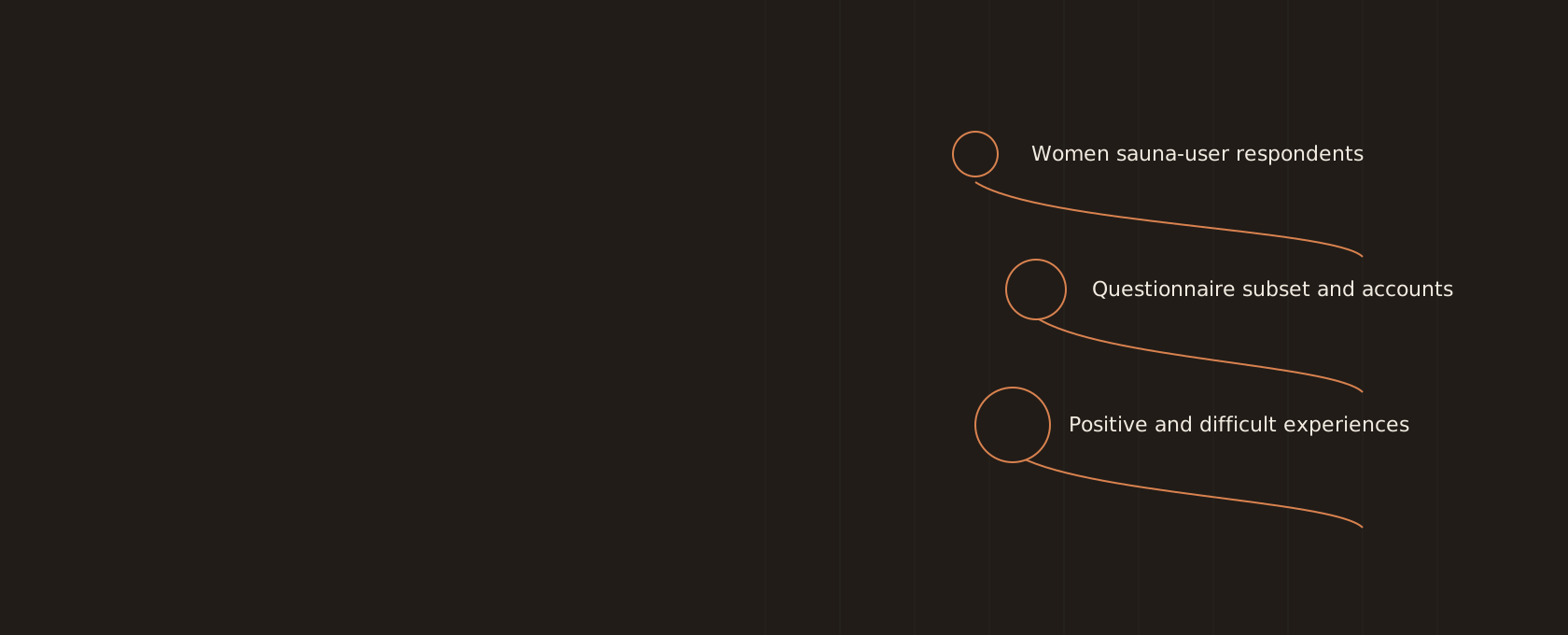
| 2025 · Lennkvist M ↗ | cross-sectional questionnaire and content-analysis study women sauna users Participants: 384. sauna, subtype not specified | Respondents described restorative experiences as well as social insecurity and some counterproductive effects. Comparison: Not reported in the reviewed abstract Self-report; subset of a larger questionnaire; no causal comparison. |
| 2024 · Engström Å ↗ | cross-sectional population survey general population respondents Participants: 971. habitual sauna bathing | Sauna users reported better health measures but also differed in age, sex and lifestyle. Comparison: sauna bathers versus non-bathers Cross-sectional self-report; selection and confounding; no causal timing. |
| 2019 · Hussain JN ↗ | Cross-sectional online survey Self-selected regular sauna users Participants: 482. Self-reported varied sauna use | Respondents frequently reported relaxation and sleep benefits, but self-selection and cross-sectional measurement prevent causal claims. Comparison: Frequency categories within respondents Self-selected respondents |
Original publication: Women's perceptions of sauna bathing and its impact on health and well-being: insights from a cross-sectional study.
What did this women-focused study ask?
The investigators examined women’s perceptions of sauna and its relationship to reported health and wellbeing. The question adds user experience from women to a literature often discussed through male clinical or cohort samples. It does not assign a heat program or establish a causal clinical effect.
The source’s value lies in describing a range of experiences, including both restorative and difficult accounts. A summary should preserve that range rather than turn the favorable parts into a universal recommendation. The study is most informative when its purpose, respondent selection and questionnaire method remain visible before any conclusion about wellbeing or participation is drawn.
Who contributed, and who was outside the sample?
The abstract reports 384 women sauna users. This is a group already engaging with the practice, not the whole population of women or a comparison including everyone who avoids sauna. People outside that selection may have different preferences, access or experiences.
That boundary matters when interpreting acceptability. The paper cannot establish what every woman would experience if assigned to start, and it does not identify a universal response across ages or medical circumstances. The inclusion of women is valuable representation without making the sample representative of every woman. Unreported demographic or setting details should remain unknown rather than inferred from an institution, author or another survey.
Why does the larger-questionnaire subset matter?
The analysis formed a subset of a larger online questionnaire. The abstract provides the participating women’s count but does not fully establish the broader invitation, response or eligibility denominator needed for a representative prevalence interpretation. The subset should not be silently treated as the entire questionnaire sample.
It also should not be added to other sauna survey totals as an independent group without checking the full methods. Related questions or participants can appear in different analyses, and separate publication titles do not resolve overlap. This summary does not assert overlap where it has not been verified; it leaves independence as a review question rather than using a larger combined count to strengthen a claim.
What kind of information did the questionnaire collect?
The source used an online questionnaire with open-ended responses, analyzed through descriptive statistics and qualitative content analysis. Those methods describe reported perceptions and themes. They are not equivalent to sleep recordings, a controlled pain intervention or a trial allocating a clinical heat exposure.
The full instrument and analysis would be needed to judge how questions were framed, how responses were handled and how themes were developed. This abstract-level appraisal does not claim to have checked every step. The appropriate reading preserves the type of evidence: a structured collection of user accounts, with quantitative description and qualitative interpretation rather than isolated clinical efficacy.
What favorable experiences were described?
Respondents described sauna as restorative and emotionally grounding, with perceived changes involving sleep and bodily pain among their accounts. These statements concern experience as reported by the users. They should not be relabeled as objectively demonstrated physiological improvement or a diagnosis changing because of heat.
Perception can be meaningful without supplying the causal answer. The paper helps explain what respondents valued and how they described wellbeing. It does not separate heat from expectation, setting, rest or social context, and it cannot establish which element produced a particular account. The source is useful when the subjective contribution is retained rather than converted into a stronger clinical claim.
Why must social insecurity remain in the summary?
The abstract also describes social insecurity and some counterproductive effects. Those findings prevent the narrative from becoming uniformly reassuring. A favorable description from some participants does not erase discomfort or establish that a shared sauna format suits every person.
The study does not provide a universal prevalence estimate for those experiences, so the summary should not invent one. Their presence is still important evidence about variation. It supports careful interpretation of a broad social-benefit claim without requiring a person to participate, disclose private information or use a more intense exposure. User preference and context should not be overridden by selecting only the positive part of the source.
| Reported feature | What it contributes | Do not infer |
|---|---|---|
| Restorative accounts | Perceived valued experience | A controlled clinical effect |
| Social insecurity | Variation and discomfort are present | A uniform positive format for every person |
| Women-user subset | A defined respondent group | All women or every survey participant |
| Open-ended content | Themes and interpretation | A representative prevalence rate or isolated heat mechanism |
Can a cross-sectional account identify an effect of starting sauna?
It cannot isolate what would happen if someone began or changed exposure. The study records perceptions at a questionnaire stage, with no randomized comparison that separates heat from other influences. The existing-user sample also cannot describe experiences among all people who never attended or stopped.
Those limitations do not make the accounts unimportant. They establish the question answered: what the selected respondents reported, rather than the effect of an assigned intervention. A clinical or population claim would need a relevant design and comparator. This page therefore keeps restorative and counterproductive perceptions together while leaving causal contribution and transfer to a new setting unresolved.
How do the global, Swedish and UK sources differ?
The Global Sauna Survey described self-selected regular users, northern Sweden MONICA compared population-survey bathers and non-bathers, and the UK paper examined identity and ritual through several social-study components. Those are different recruitment frames and questions, not automatic replications of the women’s questionnaire analysis.
Their denominators should remain separate. A valid-response count, a population-survey sauna-item count and a combined social-study total measure different things. Full methods are needed before asserting independent confirmation or shared participants. Reading across the sources can clarify motives and context, while preserving the fact that none becomes a universal clinical effect merely by agreeing with another favorable user account.
What is justified after this source appraisal?
The paper supports a description of varied perceived experiences among selected women sauna users, including restorative and uncomfortable accounts. It does not establish objective sleep or pain efficacy, a universal participation format, population prevalence or personal medical clearance.
The indexed abstract and verified corpus abstraction were read. Full recruitment, instrument details, overlap, analytic methods, funding and conflict-of-interest disclosures have not been comprehensively assessed; unreported information remains unknown. The historical safety review supplies separate limited context for physical exposure. The defensible conclusion preserves the range of experience and the user-selection boundary, with stronger causal or clinical claims requiring their own evidence and assessment.
Explore the evidence with a tool.
Questions, considered
Questions about this study
Did the women-focused sauna survey report only positive experiences?
No. Alongside restorative and emotionally grounding descriptions, some women reported social insecurity and counterproductive effects. Including these experiences preserves the range of responses. A favorable average impression should not erase discomfort, differing preferences or the fact that these were self-reported perceptions rather than measured clinical outcomes.
Follow the sourceDid the women-focused survey demonstrate better sleep physiology?
No. The questionnaire captured perceived changes such as improved sleep and reduced bodily pain. It did not establish those outcomes with sleep recordings or a controlled pain intervention. The study adds women’s experiences to the literature, while leaving the causal and physiological interpretation unresolved.
Follow the sourceWhy does participant selection matter in the women-focused sauna survey?
All respondents were women who used sauna, so the sample describes experiences among users rather than the full population of women. People who avoid sauna may have different preferences or symptoms. This limits broad claims about acceptability, benefit or suitability for women generally.
Follow the sourceFollow the evidence
Sources & references
Research summaries in this edition are based on indexed abstracts unless otherwise noted. A source link is not a claim of medical review.
- Women's perceptions of sauna bathing and its impact on health and well-being: insights from a cross-sectional study.
Lennkvist M, Hägglund H, Engström Å
Volume 84, issue 1, pages 2595806 · PMID 41340471
Open-access flag: yes.Abstract-level editorial review - Sauna bathing in northern Sweden: results from the MONICA study 2022.
Engström Å, Hägglund H, Lee E, Wennberg M, Söderberg S, Andersson M
Volume 83, issue 1, pages 2419698 · PMID 39446139
Open-access flag: yes.Abstract-level editorial review - A hot topic for health: Results of the Global Sauna Survey.
Hussain JN, Greaves RF, Cohen MM
Volume 44, pages 223-234 · PMID 31126560
Open-access flag: not recorded.Abstract-level editorial review - Sauna culture improves physical and mental wellbeing in the UK through social connection and ritual.
Newson M, McGrath R, Mosina I, Reason G, Peitz L
Volume 394, pages 119061 · PMID 41679164
Open-access flag: not recorded.Abstract-level editorial review - Benefits and risks of sauna bathing.
Hannuksela ML, Ellahham S
Volume 110, issue 2, pages 118-126 · PMID 11165553
Open-access flag: not recorded.Abstract-level editorial review