| Study | Design & population | Finding & comparison |
|---|---|---|
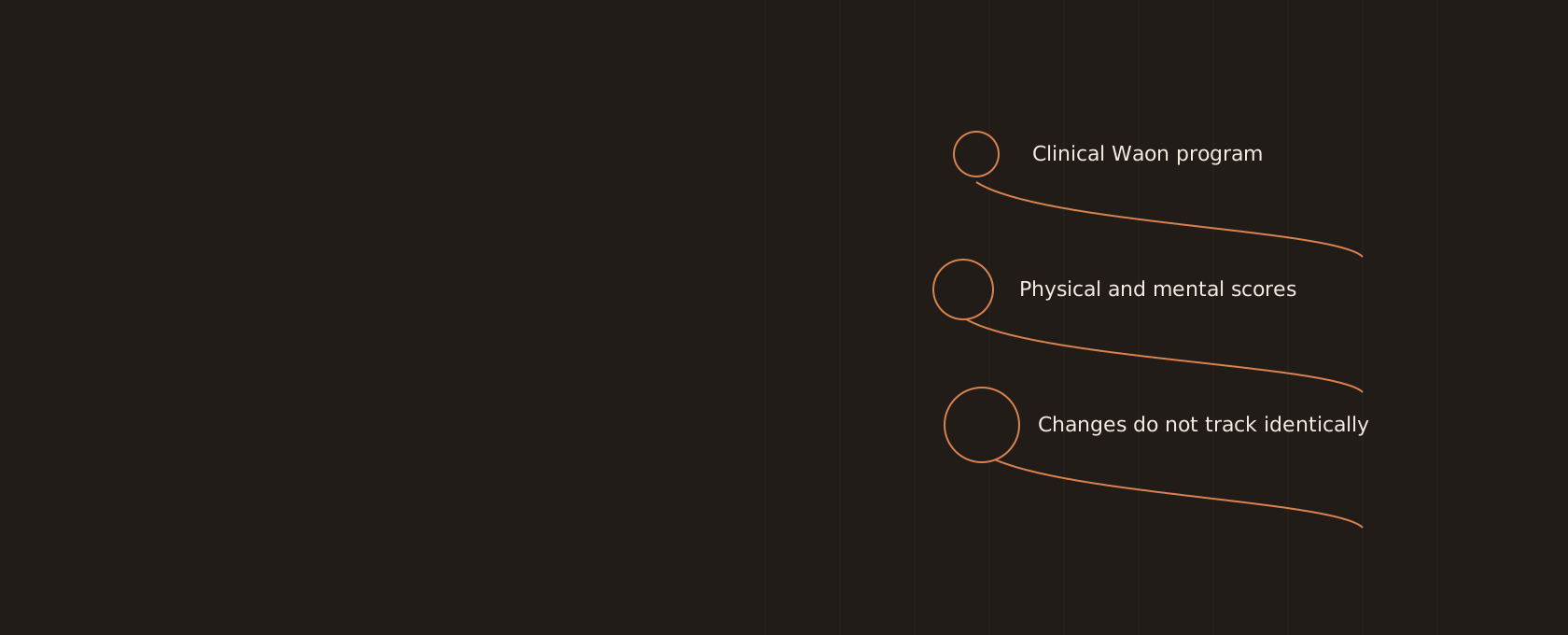
| 2015 · Sobajima M ↗ | Uncontrolled clinical before-and-after study Patients with chronic heart failure Participants: 49. Clinical far-infrared Waon therapy · 3weeks | Physical and mental quality-of-life scores improved alongside several clinical measurements. Mental and physical changes did not track identically, and an uncontrolled design cannot isolate heat effects. Comparison: Baseline versus follow-up; no separate control described No separate control group described. |
| 2016 · Tei C ↗ | randomized controlled trial Hospitalized advanced heart failure Participants: 149. far-infrared Waon · 10 days plus 30-minute covered rest per session | Functional and clinical measures favored Waon, but the between-group BNP change did not attain statistical significance; no serious events were reported. Comparison: Control with medical care Short inpatient intervention |
| 2020 · Choi HS ↗ | Uncontrolled before-after intervention Adults with BMI at least 25 Participants: 38. Dry sauna · Twice daily for 4 consecutive days | Quality-of-life scores improved, but body composition, BMI, blood pressure and heart rate did not change significantly. Comparison: Baseline versus two days after last session No untreated comparator described |
Original publication: Waon therapy improves quality of life as well as cardiac function and exercise capacity in patients with chronic heart failure.
What was the quality-of-life question?
The investigators examined physical and mental quality-of-life scores during a clinical Waon program for patients with chronic heart failure. They also assessed cardiac, exercise and vascular measurements. The report therefore concerns several distinct outcomes observed during care, rather than a single general wellbeing score.
Its design was before and after the program, with no separate control group described in the abstract. A favorable title cannot remove that limitation. The source can describe changes and relationships among measurements while leaving the additional contribution of heat unresolved. Keeping that design visible is essential before applying the findings to another clinical setting or an ordinary home infrared cabin.
Who participated in the clinical program?
Forty-nine patients with chronic heart failure entered the reported series. Their selected clinical context is part of the finding. They were not a general sample of healthy sauna users, and inclusion in the study does not establish that every person with heart failure has the same suitability or expected response.
The source’s patient selection, concurrent care and monitoring need full-methods appraisal. This summary does not infer those details from another Waon paper or assume they are identical across studies. It records a specific clinical population and avoids turning a group score change into a personal decision about heat. Research participation is not a universal clearance test.
What did Waon involve in this report?
The program used a far-infrared dry sauna at 60°C, equivalent to 140°F, followed by covered rest during a three-week clinical course. Those elements belong together as the reported intervention. The infrared device alone is not the whole program, and its methods are not an optimized recreational schedule.
A person selecting a home cabin would not thereby reproduce the clinical assessment, rest or other circumstances. The paper also did not compare a range of temperatures or frequencies to identify a universal dose. The numerical methods help reconstruct the source, while their suitability and effectiveness in a different setting remain separate questions. This page does not turn them into personal instructions.
How should physical and mental scores be separated?
The study used SF-36 quality-of-life assessment, distinguishing physical and mental components. Both improved during the program according to the registered result. Those components should retain their names, because the report did not show that their changes were interchangeable.
A structured questionnaire captures reported health-related experience. It is different from a direct measurement of every clinical outcome or a guarantee of individual improvement. A reader should identify which component is relevant before repeating a broad quality-of-life claim. The presence of a recognized instrument also does not supply a missing control group or establish that heat caused the observed change.
What did the different tracking of changes mean?
Physical and mental quality-of-life changes did not track identically with the clinical measurements. The source described relationships involving the physical component and noted that mental-component improvement did not parallel the same clinical changes. That is an observational pattern within the program.
It does not establish a separate biological mechanism for mental wellbeing or prove independence from every other influence. Correlations and lack of parallel movement cannot isolate the cause of a questionnaire response. The appropriate summary preserves the component-specific pattern while resisting a stronger mechanistic explanation. A favorable change in mental score should not be relabeled as a measured clinical psychiatric effect or an inevitable consequence of using infrared heat.
| Observed item | What the source contributes | Unsupported extension |
|---|---|---|
| Physical and mental components | Both changed during the program | One identical mechanism or response |
| Clinical measurements | Several changes were reported | Heat alone caused every change |
| Component relationships | Tracking was not parallel | An established independent mental-health mechanism |
| Clinical Waon setting | Defined program and patient context | Any home infrared cabin reproduces the intervention |
Why does the absent control matter for all these outcomes?
Concurrent care, attention, expectations or other changes could contribute to a before-and-after pattern. The abstract does not establish how much of any score or clinical difference was specifically added by the heat exposure. These are possible explanations requiring assessment, not claims that one particular explanation accounts for the result.
The full methods would be needed to examine care, timing and outcome handling. This page therefore does not describe the program as proving a causal benefit for every measurement. It describes the results as an informative clinical observation that can motivate better comparisons, with the reported component distinctions preserved rather than lost in a general success label.
Does the multicenter randomized Waon trial settle this score question?
The separate randomized Waon study provides controlled clinical context. Some functional and clinical outcomes favored the intervention, while the between-group BNP comparison did not reach statistical significance. That mixed endpoint pattern should remain visible rather than becoming a claim that every cardiac measure improved.
It is also not a replacement for the missing control in this quality-of-life series. A different trial has its own participants, program and endpoints. It cannot retrospectively establish which part of the smaller report’s physical or mental score change was caused by heat. The sources can inform one another while retaining their distinct questions and evidence limits.
How does the Korean program offer a useful contrast?
The Korean dry-sauna series reported improved quality-of-life ratings without significant changes in several physical measurements. It involved different participants, instruments and a short uncontrolled program. That source is context, not a replication of the heart-failure component pattern.
Read together, the reports show why a quality-of-life result and an objective clinical measure need separate lines. They may not change together, and an uncontrolled design cannot establish the contribution of sauna in either setting. A review should therefore avoid combining unlike scores into one effect or using a questionnaire improvement to guarantee disease-related changes. Each source needs its own population, comparator and observation window.
What remains unassessed and what can be concluded?
The indexed abstract and verified corpus abstraction were read. Full clinical methods, concurrent care, missing-data handling and formal risk of bias have not been comprehensively assessed. Funding and conflict-of-interest disclosures remain unreported in the abstraction rather than assumed absent.
The defensible conclusion is a set of physical, mental and clinical observations during a selected Waon program, with nonidentical component tracking and no isolated heat effect established. The historical safety review supplies limited general context, not individual cardiac clearance. The results should remain attached to their clinical setting and should not be converted into a universal home infrared schedule or a reason to change existing care independently.
Explore the evidence with a tool.
Questions, considered
Questions about this study
Did physical and mental quality-of-life changes match in the49-patient Waon study?
They did not track identically in the reported analyses. The authors described improvements in both quality-of-life components, with mental changes not directly related to several cardiac or functional changes. This finding is exploratory and does not establish a separate psychological mechanism caused by Waon exposure.
Follow the sourceWhat makes the quality-of-life Waon study different from a home-sauna routine?
It involved patients with chronic heart failure receiving a repeated clinical far-infrared protocol, including a period of covered bed rest after heat exposure. The result belongs to that care setting. It does not establish the benefits or safety of an unsupervised recreational sauna routine for people with heart failure.
Follow the sourceCan improved quality-of-life scores in the Waon study isolate the effect of heat?
They cannot isolate it on their own. The abstract describes measurements before and after the clinical program without a separate control group. Concurrent care, expectations and change over time remain possible explanations. The observed improvements should therefore be reported as within-group findings rather than a definitive effect attributable to heat.
Follow the sourceFollow the evidence
Sources & references
Research summaries in this edition are based on indexed abstracts unless otherwise noted. A source link is not a claim of medical review.
- Waon therapy improves quality of life as well as cardiac function and exercise capacity in patients with chronic heart failure.
Sobajima M, Nozawa T, Fukui Y, Ihori H, Ohori T, Fujii N, Inoue H
Volume 56, issue 2, pages 203-208 · PMID 25740582
Open-access flag: not recorded.Abstract-level editorial review - Waon Therapy for Managing Chronic Heart Failure - Results From a Multicenter Prospective Randomized WAON-CHF Study.
Tei C, Imamura T, Kinugawa K, Inoue T, Masuyama T, Inoue H, Noike H, Muramatsu T, Takeishi Y, Saku K, Harada K, Daida H, Kobayashi Y, Hagiwara N, Nagayama M, Momomura S, Yonezawa K, Ito H, Gojo S, Akaishi M, Miyata M, Ohishi M,
Volume 80, issue 4, pages 827-834 · PMID 27001189
Open-access flag: not recorded.Abstract-level editorial review - Repeated Dry Sauna Therapy Improves Quality of Life in Obese Korean People.
Choi HS, Kwon H, Cho KH, Thuc LC, Park SY, Kim NH, Kim WJ, Kim YK, Jeon WS, Lee JA, Kim HC, Cho EH
Volume 41, issue 5, pages 312-317 · PMID 32434303
Open-access flag: yes.Abstract-level editorial review - Benefits and risks of sauna bathing.
Hannuksela ML, Ellahham S
Volume 110, issue 2, pages 118-126 · PMID 11165553
Open-access flag: not recorded.Abstract-level editorial review