| Study | Design & population | Finding & comparison |
|---|---|---|
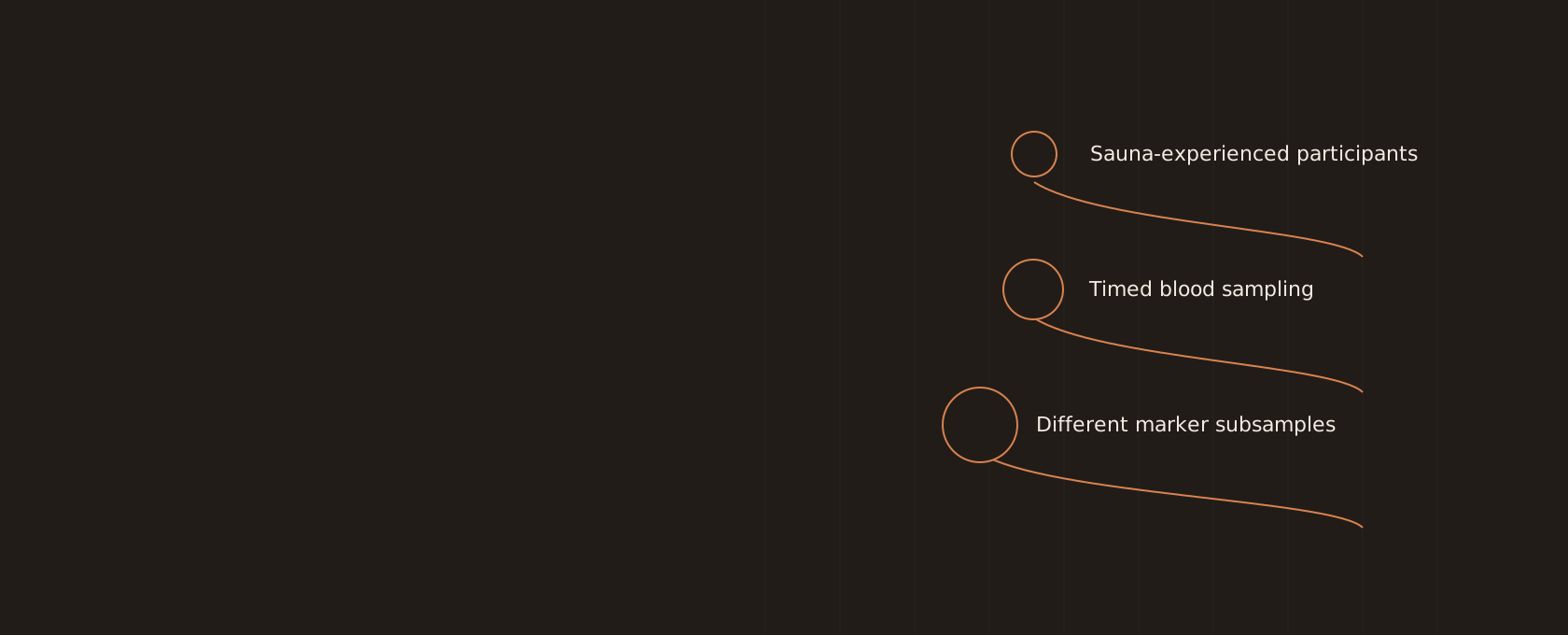
| 2018 · Kunutsor SK ↗ | Single-session before-after biomarker study Non-naive sauna users with cardiovascular risk factors Participants: 102. Finnish sauna | Selected biomarkers changed acutely while several others did not; NT-proBNP was measured in a smaller subgroup rather than all participants. Comparison: Before, immediately after and recovery Uncontrolled acute design |
| 2019 · Laukkanen T ↗ | Single-group before-after physiology study Adults with cardiovascular risk factors Participants: 93. Sauna | Autonomic patterns differed during heating and recovery; the observational within-session changes did not establish durable cardiac protection. Comparison: Before, during and after exposure No randomized control |
| 2020 · Behzadi P ↗ | Randomized-order crossover physiology study Healthy middle-aged and older adults Participants: 20. Finnish sauna | Selected cytokines increased after sauna, whereas CRP did not change; the response depended on exposure pattern and marker. Comparison: Seated time control Acute response |
Original publication: Short-term effects of Finnish sauna bathing on blood-based markers of cardiovascular function in non-naive sauna users.
Did all cardiovascular blood markers change after sauna?
No. Selected markers changed acutely while several others did not show an overall change. The experiment was designed to examine possible biochemical responses to a sauna visit, not to produce one general score of cardiac improvement.
The original publication concerns short-term blood-based markers of cardiovascular function in people already familiar with sauna. That population and time frame should remain attached to the findings. A reader should not infer that a physiological marker response demonstrates a benefit simply because the paper begins with favorable long-term associations. Those associations motivated the research question; they were not reproduced as clinical endpoints in this experiment. The useful contribution is a more detailed description of which blood measurements did and did not change, at which sampling occasions, and in which participants. Each of those qualifications affects the result’s meaning.
Who participated, and why does prior sauna experience matter?
The participants were non-naive sauna users with at least one cardiovascular risk factor. Experienced users are a particular group, rather than a representative sample of everyone considering a first session. The study does not establish whether a previously unexposed person, someone with unstable disease or a person using a different modality would respond in the same way.
The risk-factor description likewise is not a clinical clearance category. Having a risk factor and having a specific cardiac diagnosis are not interchangeable descriptions. The abstract-level record cannot supply individualized eligibility rules. A source summary should identify who took part while resisting the assumption that enrollment makes the protocol appropriate for anyone with a broadly similar label. Clinical suitability and an experimental physiological response remain separate questions, especially where medical conditions or medication use affect a person’s decision about heat exposure.
Why keep each sampling occasion visible?
Measurements were obtained before exposure, immediately afterward and during recovery. Those points allow the investigators to describe a short-term sequence. They do not establish a new baseline sustained during daily life or a response that continues indefinitely after the observed visit.
An immediate change that persists into the measured recovery interval is still an acute result. It should not be described as durable adaptation without another design and observation period. This distinction also helps explain why a marker can be useful for exploring a mechanism while remaining insufficient for a clinical promise. The paper did not follow whether an observed laboratory pattern translated into later cardiac events. The appropriate sequence is therefore exposure, sampling and measured response, with clinical implications left as questions requiring additional evidence rather than drawn as a completed pathway.
Was every biomarker measured in the full sample?
No. NT-proBNP was assessed in a smaller subgroup, rather than all enrolled participants. That distinction is central when communicating the study. The total sample size cannot be attached indiscriminately to every marker result, and the precision of a subgroup measurement should not be inferred from the larger enrollment count.
The retained source finding also distinguishes overall results from some sex-specific observations. A subgroup response and a whole-sample response are different comparisons. It would be misleading to describe a change observed in men as if it characterized every participant. Conversely, an overall null result does not tell the complete story if an explicitly reported subgroup pattern is relevant. A fuller methods review would assess how these comparisons were planned and analyzed. This appraisal does not assume that every subgroup result was prespecified or sufficiently powered merely because it appears in the abstract.
Does an unchanged injury-related marker prove safety?
It does not. A lack of detectable change in a particular blood marker under the study conditions is a result about that marker. It is not a comprehensive adverse-event assessment and cannot establish that the exposure is safe for every person or clinical setting.
The same discipline applies to a marker that increases. Its direction alone is not a complete judgment that the response was beneficial, harmful or responsible for a long-term association. Interpretation requires the biological context, timing, analytical method and appropriate clinical evidence. This page therefore avoids labeling the observed panel as proof of cardiac protection or proof of no injury. The study contributes a set of biochemical observations that can guide further investigation. Its design does not turn the absence of one laboratory signal into an individual medical clearance decision.
How does this connect with related sauna physiology papers?
An acute autonomic study followed heart-rate patterns during heating and recovery, while a separate inflammation crossover study assessed selected circulating markers. They offer useful context for the importance of timing and endpoint specificity. They do not represent the same outcome simply because the participants experienced sauna.
Potential participant overlap with related cardiovascular publications also requires attention. A collection of papers can provide different analyses without providing wholly independent groups of people. This appraisal does not claim that overlap has been fully resolved from the abstracts. The reader should therefore distinguish publications, participants and endpoints rather than treating the citation count as an independent replication count. The blood-marker study’s particular addition is the biochemical panel and its unequal marker subsamples, which deserve to remain visible beside related vascular or autonomic observations.
What evidence grade and review limits are appropriate?
The grade is C for an acute uncontrolled physiological study with marker-specific subsamples. It can describe observed changes around a visit, while leaving attribution, durability and clinical meaning uncertain. A larger total enrollment does not remove the limitations of an uncontrolled design or make every laboratory subgroup equally informative.
This summary read the indexed abstract and refreshed the bibliographic record. A completed full-text assessment of assay methods, planned subgroup analyses, overlap, funding and conflicts of interest has not been performed. Financial and competing-interest information remains unreported here because it was not established in the material reviewed. These limits should lead to a more careful description rather than an invented assurance. Future intervention work could examine the proposed pathways with appropriate controls and follow-up; that possibility is a research direction, not a result already demonstrated by this panel.
Explore the evidence with a tool.
Questions, considered
Questions about this study
Was NT-proBNP measured in the full sample of PMID 29971466?
No. The abstract identifies a smaller subgroup for that biomarker than for the overall study. Using the full enrollment count beside the NT-proBNP finding would exaggerate its sample size. Evidence tables should preserve outcome-specific denominators whenever different blood measurements were available for different subsets of participants.
Follow the sourceDid every cardiovascular biomarker change after the single sauna session?
No. The abstract reports no significant overall change in several markers, including high-sensitivity CRP and selected injury-related measurements, while NT-proBNP increased. Such mixed findings do not justify a blanket claim of improved cardiac biomarkers. Each result needs its own sampling time, population and physiological interpretation.
Follow the sourceDoes an acute NT-proBNP increase prove either benefit or harm from sauna?
Not on its own. The paper measured a short-term concentration response in experienced users with risk factors, not subsequent clinical events. The authors called for longer intervention research. Assigning a clinical meaning requires context beyond the direction of one biomarker change after a single exposure.
Follow the sourceFollow the evidence
Sources & references
Research summaries in this edition are based on indexed abstracts unless otherwise noted. A source link is not a claim of medical review.
- Short-term effects of Finnish sauna bathing on blood-based markers of cardiovascular function in non-naive sauna users.
Kunutsor SK, Häkkinen A, Zaccardi F, Laukkanen T, Lee E, Willeit P, Khan H, Laukkanen JA
Volume 33, issue 12, pages 1515-1524 · PMID 29971466
Open-access flag: yes.Abstract-level editorial review - Recovery from sauna bathing favorably modulates cardiac autonomic nervous system.
Laukkanen T, Lipponen J, Kunutsor SK, Zaccardi F, Araújo CGS, Mäkikallio TH, Khan H, Willeit P, Lee E, Poikonen S, Tarvainen M, Laukkanen JA
Volume 45, pages 190-197 · PMID 31331560
Open-access flag: not recorded.Abstract-level editorial review - Impact of Finnish sauna bathing on circulating markers of inflammation in healthy middle-aged and older adults: A crossover study.
Behzadi P, Gravel H, Neagoe PE, Barry H, Sirois MG, Gagnon D
Volume 52, pages 102486 · PMID 32951736
Open-access flag: not recorded.Abstract-level editorial review - Benefits and risks of sauna bathing.
Hannuksela ML, Ellahham S
Volume 110, issue 2, pages 118-126 · PMID 11165553
Open-access flag: not recorded.Abstract-level editorial review