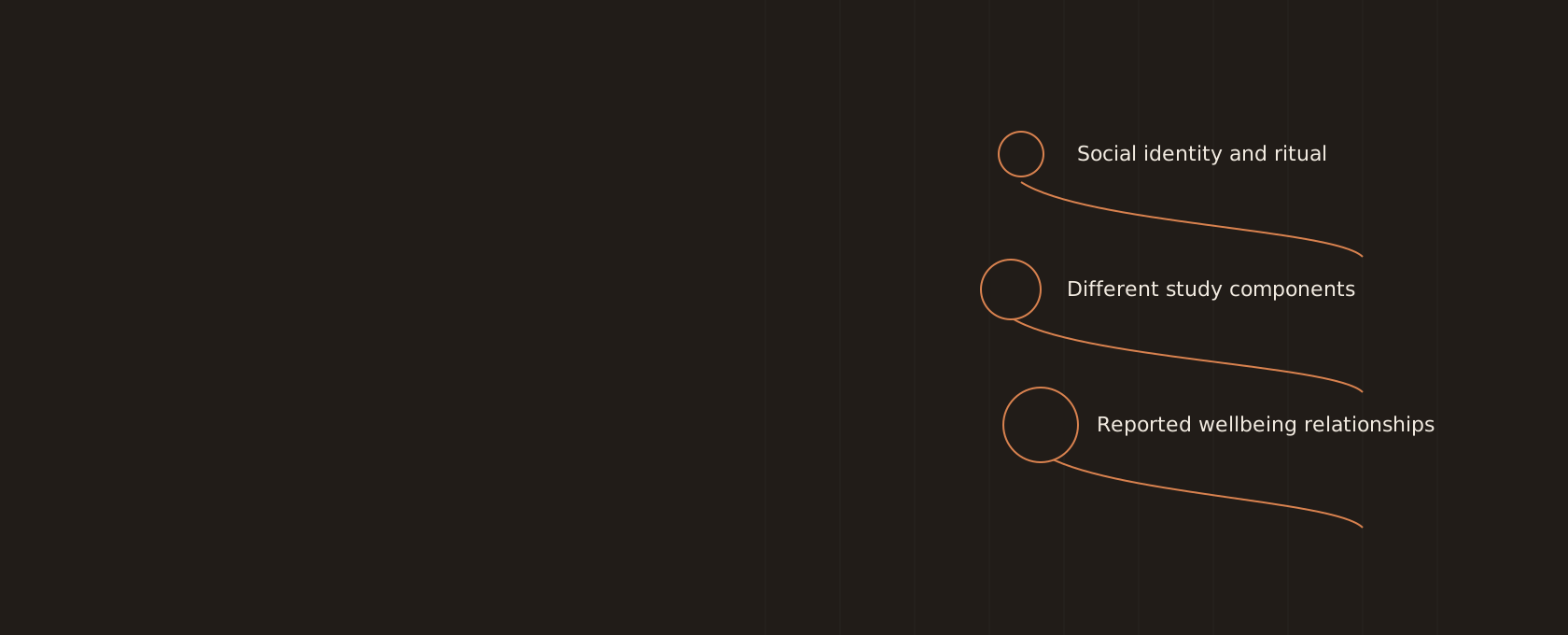
| Study | Design & population | Finding & comparison |
|---|---|---|
| 2026 · Newson M ↗ | mixed longitudinal and cross-sectional social studies Sauna users Participants: 1907. social sauna culture · Longitudinal and cross-sectional components | Stronger sauna-related identities and ritual experiences were linked to wellbeing; these studies examine social experience rather than isolating a biological heat effect. Comparison: Variation in identity, ritual and synchrony Self-reported wellbeing |
| 2026 · Magatova N ↗ | qualitative phenomenological interview study regular sauna users Participants: 11. Finnish-style sauna | Interviewees described emotional regulation, connection and reflective experiences associated with sauna rituals. Comparison: Not reported in the reviewed abstract Self-selected users; all white European; perceptions do not establish clinical efficacy. |
| 2025 · Lennkvist M ↗ | cross-sectional questionnaire and content-analysis study women sauna users Participants: 384. sauna, subtype not specified | Respondents described restorative experiences as well as social insecurity and some counterproductive effects. Comparison: Not reported in the reviewed abstract Self-report; subset of a larger questionnaire; no causal comparison. |
Original publication: Sauna culture improves physical and mental wellbeing in the UK through social connection and ritual.
Was this one uniform experiment?
No. The publication reported three study components, with longitudinal designs in some and a cross-sectional design in another. A reported combined total of 1,907 belongs to that collection, not one randomized trial of a common heat exposure and clinical endpoint.
The abstract does not establish every component’s recruitment or the independence of all observations. Those details require the full methods before totals are added or interpreted as unique people confirming one effect. The different designs also contribute different information. A change measured over time and a relationship measured at one point should not be collapsed into an identical causal estimate simply because they appear in the same publication.
| Source feature | What it contributes | Do not infer |
|---|---|---|
| Longitudinal components | Reported change across observations | Random allocation of identity or heat |
| Cross-sectional component | Relationships measured at one stage | Resolved causal timing |
| Combined total | A count across several study components | One uniform independent-participant trial |
| Ritual and synchrony variables | Social-experience relationships | A thermal dose or clinical mechanism |
What does sauna-related identity represent here?
The authors examined how identification with the practice related to reported wellbeing. This is a measured social relationship, rather than an assigned intervention that made all participants adopt a particular identity. People can differ in involvement and experience for reasons the comparison does not isolate.
The useful finding is the reported association, with participant setting and measurement retained. It does not establish that increasing identification causes a defined benefit or that every person should adopt the same practice. A strong identity may be part of a valued experience, but the source does not turn that relationship into a universal clinical program or explain the individual contribution of every surrounding factor.
What did ritual and emotional synchrony add?
The paper linked perceiving sauna as ritual and experiencing emotional synchrony with stronger sauna identities. These variables help describe the social practice as the investigators studied it. They are not a temperature-response experiment or evidence that a particular session length builds relationships.
The abstract does not establish that each component was separately manipulated or that one pathway caused every wellbeing change. A full appraisal would inspect how the variables were defined and analyzed. This summary preserves the source’s social interpretation while keeping a causal mechanism open. The result is useful for understanding a setting, without supplying an obligation to participate or a physical exposure target.
Were the outcomes clinical diagnoses?
The source examined emotional and self-reported physical wellbeing in its social framework. These are not interchangeable with a randomized clinical symptom or diagnostic outcome. A reported wellbeing relationship should not be advertised as evidence that a mental-health condition changed because of sauna.
That boundary does not diminish the relevance of everyday experience. It clarifies what the paper adds and what another design would need to answer. A reader should distinguish personal meaning, questionnaire wellbeing and clinical efficacy before transferring a finding between them. The study’s value lies in its own social question rather than an untested attempt to make every positive experience a disease-related intervention result.
Does following people over time isolate the cause?
Longitudinal measurement can document change and help describe temporal relationships. It does not itself randomly allocate heat, identity or social participation. Selection, other activities and unmeasured differences can still affect how an association develops or is reported.
The cross-sectional component has an additional timing limit because its relationships are assessed at one stage. The designs should therefore be named rather than treated as a hierarchy that automatically proves the title’s causal wording. This abstract-level summary does not claim every potential confounder was resolved. It records reported relationships while leaving the separate contributions of heat, ritual and social context uncertain.
How does the smaller interview paper differ?
The phenomenological study examined detailed experiences of selected regular users, including reflection and connection. It contributes depth and meaning rather than a population prevalence estimate. Its small demographically limited sample also differs from the UK social-study framework.
These sources can inform one another without being treated as direct replications. An interview theme does not independently verify a quantitative path, and a social association does not establish that every interviewee or new user experiences the same outcome. The evidence map should preserve the methodological contribution of each. Their shared sauna topic does not make their designs, participants or conclusions interchangeable.
Why retain less uniformly positive user accounts?
The women-focused questionnaire described restorative experiences alongside social insecurity and counterproductive effects. The global survey described motives and experiences among self-selected regular users. These sources help prevent the social narrative from becoming a universal account of everyone who might attend.
They are not identical comparison groups for this UK paper, and their denominators should remain separate. Differences in recruitment and setting matter before claims about agreement or independent confirmation. The research does not justify forcing social participation, inferring a clinical benefit from enjoyment or assuming that stronger heat produces greater connection. Context and the range of reported experience belong beside the favorable relationships.
What remains to be checked in the complete publication?
The indexed abstract and verified corpus abstraction were read. Full recruitment, repeated-measure handling, overlap, model specification and formal risk-of-bias assessment have not been comprehensively appraised. Funding and conflict-of-interest disclosures remain unreported in the abstraction rather than assumed absent.
The defensible conclusion is a set of social relationships involving identity, ritual and reported wellbeing within the paper’s components. It is not one representative population experiment, an isolated heat mechanism or a general clinical intervention. The historical safety review provides separate limited context for physical exposure, without turning a social finding into personal clearance or a prescribed participation format.
Explore the evidence with a tool.
Questions, considered
Questions about this study
Did the UK social-sauna research isolate heat from social connection?
No. It examined sauna users’ identities, rituals and perceived connection across longitudinal and cross-sectional studies. Those findings help explain the social experience of sauna, but do not isolate a biological heat effect. A wellbeing association should therefore not be presented as if participants were randomized to heat versus social contact alone.
Follow the sourceWere wellbeing outcomes in the UK sauna-culture studies purely clinical diagnoses?
No. The work concerned emotional wellbeing, self-reported physical wellbeing and social identity rather than demonstrating changes in diagnosed disease. Those outcomes are meaningful in their own right, but should not be relabeled as evidence of psychiatric remission or cardiovascular improvement. The study’s social framework should remain visible in interpretation.
Follow the sourceWhat did ritual and emotional synchrony contribute to the UK sauna analysis?
They were linked to stronger sauna-related identities, which in turn related to wellbeing in the researchers’ framework. This suggests a social pathway worth investigating, rather than proving that a ritual causes better health. Selection, shared preferences and self-report remain relevant when considering why participants describe benefits from communal sauna use.
Follow the sourceFollow the evidence
Sources & references
Research summaries in this edition are based on indexed abstracts unless otherwise noted. A source link is not a claim of medical review.
- Sauna culture improves physical and mental wellbeing in the UK through social connection and ritual.
Newson M, McGrath R, Mosina I, Reason G, Peitz L
Volume 394, pages 119061 · PMID 41679164
Open-access flag: not recorded.Abstract-level editorial review - Mental Well-Being and Regular Sauna Bathing: A Phenomenological Study of Psychological Experiences and Perceived Impact.
Magatova N, Hunt DF, Lay J
, pages 10497323261462404 · PMID 42479061
Open-access flag: not recorded.Abstract-level editorial review - Women's perceptions of sauna bathing and its impact on health and well-being: insights from a cross-sectional study.
Lennkvist M, Hägglund H, Engström Å
Volume 84, issue 1, pages 2595806 · PMID 41340471
Open-access flag: yes.Abstract-level editorial review - A hot topic for health: Results of the Global Sauna Survey.
Hussain JN, Greaves RF, Cohen MM
Volume 44, pages 223-234 · PMID 31126560
Open-access flag: not recorded.Abstract-level editorial review - Benefits and risks of sauna bathing.
Hannuksela ML, Ellahham S
Volume 110, issue 2, pages 118-126 · PMID 11165553
Open-access flag: not recorded.Abstract-level editorial review
What research question does the paper address?
The paper investigates relationships among sauna-related social identity, shared ritual and wellbeing in the United Kingdom. Its contribution is a social account of a practice, not a laboratory comparison isolating a biological dose of heat. The social variables should remain visible when the favorable title is interpreted.
A shared setting includes people and meanings as well as a thermal environment. The study can therefore help explain reported experiences without establishing that heat alone produced the outcome. This distinction is central to applying the source: a claim about social identity in the studied settings is different from a clinical claim about every sauna device or a prediction for a person beginning solitary home use.