| Study | Design & population | Finding & comparison |
|---|---|---|
| 2024 · Engström Å ↗ | cross-sectional population survey general population respondents Participants: 971. habitual sauna bathing | Sauna users reported better health measures but also differed in age, sex and lifestyle. Comparison: sauna bathers versus non-bathers Cross-sectional self-report; selection and confounding; no causal timing. |
| 2019 · Hussain JN ↗ | Cross-sectional online survey Self-selected regular sauna users Participants: 482. Self-reported varied sauna use | Respondents frequently reported relaxation and sleep benefits, but self-selection and cross-sectional measurement prevent causal claims. Comparison: Frequency categories within respondents Self-selected respondents |
| 2026 · Newson M ↗ | mixed longitudinal and cross-sectional social studies Sauna users Participants: 1907. social sauna culture · Longitudinal and cross-sectional components | Stronger sauna-related identities and ritual experiences were linked to wellbeing; these studies examine social experience rather than isolating a biological heat effect. Comparison: Variation in identity, ritual and synchrony Self-reported wellbeing |
Original publication: Sauna bathing in northern Sweden: results from the MONICA study 2022.
The question describes users and their circumstances
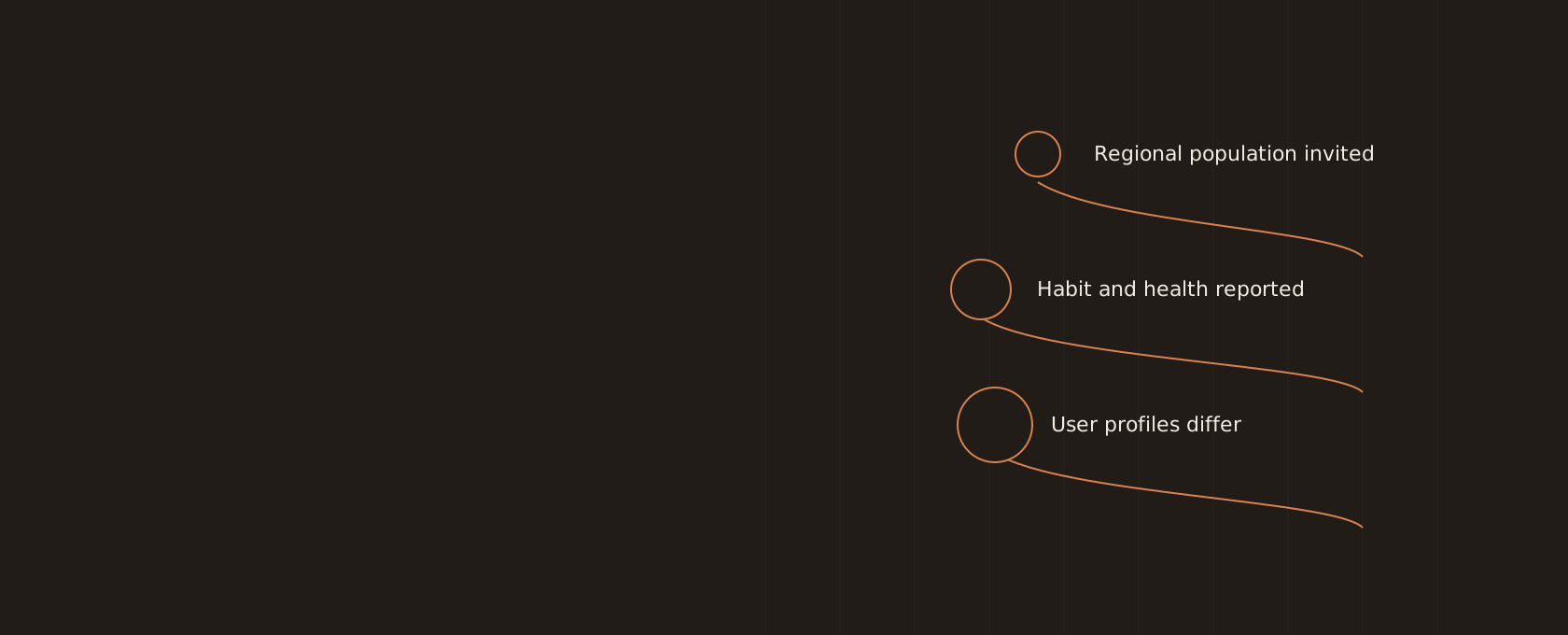
This publication asked how sauna bathers and non-bathers in northern Sweden differed in demographics, health, life attitudes and reported habits. It analyzed sauna questions within the MONICA population survey. The central comparison concerns people already living with different habits. It did not assign a sauna program or follow a newly assigned exposure to test whether health subsequently improved.
That descriptive purpose gives the study a useful role. It helps readers see the characteristics accompanying sauna participation in a community, rather than assuming that bathers and non-bathers are otherwise interchangeable. The association can generate questions about selection, access and behavior. It cannot separate the contribution of heat from those accompanying characteristics merely because the questionnaire belongs to an established cardiovascular monitoring project.
The population invitation and the analyzed group differ
Adults living in the two northernmost Swedish counties were selected from the population register for the survey invitation. This differs from inviting only enthusiastic sauna users through a wellness questionnaire. A population-based starting point gives the investigators an opportunity to compare people with different bathing habits within the same regional survey setting.
The final sauna comparison still depended on participation and answering the relevant question. The wider MONICA participant group, respondents to the sauna question and respondents classified as bathers are different denominators. A sample size should name which group it describes. The abstract does not establish whether missing answers were unrelated to health or sauna experience. It therefore supports a regional respondent comparison without guaranteeing that every eligible resident would show the same profile.
Several reported outcomes move together
Sauna bathers reported fewer hypertension diagnoses and less pain, alongside greater happiness and energy, more satisfying sleep and better general and mental health. These are related but distinct questionnaire domains. Reported hypertension diagnosis is not the same outcome as an experimentally measured blood-pressure response; reported sleep satisfaction is not an objective sleep recording.
The pattern is therefore more informative than a single undifferentiated claim of better health. It describes how several experiences and reported conditions coexist with sauna habits. It does not supply a common effect size across those domains or establish a clinical treatment response for each. The abstract summary also does not provide the detailed questionnaire wording, outcome-specific precision or complete adjustment results needed to reconstruct every comparison independently.
The differences between groups affect interpretation
Bathers were younger, more often men and described as having a healthier life profile than non-bathers. Those differences are part of the finding. They also make a simple heat-only interpretation difficult: the groups may differ in ways associated with both continued sauna participation and the health measures being compared.
The direction of influence is unresolved by collecting exposure and health information together. People who feel healthier may find sauna easier to access or continue; other activities and circumstances may accompany bathing. These are plausible interpretation problems rather than separately demonstrated explanations for every reported difference. The study should neither be dismissed because confounding is possible nor presented as if its design had eliminated it. Its descriptive value remains when the causal question is left open.
The frequency pattern is not a personal schedule
The authors described an apparent plateau in the favorable associations across reported bathing-frequency categories. That observation concerns an existing pattern of habits and self-reported health within the survey. It is not an experiment identifying a minimum effective dose, a maximum safe exposure or the best schedule for a new user.
Frequency categories can include people with different reasons for bathing, health circumstances and session characteristics. The abstract does not provide an assigned combination of temperature, duration and frequency that could isolate those dimensions. A flattening association should therefore remain a description of these data. It should not become advice to increase frequency until a particular health improvement appears, or a promise that a category guarantees the same experience for an individual.
Other surveys answer related but different questions
The Global Sauna Survey recruited current bathers through an online questionnaire and described motivations, habits and perceived benefits. Its self-selected user sample differs from the Swedish population-survey framework with bathers and non-bathers. Similar reports across them are useful context, but should not be pooled as though the recruitment processes and comparisons were identical.
The UK social-identity publication adds another perspective: its related studies considered identity, ritual, emotional synchrony and wellbeing, using both longitudinal and cross-sectional approaches. It does not demonstrate that those mechanisms explain the Swedish health differences. Reading the publications together separates descriptive user profiles, perceived experiences and social associations without turning their convergence into an independently established clinical effect of heat.
Reported wellbeing does not establish suitability for heat
A favorable respondent profile is not individual medical clearance. The MONICA comparison did not assign a standardized exposure and prospectively establish its safety across different diagnoses or medications. A person with a health concern cannot infer suitability simply because bathers in this survey reported better general health.
The contextual safety review discusses specific cardiac contraindications and alcohol-related concerns. Its broad historical discussion should not be treated as a complete contemporary checklist for every condition. These sources support keeping the descriptive health question separate from a personal decision about heat exposure, particularly when clinical circumstances differ from those represented by community respondents.
The useful conclusion remains bounded
This appraisal read the indexed abstract and refreshed its bibliographic record. It did not examine the full questionnaire, complete statistical models, weighting, missing-data methods or full-text risk of bias. Funding and competing interests were not established by the material reviewed and remain unreported here. Those limits should remain visible when the study is used in a wider benefit discussion.
The defensible conclusion is that sauna participation in this regional survey accompanied differences in reported health, demographics and lifestyle. A study measuring change after a clearly defined exposure, with suitable comparisons and attention to baseline health, would address a different question. Until then, the MONICA report is valuable evidence about user profiles and the interpretation of associations, rather than a demonstration that taking up sauna produces the entire observed health profile.
Explore the evidence with a tool.
Questions, considered
Questions about this study
Why is the northern Sweden MONICA sauna study useful for confounding?
Sauna bathers differed from non-bathers in demographics and lifestyle as well as reported health. These differences illustrate why a favorable association cannot automatically be attributed to heat exposure itself. The cross-sectional survey describes who uses sauna and how they report feeling, without isolating a causal effect.
Follow the sourceDid MONICA 2022 follow people to see whether sauna improved their health?
No. The sauna analysis compared questionnaire responses collected within a population survey. It did not assign sauna exposure and then measure a subsequent change. Better reported sleep, happiness or health among users therefore describes a contemporaneous association, rather than proof that taking up sauna created those differences.
Follow the sourceWere all MONICA participants classified as sauna users?
No. Respondents to the sauna question included both bathers and non-bathers, enabling comparisons between groups. However, not every person participating in the wider survey answered that question. The analyzed population and missing responses matter when judging how representative the findings are of northern Sweden.
Follow the sourceFollow the evidence
Sources & references
Research summaries in this edition are based on indexed abstracts unless otherwise noted. A source link is not a claim of medical review.
- Sauna bathing in northern Sweden: results from the MONICA study 2022.
Engström Å, Hägglund H, Lee E, Wennberg M, Söderberg S, Andersson M
Volume 83, issue 1, pages 2419698 · PMID 39446139
Open-access flag: yes.Abstract-level editorial review - A hot topic for health: Results of the Global Sauna Survey.
Hussain JN, Greaves RF, Cohen MM
Volume 44, pages 223-234 · PMID 31126560
Open-access flag: not recorded.Abstract-level editorial review - Sauna culture improves physical and mental wellbeing in the UK through social connection and ritual.
Newson M, McGrath R, Mosina I, Reason G, Peitz L
Volume 394, pages 119061 · PMID 41679164
Open-access flag: not recorded.Abstract-level editorial review - Benefits and risks of sauna bathing.
Hannuksela ML, Ellahham S
Volume 110, issue 2, pages 118-126 · PMID 11165553
Open-access flag: not recorded.Abstract-level editorial review